A Voice That Woke Up Souls
Saint John of Ávila was not the kind of saint who made noise for attention. He made noise because souls were asleep, and he loved them too much to let them stay that way.
He was a sixteenth-century Spanish diocesan priest, preacher, theologian, spiritual director, reformer, and Doctor of the Church. He is lovingly remembered as the Apostle of Andalusia, because he traveled throughout southern Spain preaching repentance, prayer, Eucharistic devotion, and reform with the fire of a man who had clearly met Jesus Christ.
He was also called “the Master,” not because he chased titles, but because saints, priests, bishops, students, and ordinary sinners came to him looking for wisdom. Saint John of God was converted after hearing him preach. Saint Francis Borgia was deeply moved by his words at the funeral of Empress Isabella. Saint Teresa of Ávila trusted his spiritual judgment. Saint Ignatius of Loyola admired him and wanted him to join the Society of Jesus.
John of Ávila reminds the Church that true reform does not begin with committees, popularity, or clever slogans. It begins with holiness. It begins with priests who love the Eucharist, preach the truth, guide souls patiently, and live what they teach.
This fits beautifully with The Catechism of the Catholic Church, which teaches that the Eucharist is “the source and summit of the Christian life” (CCC 1324). That was the center of Saint John’s life. Everything flowed from the altar.
A Young Man Marked by Mercy
John was born on January 6, around 1499 or 1500, in Almodóvar del Campo, Spain. His parents, Alonso de Ávila and Catalina Gijón, were devout Catholics of comfortable means. His family had wealth connected to mining, but John’s heart was never captured by comfort for long.
A beloved story from his childhood says that when John received a new cloak, he gave it to a poor child and came home wearing the poor child’s ragged garment. This story is often told in Catholic accounts of his life. Whether every detail can be historically verified or not, it certainly captures the man he became. From the beginning, his life was marked by compassion, detachment, and a tender love for the poor.
As a teenager, John went to Salamanca to study law. He seemed headed toward an honorable worldly career, but God had other plans. After a deep spiritual awakening, he left his studies and returned home, spending several years in prayer, penance, and discernment.
Later, he studied at Alcalá, where he immersed himself in theology, Sacred Scripture, the Fathers of the Church, and the great intellectual currents of Catholic Spain. This formation shaped him into one of the most powerful biblical preachers of his time. He did not preach vague inspiration. He preached Christ, the Cross, grace, repentance, confession, the Eucharist, and the holiness demanded by the Gospel.
He was ordained a priest in 1526. At his first solemn Mass, instead of hosting a comfortable celebration for the well-connected, he invited twelve poor men to eat with him. After the death of his parents, he distributed his inheritance to the poor. That was not an emotional gesture. It was his priestly mission written in action.
He belonged to Christ, and because he belonged to Christ, he belonged to the poor, the lost, and the spiritually hungry.
The Missionary Who Stayed Home
Saint John of Ávila originally wanted to become a missionary to the New World. He hoped to evangelize in the Americas, especially in New Spain. Like many zealous Catholics of his age, he saw the missions as a field ready for the Gospel.
But Providence redirected him.
While waiting in Seville, he met influential Church leaders who saw his gifts and urged him to remain in Spain. Andalusia itself needed evangelization. There were baptized Catholics who did not know Christ deeply. There were priests in need of reform. There were souls going through the motions. There were sinners who needed to hear that mercy was real, but so was conversion.
So John stayed.
This is one of the most surprising parts of his life. He wanted to cross the ocean, but God made him a missionary at home. He became the Apostle of Andalusia, preaching through cities and towns such as Seville, Córdoba, Granada, Écija, Baeza, Montilla, and beyond.
His preaching was direct, biblical, and piercing. He did not flatter people. He loved them. That is different. Real love tells the truth because salvation matters.
When someone asked him the secret to preaching well, he reportedly answered: “Love God very much.”
That simple answer says everything. A preacher can have talent, learning, confidence, and a strong voice. But without love for God, preaching becomes performance. Saint John preached like a man on fire because he loved the One he preached.
A Master Who Formed Saints
Saint John of Ávila did not merely preach to crowds. He formed souls one by one.
One of the most famous conversions linked to him was Saint John of God. In Granada, after hearing John of Ávila preach, John of God was so overwhelmed with repentance that his life changed dramatically. He would later become the founder of the Brothers Hospitallers and one of the great saints of charity.
Another famous moment involved Saint Francis Borgia, then Duke of Gandía. John of Ávila preached at the funeral of Empress Isabella. The duke was struck by the reality of death, beauty, power, and worldly glory passing away. That encounter helped move him toward deeper conversion. He eventually entered the Jesuits and became their third Superior General.
Saint Teresa of Ávila also valued John deeply. When her writings and mystical experiences needed careful spiritual evaluation, John of Ávila was one of the trusted voices whose approval mattered. After his death, Teresa reportedly said: “I weep because the Church of God loses a great pillar.”
What a testimony. Saint Teresa was not easily impressed by shallow spirituality. She recognized in John a man of prayer, doctrine, humility, and real holiness.
Saint Ignatius of Loyola also admired him. Ignatius wanted John to join the Society of Jesus, but John remained a diocesan priest. Even so, he directed many of his own students toward the Jesuits. His influence helped strengthen one of the great Catholic renewal movements of the sixteenth century.
He was a diocesan priest without worldly status, yet he helped shape saints, bishops, priests, religious, students, and reformers. That is the quiet power of holiness.
The Prison Cell That Became a Chapel
One of the most surprising chapters of Saint John’s life is that he was investigated by the Spanish Inquisition.
Around 1531, accusations arose against him. Some misunderstood his preaching. Others may have disliked how directly he challenged comfortable Christians and careless clergy. He was accused of doctrinal errors, but he remained obedient and faithful.
He spent about a year in prison and was eventually acquitted in 1533.
A famous story says that when someone told him he was in God’s hands, John replied: “He could not be in better hands.”
That is not the response of a man pretending everything is easy. That is the response of a man who has surrendered. His reputation was wounded. His freedom was taken. His mission was interrupted. Yet he trusted God.
During his imprisonment, he began the first version of Audi, Filia, his great spiritual classic. The title comes from Psalm 45, “Listen, daughter.” It was originally written as spiritual counsel for Sancha Carrillo, a devout woman under his direction.
In that prison cell, John entered more deeply into the mystery of Christ crucified. He learned, as all saints do, that suffering can either make the soul bitter or make it belong more completely to Jesus.
The Catechism teaches that the way of perfection passes by way of the Cross, and that there is no holiness without renunciation and spiritual battle (CCC 2015). Saint John lived that truth. His trial did not destroy him. It purified him.
Schools, Priests, and the Reform of the Church
Saint John of Ávila saw something clearly: if the Church needed renewal, priests needed renewal.
He founded schools, colleges, and centers of formation. His most famous educational foundation was the University of Baeza, which became an important center of Catholic learning. He cared deeply about forming young men, educating the laity, and preparing priests who could preach, teach, pray, and shepherd souls well.
This was before the seminary system from the Council of Trent became standard across the Church. In many ways, John was already thinking like a Tridentine reformer before Trent’s reforms were fully implemented.
He could not attend the Council of Trent personally because of poor health, but he wrote reform proposals called Memoriales. These addressed priestly formation, preaching, catechesis, clerical discipline, and the need for deeper Catholic renewal.
John was not a rebel. He was a faithful son of the Church. He did not want a different Church. He wanted Catholics to live the faith they had received.
His priestly spirituality was intensely Eucharistic. One famous story says that when he saw a priest handle the Eucharist carelessly, he said: “Treat Him well, for He is the Son of the good Father.”
That line should shake every Catholic heart a little. The Eucharist is not a symbol of a distant Christ. The Eucharist is Jesus Christ Himself, truly present, Body, Blood, Soul, and Divinity. Saint John knew that reverence at the altar forms reverence in the soul.
Miracles, Holy Stories, and the Fragrance of Grace
Catholic tradition preserves several miracle stories associated with Saint John of Ávila. Some are connected with formal processes, while others belong to hagiographical tradition and should be received as pious stories rather than guaranteed historical fact.
During his life, one story says there was not enough food for guests. John told the servant to set the table, bowed his head in prayer, and the table was found supplied with enough food. This story reflects his trust in Providence, though it cannot be fully verified.
Another tradition says that Christ appeared to him as a pilgrim when John was sick and encouraged him to celebrate Mass. This is a devotional story associated with his Eucharistic holiness, but it cannot be verified.
There is also a story that near the end of his life, as he suffered greatly, a crucifix spoke to him and assured him that his sins were forgiven. This, too, belongs to the hagiographical tradition and cannot be verified.
What can be said with confidence is that the Church recognized his heroic holiness, and miracles were examined in connection with his beatification. Among the miracles attributed to his intercession were the sudden healing of Catalina Rodríguez del Río from a serious tumor and arterial condition, and the preservation and healing of Francisco Martín del Burgo and José Gómez after severe burns caused by gunpowder.
Catholic accounts also preserve posthumous stories of healing and consolation through his intercession. One reported case involved Juan Ramírez de Mesa, who invoked Saint John and visited Montilla, where John’s memory and relics were venerated. This story belongs to Catholic devotional tradition and cannot be fully verified.
There are also accounts of a sweet fragrance associated with places where John had prayed or lived. In Catholic hagiography, such signs are often connected with the odor of sanctity. This cannot be treated as something every Catholic must believe, but it shows how deeply the faithful sensed holiness around him.
Words That Still Preach
Saint John of Ávila left behind words that still feel alive.
He said: “Your neighbor is a concern of Jesus Christ.”
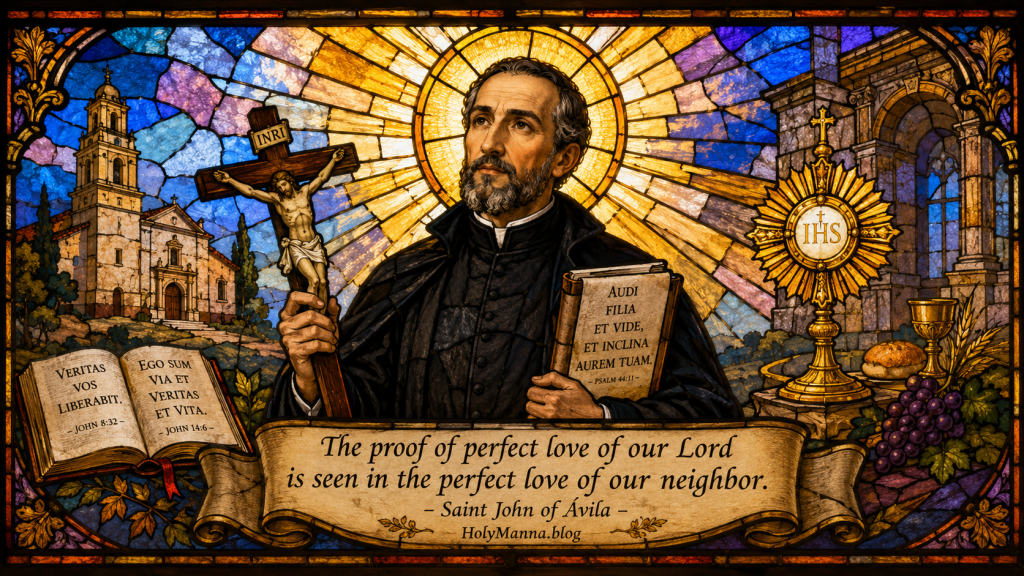
He also taught: “The proof of perfect love of our Lord is seen in the perfect love of our neighbor.”
That is a very Catholic kind of holiness. Love of God cannot remain locked inside private devotion. If prayer does not make someone more charitable, patient, honest, generous, and merciful, then something is incomplete.
Another saying associated with his final sufferings is: “My Lord, let the pain increase, and let love increase.”
That is not easy spirituality. That is mature Christianity. He was not asking for suffering because suffering is good in itself. He was asking that love would grow even in suffering. That is the Cross. That is the school of the saints.
A famous Spanish sonnet, A Jesús Crucificado, beginning “It does not move me, my God, to love You.” is traditionally attributed to him in Catholic devotional culture. The poem expresses love for God not because of heaven’s reward or hell’s punishment, but because Christ crucified is worthy of love. Its authorship is uncertain, so it should be called traditionally attributed rather than verified.
Still, the spirit of the poem fits Saint John’s heart perfectly. He wanted souls to love Christ for Christ.
The Final Years in Montilla
By 1554, poor health forced Saint John to withdraw to Montilla. His body weakened, but his mission did not end.
From Montilla, he continued writing letters, guiding souls, advising clergy, revising Audi, Filia, and offering spiritual counsel. The sickroom became another pulpit. That is how saints live. When one door closes, charity finds another.
He died on May 10, 1569, holding a crucifix. Before death, he asked to be spoken to like criminals are spoken to at the end, a striking sign of humility. He did not die boasting of his accomplishments. He died clinging to mercy.
Near the end, looking upon Christ crucified, he reportedly said:“I no longer have anxiety about this matter.”
That is a peaceful death. Not a painless death, but a peaceful one. He had preached Christ, suffered with Christ, served Christ, and now he was ready to meet Christ.
A Legacy That Outlived Spain’s Golden Age
Saint John of Ávila’s legacy only grew after death.
His first major biography was written by Venerable Louis of Granada in 1588. His cause for canonization opened in the seventeenth century. Pope Leo XIII beatified him in 1894. Pope Saint Paul VI canonized him in 1970. Pope Pius XII named him Patron of the diocesan clergy of Spain in 1946. Pope Benedict XVI declared him a Doctor of the Universal Church in 2012.
That final title matters. A Doctor of the Church is not merely a holy person. A Doctor is a saint whose teaching has special value for the whole Church. Saint John of Ávila’s doctrine on priesthood, preaching, grace, prayer, the Eucharist, charity, and reform remains a gift to Catholics today.
His feast day is May 10. His tomb in Montilla remains a place of devotion, and his influence continues especially among priests, seminarians, preachers, catechists, and those who care about serious Catholic renewal.
In Spain, his memory has particular force. He is not just a figure in old books. He is a spiritual father to diocesan priests and a symbol of Catholic reform rooted in holiness rather than ideology.
The Lesson of the Apostle of Andalusia
Saint John of Ávila teaches that reform begins with conversion.
He did not simply complain about weak Catholics, careless priests, or spiritual confusion. He preached. He prayed. He studied. He formed. He suffered. He loved. He gave away his inheritance, stayed faithful in prison, guided saints, founded schools, corrected irreverence, and spent himself for souls.
His life asks modern Catholics a very uncomfortable question: Is the faith merely something we admire, or is it something we are willing to live?
He also teaches that every Catholic has a mission close to home. John wanted to cross the ocean as a missionary, but God sent him to Andalusia. Sometimes the mission field is not far away. Sometimes it is the parish, the family, the workplace, the classroom, the group chat, the dinner table, or the wounded soul standing right in front of us.
The Catechism teaches that all Christians are called to holiness (CCC 2013). Saint John reminds us that holiness is not vague niceness. It is love shaped by truth, sacrifice, prayer, the sacraments, and mercy.
Where is God asking for deeper conversion today?
Who is the neighbor Jesus has placed close enough to love?
What would change if every Mass were approached with the reverence Saint John begged priests to have?
Saint John of Ávila’s answer would probably be simple: love God very much. Then preach Him with your life.
Engage with Us!
Share your thoughts and reflections in the comments below. Saint John of Ávila’s life gives us so much to consider, especially when it comes to prayer, preaching, the Eucharist, humility, and the renewal of the Church.
- Saint John originally wanted to be a missionary overseas, but God called him to evangelize close to home. Where might God be asking you to serve right where you are?
- His preaching helped convert saints like Saint John of God and Saint Francis Borgia. Who has helped awaken your faith through their words or example?
- Saint John endured suspicion, imprisonment, and illness without losing trust in God. What hardship in your life needs to be placed more deeply into the hands of Christ?
- He had a deep reverence for the Eucharist. How can you approach Mass, Adoration, or Holy Communion with greater love and attention?
- His advice for preaching well was simply to love God very much. How can that advice shape the way you speak, work, parent, serve, or evangelize this week?
May Saint John of Ávila pray for us, especially for priests, preachers, teachers, and all who long to see the Church renewed. May his life remind us that holiness is never outdated, that truth spoken with charity can still wake up souls, and that everything we do should be done with the love and mercy Jesus taught us.
Saint John of Ávila, pray for us!
Follow us on YouTube, Instagram and Facebook for more insights and reflections on living a faith-filled life.


Leave a comment