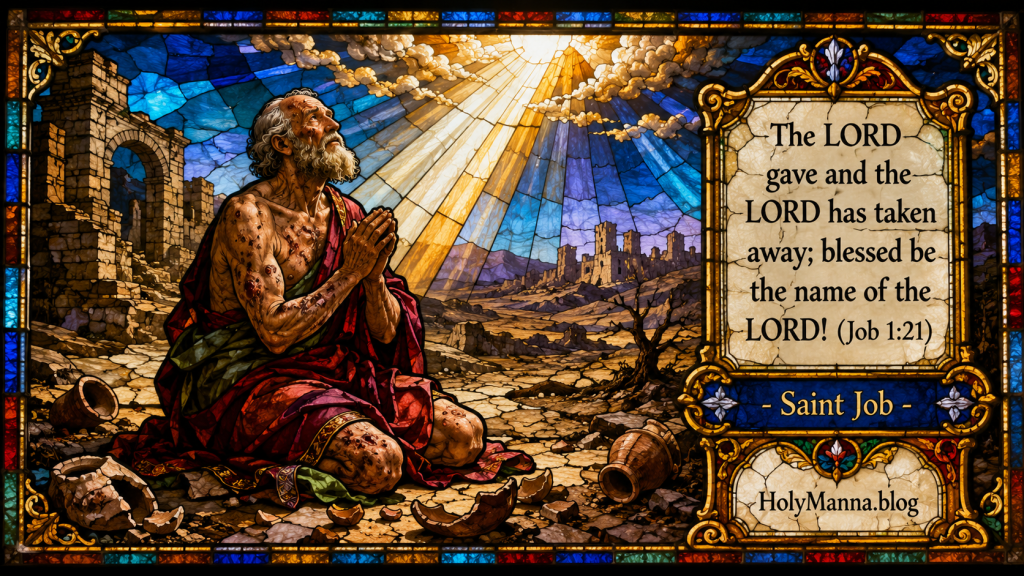
The Man Who Worshiped from the Ashes
Saint Job the Prophet is one of the most unforgettable souls in Sacred Scripture. He is not remembered because he conquered kingdoms, founded monasteries, preached to crowds, or died a martyr’s bloody death. He is remembered because everything was taken from him, and somehow, from the ashes, he still turned his face toward God.
Job was a righteous man from the land of Uz, a place outside Israel, which makes his story even more striking. He was not one of the patriarchs of Israel, not a priest of the Temple, and not a prophet in the usual public sense. Yet the Church honors him as a saint and prophet because he feared the true God, lived uprightly, and became one of Scripture’s greatest witnesses to innocent suffering.
The Catechism of the Catholic Church teaches that the holy figures of the Old Covenant are truly honored by the Church: “The patriarchs, prophets and certain other Old Testament figures have been and always will be honored as saints in all the Church’s liturgical traditions.” CCC 61. That includes Job, the man whose story became so famous that Christians still speak of “the patience of Job.”
But Job’s patience was not calm, polished, or emotionless. It was the kind of patience that sits in the dirt, covered in wounds, surrounded by confusion, and still refuses to curse God.
A Righteous Man from the East
The Book of Job begins with a simple but powerful introduction: “In the land of Uz there was a blameless and upright man named Job, who feared God and avoided evil.” Job 1:1. That one sentence tells us almost everything we need to know about his soul.
Job was wealthy, respected, and blessed with a large family. He had seven sons and three daughters, along with great herds and many servants. Scripture says he was the greatest of all the people of the East. Yet Job’s greatness was not just material. He was a man of prayer, reverence, and fatherly responsibility.
One of the most beautiful details about Job is that he offered sacrifices for his children. After his sons and daughters held their feasts, Job would rise early and pray for them, thinking that perhaps they had sinned in their hearts. This gives us a glimpse of his spiritual fatherhood. He did not simply provide food, land, and protection. He carried his children before God.
Catholic tradition usually places Job in the patriarchal period, before Moses and the giving of the Law. His world feels closer to Abraham than to David or Isaiah. There is no mention of the Temple, the Levitical priesthood, or the Law of Moses. Job acts as the priestly head of his household, offering sacrifice like the ancient fathers.
There is no dramatic conversion story for Job because Scripture presents him as already faithful. His story is not about a pagan man discovering God for the first time. It is about a righteous man being purified through suffering and drawn into a deeper encounter with the mystery of God.
The Trial That Shook Heaven and Earth
The story of Job turns on one of the most famous scenes in the Old Testament. Satan, the Accuser, appears before God and claims that Job only serves the Lord because his life is blessed. In other words, Satan says Job’s faith is not love. It is a transaction.
God permits Job to be tested, but only within limits. This is crucial. Evil is allowed to strike, but evil is not sovereign. Satan can rage, but he cannot overrule God.
Then the disasters come, one after another. Job loses his livestock. He loses his servants. Then comes the wound no parent can imagine without trembling. His children die.
Job tears his cloak, shaves his head, falls to the ground, and worships. His famous words still pierce the heart: “The LORD gave and the LORD has taken away; blessed be the name of the LORD!” Job 1:21.
This is what makes Job extraordinary. He does not pretend he is fine. He mourns like a real man. He grieves with his whole body. But he worships.
Then comes the second trial. Job is struck with terrible sores from the soles of his feet to the crown of his head. He sits among ashes and scrapes himself with a broken piece of pottery. His wife, crushed by grief herself, tells him to curse God and die. Job answers: “We accept good things from God; should we not accept evil?” Job 2:10.
That is not the voice of a man who does not feel pain. It is the voice of a man who refuses to make comfort the condition of his faith.
The Friends Who Sat in Silence, Then Spoke Too Much
Job’s friends, Eliphaz, Bildad, and Zophar, arrive to comfort him. At first, they do something deeply holy. They sit with him in silence for seven days and seven nights. No speeches. No explanations. No spiritual clichés. Just presence.
That silence may be the best thing they ever do.
Then they begin to speak.
Their argument is simple: God is just, Job is suffering, therefore Job must have sinned. They insist that suffering must be punishment. Job refuses to accept their accusation. He knows he is not perfect, but he also knows he has not committed the hidden wickedness they imagine.
This is one of the most important lessons in Job’s story. Suffering is not always a punishment for personal sin. Pope Saint John Paul II reflects on this deeply in Salvifici Doloris, explaining that Job challenges the idea that every suffering person must be guilty. Job’s friends defend a religious idea, but they apply it without mercy and without truth.
That is a warning for every Catholic. Bad comfort can wound more deeply than silence. A suffering person does not need shallow explanations. He needs love, prayer, truth, and presence.
Job’s friends began as companions. Then they became prosecutors.
The Cry of a Man Who Still Believes
Job’s patience does not mean he never struggles. He curses the day of his birth. He asks why he was allowed to live. He longs to bring his case before God. He feels abandoned, confused, and surrounded by darkness.
Yet this is where Job becomes so relatable. His faith is not plastic. It is not fake. It is not the kind of faith that smiles politely while the heart is breaking. Job speaks to God from inside the wound.
The Catechism of the Catholic Church says that illness and suffering can lead to anguish, self-absorption, despair, and even revolt against God, but they can also make a person more mature and help him search for what truly matters. Job lives that truth. He is tempted to despair, but he keeps turning toward God.
Then, in the middle of his agony, Job says one of the most famous lines in all of Scripture: “I know that my vindicator lives.” Job 19:25. Many Christians know this in the older wording: “I know that my Redeemer liveth.”
Catholic tradition has long heard in these words a cry of hope beyond death. Job does not yet see the fullness of Christ’s Resurrection, but his soul reaches toward final vindication. He believes that God will not let injustice have the last word.
When God Speaks from the Whirlwind
At last, God answers Job from the whirlwind.
But God does not answer the way modern people often want Him to answer. He does not hand Job a tidy explanation for every loss. He does not give him a chart, a theory, or a simple sentence that makes the pain disappear.
Instead, God reveals His majesty. He speaks of the foundations of the earth, the boundaries of the sea, the morning stars, wild animals, storms, strength, mystery, and creation’s hidden order. God draws Job out of the narrow courtroom of his own suffering and into the vast mystery of divine wisdom.
Job is humbled. He says: “I know that you can do all things.” Job 42:2. He also says, “I had heard of you by word of mouth, but now my eye has seen you.” Job 42:5.
That line is the key. Job does not receive all the answers. He receives something greater. He receives an encounter with the living God.
This is deeply Catholic. Faith is not finally about mastering every explanation. It is about communion with the Lord. There are moments when God does not explain the wound, but He enters the wound and reveals Himself there.
The Wounded Man Becomes an Intercessor
After God answers Job, He rebukes Job’s friends. They had spoken wrongly about Him. Then comes one of the most surprising turns in the whole story. God tells the friends to go to Job, and Job will pray for them.
The man they accused becomes their intercessor.
That detail is beautiful. Job does not merely win an argument. He becomes a vessel of mercy. He prays for the men who misunderstood him, judged him, and wounded him with their words. In this way, Job begins to look like a shadow of Christ, who prays for His persecutors from the Cross.
Then God restores Job’s fortunes. He receives twice as much as before. He has seven more sons and three more daughters. His daughters are named Jemimah, Keziah, and Keren-happuch, and Scripture says no women in the land were as beautiful as they were. Job also gives them an inheritance along with their brothers, which was unusual in the ancient world when sons were present.
That small detail matters. Job’s restored household is not only wealthy. It is generous, dignified, and marked by a surprising tenderness.
Still, Catholics should not read the ending cheaply. The children Job lost were not simply “replaced.” His grief was real. His restoration reveals God’s mercy, but it does not erase the seriousness of suffering. Job remains a man who truly lost, truly grieved, and truly endured.
Miracles, Wonders, and the Mystery of Divine Protection
Saint Job is not remembered primarily as a miracle-worker in the way later saints often are. There are no well-established Catholic traditions of Job healing the sick during his earthly life or performing visible signs for crowds.
The miracles in Job’s life are different. They are acts of divine Providence. God permits the trial, but limits Satan’s power. God preserves Job’s life. God speaks from the whirlwind. God vindicates Job. God accepts Job’s prayer for his friends. God restores his household and blesses his later years.
These are not flashy miracles, but they are mighty ones. They reveal that evil can wound, but it cannot dethrone God. They show that suffering may be permitted, but it is never outside the gaze of the Lord.
There are also later traditions and legends surrounding Job. One ancient tradition identifies him with Jobab, a king of Edom mentioned in Genesis. Catholic sources mention this tradition, but it cannot be verified with certainty and should not be treated as doctrine.
Another tradition places Job’s home in the Hauran region, near ancient places associated with Uz. Again, this is a traditional location, but it cannot be verified with certainty.
Some Eastern Christian traditions give additional details about Job’s ancestry and family, sometimes connecting him to the line of Esau. These stories belong to the wider devotional memory surrounding Job, but they go beyond what Scripture clearly tells us. They may be spiritually interesting, but they are not equal to the inspired text.
The Saint Whose Legacy Still Sits Beside the Suffering
Job’s legacy begins within Scripture itself. In Ezekiel, God names Job alongside Noah and Daniel as one of the great righteous men. In James, Christians are told: “You have heard of the perseverance of Job.” James 5:11. That phrase became part of Christian language forever.
The Roman Catholic Church commemorates Saint Job on May 10 in the Roman Martyrology. Byzantine Catholic tradition honors him on May 6 and often calls him the Holy and Just Job the Long-suffering. These different dates reflect different liturgical traditions, not a contradiction in faith.
Job’s influence on Catholic thought is enormous. Pope Saint Gregory the Great wrote Moralia in Job, one of the great works of Catholic biblical reflection. Saint Thomas Aquinas also wrote a commentary on The Book of Job, treating it as a profound meditation on divine Providence and the suffering of the just.
Job also became a spiritual companion to the sick, the grieving, the depressed, and the afflicted. In popular Catholic devotion, he is sometimes invoked by those suffering from depression, ulcers, chronic illness, or deep personal loss. That devotion is fitting because Job is the biblical saint who knows what it feels like when everything collapses.
There are no widely verified Catholic accounts of major posthumous miracles through Job’s relics or shrine in the way we might find with later saints. Still, his impact after death is undeniable. His words have comforted mourners, strengthened the sick, challenged bad theology, inspired artists, and taught generations of Christians how to pray from the ashes.
The Catholic Lesson of Job
Saint Job teaches us that faith does not always feel peaceful. Sometimes faith trembles. Sometimes faith weeps. Sometimes faith asks God why and hears only the wind for a while.
But Job also teaches that anguish does not have to become unbelief.
He does not curse God. He does not walk away. He does not accept the false accusations of his friends. He keeps speaking to the Lord, even when his prayers sound more like groans than hymns.
In the light of Christ, Job becomes even more powerful. Job is the innocent sufferer who points forward to the Innocent One. Christ loses everything. Christ is stripped, mocked, wounded, abandoned, and nailed to the Cross. But in Jesus, suffering is not merely endured. It is redeemed.
The Catechism of the Catholic Church teaches that Christ gives suffering a new meaning because it can unite us to His redemptive Passion. Job asks the ancient question: Why do the innocent suffer? Christ answers not with a theory, but with His own pierced hands.
That is why Saint Job still matters. He teaches Catholics how to suffer honestly without losing reverence. He teaches us not to judge the pain of others too quickly. He teaches us that sometimes the holiest thing a person can do is remain with God when life no longer makes sense.
When everything comfortable is stripped away, does the heart still know how to say, “Blessed be the name of the Lord”?
Engage With Us!
Share your thoughts and reflections in the comments below. Saint Job’s story touches something deep because every person eventually faces suffering that cannot be explained easily. His witness invites honest prayer, patient endurance, and a deeper trust in the God who sees more than we can see.
- When have you experienced a season where God felt silent, but you still knew He was present?
- Do you find it difficult to avoid judging others when they suffer, like Job’s friends did?
- What part of Job’s story speaks most deeply to your own faith journey?
- How can you become more present to someone who is suffering instead of trying to explain their pain away?
- What would it look like this week to say, “Blessed be the name of the Lord,” even in a difficult situation?
May Saint Job pray for all who suffer in silence, all who grieve without answers, and all who are tempted to believe that pain means God has abandoned them. Let us live with faith, endure with patience, speak with mercy, and do everything with the love and compassion Jesus taught us.
Saint Job, pray for us!
Follow us on YouTube, Instagram and Facebook for more insights and reflections on living a faith-filled life.


Leave a comment