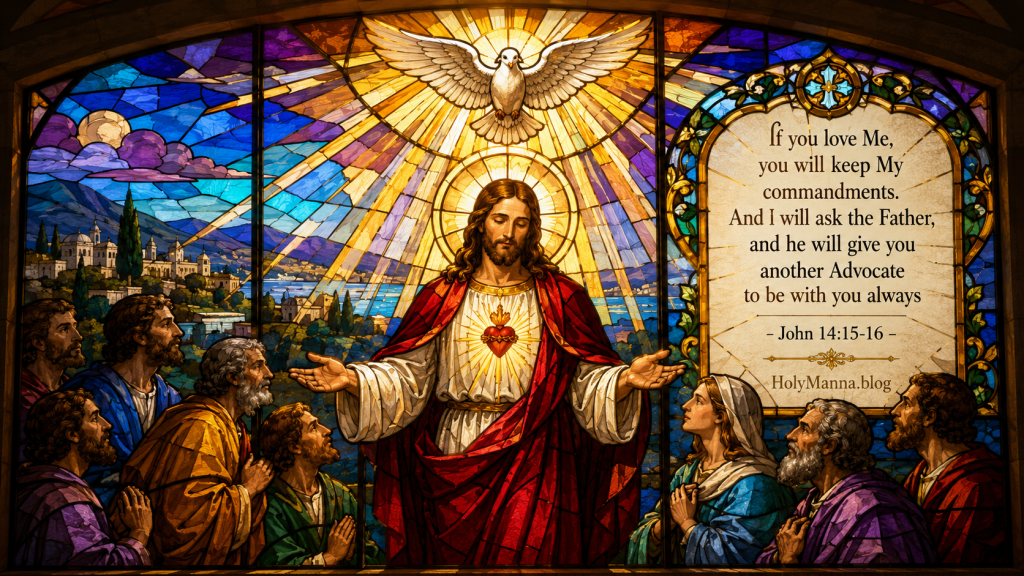
Sixth Sunday of Easter – Lectionary: 55
When Love Becomes a Dwelling Place for God
There is a quiet promise running through today’s readings: the risen Christ does not leave His people alone. He sends His Church into wounded places, fills His disciples with the Holy Spirit, and teaches them that love is not just a feeling, but a life shaped by obedience, hope, and joy.
On this Sixth Sunday of Easter, the Church stands between the empty tomb and Pentecost. The Resurrection has already changed everything, but the disciples are still learning what it means to live without seeing Jesus in the same way they once did. In John 14:15-21, Jesus speaks tenderly at the Last Supper, preparing His apostles for the Cross, His Resurrection, and His return to the Father. He promises them “another Advocate”, the “Spirit of truth”, and assures them, “I will not leave you orphans” John 14:16-18. This is not merely comfort for frightened men in an upper room. It is the foundation of the Church’s life.
That promise begins to unfold in Acts 8:5-8, when Philip brings the Gospel to Samaria. This was no small detail. Jews and Samaritans carried generations of religious and cultural division, yet the risen Christ sends His message precisely into that wounded history. As Philip proclaims the Messiah, evil spirits are cast out, the sick are healed, and “there was great joy in that city” Acts 8:8. The Holy Spirit does not create a private faith locked inside the soul. He sends the Church outward, across old boundaries, so that divided places can become places of joy.
Psalm 66 gives the proper response to such mercy: praise and testimony. The psalmist cries, “Shout joyfully to God, all the earth” Psalm 66:2, then invites the faithful to remember what God has done. The God who once delivered Israel through the sea is still delivering His people through Christ. Easter faith always remembers. It looks back at God’s mighty works, then looks at the present moment and says, “Come and hear, all you who fear God, while I recount what has been done for me” Psalm 66:16.
Saint Peter then shows what this Easter life looks like in daily practice. In 1 Peter 3:15-18, Christians are told to sanctify Christ as Lord in their hearts and to be ready to explain the reason for their hope with “gentleness and reverence” 1 Peter 3:16. The same Spirit who brings joy to Samaria also forms courage in the believer. He teaches Catholics how to witness without arrogance, suffer without bitterness, and speak the truth without losing charity.
The central theme of today’s readings is that the Holy Spirit makes the love of the risen Christ visible in the Church. He turns obedience into love, mission into joy, suffering into witness, and lonely hearts into dwelling places of God. According to The Catechism, the New Law is the grace of the Holy Spirit given through faith in Christ, a grace that forms the heart from within and brings forth charity. That is the story these readings tell together. Christ lives, and because He lives, His people are not orphans. They are loved by the Father, united to the Son, and filled with the Spirit who sends them into the world as witnesses of hope.
Where does Christ want to turn obedience into love, fear into courage, and isolation into communion with Him today?
First Reading – Acts 8:5-8
When the Gospel Walked Into a Wounded City
The first reading begins in Samaria, a place filled with old religious tension, painful history, and cultural suspicion. For centuries, Jews and Samaritans had lived with a deep division. The Samaritans accepted a form of Israel’s faith, worshiped on Mount Gerizim, and were often viewed by Jews as compromised and separated from true worship in Jerusalem. That is why this moment in Acts 8:5-8 is so powerful. The risen Christ sends the Gospel into a place many would have avoided.
This happens after the martyrdom of Saint Stephen, when persecution scatters the early Christians from Jerusalem. What looks like a disaster becomes a doorway for mission. Philip, one of the seven men chosen for service in Acts 6, goes to Samaria and proclaims Christ. The Church is beginning to live what Jesus promised before His Ascension: “You will be my witnesses in Jerusalem, throughout Judea and Samaria, and to the ends of the earth” Acts 1:8.
This reading fits beautifully into today’s central theme. In the Gospel, Jesus promises the Advocate, the Spirit of Truth, and tells His disciples, “I will not leave you orphans” John 14:18. In Samaria, that promise begins to look public. Christ does not leave wounded cities orphaned. He sends His Church, filled with the power of the Holy Spirit, to preach, heal, deliver, and bring joy.
Acts 8:5-8 – New American Bible (Revised Edition)
5 Thus Philip went down to [the] city of Samaria and proclaimed the Messiah to them. 6 With one accord, the crowds paid attention to what was said by Philip when they heard it and saw the signs he was doing. 7 For unclean spirits, crying out in a loud voice, came out of many possessed people, and many paralyzed and crippled people were cured. 8 There was great joy in that city.
Detailed Exegesis
Verse 5 – “Thus Philip went down to [the] city of Samaria and proclaimed the Messiah to them.”
Philip does not go to Samaria with vague religious encouragement. He proclaims the Messiah. That detail matters. The heart of apostolic preaching is not personal success, moral improvement, or spiritual inspiration by itself. The heart of apostolic preaching is Jesus Christ, crucified and risen.
The fact that Philip goes to Samaria also shows the missionary movement of the early Church. The Gospel is not trapped inside one ethnic group, one city, or one comfortable religious circle. Christ is the Savior of the world. The old hostility between Jews and Samaritans begins to be healed, not by diplomacy alone, but by the proclamation of the Messiah. The same Jesus who once spoke with the Samaritan woman at the well now sends His Church into Samaritan territory with the fullness of Easter faith.
Verse 6 – “With one accord, the crowds paid attention to what was said by Philip when they heard it and saw the signs he was doing.”
The crowds listen because Philip’s words are joined to visible signs. In the Bible, signs are never meant to entertain. They point beyond themselves. They reveal that God is acting. Philip’s preaching is confirmed by the power of Christ working through the Church.
The phrase “with one accord” suggests a striking unity. A divided people are suddenly listening together. That is one of the quiet miracles of the Gospel. Sin scatters. Grace gathers. Falsehood divides. Truth draws people toward communion. In this way, Samaria becomes a preview of the Church’s catholicity, meaning her universal mission to gather all peoples into Christ.
Verse 7 – “For unclean spirits, crying out in a loud voice, came out of many possessed people, and many paralyzed and crippled people were cured.”
This verse shows the Gospel confronting both spiritual bondage and bodily suffering. Unclean spirits are driven out, and the sick are healed. The Kingdom of God is not merely announced as an idea. It arrives with power.
The casting out of demons reveals Christ’s victory over Satan. The healings reveal His mercy toward the suffering. Through Philip, the risen Jesus continues the same work He performed during His earthly ministry. The Church does not replace Christ. The Church carries Christ’s presence into the world by the Holy Spirit.
This also reminds Catholics that salvation is not only about the soul in some abstract way. Christ comes to redeem the whole person. He heals, forgives, liberates, strengthens, and restores. Every healing in the New Testament points toward the final restoration of humanity in the Resurrection.
Verse 8 – “There was great joy in that city.”
This is the fruit of the Gospel. Samaria does not merely receive information. Samaria receives joy. The city that had carried religious division, spiritual oppression, and human suffering becomes a place of rejoicing.
Christian joy is not shallow positivity. It is the gladness that comes when Christ begins to reign. It is the sound of freedom after bondage. It is the peace of sinners discovering mercy. It is the amazement of a wounded people realizing that God has not forgotten them.
This verse also points toward the joy of Easter. The risen Christ is alive, and where He is proclaimed, death and darkness begin to lose their grip. The joy in Samaria prepares the reader for today’s Gospel promise: “Because I live and you will live” John 14:19.
Teachings
The first reading teaches that the Church is missionary by her very nature. Philip’s journey into Samaria is not a side story. It is a revelation of what the risen Christ intends His Church to be. The Gospel must cross borders, enter wounded histories, confront evil, heal suffering, and create joy.
The Catechism of the Catholic Church teaches this missionary identity clearly in CCC 849: “The missionary mandate. ‘Having been divinely sent to the nations that she might be “the universal sacrament of salvation,” the Church, in obedience to the command of her founder and because it is demanded by her own essential universality, strives to preach the Gospel to all men’: ‘Go therefore and make disciples of all nations.’”
That is exactly what Philip is doing. He is not acting as a religious freelancer. He is participating in the mission of the Church. The same Christ who sent the apostles now sends His disciples into every Samaria, every place marked by suspicion, division, confusion, or pain.
This reading also teaches the Catholic understanding of Christ’s victory over evil. The unclean spirits crying out and leaving the possessed show that the Kingdom of God is stronger than the kingdom of darkness. The Catechism explains this in CCC 550: “The coming of God’s kingdom means the defeat of Satan’s: ‘If it is by the Spirit of God that I cast out demons, then the kingdom of God has come upon you.’ Jesus’ exorcisms free some individuals from the domination of demons. They anticipate Jesus’ great victory over ‘the ruler of this world.’ The kingdom of God will be definitively established through Christ’s cross: ‘God reigned from the wood.’”
Philip’s ministry in Samaria flows from that victory. The Cross was not a defeat. It was the throne from which Christ conquered sin, death, and the devil. The healings in Samaria are signs that the victory of Christ is being applied in history through the Church.
There is also a beautiful connection to the spiritual longing of the human heart. Samaria’s joy is not random. It is the joy of human hearts encountering the One for whom they were made. Saint Augustine wrote in Confessions, “You have made us for yourself, O Lord, and our heart is restless until it rests in you.” That line helps explain why the city rejoices. When Christ is preached and received, restless hearts begin to find their home.
Historically, this moment is also important because it shows the unity of the Church expanding beyond Jerusalem. The Gospel first takes root among the Jews, then reaches Samaria, and eventually moves toward the Gentile world. This is not a break from Israel’s story. It is the fulfillment of God’s promise that all nations would be blessed through the descendants of Abraham. The Church is not a human organization trying to spread influence. She is the family of God being gathered from every people and place through Christ.
Reflection
This reading is deeply practical because every Catholic has a Samaria. There are places, people, wounds, memories, and conversations that feel easier to avoid. There are family tensions that never seem to heal, neighborhoods that feel spiritually dry, coworkers who seem closed to faith, and parts of the heart that still feel divided.
Philip teaches the Church what to do. He goes. He proclaims Christ. He trusts that the power belongs to God. He does not begin with resentment. He does not begin with fear. He begins with Jesus.
That is a good pattern for daily life. A Catholic can bring Christ into difficult places by praying before speaking, refusing to gossip, blessing instead of cursing, inviting instead of accusing, and staying faithful even when the results are not immediate. Sometimes evangelization looks like a clear conversation about the faith. Sometimes it looks like patience with a difficult family member. Sometimes it looks like making the Sign of the Cross in public without embarrassment. Sometimes it looks like living with such steady hope that someone finally asks why.
This reading also invites Catholics to believe that joy is possible in wounded places. Samaria had a complicated history, yet “there was great joy in that city” Acts 8:8. That means no home, parish, city, or soul is beyond the reach of Christ. The risen Lord can bring joy where there has been bitterness. He can bring unity where there has been division. He can bring freedom where there has been bondage.
Where is the Samaria in your life, the place Christ may be asking you to enter with courage instead of avoidance?
Who needs to hear about Jesus from you, not as an argument to win, but as good news offered with love?
What old division might begin to heal if Christ were placed at the center of the conversation?
The first reading ends with joy because that is what happens when the Gospel is truly received. Christ does not simply improve Samaria. He visits it. He heals it. He frees it. He fills it with joy. And through the Holy Spirit, He still sends the Church into wounded places today.
Responsorial Psalm – Psalm 66:1-7, 16, 20
The Song of a Soul That Remembers Mercy
The responsorial psalm sounds like the whole earth waking up to worship. After hearing about the joy that filled Samaria in Acts 8:8, the Church answers with Psalm 66, a hymn of praise that begins with the whole world and then moves into one person’s grateful testimony. It is as if the psalmist first stands before creation and says, “Look what God has done,” and then turns to the faithful and says, “Now listen to what He has done for me.”
This psalm was born from Israel’s memory. The people of God remembered the Exodus, the crossing of the sea, and the mighty works by which the Lord rescued them from slavery. That memory was not just history for them. It was worship. Every generation was invited to see its own life inside the story of God’s deliverance.
That is why this psalm fits so beautifully with today’s readings. In Acts 8:5-8, Samaria rejoices because Christ is preached, demons are cast out, and the sick are healed. In John 14:15-21, Jesus promises the Advocate, the Spirit of Truth, who will remain with His people. In 1 Peter 3:15-18, believers are called to explain the reason for their hope with gentleness and reverence. Psalm 66 gives that hope a voice. It teaches the Church to praise God publicly and testify personally, because the same Lord who delivered Israel still delivers His people through Christ.
Psalm 66:1-7, 16, 20 – New American Bible (Revised Edition)
Praise of God, Israel’s Deliverer
1 For the leader. A song; a psalm.
2 Shout joyfully to God, all the earth;
sing of his glorious name;
give him glorious praise.
3 Say to God: “How awesome your deeds!
Before your great strength your enemies cringe.
4 All the earth falls in worship before you;
they sing of you, sing of your name!”
Selah5 Come and see the works of God,
awesome in deeds before the children of Adam.
6 He changed the sea to dry land;
through the river they passed on foot.
There we rejoiced in him,
7 who rules by his might forever,
His eyes are fixed upon the nations.
Let no rebel rise to challenge!
Selah16 Come and hear, all you who fear God,
while I recount what has been done for me.20 Blessed be God, who did not reject my prayer
and refuse his mercy.
Detailed Exegesis
Verse 1 – “For the leader. A song; a psalm.”
This opening note reminds readers that the psalm belongs to Israel’s worship. It was not simply a private poem. It was a song meant to be prayed, sung, remembered, and shared by the people of God. In the Catholic life, the psalms still hold that same place. They are prayed in the Mass, the Liturgy of the Hours, monasteries, parish churches, and homes. They teach the faithful how to turn memory, fear, gratitude, suffering, and joy into prayer.
Verse 2 – “Shout joyfully to God, all the earth; sing of his glorious name; give him glorious praise.”
The psalm begins with a universal invitation. Not only Israel, but “all the earth” is called to praise God. This looks ahead to the mission of the Church, where the Gospel goes beyond one nation and reaches every people. The joy in Samaria from the first reading is part of this same movement. The praise of God is meant to spread.
The command to “sing of his glorious name” shows that worship is not centered on human emotion, but on who God is. His name means His revealed presence, His holiness, His mercy, His power, and His faithfulness. Catholic worship is not entertainment. It is the creature giving glory to the Creator because He is worthy.
Verse 3 – “Say to God: ‘How awesome your deeds! Before your great strength your enemies cringe.’”
The psalmist invites the faithful to speak directly to God. Praise is not only talking about God. It is talking to Him. His deeds are called “awesome” because they reveal power beyond human control.
The mention of enemies cringing before God recalls the Lord’s victories over the forces that opposed His people. In the Christian reading, this points beyond earthly enemies to sin, death, and the devil. In today’s first reading, unclean spirits cry out and leave the possessed because Christ’s victory is stronger than darkness. God’s enemies cannot stand forever before His strength.
Verse 4 – “All the earth falls in worship before you; they sing of you, sing of your name!”
The vision grows larger. The psalm imagines all creation bowing before the Lord. This is not forced humiliation. It is the proper order of reality restored. When creatures worship God, they become more fully themselves.
This verse also points toward the catholicity of the Church. The word “catholic” means universal. The Church is not meant for one tribe, one language, one class, or one culture. In Christ, all nations are invited into worship of the Father, through the Son, in the Holy Spirit.
Verse 5 – “Come and see the works of God, awesome in deeds before the children of Adam.”
Here the psalm becomes an invitation to contemplate. “Come and see” is the language of witness. The believer is not asked to invent faith from nothing. He is invited to look at what God has done.
The phrase “children of Adam” broadens the scope again. God’s works are not hidden from humanity. His saving action is meant to be recognized. For Catholics, this reaches its fullness in Christ, the new Adam, whose death and Resurrection reveal God’s greatest work. In Him, fallen humanity is offered a new beginning.
Verse 6 – “He changed the sea to dry land; through the river they passed on foot. There we rejoiced in him.”
This verse remembers the Exodus and likely also the crossing of the Jordan. God made a path where there was no path. The sea, a symbol of chaos and danger, became dry land under His command. Israel passed through because God acted first.
For Christians, this naturally calls to mind Baptism. Through water, God delivers His people. The Exodus prefigures the greater deliverance accomplished in Christ, where sin is drowned, grace is given, and the baptized are brought into new life. The psalm says, “There we rejoiced in him,” because deliverance is meant to become joy. Salvation is not merely escape from danger. It is entrance into communion with God.
Verse 7 – “Who rules by his might forever, His eyes are fixed upon the nations. Let no rebel rise to challenge!”
The Lord’s power is not temporary. He rules forever, and His gaze rests upon the nations. This is both comforting and sobering. God sees history. He sees rulers, empires, conflicts, injustices, and hidden acts of faithfulness. Nothing escapes Him.
The warning against rebellion reminds the reader that praise requires humility. The human heart is always tempted to resist God, to build its own little kingdom, and to pretend that self-rule is freedom. The psalm gently corrects that illusion. Real freedom begins when the soul stops rebelling against the One who made it.
Verse 16 – “Come and hear, all you who fear God, while I recount what has been done for me.”
The psalm now shifts from public praise to personal testimony. Earlier, the psalmist said, “Come and see.” Now he says, “Come and hear.” This is the movement of evangelization. First, the believer points to God’s mighty works. Then he shares how those works have touched his own soul.
The phrase “all you who fear God” refers to those who reverence the Lord and take His holiness seriously. Testimony is safest among the humble, because true testimony does not brag about the self. It glorifies God. The psalmist wants others to be encouraged by mercy.
Verse 20 – “Blessed be God, who did not reject my prayer and refuse his mercy.”
The psalm ends in gratitude. God listened. God did not reject the prayer. God did not withhold mercy. This is the quiet confidence of a soul that has suffered, prayed, waited, and discovered that the Lord was near.
For the Christian, this verse is fulfilled most deeply in Jesus Christ. The Father hears the Son, and in the Son, the prayers of the Church rise to heaven. Even when God’s answer does not come in the expected way, the believer can still bless Him because His mercy has not failed.
Teachings
Psalm 66 teaches the Church that praise is not optional decoration in the spiritual life. Praise is part of truth. When the soul sees reality clearly, it recognizes that God is God, that His deeds are mighty, and that His mercy deserves to be spoken aloud.
The Catechism of the Catholic Church explains the unique place of the psalms in Christian prayer in CCC 2587: “The Psalter is the book in which The Word of God becomes man’s prayer. In other books of the Old Testament, ‘the words proclaim [God’s] works and bring to light the mystery they contain.’ The words of the Psalmist, sung for God, both express and acclaim the Lord’s saving works; the same Spirit inspires both God’s work and man’s response. Christ will unite the two. In him, the psalms continue to teach us how to pray.”
That teaching is important for this Sunday. The same Spirit promised by Jesus in John 14 is the Spirit who teaches the Church to pray. He inspires the memory of God’s works and forms the response of praise. This is why Psalm 66 is not just an ancient song. It is the living prayer of the Church in Christ.
The Catechism also describes praise in CCC 2639: “Praise is the form of prayer which recognizes most immediately that God is God. It lauds God for his own sake and gives him glory, quite beyond what he does, but simply because HE IS. It shares in the blessed happiness of the pure of heart who love God in faith before seeing him in glory. By praise, the Spirit is joined to our spirits to bear witness that we are children of God, testifying to the only Son in whom we are adopted and by whom we glorify the Father.”
This is exactly what the psalm does. It praises God for His deeds, but it also praises Him because He is Lord. It remembers the sea becoming dry land, but it also bows before the God who reigns forever. It testifies to answered prayer, but it also blesses the God whose mercy is faithful even before the answer arrives.
Saint Augustine, preaching on this psalm, saw the danger of turning God’s gifts into human boasting. He taught that God removes false pride so that He can fill the soul with His own grace: “See ye how from us He has taken away, that He might give glory: has taken away ours, that He might give His own; has taken away empty, that He might give full; has taken away insecure, that He might give solid.”
That insight fits the psalm beautifully. True praise empties the soul of pride and fills it with gratitude. It teaches the believer to say, not “Look what I built,” but “Come and see the works of God.” It teaches the soul to say, not “Look how strong I was,” but “Blessed be God, who did not reject my prayer and refuse his mercy.”
Historically, Israel’s worship was shaped by remembering deliverance. The Exodus was not treated like a dusty event from the past. It was the great saving act that revealed who God was. In the Catholic Church, that pattern reaches its fullness in the Eucharist. At every Mass, the Church remembers the saving Passion, Resurrection, and Ascension of Christ, not as a mere mental exercise, but as a living participation in the one sacrifice of Jesus. The memory of mercy becomes worship.
Reflection
This psalm invites Catholics to become people who remember well. That sounds simple, but it is actually a serious spiritual discipline. The heart easily remembers insults, disappointments, embarrassments, failures, and fears. It takes grace to remember mercy with the same intensity.
The psalmist teaches a better way. Begin with praise. Say out loud what is true about God. He is faithful. He is powerful. He is merciful. He rules forever. He hears prayer. He does not abandon His people. This kind of praise slowly reorders the heart.
Then remember the works of God. For Israel, that meant the sea, the river, and deliverance from slavery. For Catholics, it means creation, the covenants, the Incarnation, the Cross, the empty tomb, Baptism, Confession, the Eucharist, and the quiet rescues God has worked in each soul. A Christian who forgets mercy becomes anxious and self-reliant. A Christian who remembers mercy becomes steady and grateful.
Finally, give testimony. Not every testimony has to be dramatic. Sometimes the most powerful witness is simple and honest. God helped someone forgive. God gave strength during grief. God brought a soul back to Confession. God protected a marriage. God opened the door to prayer again. God gave peace in a season that should have crushed a person. These stories matter because they teach others to hope.
A practical way to live this psalm is to end each day with a short act of remembrance. Before bed, a Catholic can ask where God was present that day, where mercy appeared, where prayer was answered, and where the heart was invited to trust more deeply. Over time, this forms a soul that can say with the psalmist, “Come and hear, all you who fear God, while I recount what has been done for me” Psalm 66:16.
What mercy has God shown you that deserves to be remembered more often?
When you speak about your life, do your words lead others toward anxiety, or do they help them see the works of God?
What would change in your prayer if you began with praise before asking for anything?
Who needs to hear your testimony, not as a performance, but as a quiet invitation to trust the Lord?
The psalm ends where every Christian life should end, in blessing. “Blessed be God, who did not reject my prayer and refuse his mercy” Psalm 66:20. That is the song of Israel, the song of the Church, and the song of every soul that has learned to recognize mercy after the storm.
Second Reading – 1 Peter 3:15-18
Hope That Can Speak Without Losing Its Soul
Saint Peter writes to Christians who are learning how to suffer without becoming bitter. His first letter is addressed to believers scattered across Asia Minor, living as a minority in a world that often misunderstood them. They were not necessarily facing one single organized empire-wide persecution yet, but they were experiencing suspicion, slander, social pressure, and hostility because they belonged to Christ.
That makes this reading deeply relevant. Peter is not writing from a comfortable theory of discipleship. He knows what fear feels like. He once denied Jesus beside a charcoal fire. He also knows what mercy feels like. The risen Christ restored him and made him a shepherd of the Church. So when Peter tells Christians to be ready to explain their hope, he is speaking as a man who learned that courage does not come from ego. It comes from belonging to Jesus.
This passage fits today’s theme because the Holy Spirit makes the love of the risen Christ visible in the Church. In Acts 8:5-8, that love becomes mission and joy in Samaria. In Psalm 66, it becomes praise and testimony. In John 14:15-21, Jesus promises the Advocate, the Spirit of Truth. Here in 1 Peter 3:15-18, that same Spirit forms believers who can witness with courage, gentleness, reverence, and a clear conscience.
1 Peter 3:15-18 – New American Bible (Revised Edition)
15 but sanctify Christ as Lord in your hearts. Always be ready to give an explanation to anyone who asks you for a reason for your hope, 16 but do it with gentleness and reverence, keeping your conscience clear, so that, when you are maligned, those who defame your good conduct in Christ may themselves be put to shame. 17 For it is better to suffer for doing good, if that be the will of God, than for doing evil.
18 For Christ also suffered for sins once, the righteous for the sake of the unrighteous, that he might lead you to God. Put to death in the flesh, he was brought to life in the spirit.
Detailed Exegesis
Verse 15 – “But sanctify Christ as Lord in your hearts. Always be ready to give an explanation to anyone who asks you for a reason for your hope.”
Peter begins inside the heart. Before a Christian can explain the faith well, Christ must be enthroned within. To “sanctify Christ as Lord” means to set Him apart as holy, supreme, and worthy of obedience. The Christian witness begins not with clever words, but with worship.
Peter then gives the famous call to readiness. Catholics should be prepared to explain the reason for their hope. This does not mean every Catholic must sound like a professional theologian. It means every Catholic should know the basic truth of the Gospel, live in friendship with Christ, and be able to speak honestly about why Jesus matters. The world may not always understand doctrine first, but it often notices hope. Hope makes people curious.
Verse 16 – “But do it with gentleness and reverence, keeping your conscience clear, so that, when you are maligned, those who defame your good conduct in Christ may themselves be put to shame.”
Peter immediately protects Christian witness from pride. The reason for hope must be given with “gentleness and reverence” 1 Peter 3:16. Truth should not be delivered like a weapon swung from insecurity. The Catholic faith is not defended well by arrogance, mockery, or contempt. The truth is strongest when charity carries it.
A clear conscience is also essential. Peter knows that the best defense of Christianity is a holy life. If Christians speak beautifully but live carelessly, their witness becomes hollow. If they suffer slander while continuing to live with integrity, their goodness exposes the emptiness of the accusations against them. In this way, holiness becomes apologetics.
Verse 17 – “For it is better to suffer for doing good, if that be the will of God, than for doing evil.”
Peter is realistic. Sometimes doing good brings suffering. A Christian may be misunderstood for telling the truth, mocked for chastity, rejected for fidelity to the Church, or treated unfairly for refusing to compromise conscience. Peter does not romanticize suffering, but he gives it meaning when it is united to Christ.
There is a major difference between suffering because of sin and suffering because of faithfulness. Sin brings the suffering of disorder. Faithfulness may bring the suffering of the Cross. The first should move a person to repentance. The second can become a participation in Christ’s own witness to the Father.
Verse 18 – “For Christ also suffered for sins once, the righteous for the sake of the unrighteous, that he might lead you to God. Put to death in the flesh, he was brought to life in the spirit.”
Peter grounds everything in Jesus. Christians can suffer for doing good because Christ suffered first. He is “the righteous for the sake of the unrighteous” 1 Peter 3:18. This is the heart of the Gospel. Jesus did not suffer because He deserved punishment. He suffered out of love, so that sinners could be led back to God.
The phrase “once” matters. Christ’s sacrifice is complete, perfect, and unrepeatable. At every Mass, the Church does not crucify Christ again. She sacramentally participates in the one sacrifice of Calvary, made present in an unbloody manner. Peter’s words point directly to the Catholic understanding that salvation comes through the Paschal Mystery: Christ died in the flesh and was brought to life in the spirit.
Teachings
This reading teaches that Christian witness is both spoken and embodied. A Catholic should be ready to explain the faith, but that explanation must be supported by a life that makes the Gospel credible. Peter joins three things that modern culture often separates: truth, charity, and holiness.
The Catechism of the Catholic Church speaks clearly about this duty of witness in CCC 1816: “The disciple of Christ must not only keep the faith and live on it, but also profess it, confidently bear witness to it, and spread it: ‘All however must be prepared to confess Christ before men and to follow him along the way of the Cross, amidst the persecutions which the Church never lacks.’ Service of and witness to the faith are necessary for salvation: ‘So every one who acknowledges me before men, I also will acknowledge before my Father who is in heaven; but whoever denies me before men, I also will deny before my Father who is in heaven.’”
That is exactly what Peter is asking for. The Christian does not keep faith hidden like a private hobby. Faith must be lived, professed, and offered to others. Yet Peter’s command also guards against a harsh style of witness. The truth must be spoken, but it must sound like it belongs to Christ.
The Catechism also teaches in CCC 2471: “Before Pilate, Christ proclaims that he ‘has come into the world, to bear witness to the truth.’ The Christian is not to ‘be ashamed then of testifying to our Lord.’ In situations that require witness to the faith, the Christian must profess it without equivocation, after the example of St. Paul before his judges. We must keep ‘a clear conscience toward God and toward men.’”
Peter’s words about conscience are not optional. A Catholic cannot separate public witness from private integrity. The conscience must be formed by truth, purified by repentance, strengthened by grace, and protected from compromise. This is why regular Confession, prayer, examination of conscience, and fidelity to the teachings of the Church matter so much. They keep the soul honest before God.
The Cross stands at the center of this reading. The Catechism explains the Christian’s participation in Christ’s sacrifice in CCC 618: “The cross is the unique sacrifice of Christ, the ‘one mediator between God and men.’ But because in his incarnate divine person he has in some way united himself to every man, ‘the possibility of being made partners, in a way known to God, in the paschal mystery’ is offered to all men. He calls his disciples to ‘take up [their] cross and follow [him],’ for ‘Christ also suffered for [us], leaving [us] an example so that [we] should follow in his steps.’ In fact Jesus desires to associate with his redeeming sacrifice those who were to be its first beneficiaries.”
This does not mean suffering saves apart from Christ. It means Christian suffering can be united to Christ. When a believer suffers for doing good, forgives an insult, remains faithful under pressure, or keeps loving when love becomes costly, that suffering can become a holy offering.
Saint John Chrysostom, reflecting on Christian endurance, often taught that the conduct of believers under mistreatment becomes a powerful sermon. The Christian who answers evil with patience reveals a strength the world cannot easily explain. That is the spirit of Peter’s teaching. The believer does not need to become cruel in order to be courageous. Christlike courage can be gentle, reverent, and immovable.
Saint Augustine also understood that true witness must be rooted in love. In his preaching on the Christian life, he warned that even great works are empty without charity. That connects directly to Peter’s command. A Catholic can explain many doctrines correctly, but if charity disappears, the explanation no longer resembles the Lord who suffered “the righteous for the sake of the unrighteous” 1 Peter 3:18.
Reflection
This reading lands right in the middle of ordinary Catholic life. Most people will not be dragged before judges for the faith today, but many will face smaller tests of courage. A conversation at work turns against Catholic teaching. A friend mocks Confession. A family member treats Sunday Mass like a strange obsession. A social media post makes the Church look ridiculous. A moral issue comes up, and silence suddenly feels easier than fidelity.
Peter does not tell the Christian to panic. He says to be ready. Readiness begins long before the conversation. It begins in prayer, Sunday Mass, Scripture, study of The Catechism, regular Confession, and a sincere effort to live what the Church teaches. A Catholic who is quietly faithful each day becomes less afraid when the moment comes to speak.
Peter also teaches the tone of Christian witness. Gentleness is not weakness. Reverence is not timidity. A Catholic can speak clearly without becoming rude. A Catholic can defend the truth without humiliating another person. A Catholic can disagree without hatred. In a world addicted to outrage, that kind of witness stands out.
There are simple ways to live this reading. Begin the day by consciously placing Christ as Lord in the heart. Ask the Holy Spirit for one opportunity to witness with charity. Learn one teaching of the Church well enough to explain it simply. Practice answering difficult questions without sarcasm. Keep the conscience clear by repenting quickly when sin happens. Offer small sufferings for someone who does not yet know Christ.
This is how hope becomes visible. It is not enough to say that Catholics have hope. The life must make someone wonder where that hope comes from.
If someone asked you why you still have hope, what would you say?
Does your way of defending the faith sound like Jesus, or does it sound like frustration wearing religious language?
Where is Christ asking you to suffer for doing good instead of choosing the easier path of compromise?
What part of your conscience needs to be brought back into the light through prayer, repentance, or Confession?
Saint Peter gives the Church a beautiful and demanding path. Let Christ be Lord in the heart. Be ready to speak. Stay gentle. Remain reverent. Keep the conscience clear. Endure suffering for good. Remember that Jesus suffered first, not to crush sinners, but “that he might lead you to God” 1 Peter 3:18. That is the reason for Christian hope, and it is still worth explaining.
Holy Gospel – John 14:15-21
The Promise That We Are Not Orphans
The Gospel brings the Church back into the Upper Room, where Jesus speaks to His apostles on the night before He dies. The mood is tender, solemn, and full of mystery. Judas has gone into the night. Peter’s denial is approaching. The Cross is close. The disciples can feel that something is changing, but they do not yet understand how the Passion, Resurrection, Ascension, and gift of the Holy Spirit will unfold.
Into that fear, Jesus gives one of the most consoling promises in all of The Gospel of John: “I will not leave you orphans; I will come to you” John 14:18. This is not sentimental comfort. This is covenant love. Jesus is preparing His Church to live by the Holy Spirit, the Advocate, the Spirit of Truth, who will remain with the disciples and dwell within them.
This Gospel ties together the whole Sunday. In Acts 8:5-8, the risen Christ reaches Samaria through the preaching of Philip, bringing healing, deliverance, and joy. In Psalm 66, the Church learns to praise God and testify to His mercy. In 1 Peter 3:15-18, Christians are told to explain their hope with gentleness and reverence. Here, Jesus reveals the source of that mission, praise, hope, and courage. The Holy Spirit makes the love of Christ visible in the Church.
John 14:15-21 – New American Bible (Revised Edition)
The Advocate. 15 “If you love me, you will keep my commandments. 16 And I will ask the Father, and he will give you another Advocate to be with you always, 17 the Spirit of truth, which the world cannot accept, because it neither sees nor knows it. But you know it, because it remains with you, and will be in you. 18 I will not leave you orphans; I will come to you. 19 In a little while the world will no longer see me, but you will see me, because I live and you will live. 20 On that day you will realize that I am in my Father and you are in me and I in you. 21 Whoever has my commandments and observes them is the one who loves me. And whoever loves me will be loved by my Father, and I will love him and reveal myself to him.”
Detailed Exegesis
Verse 15 – “If you love me, you will keep my commandments.”
Jesus begins with love, but He immediately gives love a shape. In the Catholic life, love is never reduced to emotion, mood, or religious enthusiasm. Love obeys. Love listens. Love remains faithful when the feeling fades.
This does not mean that Christians earn the love of Jesus by rule-keeping. It means that real love for Jesus bears the fruit of obedience. A husband who says he loves his wife but refuses fidelity is not loving her well. A disciple who says he loves Christ but ignores His commandments is living a divided life. Jesus is not crushing the heart with law. He is teaching the heart how love becomes real.
Verse 16 – “And I will ask the Father, and he will give you another Advocate to be with you always.”
Jesus promises “another Advocate”, meaning the Holy Spirit. The word often translated as Advocate, Counselor, Helper, or Paraclete carries the sense of someone called alongside to defend, strengthen, teach, console, and guide. Jesus has been the Advocate with the disciples in visible form. Now He promises that the Father will send another Advocate who will remain with them always.
This verse also reveals the life of the Trinity. The Son asks the Father. The Father gives the Spirit. The Spirit remains with the Church. The Christian life is not vague spirituality. It is communion with the Father, through the Son, in the Holy Spirit.
Verse 17 – “The Spirit of truth, which the world cannot accept, because it neither sees nor knows it. But you know it, because it remains with you, and will be in you.”
Jesus calls the Holy Spirit “the Spirit of truth”. This matters because the Holy Spirit does not lead the Church away from Christ or beyond Christ as though the Gospel were incomplete. He leads the Church more deeply into the truth of Christ.
The world cannot accept Him because the world, in the Johannine sense, refers to humanity closed off from God, organized around sin, pride, unbelief, and self-sufficiency. The Spirit cannot be received as a mere concept. He must be welcomed in faith. The disciples know Him because He remains with them and will be in them. This points to the interior life of grace. God does not merely stand outside the believer giving instructions. Through the Holy Spirit, He dwells within the soul.
Verse 18 – “I will not leave you orphans; I will come to you.”
This is one of the great promises of Christian consolation. Jesus knows the disciples will feel abandoned. They will see Him arrested, condemned, crucified, dead, and buried. They will face confusion, fear, and grief. Yet He tells them that abandonment will not have the final word.
To be an orphan is to feel fatherless, unprotected, and alone. Jesus promises that His disciples will not live that way. Through the Resurrection, through the sending of the Holy Spirit, and through His living presence in the Church, Christ comes to His own. The Catholic is not spiritually homeless. The baptized soul belongs to the household of God.
Verse 19 – “In a little while the world will no longer see me, but you will see me, because I live and you will live.”
Jesus points toward His death and Resurrection. The world will no longer see Him because His earthly life is about to pass through the Cross. But the disciples will see Him because He will rise, and because faith will open their eyes to His living presence.
The words “because I live and you will live” are the heartbeat of Easter. Christian life depends entirely on the risen life of Jesus. Catholics do not follow a dead teacher whose memory inspires decent behavior. They belong to a living Lord whose Resurrection gives life to His people.
Verse 20 – “On that day you will realize that I am in my Father and you are in me and I in you.”
Jesus speaks of a coming realization. The disciples will come to understand a communion deeper than anything they had imagined. Jesus is in the Father. The disciples are in Jesus. Jesus is in them.
This is the mystery of Christian life. Salvation is not merely being forgiven from a distance. It is being brought into communion with God. The Son draws believers into His own relationship with the Father by the Holy Spirit. This is why Catholic spirituality is not simply moral behavior. It is participation in divine life.
Verse 21 – “Whoever has my commandments and observes them is the one who loves me. And whoever loves me will be loved by my Father, and I will love him and reveal myself to him.”
Jesus returns to obedience because love must become visible. The person who receives His commandments and observes them is the one who loves Him. Again, this is not cold legalism. This is covenant fidelity.
Then Jesus gives an astonishing promise. The one who loves Him will be loved by the Father, loved by the Son, and receive the self-revelation of Christ. Obedience opens the heart to deeper intimacy. Sin clouds the soul. Love clears the vision. The faithful disciple begins to see Christ more clearly, not because he has mastered God, but because he has made room for God.
Teachings
This Gospel teaches that the Christian life is Trinitarian, sacramental, obedient, and intimate. Jesus does not leave behind a community held together only by memories. He sends the Holy Spirit so that the Church can live in communion with Him.
The Catechism of the Catholic Church teaches this clearly in CCC 729: “Only when the hour has arrived for his glorification does Jesus promise the coming of the Holy Spirit, since his Death and Resurrection will fulfill the promise made to the fathers. The Spirit of truth, the other Paraclete, will be given by the Father in answer to Jesus’ prayer; he will be sent by the Father in Jesus’ name; and Jesus will send him from the Father’s side, since he comes from the Father. The Holy Spirit will come and we shall know him; he will be with us forever; he will remain with us. The Spirit will teach us everything, remind us of all that Christ said to us and bear witness to him. The Holy Spirit will lead us into all truth and will glorify Christ. He will prove the world wrong about sin, righteousness, and judgment.”
That paragraph sounds almost like a commentary on today’s Gospel. Jesus promises the Spirit of Truth. The Father gives the Spirit. The Spirit remains with the Church. The Spirit teaches, reminds, bears witness, leads into truth, and glorifies Christ. This is why Catholics trust the Church’s apostolic faith. The Holy Spirit is not an optional inspiration added later. He is the living guide promised by Christ.
The Gospel also teaches that love and obedience belong together. The Catechism explains the New Law in CCC 1966: “The New Law is the grace of the Holy Spirit given to the faithful through faith in Christ. It works through charity; it uses the Sermon on the Mount to teach us what must be done and makes use of the sacraments to give us the grace to do it.”
This is essential. Jesus commands obedience, but He also gives grace. The Catholic moral life is not a lonely climb up a mountain of rules. It is the life of the Holy Spirit in the soul, shaping the believer from within. The commandments of Christ are not opposed to freedom. They free the heart from slavery to sin so that it can love rightly.
The Catechism also teaches in CCC 1822: “Charity is the theological virtue by which we love God above all things for his own sake, and our neighbor as ourselves for the love of God.”
This helps explain why Jesus says, “If you love me, you will keep my commandments” John 14:15. Charity is not vague niceness. It is supernatural love, poured into the heart by God, directing the soul toward God above all things and toward neighbor for God’s sake.
Saint Augustine preached powerfully on this Gospel. Reflecting on Jesus’ words, he taught that the Holy Spirit is necessary for both love and obedience: “But how do we love, unless we first receive the Holy Spirit? For love is of God, and he that loveth is born of God, and knoweth God.” Augustine understood that Jesus does not ask disciples to manufacture divine love by willpower alone. The Spirit gives what Christ commands.
Saint Thomas Aquinas later described the Holy Spirit as the one who moves the heart interiorly toward God. In Catholic theology, the Spirit is not merely external help. He is the divine Gift who dwells within the soul in grace and makes the soul capable of living as a child of God. That is why Jesus’ promise, “I will not leave you orphans” John 14:18, is so profound. The Spirit brings believers into filial life, the life of sons and daughters in the Son.
Historically, this Gospel also prepares the Church for Pentecost. The disciples who were afraid in the Upper Room would soon become apostles who preached publicly, suffered joyfully, and carried the Gospel beyond Jerusalem. The difference was not personality development. The difference was the Holy Spirit. The Advocate turned frightened men into witnesses.
Reflection
This Gospel speaks to a very modern ache. Many people today live with a quiet sense of orphanhood. They may have families, careers, entertainment, technology, and busy calendars, but deep down they feel spiritually alone. They wonder whether anyone sees them. They wonder whether life has meaning. They wonder whether God is near or only watching from a distance.
Jesus answers that ache directly: “I will not leave you orphans; I will come to you” John 14:18. The Christian life begins by believing that promise. God has not abandoned His people. Christ lives. The Holy Spirit remains. The Father loves those who love the Son.
This Gospel also asks Catholics to examine love honestly. It is easy to say that Jesus is loved. It is harder to keep His commandments when obedience costs something. Yet this is where love becomes real. Love for Christ is shown in Sunday Mass, Confession, forgiveness, chastity, truthfulness, patience, generosity, prayer, and fidelity to the teachings of the Church. These are not boxes to check. They are ways the heart says yes to Jesus.
A practical way to live this Gospel is to begin each day with a simple act of surrender to the Holy Spirit. Before checking messages, before stepping into work, before dealing with family stress, the soul can pray, “Come, Holy Spirit. Teach me to love Jesus today.” Then the day becomes a place of discipleship. An annoying interruption becomes a chance to practice patience. A temptation becomes a chance to choose freedom. A difficult conversation becomes a chance to speak truth with charity. A moment of loneliness becomes a chance to remember, “I am not an orphan.”
The Gospel also invites Catholics to recover confidence in the Holy Spirit. Many believers try to live the Christian life by discipline alone. Discipline matters, but discipline without grace becomes exhausting. Jesus promised the Advocate because He knew His disciples would need divine help. The Holy Spirit strengthens the weak, purifies the heart, reminds the soul of Christ’s words, and gives courage when obedience feels heavy.
Where do you feel most like an orphan, and have you allowed Jesus to speak His promise into that place?
What commandment of Christ is asking for your love, not just your agreement?
Do your daily choices show that Jesus is Lord in your heart, or only admired from a safe distance?
How might your life change if you asked the Holy Spirit each morning to teach you how to love Jesus more concretely?
The Gospel closes with a promise of revelation. Jesus says that whoever loves Him will be loved by the Father, and He will love that person and reveal Himself to him. This is the quiet treasure of discipleship. The more the soul loves and obeys, the more it recognizes Christ. The more it recognizes Christ, the less it lives like an orphan. The Advocate remains, the Spirit of Truth speaks, and the risen Lord continues to make His home in those who love Him.
The Spirit Who Turns Faith Into Joy
The readings for this Sixth Sunday of Easter leave the Church with a beautiful and steady promise: Christ is alive, and His people are not abandoned. The same risen Lord who sent Philip into Samaria still sends His Church into wounded places. The same God praised in Psalm 66 still hears prayer and refuses to withhold mercy. The same Christ proclaimed by Saint Peter still gives His disciples hope strong enough to suffer, gentle enough to witness, and humble enough to keep a clear conscience. The same Jesus who spoke in the Upper Room still says, “I will not leave you orphans” John 14:18.
Everything comes together in the gift of the Holy Spirit. The Advocate makes the love of Jesus visible. He turns proclamation into joy, memory into praise, suffering into witness, and obedience into intimacy with God. He teaches the Church that love is not merely a feeling, but a faithful response to Christ. As Jesus says, “If you love me, you will keep my commandments” John 14:15. That is not a burden placed on abandoned hearts. It is an invitation given to beloved children.
This Sunday asks Catholics to live like people who know they are not orphans. That means bringing Christ into the Samarias of daily life, the difficult relationships, divided places, awkward conversations, and hidden wounds that need the Gospel. It means remembering what God has already done and being willing to say, “Come and hear, all you who fear God, while I recount what has been done for me” Psalm 66:16. It means being ready to explain the reason for Christian hope, not with anger or pride, but with “gentleness and reverence” 1 Peter 3:16.
The call to action is simple, but not shallow. Ask the Holy Spirit to make faith visible this week. Choose one commandment of Christ and live it with love. Offer one conversation with greater patience. Give one reason for hope when the moment comes. Bring one old wound to prayer. Return to Confession if the conscience needs light. Step into Mass with gratitude, knowing that the risen Christ still comes to His people.
Where is the Holy Spirit asking you to move from fear into witness, from memory into praise, and from affection for Jesus into real obedience?
The Lord has not left His Church alone. The Advocate remains. The Spirit of Truth still speaks. Christ lives, and because He lives, His people can walk into the world with joy.
Engage with Us!
Share your reflections in the comments below and let this Sunday’s readings become a real conversation of faith, hope, and encouragement. The Word of God is meant to be received, prayed over, and lived, and sometimes another person’s reflection can help someone recognize what the Holy Spirit is doing in their own heart.
- In the First Reading from Acts 8:5-8, where is the “Samaria” in your life, the wounded or uncomfortable place where Christ may be asking you to bring His joy, truth, and healing?
- In Psalm 66, what is one work of God in your life that you could honestly share with others by saying, “Come and hear what He has done for me”?
- In 1 Peter 3:15-18, how can you become more ready to explain the reason for your hope with gentleness, reverence, and a clear conscience?
- In John 14:15-21, what commandment of Jesus is inviting you to love Him more concretely this week?
- As you reflect on all the readings together, where do you most need to remember Jesus’ promise, “I will not leave you orphans” John 14:18?
May this week be lived with courage, gratitude, and trust in the Holy Spirit. Let faith move beyond words and become love in action. Let every conversation, every sacrifice, every act of patience, and every hidden choice for goodness be done with the love and mercy Jesus taught us.
Sacred Heart of Jesus, we trust in You!
Immaculate Heart of Mary, pray for us!
Saint Michael the Archangel, defend us in battle!
Follow us on YouTube, Instagram and Facebook for more insights and reflections on living a faith-filled life.


Leave a comment