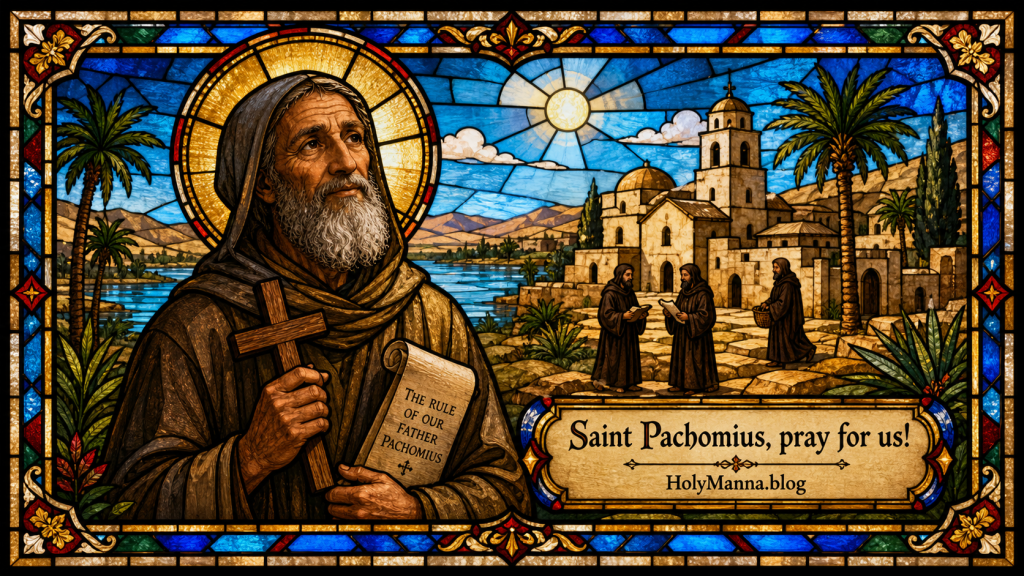
The Desert Father Who Taught Monks to Become Family
Saint Pachomius the Great is one of those saints who quietly changed the entire shape of Christian history. He was not a pope, not a bishop, not a martyr, and not even a priest. He was a former pagan soldier from Egypt who became a monk, then a spiritual father, then one of the great architects of Christian religious life.
He is most known as the father of cenobitic monasticism, which means monastic life lived in community under a rule. Saint Anthony the Great showed the Church the beauty of the solitary desert hermit. Saint Pachomius showed the Church the beauty of brothers living together, praying together, working together, obeying together, and learning holiness through daily charity.
That may sound simple, but it was revolutionary. Pachomius helped turn the desert into a school of communal sanctity. His monasteries became places where men learned that holiness was not only found in dramatic isolation, but also in patience with difficult brothers, obedience to a rule, silence before God, humble work, love for the sick, and perseverance when the spiritual life felt dry.
This is why his life fits so beautifully with The Catechism of the Catholic Church, which teaches that the consecrated life belongs deeply to the holiness of the Church: “The state of life which is constituted by the profession of the evangelical counsels… belongs undeniably to her life and holiness.” CCC 914
Saint Pachomius reminds the Church that holiness is not a private hobby. It is a life offered to God, formed in discipline, strengthened by community, and poured out in love.
The Pagan Soldier Who Was Converted by Christian Mercy
Pachomius was born around A.D. 292 in Upper Egypt, in the region known as the Thebaid. He was born into a pagan family and grew up in a world filled with the old religious customs of Egypt. Yet even before his conversion, tradition remembers him as a young man with a meek and modest spirit, someone not easily swept up by the superstitions and excesses around him.
When he was about twenty or twenty-one years old, Pachomius was forced into military service. This was not a romantic call to adventure. He and other young recruits were taken against their will and confined during their journey. While they were held at Thebes, hungry and mistreated, something happened that changed the course of his life.
Local Christians came to help them. These Christians brought food, money, and comfort to men they did not know. They did not ask whether the soldiers could repay them. They did not ask whether they were already Christian. They simply saw suffering men and loved them for the sake of Christ.
Pachomius was stunned. He asked who these people were. When he learned that they were Christians, and that they did these works of mercy because they served the God of heaven and earth, his heart began to open.
This is one of the most powerful details in his entire story. Pachomius was not first converted by a clever argument. He was not won over by a public debate. He was touched by charity. Ordinary Christians fed hungry strangers, and that mercy became the doorway to his conversion.
After his release from military service, Pachomius entered the catechumenate and was baptized. One prayer associated with him captures the sincerity of his conversion: “O God, Creator of heaven and earth, cast on me an eye of pity: deliver me from my miseries: teach me the true way of pleasing you, and it shall be the whole employment, and most earnest study of my life to serve you, and to do your will.”
That prayer reveals the heart of Saint Pachomius. He did not want Christianity as a decoration. He wanted a whole new life. He wanted to know how to please God.
After baptism, he placed himself under the guidance of a holy desert hermit named Palemon, also spelled Palamon. Palemon did not sugarcoat the ascetic life. He warned Pachomius that the life was severe, filled with fasting, vigils, prayer, Scripture meditation, manual labor, and little sleep. Pachomius accepted the discipline.
This detail matters. Pachomius did not immediately decide that he was ready to lead others. First, he became a disciple. Before he became a father of monks, he learned how to be a son.
When the Desert Became a Monastery
Under Palemon, Pachomius learned the hard beauty of the desert. He prayed, worked, fasted, kept vigil, and learned to discipline his body so that his soul could become more free for God. He was not chasing suffering for its own sake. He was learning how to belong entirely to Christ.
At a deserted place called Tabennisi, near the Nile, Pachomius experienced the call that would define his mission. Tradition says that he heard a divine command to remain there and build a monastery. A traditional version of the message says: “Very many eager to embrace the monastic life will come hither to thee.”
There is also a famous story that an angel appeared to Pachomius and gave him instructions for how the monks should live. This is one of the best-known legends connected with him. Catholic tradition has preserved the story, but it should be treated as a hagiographical tradition rather than as a detail that can be fully verified in every form. The deeper truth of the story is clear: Pachomius believed his monastic mission came from God, and his communities were meant to live according to heavenly order, not personal preference.
With the blessing and help of Palemon, Pachomius began building at Tabennisi. His first companion was his own brother, John. Others soon came. Eventually, the community grew so much that more monasteries were founded, including the important monastery at Pbow.
This was the beginning of a new kind of Christian life. Monks no longer lived only as scattered hermits. Under Pachomius, they lived in community. They prayed together, worked together, ate together, learned obedience together, kept silence together, and submitted to a common rule.
That sounds peaceful until real human nature enters the room. Community life reveals impatience. It exposes pride. It tests humility. It uncovers selfishness. Pachomius understood that living with others could be a kind of desert all its own.
A solitary monk might battle demons in the wilderness. A community monk also battles the irritation that rises when a brother annoys him at dinner, interrupts his work, misunderstands him, corrects him, or needs mercy at an inconvenient time.
That is why Pachomius’s vision was so powerful. He showed that Christian community can become a furnace of holiness.
The Rule, the Work, and the Holy Silence
The Rule of Saint Pachomius organized the daily life of the monks with discipline and charity. His monks lived simply. They wore rough garments, practiced silence, worked with their hands, prayed the psalms, meditated on Scripture, fasted, and gathered for the sacred mysteries. The Eucharist remained central to their life, even though Pachomius himself was not a priest.
His monks worked constantly, and they were expected to keep their minds turned toward God. Scripture was not something they only heard once a week. It was meant to fill the memory, shape the imagination, and guide the whole day. They sang psalms during work and meditated on the Word of God as they moved from one task to another.
There was also a striking discipline of silence. The monks were so committed to guarding their speech that they used signs to ask for necessities. This was not because speech is evil. It was because careless speech can easily become vanity, gossip, complaint, or distraction.
Saint Pachomius also understood that discipline must be joined to wisdom. His rule was strict, but not cruel. The monks’ fasting and labor were adjusted according to strength. The weak and sick were not rejected simply because they could not endure the same austerities as stronger men. Pachomius knew that holiness is not proven by crushing the weak. Holiness is proven by charity.
His own asceticism was severe. Tradition says he wore haircloth, slept sitting up for many years, and never ate a full meal after his conversion. Yet he did not demand identical austerity from everyone. He carried burdens patiently and helped others grow according to their capacity.
That balance is very Catholic. The spiritual life is not laziness, but it is also not prideful harshness. Grace builds discipline, and discipline must always serve charity.
A Father to Monks, Virgins, Sinners, and the Weak
Saint Pachomius did not only form monasteries for men. One of the most important parts of his legacy is connected to his sister. When she came wanting to see him, he preserved the enclosure and did not casually break the discipline of the monastery. But when he learned that she desired the religious life, he arranged for a women’s monastery on the other side of the Nile.
This is a beautiful and sometimes overlooked part of his story. Pachomius helped nurture organized women’s consecrated life as well as men’s monastic life. His mission was not simply to create a brotherhood of monks. It was to help souls belong more completely to God.
His fatherly heart is also seen in the story of Silvanus, a former actor who entered the monastery to do penance. Silvanus did not immediately become a model monk. He behaved foolishly and struggled with discipline. Some of the brothers wanted him expelled. Pachomius, however, corrected him with patience, prayed for him, wept for him, and refused to give up too quickly.
Eventually, Silvanus repented deeply and became a model of humility.
That story reveals the heart of Saint Pachomius. He was not soft on sin, but he was patient with sinners. He knew that conversion can take time. He knew that a soul being remade by grace may need correction, mercy, structure, and someone willing to keep hoping.
Another famous story tells of a monk who made two mats instead of one and displayed them so Pachomius would notice his hard work. Pachomius saw through the action. The work itself was good, but the desire to be admired was spiritually dangerous. He said: “This brother hath taken a great deal of pains from morning till night, to give his work to the devil.”
That is a sharp line, but it is spiritually brilliant. Even good works can become poisoned by vanity. Even religious effort can become self-display. Pachomius teaches that the question is not only, What was done? The deeper question is, For whom was it done?
Miracles in the Desert
Many miracles and spiritual gifts are associated with Saint Pachomius in Catholic hagiographical tradition. These stories should be received with reverence, while also recognizing that many come from ancient lives of the saints rather than modern historical documentation.
Tradition says that Pachomius sometimes spoke Greek or Latin miraculously, even though he had never learned those languages. This gift would have allowed him to communicate beyond the limits of his natural education. He was also said to have healed the sick and delivered people afflicted by demons through blessed oil.
One story tells of a woman suffering from a long hemorrhage who touched his cowl in faith and was healed. This story clearly echoes the Gospel account of the woman who touched the garment of Christ and was cured. Whether every detail can be historically verified or not, the spiritual meaning is unmistakable. The saints do not heal by their own power. Christ heals through His servants.
Other stories describe exorcisms connected with blessed oil or blessed bread. In these accounts, people afflicted by evil spirits were delivered through the prayer and blessing associated with Pachomius. These stories cannot all be verified in the modern sense, but they belong to the ancient tradition surrounding his sanctity.
He was also remembered as having the gift of prophecy. He is said to have foretold a decline in monastic fervor in later generations. That warning still feels painfully relevant. Every generation begins with fire and then must fight against comfort, routine, tepidity, and spiritual forgetfulness.
There is also a tradition that associates Saint Pachomius with the early use of the prayer rope as an aid for repeated prayer. This tradition cannot be stated as absolutely certain, since other traditions connect the prayer rope with Saint Anthony and other desert figures. Still, it shows how strongly Pachomius is remembered as a man who helped ordinary monks persevere in prayer through structure, repetition, and discipline.
Trials Without Martyrdom
Saint Pachomius was not a martyr. He did not die by execution for the faith. Yet his life was filled with hardship.
He endured forced military service as a young man. He embraced the severe discipline of the desert. He experienced the death of his brother John. He carried the burdens of leadership as thousands of monks came under his spiritual care. He corrected the proud, encouraged the weak, guided the confused, and bore the weight of governing communities filled with real human beings.
He also faced accusations. In 348, he was called before a council of bishops at Latopolis to answer charges brought against him. Tradition says he responded with such humility that the bishops admired him. This moment shows the Catholic spirit of his holiness. Pachomius did not place himself above the Church. He submitted himself to ecclesial authority.
He also opposed Arianism, the heresy that denied the full divinity of Christ. This places Pachomius within the great Catholic struggle for the truth of who Jesus is. He was visited by Saint Athanasius, the heroic defender of Nicene orthodoxy. Pachomius’s monastic life was not vague spirituality. It was rooted in the true faith of the Church.
Another surprising fact is that Pachomius refused priestly ordination. He served the Church humbly, but he did not seek clerical status. He preferred that his monks not chase ordination either, unless it served the needs of the Church. His monasteries received priests for the sacraments, but Pachomius himself remained a monk and abbot.
Near the end of his life, a plague struck his communities and carried off many monks. Pachomius himself became ill. Tradition says he suffered patiently for forty days, encouraged his monks, appointed a successor, made the sign of the cross, and died on May 9, around A.D. 346 to 348. The Vatican tradition commonly gives the year as 348.
His death was not martyrdom by blood, but it was a final offering of patience, obedience, and fatherly love.
The Saint Whose Monasteries Outlived Empires
Ancient Catholic sources emphasize miracles during Pachomius’s lifetime more than specific posthumous miracles after his death. No widely verified Catholic tradition of particular posthumous healings is commonly attached to him in the same way it is with some other saints. That should be said plainly. The miracle most clearly visible after his death is the astonishing endurance of his spiritual legacy.
By the time he died, Pachomius had founded multiple monasteries for men and women. Some traditions count nine monasteries for men and two for women. Thousands of monks lived under the Pachomian way. His rule and model influenced Christian monasticism far beyond Egypt.
Saint Jerome translated the Rule of Pachomius into Latin, helping carry his influence into the Western Church. Saint Basil in the East and Saint Benedict in the West were both influenced by the tradition of ordered communal monastic life that Pachomius helped pioneer. That means his fingerprints are found across the history of Catholic religious life, from ancient Egypt to medieval Europe and beyond.
The cultural impact is enormous. Monasteries preserved Scripture, copied manuscripts, cultivated prayer, taught discipline, served the poor, educated Christians, and shaped Catholic civilization. Pachomius did not do all of that by himself, of course, but he helped create one of the forms of life that made it possible.
His feast day is celebrated in the Catholic Church on May 9. He is honored as one of the great fathers of monastic life and especially as the father of monks living in community. In art, he may be shown in the clothing of a desert monk. There is also a legendary image of him crossing the Nile on the back of a crocodile. This story cannot be verified as historical, but it became part of the symbolic imagination around him. It points to the Egyptian setting of his life, the dangers of the Nile, and the belief that God protected His servant.
His memory remains especially important for monks, religious communities, and anyone trying to live holiness with other people. That last part matters. Most Christians are not called to a monastery, but almost everyone is called to some kind of common life. Family life, parish life, marriage, friendship, work, and ministry all reveal whether charity is real.
The Holiness of Living With Other People
Saint Pachomius teaches a lesson that modern Christians badly need. Holiness is not proven only in private prayer. It is proven in the way a person treats the people nearby.
It is easy to love an idea of humanity. It is harder to love the brother who talks too much, the sister who needs patience, the coworker who irritates, the family member who misunderstands, or the parishioner who does things differently.
Pachomius built communities because he understood that God forms souls through shared life. Prayer matters. Fasting matters. Silence matters. Scripture matters. The Eucharist matters most of all. But charity is tested in community.
The Catechism of the Catholic Church teaches that religious life is a gift received from Christ and offered for the good of the Church. It says: “Religious life derives from the mystery of the Church. It is a gift she has received from her Lord.” CCC 926 Saint Pachomius stands near the root of that gift.
His life invites Christians to ask serious questions. Is faith visible in acts of mercy, the way it was visible in the Christians who fed Pachomius? Is work done for God, or secretly for applause? Is community treated as a burden, or as a place where Christ is forming patience? Is discipline used to grow in love, or to feel superior to others?
Saint Pachomius also gives hope to anyone who came to faith later, anyone who has a complicated past, and anyone who wonders whether ordinary charity really matters. He was converted because Christians fed hungry prisoners. No act of mercy is small when God is inside it.
The lesson is simple and demanding. Pray faithfully. Work humbly. Speak carefully. Serve quietly. Submit to the Church. Be patient with weakness. Correct with love. Receive correction with humility. Let community become a school of holiness.
Engage with Us!
Share your thoughts and reflections in the comments below. Saint Pachomius gives so much to ponder, especially for anyone trying to grow in holiness while living, working, worshiping, and serving alongside others.
- Where is God using community to teach patience, humility, and charity right now?
- What ordinary act of mercy might become someone else’s doorway back to Christ?
- Is there any good work that has quietly become mixed with vanity or the desire to be noticed?
- How can silence, Scripture, prayer, and disciplined work become more present in daily life?
- What would it look like to treat family, parish, work, or ministry as a kind of monastery where God forms the heart?
Saint Pachomius shows that holiness can grow in the desert, but it can also grow at the dinner table, in the workplace, in a parish meeting, beside the sick, and among imperfect people learning to love one another. May his example encourage every soul to live with faith, practice mercy, and do everything with the love and compassion Jesus taught His Church.
Saint Pachomius, pray for us!
Follow us on YouTube, Instagram and Facebook for more insights and reflections on living a faith-filled life.

 Holy Manna!
Leave a comment