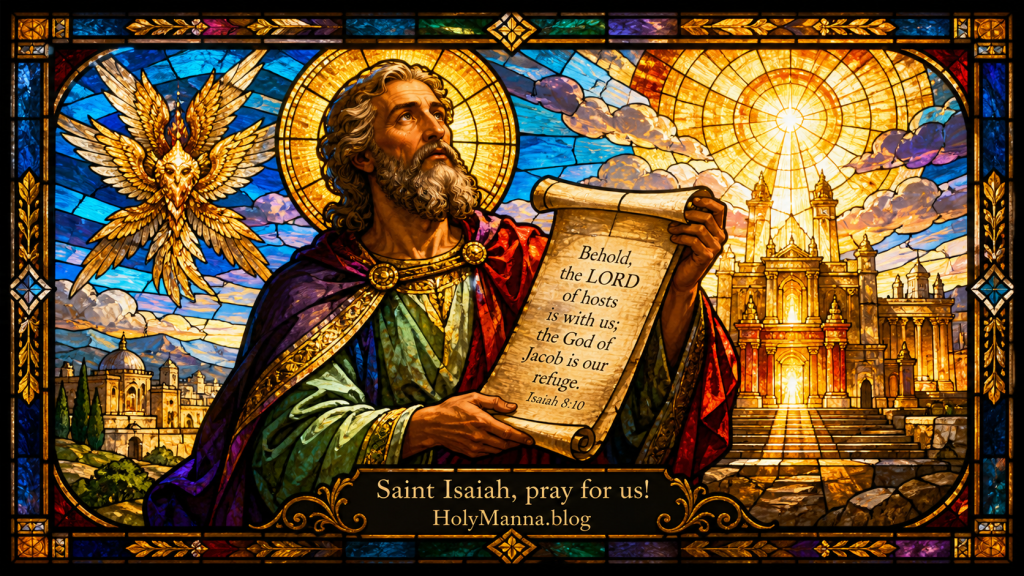
The Prophet Who Saw the Holy One
Saint Isaiah, also called Isaias in older Catholic writings, is one of the greatest prophets of the Old Testament and one of the most powerful witnesses to the coming of Christ. Long before Bethlehem, Calvary, and the empty tomb, Isaiah spoke of Emmanuel, the suffering Servant, the light to the nations, and the holiness of the Lord.
The Catholic Church honors Isaiah as a saint, not as a distant religious figure from another world, but as one of God’s chosen servants who prepared Israel for the coming of the Messiah. The Catechism of the Catholic Church teaches that the prophets and other Old Testament figures “have been and always will be honoured as saints in all the Church’s liturgical traditions” CCC 61. That means Isaiah belongs to the family of saints, and his voice still teaches the Church how to pray, repent, worship, and hope.
He is most known for his vision of God in the Temple, his call to holiness and justice, his prophecies of Christ, and the heavenly hymn that Catholics still pray at every Mass: “Holy, holy, holy is the LORD of hosts!” Isaiah 6:3.
Born for a Time of Fear and Unfaithfulness
Isaiah lived in Judah in the eighth century before Christ. He was the son of Amoz, not the prophet Amos, though the names are easy to confuse. Catholic tradition and older biblical scholarship often describe Isaiah as a man of noble or prominent background, likely connected to Jerusalem and familiar with the royal court. His language, confidence, and access to kings all suggest that he was educated and respected.
He was married, and Scripture calls his wife “the prophetess.” He had at least two sons, Shear-jashub and Maher-shalal-hash-baz, whose names carried prophetic meaning. In Isaiah’s world, even family life could become a living sign from God.
Isaiah began his prophetic ministry in the year King Uzziah died, around 742 B.C. He served during the reigns of Uzziah, Jotham, Ahaz, and Hezekiah. These were dangerous days. Assyria was rising like a storm. The northern kingdom of Israel was moving toward destruction. Judah’s rulers were tempted to trust in military alliances, political strategies, and pagan powers instead of trusting the Lord.
That is where Isaiah enters the story. He was not sent to flatter kings or comfort people in their sins. He was sent to wake up a frightened nation and remind them that the Lord alone is holy, faithful, and mighty to save.
The Burning Coal and the Courage to Say Yes
The defining moment of Isaiah’s life came in the Temple. He saw the Lord seated upon a high and lofty throne, with the train of His garment filling the sanctuary. Seraphim cried out before Him, “Holy, holy, holy is the LORD of hosts! All the earth is filled with his glory!” Isaiah 6:3.
Isaiah did not respond with pride. He did not say, “Finally, God has chosen the right man.” He saw God’s holiness and immediately saw his own unworthiness. He cried, “Woe is me, I am doomed! For I am a man of unclean lips” Isaiah 6:5.
Then one of the seraphim touched his mouth with a burning coal taken from the altar, saying that his sin had been purged. Only after being purified did Isaiah hear the Lord ask, “Whom shall I send? Who will go for us?” Isaiah answered with one of the most famous responses in all of Scripture: “Here I am… send me!” Isaiah 6:8.
That moment reveals the heart of every true vocation. God does not call the perfect. He purifies the willing. Isaiah’s mission began with humility, repentance, worship, and obedience.
The Prophet of Holiness, Justice, and Trust
Isaiah’s message was not soft, but it was merciful. He condemned empty religious practice, hypocrisy, pride, idolatry, corruption, injustice, and the neglect of the poor. He warned that sacrifices and prayers mean nothing when people refuse conversion. Through Isaiah, God called His people to wash themselves clean, stop doing evil, learn to do good, seek justice, and defend the vulnerable.
This is deeply Catholic. Worship and moral conversion belong together. Prayer cannot be separated from justice. The Eucharist cannot be treated as a religious decoration while the heart remains hard. Isaiah’s preaching points toward the Catholic understanding that true worship must shape the whole person.
He also challenged kings. When King Ahaz feared political disaster, Isaiah told him to trust the Lord rather than panic. His warning still feels painfully relevant: “Unless your faith is firm, you shall not be firm!” Isaiah 7:9.
That is Isaiah in one sentence. When faith collapses, everything else becomes unstable.
The Prophet Who Pointed to Christ
Isaiah is sometimes called the “Fifth Evangelist” because his prophecies speak so clearly of Christ. This does not mean Isaiah wrote one of the four Gospels. It means that the Church has long heard in Isaiah’s words the voice of one who announced the mystery of Jesus centuries before the Incarnation.
Through Isaiah, God gave the prophecy of Emmanuel: “The virgin shall be with child, and bear a son, and shall name him Emmanuel” Isaiah 7:14. The Church reads this in the light of Christ and the Virgin Mary. The Catechism teaches that Mary’s virginal motherhood fulfills the divine promise given through Isaiah, that a virgin would conceive and bear a son CCC 497.
Isaiah also foretold the child born for us, the shoot from the stump of Jesse, the servant who would bring justice to the nations, and the suffering Servant who would bear the sins of many. The Church sees these prophecies fulfilled in Jesus Christ. The Catechism teaches that Jesus’ redemptive death fulfills Isaiah’s prophecy of the suffering Servant CCC 601.
This is why Isaiah fills the Church’s liturgical life. Advent listens to him with longing. Christmas hears him with joy. Holy Week reads him with tears. Every Mass echoes his vision when Catholics pray the Sanctus: “Holy, Holy, Holy Lord God of hosts.”
Signs, Wonders, and Miracles During His Life
The miracles associated with Isaiah are not magic tricks or displays of personal power. They are works of God announced through His prophet.
One of the greatest miracles connected to Isaiah is the deliverance of Jerusalem from the Assyrians. During the reign of King Hezekiah, the Assyrian army threatened Jerusalem, and humanly speaking, the city seemed doomed. Hezekiah turned to the Lord, and Isaiah gave him God’s word of hope. Jerusalem would not fall. Scripture records that the angel of the Lord struck down the Assyrian camp, and the enemy withdrew. Sirach later praised this event, saying that God saved His people through Isaiah Sirach 48:20-22.
Isaiah was also connected to the healing of King Hezekiah. When Hezekiah became gravely ill, Isaiah first told him to set his house in order because death was near. But Hezekiah prayed and wept before the Lord. God then sent Isaiah back with a message of mercy. The Lord had heard the king’s prayer, seen his tears, and would add fifteen years to his life. As a sign, the shadow on the stairway of Ahaz moved backward. Sirach remembers this wonder by saying that Isaiah “turned back the sun” and prolonged the king’s life Sirach 48:23.
Another unforgettable sign from Isaiah’s life was stranger and more uncomfortable. At God’s command, Isaiah walked naked and barefoot for three years as a prophetic sign against Egypt and Ethiopia Isaiah 20:2-4. This was a warning to Judah not to place its hope in foreign powers. It reminds the Church that the prophets did not simply preach with words. Sometimes their whole lives became the sermon.
A Prophet Who Suffered for the Truth
Isaiah’s mission was not easy. He spoke to people who often did not want to listen. He challenged rulers who preferred political calculation over faith. He exposed religious hypocrisy. He warned of judgment. He told uncomfortable truths in a culture that wanted reassurance without repentance.
Scripture does not record the details of Isaiah’s death. However, ancient tradition says he suffered martyrdom under the wicked King Manasseh. According to this tradition, Isaiah was condemned and sawn in two. Some early Christian writers connected this with Hebrews 11:37, which speaks of the faithful who “were sawed in two”.
Because Scripture itself does not give the account, it should be treated carefully as ancient tradition rather than a directly verified biblical event. Still, the tradition is old, widespread, and deeply fitting with the life of a prophet who gave everything to speak God’s word.
A more detailed version of the story says Isaiah hid inside a hollow tree or log and was then sawn apart. That detail comes from later legendary tradition and cannot be historically verified. Even so, the spiritual meaning is clear. Isaiah’s witness was costly. He belonged to that long line of faithful servants who would rather suffer than betray the truth.
The Saint Whose Legacy Filled the Church
After Isaiah’s death, his legacy only grew. The book that bears his name became one of the most important books of the Old Testament for the Christian understanding of Jesus. The Gospels, the Apostles, the Fathers of the Church, and the liturgy all return to Isaiah again and again.
His words shape Advent. They prepare the heart for Emmanuel. His prophecies shape Christmas, especially the joy of the child born for us. His Servant Songs shape Holy Week, especially the Church’s meditation on Christ’s Passion. His vision of heavenly worship shapes the Mass itself.
A tradition also says that Isaiah’s tomb was once venerated in Paneas in northern Palestine and that his relics were later taken to Constantinople in the fifth century. As with many ancient relic traditions, this should be received as tradition rather than treated as something that can be fully verified today.
Isaiah is commemorated in the current Roman Catholic saint listings on May 9, though older Catholic references sometimes list July 6. Byzantine Catholic tradition also honors him on May 9 and remembers him as a prophet and martyr.
His cultural impact is enormous. He appears in icons, church art, sacred music, Advent hymns, Christmas readings, Passiontide liturgy, and the imagination of Christian civilization. In sacred art, he is often shown holding a scroll with the Emmanuel prophecy. In the Sistine Chapel, Michelangelo included him among the great prophets who prepared the world for Christ.
The Lesson Isaiah Still Teaches
Saint Isaiah teaches that holiness is not optional. God is not one voice among many. He is the Holy One. When Isaiah saw Him, everything changed.
He also teaches that worship without conversion becomes hollow. A person can say prayers, attend religious services, and use holy language while still refusing justice, humility, mercy, and repentance. Isaiah would not let God’s people hide behind religious appearances. That is a hard message, but it is a healing one.
Most of all, Isaiah teaches hope. Not cheap optimism. Not pretending everything is fine. Real hope. The kind of hope that looks at sin, war, corruption, fear, exile, suffering, and death, then still says that God is faithful.
For Catholics, Isaiah’s hope finds its fulfillment in Jesus Christ. The child born of the Virgin, the light to the nations, the suffering Servant, and the King whose kingdom has no end are all fulfilled in Him.
Where is God asking for firmer faith instead of fear? Where has worship become routine instead of transformative? Where is the Lord inviting the heart to say, like Isaiah, “Here I am… send me!”?
Engage With Us!
Share your thoughts and reflections in the comments below. Saint Isaiah’s life gives us so much to think about, especially when faith feels difficult, culture feels unstable, and trusting God feels harder than trusting our own plans.
- What part of Isaiah’s story speaks most clearly to your own faith right now?
- Do you find it easier to trust God, or to rely on control, comfort, politics, money, or personal plans?
- What might God be asking to purify in your life before sending you on mission?
- How can Isaiah’s words, “Here I am… send me!”, become part of your own prayer?
- Where do you need to remember that Jesus is Emmanuel, God with us, even when life feels uncertain?
May Saint Isaiah help every soul listen more deeply, repent more honestly, worship more reverently, and hope more courageously. Let his witness remind us to live a life of faith, to trust the Holy One in every trial, and to do everything with the love and mercy Jesus taught us.
Saint Isaiah, pray for us!
Follow us on YouTube, Instagram and Facebook for more insights and reflections on living a faith-filled life.


Leave a comment