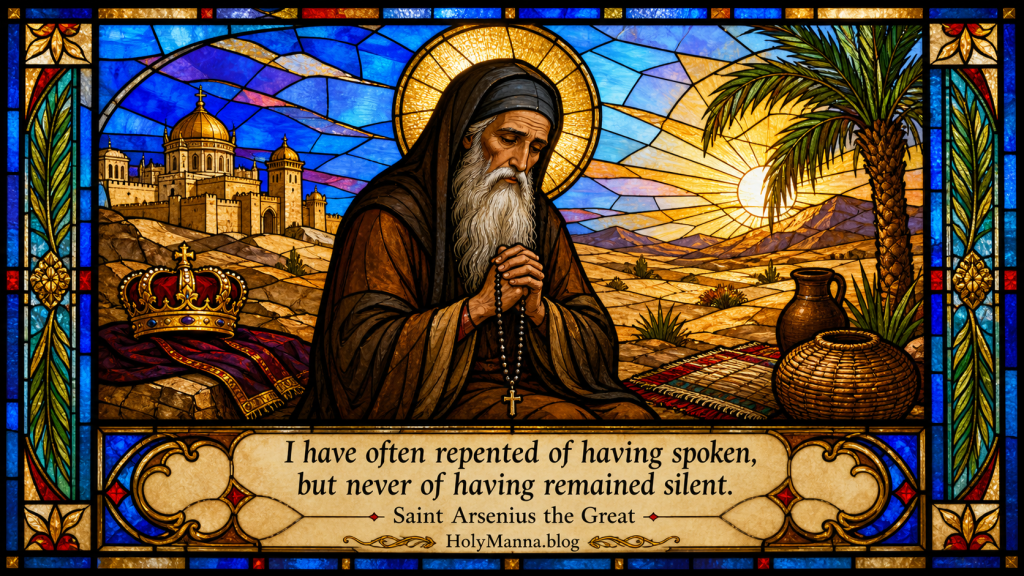
The Tutor of Emperors Who Learned the Silence of God
Saint Arsenius the Great is one of those saints whose life feels almost impossible to imagine today. He had power, education, status, connections, and a future that most people would envy. He was a Roman nobleman, a deacon of the Church, and the trusted tutor of imperial princes. He lived close to the center of earthly power in Constantinople.
Then he walked away.
Not because he hated the world, and not because creation was bad, but because he heard God calling him to something more hidden, more severe, and more total. Arsenius left the imperial court and entered the Egyptian desert, where he became one of the great Desert Fathers. He is remembered especially for silence, humility, prayer, tears of repentance, and radical detachment from worldly honor.
His life beautifully reflects what The Catechism of the Catholic Church teaches about hermits, who give their lives to God in “the silence of solitude”, prayer, and penance, revealing the hidden heart of the Church’s intimacy with Christ, CCC 921.
Saint Arsenius teaches a lesson that every generation needs, but maybe especially ours: the soul cannot hear God clearly when it is constantly chasing noise, attention, and approval.
From Rome to the Imperial Court
Saint Arsenius was born around the year 354 in Rome, into a noble and well-educated family. Catholic tradition remembers him as a man of impressive learning, trained in Greek and Latin literature, and formed in both sacred and classical studies. He is also traditionally described as a deacon of the Roman Church.
Because of his education and character, Arsenius was chosen for a rare and prestigious role. Emperor Theodosius the Great wanted someone to educate his sons, Arcadius and Honorius, who would later become emperors. According to Catholic tradition, Pope Saint Damasus helped recommend Arsenius for this responsibility. Around the year 383, Arsenius went to Constantinople and became tutor to the imperial princes.
There is a famous story from his time at court. One day, Emperor Theodosius found his sons sitting while Arsenius stood to instruct them. The emperor corrected this immediately. The teacher, he said, should sit, and the princes should stand before him. It was a striking reminder that wisdom and virtue are greater than royal blood.
But even surrounded by honor, Arsenius became restless. He had influence, comfort, and prestige, but his heart longed for God alone. In prayer, he heard the famous call: “Arsenius, flee the company of men, and thou shalt be saved.”
So he fled.
He left Constantinople secretly and traveled to Egypt, where he entered the desert of Scetis, one of the great centers of early Christian monastic life. The man who once formed emperors now desired to be formed by monks.
This was not a conversion from paganism to Christianity. It was a deeper conversion within the Christian life, a movement from honor to humility, from public influence to hidden prayer, from worldly greatness to the greatness of the saints.
The Silence That Became His Sermon
When Arsenius arrived in the desert, he placed himself under the guidance of Saint John the Dwarf, also known as Saint John the Short. The desert monks did not care that Arsenius had been a famous tutor at court. In the desert, the question was not, “Who do people think you are?” The question was, “Are you humble enough to become holy?”
Saint John tested him. During a meal, he ignored Arsenius and left him standing while the others ate. Then he threw a piece of bread on the ground and told Arsenius to eat if he wished. Arsenius quietly sat on the ground and ate the bread.
Saint John saw that this former nobleman was ready for the desert. Arsenius had begun to learn the first lesson of holiness: humility.
One of the most beautiful stories about him comes from his own awareness that education and holiness are not the same thing. When people wondered why such a learned Roman would seek wisdom from simple Egyptian monks, Arsenius said that although he knew Greek and Latin learning, he had not yet learned the alphabet of the wisdom possessed by those holy men.
That line says so much. Arsenius was brilliant, but he knew brilliance could not save him. He needed grace. He needed humility. He needed God.
His life in the desert was severe. He prayed for long hours, fasted, worked with his hands, and lived in poverty. He made mats from palm leaves, like many of the desert monks. One famous penitential practice says that he refused to change the water he used to soak the palm leaves. As the water became foul-smelling, he endured it as penance for the perfumes and luxuries he had enjoyed in the imperial court.
He became especially known for tears of repentance. Catholic tradition says he wept so often during prayer that he kept a cloth nearby to wipe his eyes. These were not dramatic tears for attention. They were the tears of a man who had seen the vanity of the world and the mercy of God.
The miracles associated with Arsenius during his earthly life are not usually public healings or spectacular signs. His wonders were quieter, more desert-like. The divine voice that called him into solitude, his victory over temptation, his gift of tears, his spiritual wisdom, and his transformation from court official to hidden monk are the kinds of miracles that reveal what grace can do inside a soul.
Some traditions also speak of visions and angelic assistance during his struggles with temptation. These stories belong to the spiritual world of the Desert Fathers and should be received as pious traditions meant to teach perseverance, humility, and trust in God.
His most famous saying is still powerful today: “I have often repented of having spoken, but never of having remained silent.”
That is not a command to be cold, rude, or distant. It is a warning that careless speech can wound the soul. Arsenius knew that silence, when filled with prayer, can become a shelter where God purifies the heart.
A White Martyrdom in the Desert
Saint Arsenius was not a martyr in the bloody sense. He was not executed for the faith. But his life was a kind of white martyrdom, a daily dying to comfort, praise, control, and self-importance.
He faced hardship through asceticism, solitude, spiritual warfare, and instability. He had once lived in imperial comfort, but in the desert he chose poverty. He had once held the attention of princes, but in the desert he avoided human praise. He had once taught in the court of emperors, but in the desert he became a disciple.
There were also real dangers. The monastic settlements of Scetis were attacked more than once by raiders. Arsenius eventually had to leave Scetis because of violence and insecurity. He lived in different places, including near Troe, also called Petra, and later near Canopus, before returning toward Troe near the end of his life.
He also suffered the burden of his own reputation. People wanted to visit him because he was famous for holiness. Noble women, clergy, and even imperial figures desired access to him. One story says Saint Melania the Elder traveled to see him, but Arsenius responded with severity, because he feared that too many visitors would disturb his solitude and make him spiritually proud. This can sound harsh to modern ears, but in the desert tradition it shows how seriously he guarded his vocation.
Another famous story says that Emperor Arcadius later wanted Arsenius to return, advise him, or administer money for the poor and the monasteries. Arsenius refused. He knew that even good works, if not part of one’s vocation, can become a temptation away from God’s will.
There is also a story that a relative left Arsenius a large inheritance. Arsenius rejected it, saying: “I died before him.” In other words, he had already died to the world when he became a monk.
That is classic Arsenius. Severe, direct, and unforgettable.
Near the end of his life, his disciples saw him weeping and asked if he was afraid of death. He admitted that a holy fear had accompanied him since he entered the monastic life. This is deeply human and deeply Catholic. Arsenius trusted God, but he never treated salvation casually. He lived with reverence before judgment, mercy, and eternity.
He died around the year 449 or 450, at about ninety-five years old. Before his death, he asked to be remembered at the Holy Sacrifice of the Mass. This is a beautiful Catholic detail. Even a great saint desired the prayers of the Church. The Catechism of the Catholic Church teaches that the communion of saints unites the faithful on earth, the souls being purified, and the blessed in heaven, CCC 946 to 962. Arsenius knew that no Christian is saved alone. We belong to Christ, and in Christ, we belong to one another.
The Saint Who Still Teaches Silence
After his death, Saint Arsenius became one of the great models of the eremitic life. His sayings were preserved in the tradition of the Desert Fathers, especially in collections like The Sayings of the Desert Fathers. He was remembered not because he founded a great institution, but because he became a living icon of silence, repentance, and humility.
His disciples, including Alexander, Zoilus, and Daniel, helped preserve his memory. Later monks looked to him as a model of prayer, detachment, and holy fear of God. Saints and spiritual writers continued to present him as one of the great examples of desert holiness.
There are also posthumous miracle traditions connected to his devotion. In the Italian town of Sant’Arsenio, in the province of Salerno, he is venerated as a patron. A local tradition says that on May 14, 1857, a wooden statue of Saint Arsenius began to exude liquid, and a faded cloth flower in the statue’s hand regained its color. The event reportedly drew crowds and was notarized, though natural explanations were also proposed. The story remains part of local devotion, but it cannot be verified with complete certainty.
Another local legend says that the sculptor Giacomo Colombo left the face of a statue of Saint Arsenius unfinished overnight, only to find it completed the next day. Devotees interpreted this as divine intervention. This story is best understood as a devotional legend and cannot be historically verified.
The town of Sant’Arsenio continues to honor him as patron, with devotion especially associated with July 19. In other Catholic and Eastern Christian traditions, his commemoration may appear on different dates, including May 8. This variation is not unusual for ancient saints, especially those honored across East and West.
Saint Arsenius’s cultural impact is strongest in monastic spirituality. He stands as one of Christianity’s great witnesses to silence. In a loud world, he still feels strangely modern. He reminds Catholics that not every holy life is public, not every mission is visible, and not every soul is called to constant activity.
Sometimes the greatest sermon is a life hidden with Christ.
Learning to Be Quiet Enough for God
Saint Arsenius can feel intimidating. Most Catholics are not called to leave their families, jobs, parishes, and responsibilities to live alone in the desert. The Church does not ask every Christian to imitate the exact lifestyle of a hermit. But every Catholic can learn from his virtues.
He teaches that silence is not emptiness. Silence can be love. Silence can be repentance. Silence can be the place where the heart finally stops performing and starts listening.
He also teaches that worldly success is not the same as holiness. Arsenius had what many people spend their lives chasing. He had status, education, access, and influence. Yet he discovered that none of those things could satisfy the soul if they became substitutes for God.
His life also challenges the modern addiction to attention. Many people today feel pressure to be seen, heard, followed, liked, and praised. Arsenius reminds the Church that hiddenness can be holy. A quiet life lived faithfully before God is not wasted.
For practical daily life, Catholics can imitate Saint Arsenius by creating small spaces of silence. Put the phone away for ten minutes. Sit before a crucifix. Pray slowly. Make a good examination of conscience. Go to Confession regularly. Be slower to speak when angry. Refuse gossip. Choose humility when pride wants the last word.
His famous saying is worth carrying into daily life: “I have often repented of having spoken, but never of having remained silent.”
That does not mean Catholics should avoid truth or charity. It means speech should be purified by love. Saint Paul reminds us in Ephesians 4:29, “Let no evil talk come out of your mouths, but only such as is good for edifying.” Arsenius lived that verse with desert intensity.
Where might God be inviting you to practice silence today?
What noise has become normal in your life, even though it keeps your heart restless?
What would change if your words became fewer, gentler, and more rooted in prayer?
Saint Arsenius the Great is not simply a saint of the past. He is a needed teacher for a distracted age. He points us back to the hidden room of the heart, where God waits, where mercy heals, and where the soul learns that being known by Christ is greater than being admired by the world.
Engage With Us!
Share your thoughts and reflections in the comments below. Saint Arsenius lived a life that feels very different from modern life, but his witness speaks powerfully to our world of noise, distraction, and constant attention-seeking.
- What part of Saint Arsenius’s life challenges you the most?
- Do you find silence peaceful, uncomfortable, or difficult? Why do you think that is?
- Where in your daily life could you create more room for prayer and quiet with God?
- How can Saint Arsenius’s humility help you resist pride, comparison, or the desire to be noticed?
- What is one conversation, habit, or distraction that might become holier if you practiced more silence?
May Saint Arsenius the Great pray for us, that we may seek God above praise, choose humility over vanity, and learn to speak only with love. Let us live a life of faith, doing all things with the love and mercy Jesus taught us, so that even our silence may become a prayer.
Saint Arsenius the Great, pray for us!
Follow us on YouTube, Instagram and Facebook for more insights and reflections on living a faith-filled life.


Leave a comment