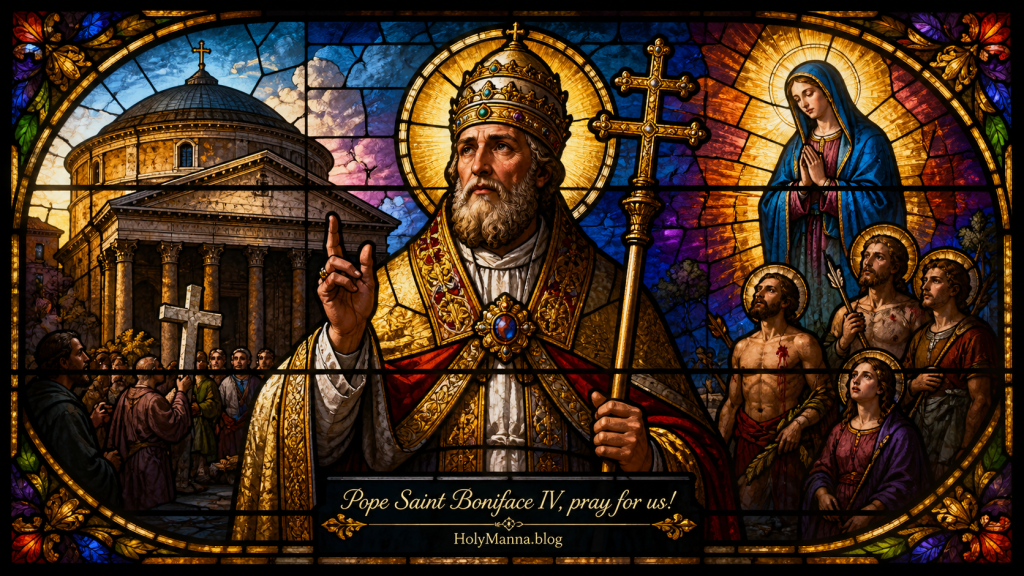
The Pope Who Claimed the Pantheon for Christ
Pope Saint Boniface IV lived in a world that must have felt like it was coming apart.
Ancient Rome was no longer the mighty empire it had once been. The city had seen invasions, poverty, famine, floods, disease, and political uncertainty. The old pagan temples still stood, but the world they represented had faded. The Church, meanwhile, was carrying the poor, preserving learning, guarding the faith, and keeping alive the worship of Jesus Christ in a wounded city.
Into that world stepped Boniface IV, a pope remembered not for military victories or dramatic political power, but for something quieter and more Catholic. He took one of pagan Rome’s most famous buildings, the Pantheon, and consecrated it to God in honor of the Blessed Virgin Mary and all the martyrs.
That one act tells us so much about the Catholic imagination. The Church does not destroy beauty simply because it once belonged to the wrong thing. She purifies it. She baptizes it. She lifts it up and says, “This too can belong to Christ.”
The Catechism of the Catholic Church teaches that sacred art is meant to draw the human person toward God, saying, “Genuine sacred art draws man to adoration, to prayer, and to the love of God.” CCC 2502.
Pope Saint Boniface IV understood that truth in stone, altar, relics, and liturgy.
A Son of the Marsi with a Monastic Heart
Boniface was born around the year 550 in the Marsican region of central Italy, in what is now Abruzzo. His father was named John and was a physician. That small detail gives us a glimpse into the kind of family Boniface may have come from: educated, respected, and familiar with service to others.
Before becoming pope, Boniface served as a deacon in Rome under Pope Saint Gregory the Great. That alone is important. Gregory was one of the towering figures of Catholic history, a pope, reformer, theologian, and saint whose influence shaped the medieval Church. To serve under him was to be formed in a school of prayer, discipline, pastoral care, and practical charity.
Boniface also served as a dispensator, meaning he helped administer the patrimonies and resources of the Church. This was not simply a desk job. In an age of famine and instability, Church property was tied to feeding the poor, sustaining clergy and monasteries, and keeping the city alive. Boniface learned holiness through responsibility.
Catholic tradition also remembers him as deeply connected to monastic life. Some sources call him a Benedictine monk, and local Italian tradition associates him with monastic communities near Rome. What can be safely said is that Boniface had a strongly monastic spirit. He valued prayer, discipline, simplicity, and the ordered life of those who seek God above all things.
Later tradition says he even turned his own house into a monastery and gave generously for the support of monks. This fits the way the Church remembers him. The Roman Martyrology praises him not only for the consecration of the Pantheon, but also for his merits regarding monastic life.
There is something beautiful about that combination. Boniface was a pope who stood in the public center of Rome, but his heart was shaped by the quiet rhythm of the monastery.
The Pantheon Becomes a Church
The defining moment of Boniface’s papacy came in 609, or possibly 610, when he received permission from the Byzantine emperor Phocas to transform the Pantheon into a Catholic church.
The Pantheon was one of the architectural wonders of the ancient world. Its massive dome, great oculus, and majestic interior still leave visitors speechless today. But in Boniface’s time, it was a former pagan temple, associated with the old gods of Rome.
Boniface did not leave it as a monument to a dead religion. He consecrated it as the Church of Santa Maria ad Martyres, Saint Mary and the Martyrs.
This was a stunning Catholic statement. A building once associated with many false gods was now dedicated to the one true God, in honor of the Blessed Virgin Mary and the saints who had shed their blood for Christ.
Saint Bede the Venerable later described the meaning of this consecration in The Ecclesiastical History of the English People. He wrote that the Pantheon was purified and dedicated so that “the devils being excluded, the blessed company of the saints might have therein a perpetual memorial.”
That line is not a quote from Boniface himself, but it captures the early Catholic understanding of what had happened. The idols were gone. The saints had entered. Christ had claimed the space.
Tradition says Boniface had the relics of many martyrs brought from the catacombs and placed beneath the altar. A famous version of the story says that twenty-eight cartloads of martyrs’ bones were carried into the Pantheon. Whether every detail of that tradition can be verified is difficult to prove, but the theological meaning is unmistakable. The Church placed the witness of the martyrs at the heart of a building once tied to pagan worship.
This is the Communion of Saints made visible.
The Catechism of the Catholic Church teaches, “The communion of saints is the Church.” CCC 946. It also teaches that the saints in heaven do not stop caring for us, saying, “Their intercession is their most exalted service to God’s plan.” CCC 956.
Boniface’s Pantheon became a stone sermon about that truth. The martyrs were not dead heroes of the past. They were living members of the Body of Christ, still honored, still loved, still close to the Church on earth.
A Pope of Prayer, Order, and Quiet Strength
Boniface IV became pope on August 25, 608, and served until his death on May 8, 615. His pontificate was not easy. Rome suffered from famine, disease, flooding, and social instability. The political world around him was divided between Byzantine authority and Lombard power. The pope had to shepherd souls while the city itself struggled to survive.
That kind of holiness does not always look dramatic from the outside. Sometimes sanctity looks like remaining faithful when everything around you feels fragile.
Boniface also showed concern for the wider Church beyond Rome. Saint Mellitus, the first Bishop of London, came to Rome during Boniface’s pontificate to consult him about the needs of the young English Church. Bede records that Mellitus took part in a Roman synod concerning the life and peace of monks. Some later documents connected with that council are historically disputed, so they must be handled carefully, but the larger picture remains clear. Boniface cared about monastic discipline and the growth of the Church in newly evangelized lands.
His papacy also overlapped with theological tensions involving the Three Chapters controversy. Saint Columbanus, the great Irish missionary monk, wrote sharply to Boniface about this difficult issue. This moment reminds us that the saints were real people living through real confusion, real theological disputes, and real ecclesial pressures. The Church has always had to endure storms from within and without, yet Christ remains faithful to His promise.
Boniface’s greatness was not that his age was peaceful. His greatness was that he stayed faithful in an age that was not peaceful.
Miracles, Legends, and the Demons of the Pantheon
There are no clearly verified miracle stories from the life of Pope Saint Boniface IV in the major Catholic traditions. His sanctity is remembered more through his holiness, monastic spirit, pastoral leadership, and the consecration of the Pantheon than through a collection of personal miracle accounts.
Still, there are famous legends associated with him, especially around the Pantheon.
One popular legend says that when Boniface purified and consecrated the Pantheon, demons fled from the building. In some versions, seven demons escaped, representing the pagan deities once honored there. One colorful version says that a demon tried to flee through the oculus in the roof and knocked away a great bronze or golden pine cone that had once closed the opening. This story is part of Catholic folklore and cannot be historically verified.
Even as legend, it says something true about how Catholics understood the moment. The consecration of the Pantheon was spiritual warfare in stone and incense. A place once connected with idols was now given to Christ, Mary, and the martyrs.
The Church has always taken seriously the reality that places, habits, cultures, and hearts can be purified. The victory of Christ is not only private. It reaches art, cities, families, buildings, memory, and history.
That is why the Pantheon story still speaks today. Every Christian has places in the heart that need to be reclaimed. Every age has cultural spaces that need to be purified and offered back to God.
What part of your own life still needs to become a church instead of a temple to something false?
Hardship Without Martyrdom
Pope Saint Boniface IV was not a martyr. He did not die by execution for the faith. His hardships were the hardships of leadership, responsibility, and holiness in a broken time.
He had to guide the Church while Rome suffered from famine, pestilence, floods, and political weakness. He lived in the shadow of a fallen empire. He had to care for monks, clergy, the poor, and the faithful while also navigating imperial politics and theological tensions.
This kind of suffering can be easy to overlook because it is not as dramatic as martyrdom. Yet the Church needs saints like Boniface. Not every saint dies in the arena. Some saints carry the burden of administration. Some saints protect the liturgy. Some saints preserve sacred places. Some saints make sure that beauty survives long enough to become prayer.
The lesson is deeply Catholic. Holiness is not limited to extraordinary moments. It is also found in duty, fidelity, reverence, and perseverance.
As Saint Paul teaches, “present your bodies as a living sacrifice, holy and acceptable to God, which is your spiritual worship.” Romans 12:1.
Boniface offered his life as that kind of living sacrifice.
The Feast Behind the Feast
One of the most important parts of Boniface’s legacy is his connection to the development of All Saints’ Day.
He did not establish the modern November 1 Solemnity of All Saints in the exact form we celebrate today. That development came later, especially through Pope Gregory III and Pope Gregory IV. However, Boniface’s dedication of the Pantheon to Mary and all the martyrs helped lay important Western foundations for the Church’s collective celebration of the saints.
The original anniversary of the Pantheon’s consecration was associated with May 13. Over time, the Western Church’s celebration of all saints became fixed on November 1. So while Boniface IV should not be credited as the sole founder of All Saints’ Day, he belongs very much to its story.
That is a surprising and beautiful legacy. A pope from a wounded Rome helped prepare the way for one of the Church’s most beloved feasts, the day when Catholics rejoice in all the saints, known and unknown, canonized and hidden, famous and forgotten.
The Catechism of the Catholic Church reminds us that the saints help the Church by their example and intercession. It says, “When they entered into the joy of their Master, they were put ‘in charge of many things.’ Their intercession is their most exalted service to God’s plan.” CCC 956.
Boniface understood that the martyrs were not merely historical memories. They were family.
Death, Relics, and a Legacy That Still Breathes
Pope Saint Boniface IV died in Rome on May 8, 615. He was buried in the portico of Saint Peter’s Basilica. His relics were later moved more than once, including during the medieval period and finally into the new Saint Peter’s Basilica in the early 17th century.
His feast is celebrated on May 8 in the current Roman Martyrology. Some older and local traditions preserve other dates, especially May 25, which helps explain why certain local celebrations may not match the universal calendar exactly.
In the Abruzzo region, especially in places connected to his Marsican origins, Boniface remains a figure of local devotion and patronal celebration. Communities remember him with religious rites, processions, Masses, and cultural festivities. This is the Catholic memory at work. A saint is not merely a name in a book. A saint becomes part of the spiritual inheritance of a people.
Yet his greatest cultural impact remains the Pantheon.
Because Boniface consecrated it as a church, one of the greatest buildings of antiquity survived as a living Christian place of worship. Tourists still enter it, but the Catholic heart sees more than architecture. It is not only a masterpiece of Roman engineering. It is a church dedicated to the Mother of God and the martyrs.
That is Boniface’s legacy after death. The building still stands. The altar remains. The saints are still honored. The beauty still points upward.
A Saint for a Culture That Needs Conversion
Pope Saint Boniface IV is a saint for anyone who wonders what Catholics should do with a broken culture.
His answer was not panic. His answer was consecration.
He did not pretend paganism was harmless. He did not leave the Pantheon as it was. But he also did not waste its beauty. He purified it and gave it to God.
That is a powerful lesson for modern Catholics. We live in a world full of beauty mixed with confusion. Art, technology, entertainment, architecture, music, and even social media can become temples to ego, pleasure, distraction, and false gods. But under Christ, what is noble can be redeemed. What is beautiful can be purified. What is human can become holy.
The Catholic life is not about running from the world in fear. It is about belonging so deeply to Christ that everything good can be offered back to Him.
What would it look like to consecrate your home more intentionally to Christ? What would it look like to let Mary and the saints into the places of your life that still feel spiritually empty? What beauty in your life could become prayer?
Boniface teaches us that conversion is not only personal. It can be cultural. It can be architectural. It can be artistic. It can be communal. It can happen in the heart, and it can happen in the middle of a city.
Engage With Us!
Share your thoughts and reflections in the comments below. Pope Saint Boniface IV reminds us that Christ can reclaim anything, even the places and parts of life that once seemed far from Him.
- What part of Pope Saint Boniface IV’s story stands out to you the most?
- Why do you think the Church chose to consecrate the Pantheon rather than simply abandon it as a pagan monument?
- What is one area of modern culture that Catholics should work to purify and offer back to Christ?
- How can devotion to Mary and the martyrs help strengthen your own faith today?
- Is there a place in your own heart that needs to be reclaimed for God?
May Pope Saint Boniface IV inspire us to see beauty through Catholic eyes, to honor the saints as living members of Christ’s Body, and to offer every part of life back to God. Let us live with faith, courage, reverence, and hope, doing everything with the love and mercy Jesus taught us.
Pope Saint Boniface IV, pray for us!
Follow us on YouTube, Instagram and Facebook for more insights and reflections on living a faith-filled life.


Leave a comment