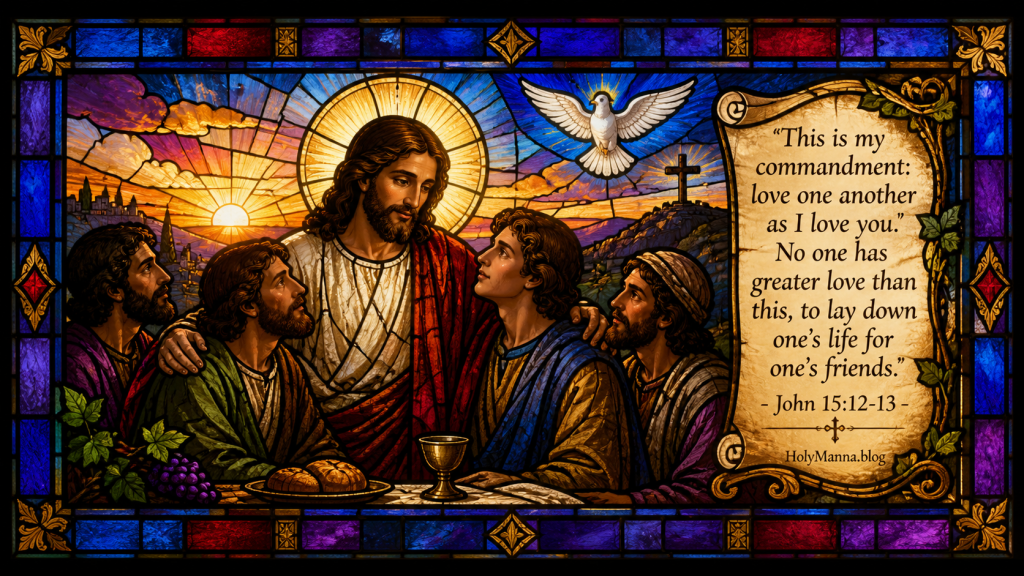
Friday of the Fifth Week of Easter – Lectionary: 289
Chosen, Sent, and Held Together by Love
There is a quiet joy in today’s readings, the kind of joy that comes when confusion gives way to peace and the heart remembers that it belongs to Christ.
On this Friday of the Fifth Week of Easter, the Church listens to three movements of one beautiful story. In Acts 15:22-31, the early Church faces a real crisis. Gentile converts have been disturbed by teachers who acted without apostolic authority, placing unnecessary burdens on believers who had newly received the Gospel. The apostles and presbyters respond not with personal opinions, but with prayerful discernment, communion, and the guidance of the Holy Spirit. Their letter brings peace because it comes from the heart of the apostolic Church, where truth and charity are meant to live together.
Then Psalm 57:8-10, 12 lifts that peace into praise. The psalmist sings, “My heart is steadfast, God, my heart is steadfast” Psalm 57:8. This is the voice of a soul anchored in the Lord, ready to praise Him “among the peoples” and “among the nations” Psalm 57:10. That matters because the first reading is also about the nations being welcomed into the covenant through Christ. The Gospel is no longer confined to one people or culture. The risen Lord is gathering His Church from every nation under heaven.
Finally, in John 15:12-17, Jesus reveals the source of this unity and mission. He does not merely call His disciples servants. He calls them friends. He gives them the commandment that holds the Church together in every age: “Love one another as I love you” John 15:12. This love is not vague kindness or sentimental agreement. It is sacrificial, obedient, fruitful, and rooted in the Cross. As The Catechism of the Catholic Church teaches, charity is the virtue by which Christians love God above all things and love their neighbor for the love of God CCC 1822.
The central theme of today’s readings is this: Christ chooses His friends, guides His Church through the Holy Spirit, and sends them to bear lasting fruit through obedient love. The Church is not held together by personality, preference, or cultural comfort. She is held together by apostolic truth, steadfast praise, and the love of Christ poured into hearts by the Holy Spirit.
What if the peace the heart longs for is found not in carrying every burden, but in receiving Christ’s friendship and obeying His command to love?
First Reading – Acts 15:22-31
The First Council and the Peace of Apostolic Truth
The first reading brings the Church back to one of her earliest and most important moments of discernment. The Gospel had begun to spread beyond Jerusalem, and Gentiles were entering the Church in great numbers. This was beautiful, but it also created a serious question. Did Gentile converts need to observe the full Mosaic Law, including circumcision, in order to belong fully to Christ?
Some believers had gone to Antioch and troubled the Gentile Christians by teaching this as necessary. The issue was not a small disagreement about customs. It touched the very heart of salvation, the unity of the Church, and the relationship between the Old Covenant and the New Covenant fulfilled in Jesus Christ.
So the apostles and presbyters gathered in Jerusalem. This moment, often called the Council of Jerusalem, shows the Church acting as the Church: prayerfully, apostolically, and under the guidance of the Holy Spirit. Today’s passage gives the result of that council. A letter is sent. Messengers are chosen. The Gentile believers receive not confusion, but peace.
This fits beautifully into today’s central theme. Christ chooses His friends, guides His Church through the Holy Spirit, and sends them to bear lasting fruit through obedient love. The apostles do not impose needless burdens, but they also do not abandon moral truth. They protect communion, preserve doctrine, and bring joy to a disturbed people.
Acts 15:22-31 – New American Bible (Revised Edition)
Letter of the Apostles. 22 Then the apostles and presbyters, in agreement with the whole church, decided to choose representatives and to send them to Antioch with Paul and Barnabas. The ones chosen were Judas, who was called Barsabbas, and Silas, leaders among the brothers. 23 This is the letter delivered by them: “The apostles and the presbyters, your brothers, to the brothers in Antioch, Syria, and Cilicia of Gentile origin: greetings. 24 Since we have heard that some of our number [who went out] without any mandate from us have upset you with their teachings and disturbed your peace of mind, 25 we have with one accord decided to choose representatives and to send them to you along with our beloved Barnabas and Paul, 26 who have dedicated their lives to the name of our Lord Jesus Christ. 27 So we are sending Judas and Silas who will also convey this same message by word of mouth: 28 ‘It is the decision of the holy Spirit and of us not to place on you any burden beyond these necessities, 29 namely, to abstain from meat sacrificed to idols, from blood, from meats of strangled animals, and from unlawful marriage. If you keep free of these, you will be doing what is right. Farewell.’”
Delegates at Antioch. 30 And so they were sent on their journey. Upon their arrival in Antioch they called the assembly together and delivered the letter. 31 When the people read it, they were delighted with the exhortation.
Detailed Exegesis
Verse 22 – “Then the apostles and presbyters, in agreement with the whole church, decided to choose representatives and to send them to Antioch with Paul and Barnabas. The ones chosen were Judas, who was called Barsabbas, and Silas, leaders among the brothers.”
The decision is not made by one isolated preacher or one private interpretation. The apostles, presbyters, and the whole Church act in communion. This is an early glimpse of the Church’s visible unity. The Gospel is personal, but it is never individualistic. Christ founded a Church, not a collection of disconnected opinions.
The choice of Judas Barsabbas and Silas is also significant. The letter will not travel alone. It will be carried by trusted witnesses. In the ancient world, letters were often accompanied by representatives who could explain the message, answer questions, and confirm its authenticity. The Church sends both written teaching and living witnesses, which reflects the Catholic understanding of Sacred Scripture, Sacred Tradition, and apostolic authority working together.
Verse 23 – “This is the letter delivered by them: ‘The apostles and the presbyters, your brothers, to the brothers in Antioch, Syria, and Cilicia of Gentile origin: greetings.’”
The tone of the letter matters. The apostles and presbyters call the Gentile Christians “brothers” Acts 15:23. That word would have meant something powerful. These Gentiles were not second-class believers. They were not tolerated outsiders. They were family in Christ.
The Church is already living the catholicity that she professes. The word “Catholic” means universal, not because the Church erases every culture, but because Christ gathers every nation into one Body. Antioch, Syria, and Cilicia represent the expanding mission of the Church beyond Jerusalem. The Gospel is moving outward, and the apostles are making sure that unity in Christ remains stronger than cultural tension.
Verse 24 – “Since we have heard that some of our number who went out without any mandate from us have upset you with their teachings and disturbed your peace of mind.”
This verse reveals the pastoral heart of apostolic authority. The apostles recognize that unauthorized teaching has disturbed the peace of the faithful. False or burdensome teaching is not harmless. It can wound consciences, confuse communities, and make the Gospel seem heavier than Christ intended.
The phrase “without any mandate from us” Acts 15:24 is especially important. Not everyone who speaks religiously speaks with the authority of the Church. From the beginning, apostolic mission required communion with apostolic authority. The Church is not trying to control people for the sake of power. She is protecting the flock from confusion.
This is still deeply relevant. Catholics live in an age of endless opinions, podcasts, social media debates, and self-appointed teachers. The question is not only whether something sounds spiritual. The question is whether it is faithful to Christ and His Church.
Verse 25 – “We have with one accord decided to choose representatives and to send them to you along with our beloved Barnabas and Paul.”
The phrase “with one accord” Acts 15:25 shows the fruit of true discernment. The apostles and presbyters are not acting out of rivalry or political strategy. They are seeking communion in the Holy Spirit.
Barnabas and Paul are called “beloved” Acts 15:25. This matters because they had been missionaries to the Gentiles. They had seen the grace of God poured out beyond the boundaries many Jewish Christians expected. The council affirms their mission. The Church does not reject evangelization to the Gentiles. She clarifies it and strengthens it.
This is what true authority does. It does not suffocate mission. It gives mission a trustworthy foundation.
Verse 26 – “Who have dedicated their lives to the name of our Lord Jesus Christ.”
Barnabas and Paul are praised because they have risked their lives for Christ. Their authority is not merely administrative. It is sealed by sacrifice. They are men who have suffered for the name of Jesus.
In Scripture, “the name” of the Lord is never just a label. It represents His person, His authority, and His saving power. To dedicate one’s life to the name of Jesus Christ means to belong entirely to Him. This verse quietly connects the first reading to the Gospel, where Jesus says, “No one has greater love than this, to lay down one’s life for one’s friends” John 15:13. Barnabas and Paul are already living that kind of love.
Verse 27 – “So we are sending Judas and Silas who will also convey this same message by word of mouth.”
Again, the Church sends both a written message and oral explanation. Judas and Silas will confirm the letter “by word of mouth” Acts 15:27. This is a beautiful biblical witness to the Catholic understanding that the faith is transmitted not only through written texts, but also through living apostolic preaching.
The Church does not hand people a document and abandon them to figure it out alone. She teaches, explains, accompanies, and safeguards. Truth is delivered in communion.
Verse 28 – “It is the decision of the holy Spirit and of us not to place on you any burden beyond these necessities.”
This is the heart of the reading. The apostles do not simply say, “This is our opinion.” They say, “It is the decision of the holy Spirit and of us” Acts 15:28. The Church understands herself as guided by the Holy Spirit when she teaches in apostolic communion.
This does not mean every Church leader is personally perfect. It means Christ keeps His promise to guide His Church. The Holy Spirit does not replace the apostles’ judgment. He works through their discernment, communion, and authority.
The apostles also show pastoral wisdom. They refuse to place unnecessary burdens on the Gentile Christians. Catholic morality is not about inventing heavy loads. It is about helping souls live in freedom, holiness, and communion with God. The Church has the authority to bind and loose, but that authority is ordered toward salvation.
Verse 29 – “Namely, to abstain from meat sacrificed to idols, from blood, from meats of strangled animals, and from unlawful marriage. If you keep free of these, you will be doing what is right. Farewell.”
The apostles give specific requirements. Some relate to table fellowship between Jewish and Gentile Christians. Others, especially abstaining from unlawful marriage, concern moral purity. The purpose is not to force Gentiles to become culturally Jewish. The purpose is to preserve communion, avoid idolatry, and protect Christian holiness.
The early Church had to teach Gentile converts how to leave pagan practices behind. Meat sacrificed to idols was connected to pagan worship. Blood and strangled animals created serious obstacles to fellowship with Jewish Christians. Unlawful marriage pointed to sexual unions forbidden by God’s law. The apostles are saying that freedom in Christ is real, but freedom must never become compromise with idolatry or immorality.
The letter ends simply: “If you keep free of these, you will be doing what is right” Acts 15:29. Christian life is not meant to be complicated by unnecessary burdens, but it does require obedience.
Verse 30 – “And so they were sent on their journey. Upon their arrival in Antioch they called the assembly together and delivered the letter.”
The Church’s decision is not hidden. The assembly is called together. The faithful hear the apostolic judgment publicly. This shows that doctrine is not private information for a spiritual elite. The whole community deserves clarity.
Antioch was one of the great missionary centers of the early Church. It was the place where disciples were first called Christians. For that community to receive this letter meant that the mission to the Gentiles could continue with confidence and peace.
Verse 31 – “When the people read it, they were delighted with the exhortation.”
The fruit of apostolic teaching is joy. The people are “delighted” Acts 15:31 because truth has lifted confusion from their hearts. They are not delighted because the Church removed every commandment. They are delighted because the Church removed false burdens while preserving what was necessary.
This is a beautiful image of how Catholic teaching should be received. When properly understood, the teaching authority of the Church is not an enemy of joy. It is a servant of joy. It helps the faithful walk without being crushed by confusion.
Teachings: Apostolic Authority, Catholic Unity, and Freedom in Christ
This reading is one of the clearest biblical foundations for the Catholic understanding of apostolic authority. The Church receives the Gospel from Christ through the apostles. The apostles teach, govern, discern, and hand on the faith. This is not a later invention. It is already visible in Acts 15.
The Catechism of the Catholic Church teaches that the apostles handed on what they received from Christ and the Holy Spirit. It says, “The Gospel was handed on in two ways: orally and in writing.” CCC 76. This helps explain why the apostles send both a letter and living messengers. The Church’s faith is not a dead document. It is a living inheritance.
The Catechism also teaches, “This living transmission, accomplished in the Holy Spirit, is called Tradition.” CCC 78. That is exactly what appears in this reading. The apostles receive the question, discern in the Spirit, and transmit the Church’s judgment to the faithful.
The authority of the Church is also connected to the Magisterium. The Catechism states, “The task of interpreting the Word of God authentically has been entrusted solely to the Magisterium of the Church.” CCC 85. This is not because bishops are more clever than everyone else. It is because Christ entrusted His Church to the apostles and their successors.
The Council of Jerusalem also foreshadows the later councils of the Church. Throughout history, when serious disputes threatened the faith, the Church gathered in council to clarify doctrine. Nicaea defended the divinity of Christ. Ephesus defended Mary as Mother of God because her title protects the truth about Jesus. Trent responded to confusion during the Protestant Reformation. Vatican II taught on the Church, Scripture, liturgy, and the Church’s mission in the modern world. The pattern is already present in Acts 15: the Church gathers, discerns, teaches, and sends.
Saint Ignatius of Antioch, writing early in the second century, expressed this Catholic instinct for visible communion when he wrote, “Wherever Jesus Christ is, there is the Catholic Church.” Letter to the Smyrnaeans 8:2. That line fits today’s reading because Antioch is not left to itself. The local Church receives guidance from the apostolic Church.
Saint Cyprian of Carthage later wrote, “He can no longer have God for his Father who has not the Church for his mother.” On the Unity of the Catholic Church 6. His words may sound strong to modern ears, but they express a deeply biblical truth. Christ does not save believers into isolation. He makes them members of His Body, the Church.
This reading also reveals the proper meaning of Christian freedom. The Gentiles are not required to become Jewish in every ceremonial detail. Salvation comes through the grace of the Lord Jesus Christ, not through the full observance of the Mosaic Law. At the same time, they are not told to live however they want. They must reject idolatry, preserve communion, and live moral purity.
That is a very Catholic balance. Grace is not license. Obedience is not slavery. The Holy Spirit frees the Church from false burdens so she can carry the sweet yoke of Christ.
Reflection: Letting the Church Restore Peace to the Heart
There is something deeply human in this reading. The believers in Antioch were disturbed. Their peace of mind had been shaken. They had received the Gospel with joy, but then other voices came along and made them wonder whether they were not enough, whether Christ was not enough, whether they needed to carry a burden the Lord had not placed on them.
That still happens. A Catholic can be disturbed by harsh voices, confused by online arguments, weighed down by scrupulosity, or tempted to believe that personal opinion is safer than the teaching Church. Today’s reading gently but firmly points the soul back home. Christ has not left His people orphaned. He guides His Church through the Holy Spirit.
This passage invites Catholics to recover trust in the Church as mother. That does not mean every question disappears overnight. It does not mean every teaching is immediately easy to understand. It means the faithful can approach the Church with humility, patience, and confidence, believing that Christ still speaks through the apostolic faith.
A practical step is to bring confusion into the light instead of letting it grow in isolation. When a teaching feels difficult, the answer is not to run first to outrage or private interpretation. The better path is to read The Catechism of the Catholic Church, speak with a faithful priest, pray before the Blessed Sacrament, and ask the Holy Spirit for docility. Peace often returns when the soul stops treating obedience as defeat and begins seeing it as trust.
Another step is to reject unnecessary burdens. Not every anxious religious thought comes from God. Not every demanding voice speaks for the Church. The apostles were careful not to impose what was unnecessary, but they were also clear about what was essential. The Catholic life requires both freedom and discipline, both mercy and truth.
This reading also challenges every believer to become a source of peace rather than confusion. Words matter. Advice matters. Religious conversations matter. A Catholic should be careful not to disturb another person’s peace with opinions dressed up as doctrine. The Church needs faithful witnesses like Judas, Silas, Barnabas, and Paul, people who carry the truth with charity and strengthen the hearts of others.
Where has confusion disturbed the peace of the heart?
Is there a false burden being carried that Christ and His Church have not actually placed there?
Is there a true command being resisted because obedience feels uncomfortable?
How can the words spoken today bring peace, clarity, and encouragement to someone else?
The people of Antioch were delighted because the Church spoke with the Holy Spirit, and the burden became clear. The same Lord still desires that kind of peace for His people. He does not call His friends into chaos. He calls them into communion, truth, and joy.
Responsorial Psalm – Psalm 57:8-10, 12
A Steadfast Heart That Wakes the Dawn
The responsorial psalm sounds like the song of a soul that has passed through danger and still chooses praise. Psalm 57 is traditionally connected with David hiding from Saul in a cave, a moment when fear, betrayal, and uncertainty could have swallowed his heart. Yet David does not let darkness have the final word. He steadies his heart before God and prepares to sing.
That makes this psalm a perfect response to today’s first reading from Acts 15:22-31. The Gentile Christians in Antioch had been disturbed by confusing teachings, but the apostolic letter restored peace. Once the Church speaks in communion with the Holy Spirit, the heart can become steadfast again. The psalm then lifts that restored peace into worship. The soul that has received clarity from God does not remain silent. It praises Him “among the peoples” and chants His praise “among the nations” Psalm 57:10.
This also prepares the heart for the Gospel. In John 15:12-17, Jesus calls His disciples friends and commands them to love as He loves. A steadfast heart is not merely calm. It is ready for mission. It has been loved, guided, and chosen, so now it can praise, witness, and bear fruit that remains.
Psalm 57:8-10, 12 – New American Bible (Revised Edition)
8 My heart is steadfast, God,
my heart is steadfast.
I will sing and chant praise.
9 Awake, my soul;
awake, lyre and harp!
I will wake the dawn.
10 I will praise you among the peoples, Lord;
I will chant your praise among the nations.12 Exalt yourself over the heavens, God;
may your glory appear above all the earth.
Detailed Exegesis
Verse 8 – “My heart is steadfast, God, my heart is steadfast. I will sing and chant praise.”
David begins not with his circumstances, but with his heart. The repetition matters. “My heart is steadfast, God, my heart is steadfast” Psalm 57:8 sounds like a man preaching truth to his own soul. He may still be surrounded by danger, but he is no longer ruled by it.
In Catholic prayer, the heart is the hidden center of the person, the place where one chooses God or turns away from Him. A steadfast heart is not a heart that feels nothing. It is a heart that has decided where its trust belongs. This verse teaches that praise is not only a response to comfort. Praise can be an act of spiritual resistance.
After the apostolic decision in Acts 15, the Church at Antioch receives peace. In the psalm, that peace becomes worship. When the heart is steadied by truth, it can sing again.
Verse 9 – “Awake, my soul; awake, lyre and harp! I will wake the dawn.”
This verse is full of holy energy. David speaks to his own soul as if waking a sleeping friend. He calls for the lyre and harp because praise is not meant to remain trapped inside. It becomes embodied, voiced, and offered.
The phrase “I will wake the dawn” Psalm 57:9 is especially beautiful. Usually the dawn wakes the world, but here the worshiper rises before the dawn and greets it with praise. This is the posture of Easter faith. The Christian does not wait until every shadow disappears before praising God. The Christian praises because Christ is risen, and because the light has already conquered the darkness.
This verse also carries a quiet challenge. Many hearts are awakened first by anxiety, notifications, deadlines, and fear. David invites the believer to let praise have the first word.
Verse 10 – “I will praise you among the peoples, Lord; I will chant your praise among the nations.”
Here the psalm expands from personal prayer to public witness. David’s praise is not private escape. It becomes missionary. He will praise the Lord “among the peoples” and “among the nations” Psalm 57:10.
This fits perfectly with the Easter season and the first reading. In Acts 15, the Church recognizes that Gentile believers truly belong to Christ. The nations are being gathered into the praise of Israel’s God. The psalm becomes a song for a Church that is becoming visibly catholic, universal, and missionary.
Catholic worship always has this movement. It begins in the heart, gathers in the Church, and goes out to the nations. The Mass forms disciples who are sent. Praise is never meant to be sealed off from mission.
Verse 12 – “Exalt yourself over the heavens, God; may your glory appear above all the earth.”
The psalm ends by lifting the eyes above every earthly fear. David does not ask merely for personal relief. He asks that God be exalted over the heavens and that His glory appear over all the earth.
This verse reminds the Church that the goal of salvation history is the glory of God. The apostles in Acts 15 are not simply solving an administrative problem. They are making room for God’s glory to be seen among the Gentiles. The psalmist is not simply singing to feel better. He is joining the whole created order in proclaiming that God reigns.
In the light of John 15, this glory is revealed through love. Jesus glorifies the Father by laying down His life. His friends glorify God by bearing fruit that remains. The glory that appears above all the earth is not worldly domination. It is the glory of divine love made visible in the Church.
Teachings: The Psalms as the Prayer of Christ and His Church
The psalms are not merely ancient poems. They are the prayer book of Israel, the prayer of Jesus, and the prayer of the Church. When the Church sings Psalm 57, she does not simply remember David’s trust. She enters into a school of prayer formed by the Holy Spirit.
The Catechism of the Catholic Church teaches, “The Psalms both nourished and expressed the prayer of the People of God assembled during the great feasts at Jerusalem and each Sabbath in the synagogues. Their prayer is inseparably personal and communal; it concerns both those who are praying and all men. The Psalms arose from the communities of the Holy Land and the Diaspora, but embrace all creation. Their prayer recalls the saving events of the past, yet extends into the future, even to the end of history; it commemorates the promises God has already kept, and awaits the Messiah who will fulfill them definitively.” CCC 2588
That is exactly what happens in today’s responsorial psalm. The prayer is personal because David says, “My heart is steadfast” Psalm 57:8. It is communal because it is sung by the Church at Mass. It is missionary because it reaches “among the nations” Psalm 57:10. It is messianic because every psalm finds its fullness in Christ.
The Catechism also says, “The Psalter is the book in which the Word of God becomes man’s prayer.” CCC 2587. That one sentence explains why the psalms belong so deeply at the heart of Catholic worship. God gives His people words, and then His people return those words to Him in faith, praise, repentance, and love.
Saint Augustine loved the psalms because he heard Christ praying in them. In his teaching on the psalms, Augustine often explained that Christ speaks as Head and Body, meaning Christ the Head and the Church His Body pray together. This is why a Catholic can hear David’s voice, the Church’s voice, and Christ’s voice in one psalm. The believer is not praying alone. The whole Christ is praying.
The Church’s liturgy makes this visible. At every Mass, the responsorial psalm is not a musical pause between readings. It is the inspired response of the Church to the Word of God. The people hear God speak, and then they answer Him with His own inspired words. On this day, after hearing about the peace brought by apostolic authority, the Church answers with a steadfast heart and missionary praise.
The Catechism teaches about praise, “Praise is the form of prayer which recognizes most immediately that God is God. It lauds God for his own sake and gives him glory, quite beyond what he does, but simply because HE IS.” CCC 2639
This is the heart of Psalm 57. David does not praise God only because danger is gone. He praises because God is God. The Church does not sing only when life feels manageable. She sings because Christ is risen, the Holy Spirit guides her, and the glory of God is destined to fill the earth.
Reflection: Let Praise Have the First Word
There is a simple but demanding lesson in this psalm. The heart must be trained to become steadfast. It does not happen by accident. A steadfast heart is formed through prayer, Scripture, worship, obedience, and trust repeated day after day.
Many people wake up and immediately surrender their attention to fear. The mind starts racing before the soul starts praying. The day begins with headlines, messages, pressure, and worry. David offers a different way. “Awake, my soul” Psalm 57:9. The first awakening should belong to God.
A Catholic can live this psalm in very practical ways. Begin the day with a short act of praise before reaching for the phone. Pray one psalm slowly. Make the Sign of the Cross with attention. Thank God for one specific grace. Ask the Holy Spirit to make the heart steadfast before the noise begins. These small acts are not spiritual decoration. They are training in holy stability.
This psalm also invites the believer to turn private faith into public witness. David praises God “among the peoples” Psalm 57:10. For most Catholics, that does not mean preaching on a street corner. It may mean speaking of God naturally at home, refusing to hide the faith out of embarrassment, praying before meals in public, encouraging a struggling friend, or letting joy become visible in ordinary life.
The heart that is steadfast in God becomes free. It does not need every circumstance to be perfect before it can praise. It does not need everyone’s approval before it can witness. It does not need full control before it can trust.
What usually wakes the heart first: praise, worry, resentment, or distraction?
Where is God inviting the soul to become steadfast instead of reactive?
How can praise become more than a Sunday habit and become the first movement of each day?
Who among the peoples and nations nearby needs to hear, through one Catholic life, that God is still worthy of praise?
Today, the psalmist teaches the Church how to stand in the light before the dawn has fully broken. The heart that belongs to Christ can sing while the world is still waking up, because Easter has already begun.
Holy Gospel – John 15:12-17
The Commandment of the Friend Who Laid Down His Life
The Gospel brings the heart of today’s readings into full view. After the apostolic letter in Acts 15:22-31 restores peace to the Gentile Christians, and after Psalm 57:8-10, 12 teaches the heart to become steadfast in praise, Jesus reveals the source of the Church’s unity and mission. The Church is held together by the love of Christ.
These words from John 15 are spoken during the Last Supper, on the night before the Cross. Jesus is not giving casual advice. He is speaking to His disciples with the tenderness and urgency of a Savior who knows His Passion is near. In the ancient world, a rabbi might call disciples servants or students. Jesus goes further. He calls them friends.
This friendship is not sentimental. It is covenantal, obedient, sacrificial, and fruitful. Jesus gives one commandment: “Love one another as I love you” John 15:12. Then He reveals the measure of that love: the laying down of His life. The Church in Acts 15 can discern in unity because Christ has made His disciples friends. The psalmist can praise among the nations because Christ sends His friends to bear fruit. The Christian can love because Christ first chose, loved, and appointed him.
John 15:12-17 – New American Bible (Revised Edition)
12 This is my commandment: love one another as I love you. 13 No one has greater love than this, to lay down one’s life for one’s friends. 14 You are my friends if you do what I command you. 15 I no longer call you slaves, because a slave does not know what his master is doing. I have called you friends, because I have told you everything I have heard from my Father. 16 It was not you who chose me, but I who chose you and appointed you to go and bear fruit that will remain, so that whatever you ask the Father in my name he may give you. 17 This I command you: love one another.
Detailed Exegesis
Verse 12 – “This is my commandment: love one another as I love you.”
Jesus does not present love as one option among many. He calls it “my commandment” John 15:12. This love is the identifying mark of Christian discipleship. It is also the fulfillment of the Law because it flows from the heart of Christ Himself.
The key word is “as” John 15:12. Christians are not merely commanded to love according to personality, convenience, chemistry, or emotion. They are commanded to love as Jesus loves. His love is patient with weakness, truthful before sin, merciful toward sinners, obedient to the Father, and willing to suffer for the salvation of others.
This verse also explains the spirit behind the first reading. The apostles do not act out of control or pride. They act out of charity, protecting the Gentile Christians from false burdens while preserving what is necessary for communion and holiness. Real Catholic love does not separate mercy from truth.
Verse 13 – “No one has greater love than this, to lay down one’s life for one’s friends.”
Jesus now defines the greatest love. It is not merely affection. It is self-gift. The Cross is already standing behind this sentence. Jesus is about to lay down His life, not for perfect people, but for weak, frightened, sinful friends.
This verse has shaped Catholic imagination for centuries. It is the love of the martyrs, the love of missionaries, the love of parents who sacrifice quietly, the love of priests who pour themselves out for souls, and the love of every disciple who chooses another’s good over selfish comfort.
The phrase “lay down one’s life” John 15:13 does not only refer to physical martyrdom, though it certainly includes it. Most Christians lay down their lives one hidden act at a time. They forgive. They stay faithful. They serve when tired. They tell the truth with charity. They resist selfishness when no one sees. The Cross becomes daily.
Verse 14 – “You are my friends if you do what I command you.”
Jesus’ friendship is a gift, but it is not separated from obedience. This verse can sound strange to modern ears because many people think friendship means affirmation without expectation. Jesus teaches something deeper. True friendship with Him means communion with His will.
Obedience does not make the disciple a slave in the negative sense. Obedience proves that love has become real. A person who claims friendship with Christ while rejecting His commandments is trying to have intimacy without conversion.
This connects directly to Acts 15. The Gentile Christians are freed from unnecessary burdens, but they are not freed from obedience. The apostolic Church gives them necessary commands because friendship with Christ must take visible shape in life.
Verse 15 – “I no longer call you slaves, because a slave does not know what his master is doing. I have called you friends, because I have told you everything I have heard from my Father.”
This is one of the most tender lines in the Gospel. Jesus does not keep His disciples at a distance. He reveals the Father’s heart to them. He brings them into divine intimacy.
In Scripture, Moses is called a friend of God, and Abraham is remembered as God’s friend. Now Jesus extends this astonishing dignity to His disciples. They are not merely workers carrying out orders without understanding. They are friends who have been entrusted with the Father’s revelation.
Still, this friendship does not make Jesus less Lord. It makes His lordship more beautiful. The King of the universe stoops low enough to call His disciples friends, then raises them high enough to share in His mission.
Verse 16 – “It was not you who chose me, but I who chose you and appointed you to go and bear fruit that will remain, so that whatever you ask the Father in my name he may give you.”
This verse destroys spiritual pride and spiritual despair at the same time. The disciple did not begin the relationship by choosing Christ first. Christ chose first. Grace came first. Love came first.
Jesus also says that He “appointed” His disciples John 15:16. Friendship with Christ is not passive. It becomes mission. The chosen are sent. The loved are made fruitful. The friends of Jesus are not meant to produce shallow results that disappear with mood, trend, or applause. They are appointed to “bear fruit that will remain” John 15:16.
This fruit includes holiness, charity, evangelization, perseverance, and the salvation of souls. It is the fruit seen in the apostles, in the saints, and in every ordinary Catholic who lets grace become visible through faithful love.
The promise about prayer is also rooted in this mission. Jesus is not offering a blank check for selfish desire. Prayer “in my name” John 15:16 means prayer in communion with His person, His will, and His mission.
Verse 17 – “This I command you: love one another.”
Jesus ends where He began. The repetition matters. He knows the human heart. He knows that even religious people can become divided, proud, harsh, tribal, and forgetful. So He repeats the commandment: “love one another” John 15:17.
This is not because love is easy. It is because love is essential. Without charity, apostolic authority becomes cold. Without charity, praise becomes performance. Without charity, mission becomes ego. With charity, the Church becomes recognizable as the Body of Christ.
Teachings: Charity, Friendship With God, and the Fruit That Remains
The Catholic tradition sees this Gospel as one of the clearest revelations of Christian love. Jesus does not merely teach love. He becomes its measure. The commandment is new because the standard is Christ Himself.
The Catechism of the Catholic Church teaches, “The entire Law of the Gospel is contained in the ‘new commandment’ of Jesus, to love one another as he has loved us.” CCC 1970
This means Catholic morality cannot be reduced to rule keeping, but it also cannot be reduced to vague kindness. The Law of the Gospel is the life of Christ taking shape in the disciple. Love is the heart of the commandments, and the commandments protect authentic love.
The Catechism also teaches, “Charity is the theological virtue by which we love God above all things for his own sake, and our neighbor as ourselves for the love of God.” CCC 1822
This is important because Christian love is not merely being pleasant. It is a supernatural virtue. It comes from grace. A person can naturally love those who are easy to love, but charity teaches the heart to love for God’s sake, even when love costs something.
Then The Catechism explains, “Jesus makes charity the new commandment. By loving his own ‘to the end,’ he makes manifest the Father’s love which he receives. By loving one another, the disciples imitate the love of Jesus which they themselves receive.” CCC 1823
That sentence is the key to today’s Gospel. The disciples do not invent Christian love. They receive it first. Jesus loves them “to the end”, then commands them to love with that same pattern. The Christian life begins not with human strength, but with receiving the love of Christ.
Saint Thomas Aquinas gives a classic Catholic explanation of charity when he writes, “Charity is the friendship of man for God.” Summa Theologiae, II-II, Question 23, Article 1 This fits beautifully with Jesus’ words, “I have called you friends” John 15:15. Charity is not only service from a distance. It is friendship with God that overflows into love of neighbor.
Pope Saint John Paul II taught that the commandment of love must be understood through the Cross. In Veritatis Splendor, he wrote, “Jesus’ way of acting and his words, his deeds and his precepts constitute the moral rule of Christian life.” Veritatis Splendor 20 In other words, Catholic morality is not an abstract system floating above real life. It is the life of Jesus becoming the pattern of the Christian.
The saints show what this Gospel looks like when lived completely. Saint Maximilian Kolbe laid down his life for a fellow prisoner at Auschwitz, giving the modern world a dramatic image of John 15:13. Saint Teresa of Calcutta laid down her life slowly through service to the poorest of the poor. Saint Thérèse of Lisieux bore fruit that remains through hidden love, small sacrifices, and confidence in God. The forms differ, but the commandment is the same.
The Church’s history is filled with people who proved that friendship with Christ becomes fruitful love. Some bore fruit through martyrdom. Some bore fruit through teaching. Some bore fruit through marriage, parenting, priesthood, religious life, works of mercy, and quiet fidelity. The fruit remains because it comes from Christ.
Reflection: Living as Friends Chosen by Christ
This Gospel reaches into the ordinary places where love is tested. It is one thing to admire the idea of sacrificial love. It is another thing to practice it with family, coworkers, parishioners, friends, and the people who know exactly how to irritate the soul.
Jesus does not say, “Love one another when it feels natural.” He says, “Love one another as I love you” John 15:12. That love has a shape. It forgives without pretending sin does not matter. It tells the truth without cruelty. It serves without keeping score. It sacrifices without making every sacrifice a public announcement. It obeys the Father when comfort suggests another path.
A practical way to live this Gospel is to begin each day by remembering the order of grace. Christ chose first. Before the emails, family responsibilities, traffic, deadlines, temptations, and frustrations, the disciple is already chosen by Jesus. That truth changes the whole day. A chosen friend of Christ does not need to chase worth through approval, control, pleasure, or resentment.
Another step is to ask where love needs to become concrete. Someone may need an apology. Someone may need patient listening. Someone may need correction spoken gently. Someone may need hidden service. Someone may need prayer. Love becomes real when it becomes specific.
This Gospel also invites Catholics to examine obedience. Jesus says, “You are my friends if you do what I command you” John 15:14. Obedience is not the enemy of friendship with Christ. It is the proof that friendship has entered the will. The heart that loves Jesus begins to trust His commandments, even when they challenge pride, comfort, or cultural expectations.
Finally, Jesus calls His friends to bear fruit that remains. That is a powerful challenge in a world addicted to instant reaction and temporary attention. Much of modern life disappears quickly. Posts fade. Trends change. Arguments vanish. Applause evaporates. But charity remains. Holiness remains. Souls matter forever.
Where is Jesus asking for love to become sacrifice rather than sentiment?
Is there an area of life where friendship with Christ has not yet become obedience?
What fruit is being produced right now, and will it remain?
Who needs to experience the love of Christ through one concrete act of patience, courage, forgiveness, or service today?
The Gospel leaves the Church with a commandment that is simple enough for a child to remember and deep enough for a saint to spend a lifetime living. Jesus has chosen His disciples, called them friends, and appointed them to bear fruit. The only way to remain faithful to that calling is the way He gave on the night before He died: love one another as He loves.
The Peace of the Church, the Song of the Heart, and the Love That Remains
Today’s readings gather the soul into one clear Easter truth: Christ does not leave His friends confused, isolated, or fruitless. He guides His Church, steadies the heart in praise, and commands His disciples to love with the same love that carried Him to the Cross.
In Acts 15:22-31, the early Church shows what apostolic faith looks like when confusion threatens peace. The apostles and presbyters do not abandon the Gentile believers to uncertainty. They discern together, speak with authority, and send a message that restores joy. Their words, “It is the decision of the holy Spirit and of us” Acts 15:28, remind every Catholic that Christ continues to guide His Church through the Holy Spirit. The Church is not merely a human institution trying to manage religious opinions. She is the Body of Christ, entrusted with the truth that sets hearts free.
Then Psalm 57:8-10, 12 teaches what a restored heart does next. It sings. The psalmist says, “My heart is steadfast, God, my heart is steadfast” Psalm 57:8. This is the prayer of someone who has learned that praise does not need to wait for perfect circumstances. A heart anchored in God can wake the dawn. A soul strengthened by truth can praise the Lord among the peoples and nations.
Finally, in John 15:12-17, Jesus reveals the deepest reason for the Church’s unity and the soul’s praise. He calls His disciples friends. He chooses them first. He appoints them to bear fruit that will remain. Then He gives the commandment that holds everything together: “Love one another as I love you” John 15:12. This love is not shallow sentiment or polite religious language. It is cruciform love. It is patient, obedient, sacrificial, fruitful, and faithful.
The call today is beautifully simple and deeply demanding. Trust the Church Christ guides. Let praise steady the heart before anxiety takes over. Love the people in front of you with the love of Jesus, not merely when it is easy, but when it costs something.
A Catholic life does not need to be loud to bear fruit that remains. It can begin with obedience to the truth, a morning prayer of praise, a sincere apology, a hidden sacrifice, a difficult act of forgiveness, or a decision to love someone without keeping score. These ordinary choices become holy when they are joined to Christ.
Where is the Lord inviting the heart to move from confusion into peace, from fear into praise, and from self-protection into sacrificial love?
Christ has chosen His friends. He has not chosen them for comfort alone, but for communion, mission, and fruit that lasts into eternity. Today, the invitation is to receive His friendship again, walk with His Church, wake the dawn with praise, and love in a way that makes His presence visible.
Engage with Us!
Share your reflections in the comments below. Today’s readings invite every Catholic heart to consider where Christ is bringing peace, where He is calling forth praise, and where He is asking for love that bears fruit and remains.
- For the First Reading from Acts 15:22-31: Where has confusion disturbed your peace, and how might deeper trust in Christ’s Church help restore clarity and joy?
- For the Responsorial Psalm from Psalm 57:8-10, 12: What would change in your daily life if praise became the first movement of your heart each morning?
- For the Holy Gospel from John 15:12-17: Who is Jesus asking you to love today with patience, sacrifice, forgiveness, or mercy?
- For the central theme of the readings: How is Christ inviting you to live as His chosen friend and bear fruit that will remain?
May these readings help every heart grow more steadfast in faith, more joyful in praise, and more generous in love. Let us live each day as friends chosen by Christ, doing everything with the love and mercy Jesus taught us.
Sacred Heart of Jesus, we trust in You!
Immaculate Heart of Mary, pray for us!
Saint Michael the Archangel, defend us in battle!
Follow us on YouTube, Instagram and Facebook for more insights and reflections on living a faith-filled life.


Leave a comment