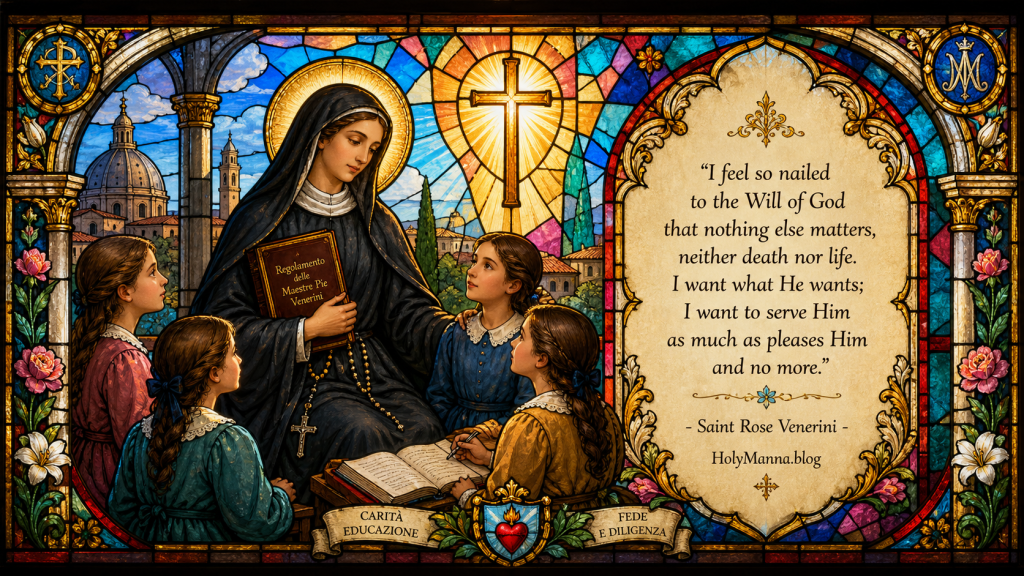
A Classroom Lit by the Gospel
Saint Rose Venerini was not a queen, a martyr, or a mystic hidden away from the world. She was something quieter, but deeply powerful. She was a Catholic teacher who saw that ignorance could wound the soul, and that education, when rooted in Christ, could become a road to salvation.
Born in Viterbo, Italy, in 1656, Rose became one of the great pioneers of Catholic education for girls. She founded what is often called the first public school for girls in Italy and established the Maestre Pie Venerini, known today as the Venerini Sisters. Her mission was simple but revolutionary: teach girls the faith, form their minds, strengthen their hearts, and help them live with dignity before God and society.
Her motto captures the whole fire of her vocation: “Educate to save.”
That was Saint Rose’s genius. She did not see education as merely learning letters, numbers, or manners. She saw education as a work of mercy. She knew that a girl who learned to pray, read, think clearly, and understand the faith was being prepared not only for earthly life, but for eternal life.
The Catechism of the Catholic Church teaches that the saints are given to the Church as models and intercessors, witnesses of what the Holy Spirit can do in a human soul. CCC 828. Saint Rose Venerini shows us what holiness looks like when it enters a classroom, gathers the forgotten, and patiently teaches them the way to Heaven.
A Daughter of Viterbo with a Heart Already Promised to God
Rose Venerini was born on February 9, 1656, in Viterbo, Italy. She was baptized the next day. Her father, Goffredo Venerini, was a physician who served at the Grand Hospital of Viterbo. Her mother, Marzia Zampichetti, came from an old Viterbo family. Rose grew up in a home where faith, service, and Christian virtue were taken seriously.
She was one of four children: Domenico, Maria Maddalena, Rosa, and Orazio. From a young age, Rose showed intelligence, sensitivity, and a deep attraction to God. According to her early biographer, Father Girolamo Andreucci, S.J., Rose made a private vow at only seven years old to consecrate her life to God.
That detail matters. It shows that Rose’s vocation did not begin as a career plan or a social project. It began as a promise to the Lord.
As a young woman, she wrestled with the question many faithful Catholics face in different forms: what does God actually want? In her time, women of her rank were usually expected either to marry or enter a cloister. Rose considered religious life seriously. In 1676, she entered the Dominican Monastery of Saint Catherine in Viterbo, where her aunt lived. There she learned silence, prayer, and meditation.
But God’s path for her was not the cloister. After only a few months, her father died suddenly, and Rose returned home to care for her grieving mother. More sorrow followed. Her brother Domenico died at the age of twenty-seven, and her mother died soon after, overcome by grief.
A common Catholic biographical tradition says Rose had once felt affection for a young man who died in unknown circumstances. This story is preserved in some Catholic accounts, but it is not the main focus of the official Vatican biography, so it should be treated carefully as part of the traditional story surrounding her discernment rather than as the central explanation of her vocation.
What is clear is that suffering purified Rose’s heart. Grief did not make her bitter. It made her available.
The Rosary Circle That Became a Revolution
Around 1684, Rose began gathering girls and women in her home to pray the Rosary. At first glance, it may have seemed like a small neighborhood devotion. But in that room, while women prayed familiar prayers, Rose noticed something painful. Many could recite the words of the faith, but they did not really understand them.
She saw cultural poverty, moral confusion, and spiritual neglect. She saw women and girls who had never been properly formed. They were not unintelligent. They had simply been forgotten.
So Rose began teaching. She explained the prayers. She explained the mysteries of the faith. She taught Christian doctrine. She gave spiritual counsel. Slowly, the Rosary gathering became a school of faith.
Pope Pius XII later summarized her mission beautifully when he said, “From the beginning Blessed Rose taught in order to sanctify.”
That line is the key to Saint Rose. She did not teach to impress. She did not teach to climb a social ladder. She taught so souls could be sanctified.
On August 30, 1685, with the approval of Cardinal Urbano Sacchetti, Bishop of Viterbo, and with the help of Gerolama Coluzzelli and Porzia Bacci, Rose opened her first school. It was a school for girls, especially poor girls, and it was rooted in Catholic formation.
At the time, this was bold. Many girls did not receive formal education. Poor girls were often left without serious instruction in reading, doctrine, virtue, or preparation for life. Rose believed they deserved better because they were daughters of God.
The Catechism teaches that true education should form children in virtue, sound judgment, self-mastery, and authentic freedom. CCC 2223. Saint Rose understood this long before modern educational language caught up. Her school was not merely about information. It was about formation.
A Teacher Who Built More Than Schools
Saint Rose’s first school in Viterbo became the beginning of a wider mission. Her method was simple, human, and deeply Catholic. Girls were taught to read, to understand the faith, to pray, to live morally, and to prepare for their place in family and society.
This was not rebellion against womanhood or tradition. It was the elevation of women through Catholic truth. Rose wanted girls to become wise, virtuous, capable, and holy. She knew that when women are formed in the faith, families are strengthened, parishes are renewed, and society becomes more humane.
Her work spread quickly. Cardinal Marcantonio Barbarigo, Bishop of Montefiascone, recognized the importance of her mission and invited her into his diocese. From 1692 to 1694, Rose opened several schools in Montefiascone and the surrounding towns near Lake Bolsena. She trained teachers, organized communities, and helped families understand the value of Catholic education.
One of the most beautiful parts of her story is her connection to Saint Lucy Filippini. Rose recognized Lucy’s gifts and entrusted her with the schools in Montefiascone when she returned to Viterbo. Saint Lucy would later become a major Catholic educator and foundress herself. In the life of Saint Rose Venerini, holiness multiplied. A teacher formed another teacher. A saint helped raise up another saint.
Rose eventually opened more than forty schools. Some sources speak of about fifty, but the safest historical wording is that she opened more than forty. Either way, the fruit is astonishing. What began with a Rosary gathering in a home became a movement of Catholic education.
There are no widely documented, verified miracle stories from Rose’s lifetime in the same way there are for some wonder-working saints. Her “miracles” during life were often the quieter kind: girls formed in faith, families strengthened, sinners called back, the poor served, and communities renewed. Catholic sources also describe her comforting and even curing the sick, encouraging the discouraged, consoling the afflicted, and helping people escape moral slavery. These works reveal a saint whose charity was practical, steady, and deeply rooted in Christ.
Arrows, Fire, and the Cost of Doing God’s Work
Saint Rose’s mission was not welcomed by everyone. Some clergy resisted because they believed catechetical instruction belonged exclusively to them. Others were offended that a woman of her social class would dedicate herself to educating poor girls. Some people simply did not understand why girls needed such formation.
A traditional story preserved in Catholic saint profiles says that opposition sometimes became violent. According to this story, teachers connected to Rose’s work were shot at with bows, and houses were set on fire. This story is associated with her life, but it cannot be fully verified from the most official sources used in the research, so it should be understood as a traditional account rather than a confirmed historical detail.
Even without that dramatic story, the verified hardships are clear. Rose faced suspicion, rejection, failure, and internal conflict. When she returned to Viterbo after her work in Montefiascone, she found that some teachers had left and formed a rival school. Her congregation’s history describes this as a kind of small schism. Rose handled it with patience, firmness, and charity.
She also experienced a painful failure in Rome. In 1706, she went to Rome, but her first attempt did not succeed. It wounded her deeply. She had to wait six long years before she could open a school there.
That delay says something important about sainthood. Saints are not people whose plans always work immediately. Saints are people who keep obeying God after disappointment.
On December 8, 1713, Rose finally opened a school near the Campidoglio in Rome. Then came one of the most famous moments of her life. On October 24, 1716, Pope Clement XI visited the school with eight cardinals. He observed the lessons and was deeply moved. At the end of the visit, he told her, “Signora Rosa, you are doing that which we cannot do. We thank you very much because with these schools you will sanctify Rome.”
Imagine hearing that from the pope after years of struggle, misunderstanding, and failure. Rose had not wasted her life. God had been using every hidden sacrifice.
Saint Rose was not a martyr in the sense of shedding her blood for the faith. She died naturally. But she did experience the white martyrdom of perseverance: rejection, exhaustion, misunderstanding, and the daily sacrifice of giving herself away for souls.
A Soul Nailed to the Will of God
The heart of Saint Rose’s holiness was obedience to God’s will. Her most famous verified saying is one of those quotes that should be read slowly:
“I feel so nailed to the Will of God that nothing else matters, neither death nor life. I want what He wants; I want to serve Him as much as pleases Him and no more.”
Pope Benedict XVI quoted this same thought at her canonization, saying, “I find myself so bound to the divine will that neither death nor life is important: I want to live as he wishes and I want to serve him as he likes, and nothing more.”
That is not passive resignation. That is freedom. Rose was not controlled by success, praise, comfort, or fear. She wanted what God wanted.
Pope Pius XII also preserved another saying of hers: “So long as God is pleased, everything is dear to me.”
When Father Martinelli, her spiritual director, worried that she might abandon the work if he left, Rose answered, “So it would be, if I had undertaken this for Father Martinelli, and not for the love and glory of God.”
That is the strength of a mature Catholic soul. She loved her spiritual guides, but her mission did not depend on human approval. It depended on God.
Her spirituality was nourished by prayer, the Eucharist, devotion to the Blessed Virgin Mary, and the Ignatian spirit of discerning and doing God’s will. She called mental prayer essential nourishment for the soul. The Vatican biography says prayer was like the breath of her day.
One of her most beautiful spiritual images was what she called “The Greatest Circle.” In prayer, she imagined the whole world as a great circle. She placed herself at its center and contemplated Jesus offering Himself to the Father through every Mass being celebrated throughout the world. In this way, she spiritually united her work, suffering, and love to the Eucharistic Sacrifice of Christ.
This is deeply Catholic. The Mass is not merely a gathering or a memory. It is the sacramental making-present of Christ’s one sacrifice. CCC 1367. Rose’s teaching flowed from that Eucharistic center.
The Miracle That Helped Raise Her to the Altars
Saint Rose died in Rome on May 7, 1728, in the house of San Marco near the Church of the Gesù. She was seventy-two years old. Her remains were first buried in the Church of the Gesù, a church she loved. In 1952, around the time of her beatification, her remains were transferred to the chapel of the Generalate of the Maestre Pie Venerini in Rome.
Her reputation for holiness continued after death. She was beatified by Pope Pius XII on May 4, 1952, and canonized by Pope Benedict XVI on October 15, 2006.
The most clearly documented miracle associated with her canonization was the healing of a Cameroonian boy named Onguen Meyong. As a child, Onguen became seriously ill with symptoms that included fever, weakness, swollen glands, abdominal swelling, and serious physical deterioration. A biopsy later confirmed tuberculous adenitis.
His mother and grandmother went to a leprosarium where Sister Maria José Carregosa Santana, a Brazilian Maestra Pia Venerini, invited people to pray a novena to Blessed Rose Venerini for the boy’s healing. Catholics, Lutherans, and animists joined in prayer. By the fifth day of the novena, Onguen began to improve. By the end of the novena, the swelling, pain, and visible symptoms had disappeared. When the biopsy results arrived months later, the boy was already running and playing.
The Church investigated the case carefully. The medical commission judged the healing scientifically inexplicable. The theologians recognized the connection between the prayer to Blessed Rose and the healing. Pope Benedict XVI authorized the decree recognizing the miracle in 2006, and Rose Venerini was canonized later that year.
Catholic sources also mention miracles and favors attributed to her intercession after death, but the healing of Onguen Meyong is the most clearly documented miracle from the research.
A Legacy That Crossed Oceans
Saint Rose’s work did not end in Rome. The Maestre Pie Venerini continued her mission, bringing Catholic education to new generations. Interestingly, her institute did not begin as a formal religious congregation with public vows. It began as a lay institute of women dedicated to education and Christian formation. Only in 1933 did the Maestre Pie become a formal religious congregation with public vows.
That is a surprising and important detail. Saint Rose helped pioneer a form of female apostolic life that served the Church outside the cloister before such work fit neatly into later structures.
Her spiritual daughters eventually carried the mission beyond Italy. In 1909, six Venerini Sisters arrived in Boston after a fourteen-day voyage and began serving Italian immigrant families in Lawrence, Massachusetts. They taught children, helped working families, strengthened parish life, and created spaces where immigrant Catholic children could grow in faith and dignity. Over time, the Venerini Sisters established communities in Massachusetts, Rhode Island, and New York. They also opened Venerini Academy in Worcester in 1945 and helped develop early childhood education programs.
The Venerini mission later expanded to places such as Latin America, India, Africa, Eastern Europe, and beyond. Today, Saint Rose’s legacy continues wherever Catholic educators see teaching as a form of evangelization.
Her feast day is May 7. She is especially remembered as a patron and model for Catholic educators, teachers, girls’ education, and women serving in apostolic ministry.
The Saint Who Reminds Us That Formation Saves Lives
Saint Rose Venerini’s life feels especially timely. She lived in a world where many people knew religious words but lacked deep formation. That sounds familiar. Many Catholics today know prayers from childhood, but struggle to understand the faith. Many young people are surrounded by information, but starving for wisdom.
Rose would not have responded with cynicism. She would have opened a school. She would have gathered people to pray. She would have taught patiently. She would have trusted that grace works through repetition, discipline, love, and truth.
Her life reminds us that teaching the faith is not a small thing. Parents teaching children to pray are doing holy work. Catechists preparing students for the sacraments are doing holy work. Catholic school teachers, OCIA leaders, youth ministers, grandparents, godparents, and faithful friends who explain the faith with patience are continuing a mission that saints like Rose understood deeply.
What would change if every Catholic saw formation as an act of love?
Saint Rose teaches that holiness does not always look dramatic. Sometimes it looks like showing up, explaining the same truth again, correcting with gentleness, praying before class, trusting God after failure, and believing that one soul formed in Christ is worth every sacrifice.
Her story also reminds us that women have always played a powerful role in the Church’s mission. Rose did not need to imitate men to be strong. She was strong precisely as a Catholic woman, spiritual mother, teacher, and servant of souls. She raised up girls by giving them Christ.
That is real empowerment. That is Catholic formation. That is education ordered toward Heaven.
Engage with Us!
Share your thoughts and reflections in the comments below. Saint Rose Venerini’s life gives us so much to think about, especially in a time when many people are educated in facts but not always formed in wisdom.
- Where in your life is God asking you to teach, guide, or encourage someone with patience and love?
- Do you see education as only practical success, or as a path toward virtue, holiness, and truth?
- Who helped form your faith, and how can you carry that gift forward for someone else?
- What does Saint Rose’s motto, “Educate to save,” stir in your heart?
- How can your home, parish, classroom, or workplace become a place where others are gently led closer to Christ?
Saint Rose Venerini reminds us that every soul is worth forming, every child is worth teaching, and every act of patient love can become a seed of salvation. May her example encourage us to live with faith, serve with courage, and do everything with the love and mercy Jesus taught us.
Saint Rose Venerini, pray for us!
Follow us on YouTube, Instagram and Facebook for more insights and reflections on living a faith-filled life.


Leave a comment