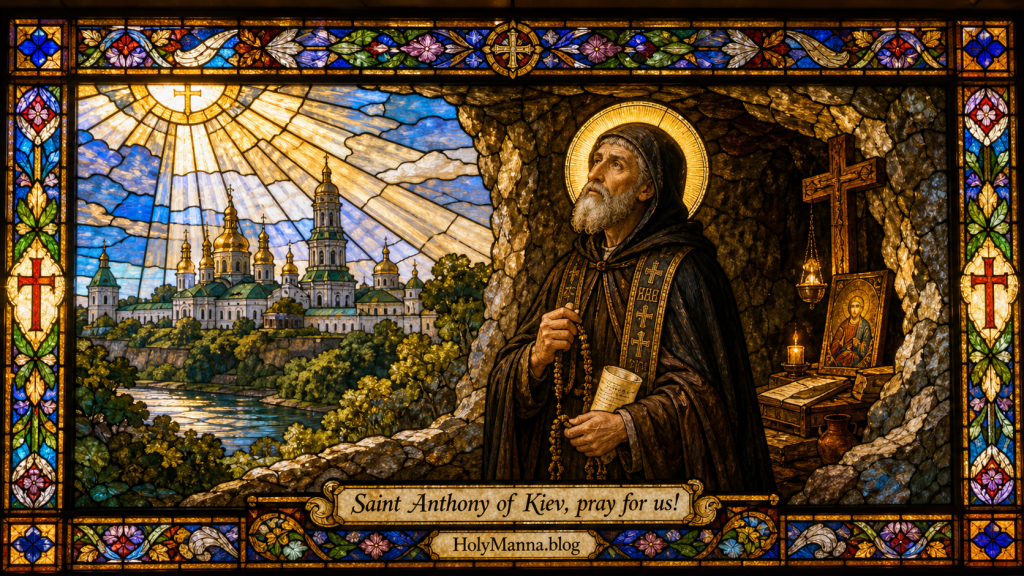
The Cave That Became a School of Holiness
Saint Anthony of Kiev, also known as Saint Anthony Pechersky or Saint Anthony of the Caves, was one of the great fathers of Christian monasticism in the lands of Kyivan Rus’. Born around 983 in Liubech, near Chernihiv in present-day Ukraine, he became the founder of the Kyiv-Pechersk Lavra, the famous Monastery of the Caves in Kyiv.
He was not a bishop, not a martyr, not a great public preacher, and not a writer whose books filled libraries. He was a hermit. He was a man of silence, fasting, prayer, and hidden surrender to God. Yet from his hidden cave came one of the most influential monasteries in Eastern Christian history.
The Roman Catholic Church remembers him as a saint of the shared Christian heritage of East and West. The Roman Martyrology honors him as a hermit who continued in Kyiv the monastic life he had learned on Mount Athos. From a Catholic perspective, Saint Anthony reminds the Church that holiness is not always loud. Sometimes the saints who change history are the ones who disappear into prayer.
The Catechism of the Catholic Church teaches that hermits “devote their life to the praise of God and salvation of the world through a stricter separation from the world, the silence of solitude and assiduous prayer and penance” (CCC 920). That sentence could almost serve as a short biography of Saint Anthony of Kiev.
From Liubech to Mount Athos
Saint Anthony was born with the name Antipas or Antyp, according to tradition. His birthplace, Liubech, was located in the region of Chernihiv, in the newly Christianized world of Kyivan Rus’. This was a time when Christianity was still taking deep root among the Slavic peoples after the baptism of Rus’ under Prince Vladimir in 988.
From his youth, Anthony was drawn to a life of prayer and asceticism. He desired not just to know about God, but to belong entirely to Him. That desire led him far from home to Mount Athos, the great monastic mountain of the Christian East. There, surrounded by monks who lived lives of fasting, chanting, silence, and spiritual warfare, Anthony received formation in the monastic life.
On Mount Athos, he took the name Anthony, placing himself under the spiritual shadow of Saint Anthony the Great, the great desert father of Egypt. That choice was meaningful. Anthony of Kiev would become, in his own land, what Anthony the Great had been in the Egyptian desert: a father of monks, a man of prayer, and a spiritual guide for generations.
Tradition says that his abbot eventually recognized that Anthony’s holiness was not meant to remain only on Athos. He sent him back to his homeland so that he could plant the monastic life there. One hagiographic saying places these words on the lips of the abbot: “Anthony, it is time for you to guide others in holiness. Return to your own land, and be an example for others. May the blessing of the Holy Mountain be with you.” This saying cannot be verified as an exact historical quote, but it beautifully captures the mission Anthony received.
A Hermit Returns Home
When Anthony returned to the region of Kyiv, he did not seek comfort, position, or influence. He did not settle into an established monastery simply because it was available. According to tradition, he found the existing monasteries less austere than the way of life he had learned on Mount Athos.
So he chose a cave.
Near Kyiv, on a hill above the Dnieper River, there was a cave associated with the priest Hilarion, who later became Metropolitan of Kyiv. Anthony entered that cave and made it his home. There he prayed. There he fasted. There he labored with his hands. There he lived in silence before God.
A traditional prayer attributed to him says: “Lord, let the blessing of Mount Athos be upon this spot, and strengthen me to remain here.” Like many sayings from early hagiography, this cannot be treated as a verified quotation. Still, it expresses the whole meaning of Anthony’s life. He wanted the holiness of Athos to take root in Kyiv.
His cave was small, but his soul was wide open to God. His food was simple. Some traditions say he ate only dry bread and drank a little water every other day, or even every third day. Catholic accounts describe his life as one of bread, water, vegetables, poverty, silence, mercy, and prayer.
To modern ears, that might sound extreme. But Anthony was not punishing himself because he hated the body. He was disciplining himself because he wanted freedom. He wanted nothing to master him except Christ.
The Hidden Father of the Kyiv Caves
Anthony wanted solitude, but holiness attracts souls. People began to come to his cave seeking counsel, blessing, prayer, and healing. Some came out of curiosity. Others came in spiritual need. Some came and never left, because they too desired a life entirely given to God.
Among his earliest disciples were Nikon, a priest; Barlaam, who became the first superior of the growing community; and Saint Theodosius of the Caves, who would become one of Anthony’s greatest spiritual sons. Anthony was the spark. Theodosius would help organize the flame.
When the number of monks grew to twelve, they dug a larger cave with cells and a small church. Anthony then did something very revealing. He did not cling to leadership. He appointed Barlaam as abbot and withdrew again into deeper solitude.
This is one of the most beautiful things about Saint Anthony. He founded a great monastic movement while trying not to become famous. He did not want a platform. He did not want applause. He wanted God.
Catholic tradition remembers him as gentle and merciful. One account says he “never showed himself unjust or angry” and was compassionate, silent, and full of mercy toward everyone. Another surprising story says he even gave food to robbers. In other words, Anthony’s asceticism did not make him harsh. It made him free enough to be merciful.
That matters. True Catholic holiness does not turn a person into stone. It makes the heart more like Christ’s Heart.
Tears, Fasting, and Prayer
The monastery that grew from Anthony’s cave became the Kyiv-Pechersk Lavra, also called the Monastery of the Caves. It became one of the greatest monastic centers in Eastern Christianity. It formed monks, preserved sacred learning, inspired iconography, supported pilgrimage, and shaped the spiritual culture of Ukraine and the wider Slavic Christian world.
A famous line from the cave tradition says that while many monasteries were built by princes and nobles, Anthony’s monastery was built “with tears, fasts and prayers.” This is not a casual phrase. It tells the truth about how God often builds His greatest works.
Anthony did not begin with money. He began with repentance.
He did not begin with influence. He began with prayer.
He did not begin by controlling others. He began by surrendering himself.
The Catholic Church teaches that the evangelical counsels of poverty, chastity, and obedience are a special way of following Christ more closely. Anthony’s life embodied this truth. He showed that Christian freedom is not doing whatever one wants. Christian freedom is becoming so detached from worldly noise that the soul can finally hear God clearly.
What caves of silence might God be asking the modern heart to enter, not to escape the world, but to love it more purely?
Wonderworking and Prophetic Insight
Saint Anthony is associated with several miracles and holy stories, many of them preserved in Eastern Christian hagiography and later monastic tradition. Catholics can receive these stories with reverence while also being honest about what can and cannot be historically verified.
One of the most common traditions says Anthony was given the gift of clairvoyance, meaning spiritual insight into hidden or future things. Byzantine Catholic liturgical texts praise him as one who could behold the future as though it were present. Stories say that princes and soldiers came to him for blessings, and that he foretold events connected with battles and the fate of certain men. These accounts belong to hagiographic tradition and cannot be fully verified by modern historical methods.
Another important legend concerns the building of the great church of the Caves. According to tradition, the Mother of God appeared in connection with the project, and master builders came from Constantinople to help build the church. Some versions of the story say the Theotokos herself foretold Anthony’s approaching death. This story cannot be verified as strict history, but it reveals how the monks understood their monastery: not merely as a human institution, but as a place under the protection of the Blessed Virgin Mary.
Another liturgical story says Anthony, through zealous prayer and faith, called down fire from heaven to prepare and purify the place where a church in honor of the Mother of God would be built. Byzantine Catholic texts compare him to the prophet Elijah. This story also belongs to sacred legend and cannot be verified historically, but it expresses the tradition’s conviction that Anthony was a man whose prayer was powerful before God.
The miracle stories surrounding Anthony all point to the same truth. He was not remembered as a magician or spiritual celebrity. He was remembered as a man so surrendered to God that God’s grace seemed to shine through him.
Trouble with Princes and the Cost of Holiness
Saint Anthony lived in a world where politics, family loyalty, military power, and religion were deeply intertwined. His monastery attracted men from different social classes, including men connected with noble or princely households. That created tension.
One famous story from the broader Kyiv Caves tradition concerns Nikon, a priest associated with Anthony’s community. When Prince Izyaslav wanted certain men returned from monastic life, Nikon is said to have answered that he could not take soldiers away from the King of Heaven. This quote belongs to Nikon, not Anthony, but it shows the spiritual seriousness of the monastery Anthony founded.
Anthony himself also faced suspicion. During political unrest in Kyiv, Prince Izyaslav suspected him of sympathizing with rivals. Anthony was taken or forced to leave for Chernihiv, where he dug another cave and helped inspire another monastic settlement. Eventually, he returned to Kyiv after reconciliation.
This part of Anthony’s life is important because it reminds Christians that holiness does not always make life peaceful. Sometimes faithfulness brings misunderstanding. Sometimes the person who wants only God becomes threatening to people who want control.
Anthony endured this not by becoming bitter, but by remaining what he had always been: a man of prayer.
He was not a martyr in the bloody sense. He was not executed for the faith. But he did carry the white martyrdom of ascetic life, exile, suspicion, poverty, and hidden sacrifice. His whole life was a slow offering.
The Saint Who Disappeared Even in Death
Saint Anthony died on July 10, 1073, around the age of ninety. Tradition says he blessed the foundation of the larger stone church needed by the growing monastery shortly before his death, though he did not live to see it completed.
In death, Anthony remained consistent with his life. He had spent his years seeking hiddenness, and tradition says he asked that his remains be hidden from human eyes. Unlike many saints whose relics became visible centers of devotion, Anthony’s relics are traditionally said to remain hidden in the caves.
This is one of the most striking and surprising facts about him. The founder of one of Eastern Europe’s greatest monastic centers remained hidden even after death.
There are traditions of healing and divine help connected with his cave and the monastery that grew around it. Pilgrims came to the Kyiv Caves seeking prayer, grace, repentance, and healing. Stories of miracles after Anthony’s death belong to the devotional memory of the monastery, though many cannot be verified in the modern historical sense.
Still, the spiritual meaning is clear. Anthony’s hidden life continued to bear fruit. His cave became a place of pilgrimage. His monastery became a spiritual home. His witness became a seed planted deep in Christian history.
The Catechism teaches that the saints “contemplate God, praise him and constantly care for those whom they have left on earth” (CCC 2683). This is the Catholic meaning of devotion to Saint Anthony of Kiev. The faithful do not honor him as a figure locked in the past. They honor him as a living member of the Body of Christ, one who intercedes before God.
The Lavra and a Legacy Larger Than a Lifetime
The Kyiv-Pechersk Lavra became one of the most important Christian pilgrimage centers in Eastern Europe. It shaped the religious, cultural, and intellectual life of Kyivan Rus’ and later generations. It became associated with saints, monks, chroniclers, iconographers, healers, and spiritual writers.
One of its great literary treasures is the Kyivan Cave Patericon, a collection of stories about the monks of the Kyiv Caves. It preserves the spiritual atmosphere of the monastery, including accounts of ascetic struggle, miracles, temptations, humility, obedience, and monastic wisdom. Through this tradition, Anthony’s influence reached far beyond those who knew him personally.
The Lavra also became a center of sacred art, education, medicine, and pilgrimage. It endured raids, fires, political upheaval, Soviet anti-religious persecution, war, and restoration. Its very survival tells a story of spiritual endurance.
For Catholics, Anthony’s legacy is also a reminder of the dignity of the Eastern Christian tradition. Vatican II taught that the traditions of the Eastern Churches deserve honor because they preserve ancient apostolic treasures. Saint Anthony stands in that sacred inheritance. His life speaks in the language of the Christian East, but the truth of his witness belongs to the whole Church.
He is commemorated in the Roman Catholic tradition on May 7 and in many Byzantine Catholic calendars on July 10. Byzantine Catholic liturgical texts honor him as “Our Venerable Father Anthony of the Monastery of the Caves in Kiev.” One troparion sings of him leaving worldly tumult, seeking the calm haven of Mount Athos, and then coming to the Mount of Kyiv. This is exactly his story: he left the noise of the world so that he could bring the peace of God back to his people.
The Quiet Lesson of Saint Anthony
Saint Anthony of Kiev teaches that hidden holiness can change history.
That is not a romantic idea. It is a Catholic truth. The Church is built not only by councils, cathedrals, missions, and public preaching. The Church is also built by unseen prayer, fasting, tears, repentance, and sacrifice.
Anthony’s life challenges the modern Christian. So much of the world trains people to be noticed. Anthony teaches the freedom of being hidden with God. So much of the world rewards noise. Anthony teaches the power of silence. So much of the world says influence comes from visibility. Anthony shows that real spiritual influence comes from holiness.
His life also corrects a common misunderstanding of asceticism. Anthony did not fast because creation was evil. He fasted because Christ was worth everything. He did not enter the cave because people were worthless. He entered the cave so he could love them better in God.
In a noisy age, Saint Anthony asks a gentle but serious question: Is there room in the soul for silence, or has every cave been filled with distraction?
His life invites ordinary Catholics to begin again in simple ways. A person does not need to move into a cave to learn from Anthony. A Catholic can create small spaces of silence each day. A Catholic can fast with humility. A Catholic can pray before speaking. A Catholic can give mercy instead of anger. A Catholic can serve without needing recognition.
Saint Anthony’s cave became a monastery because his hidden surrender was real. The same can happen in a home, a parish, a workplace, or a family. When one person gives God room, grace begins to spread.
Engage with Us!
Share your thoughts and reflections in the comments below. Saint Anthony of Kiev lived a hidden life, but his hidden holiness shaped generations. His story invites every Catholic to ask what God might do through a soul that chooses prayer over noise, humility over recognition, and faithfulness over comfort.
- Where in your daily life is God inviting you into more silence and prayer?
- What distractions make it hardest for you to hear the voice of Christ?
- How can Saint Anthony’s humility help you serve others without needing recognition?
- What small act of fasting, mercy, or prayer could you offer this week for the salvation of souls?
- How does Saint Anthony’s hidden life challenge the modern desire to be seen, praised, or constantly connected?
May Saint Anthony of Kiev pray for all who desire a deeper life with Christ. May his hidden cave remind every heart that God sees what the world overlooks. Live with faith, stay rooted in prayer, and do everything with the love and mercy Jesus taught us.
Saint Anthony of Kiev, pray for us!
Follow us on YouTube, Instagram and Facebook for more insights and reflections on living a faith-filled life.

 Holy Manna!
Leave a comment