Thursday of the Fifth Week of Easter – Lectionary: 288
Grace, Joy, and the Door Opened to the Nations
There are moments when the Church has to remember that salvation is not a reward for the spiritually impressive, but a gift poured out by the mercy of Jesus Christ.
Today’s readings bring us into one of those moments. In Acts 15:7-21, the young Church gathers in Jerusalem to answer a serious question: must Gentile converts take on the full yoke of the Mosaic Law in order to belong to Christ? This was not a small disagreement about customs. It touched the heart of the Gospel, the unity of the Church, and the mission Christ had entrusted to the Apostles. Peter stands up and reminds the assembly that God had already given the Holy Spirit to the Gentiles, purifying their hearts by faith. Then he says the line that opens the whole day’s reflection: “We believe that we are saved through the grace of the Lord Jesus” Acts 15:11.
That grace does not make the Christian life careless or shallow. James still calls the Gentile believers to avoid idolatry, sexual immorality, and practices that would wound communion with Jewish Christians. The Church is not lowering the call to holiness. She is removing unnecessary burdens so that the nations can enter fully into the covenant life of Christ. This is the Catholic balance: grace saves, obedience forms, and charity keeps the Church united.
That same movement echoes through Psalm 96:1-3, 10, where all the earth is invited to sing a new song and proclaim God’s glory among the nations. What happens in Jerusalem is not a private administrative decision. It is the unfolding of God’s ancient plan, that every people and nation would come to know the Lord. The Psalm gives the Church her missionary voice: “Tell his glory among the nations; among all peoples, his marvelous deeds” Psalm 96:3.
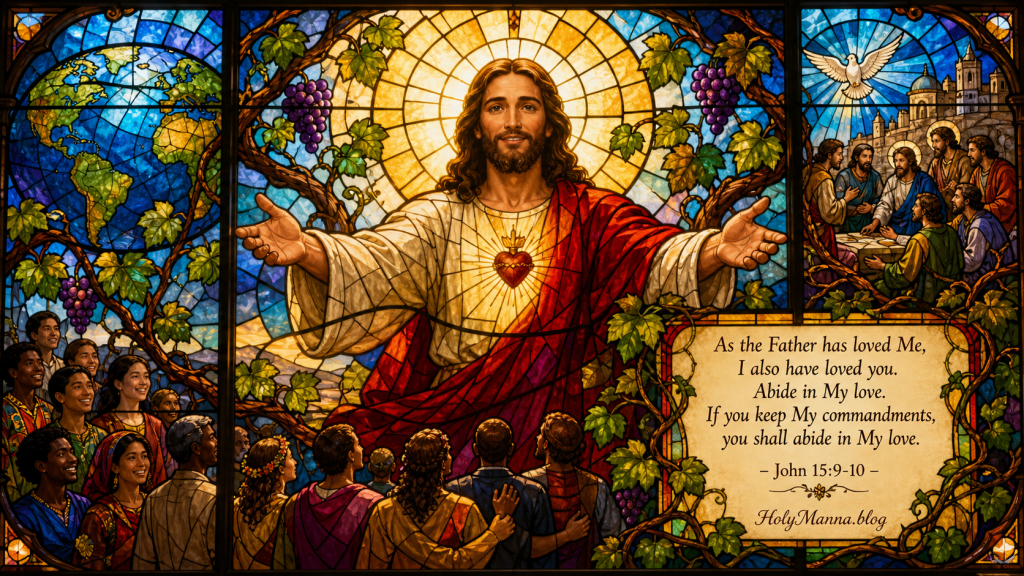
Then John 15:9-11 reveals the heart behind it all. Jesus does not merely invite His disciples into a system of belief. He invites them into His own relationship with the Father: “As the Father loves me, so I also love you. Remain in my love” John 15:9. To remain in that love means keeping His commandments, not as fearful servants trying to earn affection, but as beloved children living inside the grace they have received.
The central theme of today’s readings is this: the grace of Christ opens the door to salvation, forms us in obedient love, and sends us out with joy to proclaim His glory. The Church is most herself when she welcomes what God is doing, guards the truth with charity, and teaches the nations to remain in the love of Jesus. Where is Christ inviting your heart to trade unnecessary burdens for deeper obedience, greater freedom, and complete joy?
First Reading – Acts 15:7-21
The Church Learns How Grace Opens the Door Without Lowering the Call
The first reading places us inside one of the most important moments in the history of the early Church: the Council of Jerusalem. The Gospel had begun to spread beyond the Jewish people into the Gentile world, and a difficult question had to be answered. Did Gentile converts need to be circumcised and observe the full Mosaic Law in order to be saved, or was faith in Jesus Christ enough to bring them fully into the covenant family of God?
This was not a casual debate about preferences. For the Jewish people, circumcision, dietary practices, and the Law of Moses were deeply tied to covenant identity. These practices had marked Israel as God’s chosen people for generations. Yet now, through the preaching of Peter, Paul, and Barnabas, Gentiles were receiving the Holy Spirit and believing in Christ. The Church had to discern whether God was doing something new while still remaining faithful to everything He had promised through Israel.
This reading fits beautifully into today’s central theme: the grace of Christ opens the door to salvation, forms believers in obedient love, and sends the Church to proclaim God’s glory among all nations. Peter speaks with apostolic clarity. James speaks with pastoral wisdom. Paul and Barnabas testify to what God has done. The whole Church learns that salvation is not earned through ritual burden, but received through the grace of the Lord Jesus. Yet that grace still calls believers to holiness, charity, and communion.
Acts 15:7-21 – New American Bible (Revised Edition)
7 After much debate had taken place, Peter got up and said to them, “My brothers, you are well aware that from early days God made his choice among you that through my mouth the Gentiles would hear the word of the gospel and believe. 8 And God, who knows the heart, bore witness by granting them the holy Spirit just as he did us. 9 He made no distinction between us and them, for by faith he purified their hearts. 10 Why, then, are you now putting God to the test by placing on the shoulders of the disciples a yoke that neither our ancestors nor we have been able to bear? 11 On the contrary, we believe that we are saved through the grace of the Lord Jesus, in the same way as they.” 12 The whole assembly fell silent, and they listened while Paul and Barnabas described the signs and wonders God had worked among the Gentiles through them.
James on Dietary Law. 13 After they had fallen silent, James responded, “My brothers, listen to me. 14 Symeon has described how God first concerned himself with acquiring from among the Gentiles a people for his name. 15 The words of the prophets agree with this, as is written:
16 ‘After this I shall return
and rebuild the fallen hut of David;
from its ruins I shall rebuild it
and raise it up again,
17 so that the rest of humanity may seek out the Lord,
even all the Gentiles on whom my name is invoked.
Thus says the Lord who accomplishes these things,
18 known from of old.’19 It is my judgment, therefore, that we ought to stop troubling the Gentiles who turn to God, 20 but tell them by letter to avoid pollution from idols, unlawful marriage, the meat of strangled animals, and blood. 21 For Moses, for generations now, has had those who proclaim him in every town, as he has been read in the synagogues every sabbath.”
Detailed Exegesis
Verse 7 – “After much debate had taken place, Peter got up and said to them, ‘My brothers, you are well aware that from early days God made his choice among you that through my mouth the Gentiles would hear the word of the gospel and believe.’”
Peter rises after much debate, which shows that the early Church did not avoid hard questions. The Apostles listened, discussed, and discerned together. Yet Peter’s voice carries special weight because Christ had entrusted him with the keys of the kingdom in Matthew 16:18-19. Peter reminds the assembly that God had already chosen him to preach the Gospel to the Gentiles, especially in the conversion of Cornelius in Acts 10. This was not Peter’s private idea. It was God’s action.
Verse 8 – “And God, who knows the heart, bore witness by granting them the holy Spirit just as he did us.”
Peter points to the Holy Spirit as the decisive witness. God does not merely judge by external observance. He knows the heart. The Gentiles had received the same Holy Spirit given to the Jewish believers at Pentecost. This means God Himself had confirmed their entrance into the Church. The heart of Catholic faith is visible here: the Church discerns doctrine not by trends or pressure, but by what God has revealed and accomplished through Christ and the Holy Spirit.
Verse 9 – “He made no distinction between us and them, for by faith he purified their hearts.”
This verse is the turning point. God made no distinction between Jewish and Gentile believers in the matter of salvation. Their hearts were purified by faith, not by circumcision or ritual observance. This does not mean external obedience is meaningless. It means that salvation begins with God’s grace received by faith. The purification of the heart is an interior work of God, which then bears fruit in a holy life.
Verse 10 – “Why, then, are you now putting God to the test by placing on the shoulders of the disciples a yoke that neither our ancestors nor we have been able to bear?”
Peter warns that requiring Gentiles to carry the full yoke of the Mosaic Law would be putting God to the test. The “yoke” here refers to the burden of the Law understood as a complete covenant system. Israel had struggled to bear it faithfully. Peter is not insulting the Law, which was holy and given by God. He is saying that the Law could not save. Christ came to fulfill the Law and bring salvation through grace. To demand the old yoke as necessary for salvation would be to resist what God had already revealed in Christ.
Verse 11 – “On the contrary, we believe that we are saved through the grace of the Lord Jesus, in the same way as they.”
This is the theological heart of the reading. Peter does not say the Gentiles are saved like the Jews. He says Jews and Gentiles alike are saved through the grace of the Lord Jesus. That order matters. Nobody enters salvation by ancestry, achievement, or religious résumé. Everyone is saved by grace. This is deeply Catholic. Grace comes first. Human cooperation follows. Holiness is the fruit of grace, not the price paid to purchase it.
Verse 12 – “The whole assembly fell silent, and they listened while Paul and Barnabas described the signs and wonders God had worked among the Gentiles through them.”
The silence of the assembly is reverent. After Peter’s testimony, Paul and Barnabas share what God has done among the Gentiles. The signs and wonders confirm that the mission to the Gentiles is not a human project. God is acting. The Church is learning to recognize His fingerprints. This is also a beautiful picture of apostolic unity: Peter gives doctrinal clarity, Paul and Barnabas offer missionary testimony, and the whole Church listens.
Verse 13 – “After they had fallen silent, James responded, ‘My brothers, listen to me.’”
James, the leader of the Church in Jerusalem, now speaks. His role is pastoral and practical. He must help the local Church, especially Jewish Christians, understand how Gentile believers can be welcomed without creating scandal or division. The Church’s discernment is not only about abstract doctrine. It is also about communion, charity, and how real people live together as one body in Christ.
Verse 14 – “Symeon has described how God first concerned himself with acquiring from among the Gentiles a people for his name.”
James refers to Peter as Symeon, using the Hebrew form of his name. He recognizes that Peter’s testimony reveals God’s initiative. The phrase “a people for his name” is important because it was traditionally used for Israel. Now James sees that Gentiles, too, are being gathered into God’s covenant people through Christ. This does not erase Israel. It shows the fulfillment of God’s promise that all nations would be blessed.
Verse 15 – “The words of the prophets agree with this, as is written:”
James turns to Scripture. This is a model for Catholic discernment. The Church does not simply follow experiences, even powerful ones. She interprets them in light of divine revelation. The Holy Spirit’s work among the Gentiles agrees with the prophets. True development in the Church never contradicts what God has revealed. It unfolds its meaning more fully.
Verse 16 – “‘After this I shall return and rebuild the fallen hut of David; from its ruins I shall rebuild it and raise it up again,”
James quotes the prophet Amos. The “fallen hut of David” points to the restoration of David’s kingdom. For Catholics, this restoration is fulfilled in Jesus Christ, the Son of David, whose kingdom is the Church. What seemed ruined is raised up again in Christ. The Church is not merely a human institution. She is the restored people of God gathered under the reign of the Messiah.
Verse 17 – “so that the rest of humanity may seek out the Lord, even all the Gentiles on whom my name is invoked. Thus says the Lord who accomplishes these things,”
The restoration of David’s house has a missionary purpose. It is not only for Israel, but for all humanity. The Gentiles are not an afterthought. They are part of God’s plan. This verse connects directly with Psalm 96:3: “Tell his glory among the nations; among all peoples, his marvelous deeds.” The Church’s mission to the nations is not a modern invention. It is rooted in the prophets and fulfilled in Christ.
Verse 18 – “known from of old.’”
God’s plan was known from ancient times. What feels new to the early Church is not new to God. This is comforting. The Church may face surprising moments in history, but God is never surprised. His plan unfolds through time, often in ways that stretch His people beyond what they expected.
Verse 19 – “It is my judgment, therefore, that we ought to stop troubling the Gentiles who turn to God,”
James reaches a pastoral conclusion. Gentile converts should not be troubled with unnecessary burdens. This does not mean doctrine should be softened. It means the Church must not make salvation harder than Christ makes it. There is a serious warning here for every generation. Catholics must never confuse the saving demands of the Gospel with personal preferences, cultural habits, or extra burdens that obscure the mercy of God.
Verse 20 – “but tell them by letter to avoid pollution from idols, unlawful marriage, the meat of strangled animals, and blood.”
James gives four requirements. These address idolatry, sexual immorality, and practices especially offensive to Jewish Christians. The point is not that Gentiles are free to live however they want. They must reject pagan worship and immoral living. They must also act with charity toward Jewish believers so that table fellowship and ecclesial unity can be preserved. Grace welcomes them fully, but grace also teaches them how to live as members of one holy Church.
Verse 21 – “For Moses, for generations now, has had those who proclaim him in every town, as he has been read in the synagogues every sabbath.”
James recognizes the deep presence of Jewish communities throughout the ancient world. Gentile Christians would often live near Jews and Jewish Christians who heard Moses read every Sabbath. The instructions are therefore practical and charitable. The Church is protecting unity. The Gentiles are not required to become Jews, but they are asked to live in a way that does not create unnecessary division. Christian freedom must always be shaped by love.
Teachings: The Apostolic Church Guards Grace and Unity
This reading shows the Church acting as the Church: apostolic, scriptural, pastoral, and guided by the Holy Spirit. The Council of Jerusalem is a living example of how the Church discerns truth. The Apostles do not take a vote to invent doctrine. They listen to testimony, interpret events through Scripture, honor Peter’s witness, and make a decision for the good of the whole Church.
The heart of the reading is the Catholic teaching on grace. Peter says, “We believe that we are saved through the grace of the Lord Jesus” Acts 15:11. The Catechism of the Catholic Church teaches, “Our justification comes from the grace of God. Grace is favor, the free and undeserved help that God gives us to respond to his call to become children of God, adoptive sons, partakers of the divine nature and of eternal life” CCC 1996.
That quote gives the key to the whole passage. Grace is free and undeserved, but it is not inactive. It enables a response. It makes us children of God. It brings us into divine life. The Gentiles are not welcomed because standards no longer matter. They are welcomed because Christ has opened the way, and now they are called to live as God’s holy people.
The Catechism also teaches, “The first work of the grace of the Holy Spirit is conversion, effecting justification in accordance with Jesus’ proclamation at the beginning of the Gospel: ‘Repent, for the kingdom of heaven is at hand’” CCC 1989. This connects directly to the Gentiles in Acts 15. Their hearts were purified by faith, but that purification also meant conversion. They had to leave idols behind. They had to reject sexual immorality. They had to learn charity in communion with the whole Church.
St. Augustine captured the mystery of grace and cooperation in a famous teaching: “He who created you without you will not justify you without you” Sermon 169. This does not mean human effort earns salvation. It means God’s grace does not treat us like lifeless objects. Grace awakens the heart, calls for faith, and invites cooperation. Peter defends grace. James explains what cooperation looks like in community.
This reading also foreshadows the Church’s later councils. From Jerusalem onward, the Church has gathered to clarify doctrine, defend the faith, and protect communion. The pattern is already here: the Apostles face confusion, seek the Holy Spirit, read the moment through Scripture, and speak with authority. This is why Catholic faith is not built on private interpretation. It is received through the Church Christ founded, the Church that continues to teach with apostolic authority.
Reflection: Living Free Without Living Careless
This reading speaks powerfully to Catholics today because many people still misunderstand grace. Some think faith is mainly about carrying religious burdens. Others think grace means nothing is required. The Council of Jerusalem shows a better way. Christ removes the yoke that cannot save and gives the grace that can. Then He teaches His people to live in holiness, charity, and joy.
In daily life, this means Catholics should be careful not to place unnecessary burdens on others. A person returning to Mass, learning to pray, seeking confession after years away, or trying to understand the faith does not need suspicion first. That person needs truth, patience, and a real encounter with the mercy of Jesus Christ. The Church should never make people feel as if they must become culturally perfect before they can come to Christ.
At the same time, this reading does not excuse shallow discipleship. James still tells the Gentiles to turn away from idols and immoral living. Every Catholic has modern idols to renounce. Comfort can become an idol. Approval can become an idol. Money, lust, politics, entertainment, and control can all become false gods. Grace does not leave those idols untouched. Grace gives the strength to walk away from them.
A simple way to live this reading is to examine whether faith is being lived as a burden or as a gift. The commandments of Christ are not chains. They are the path of love. The sacraments are not religious chores. They are encounters with grace. The Church is not a club for the flawless. She is the household of God, where sinners are purified, strengthened, and taught how to love.
Another practical step is to practice charity in community. James cared about the unity of Jewish and Gentile Christians. That matters in parish life today. Not every preference is doctrine. Not every disagreement needs to become a battlefield. Catholics can hold firmly to truth while still making room for patience, reverence, and kindness.
Where has the Catholic faith started to feel like a yoke Christ never placed on your shoulders?
Where might Christ be asking you to stop calling your own preferences “truth” and start making room for charity?
Which modern idol needs to be rejected so your heart can remain purified by faith?
How can your life make it easier, not harder, for someone else to turn toward God?
The Council of Jerusalem reminds the Church in every age that grace is not weakness. Grace is the power of Christ opening the door, cleansing the heart, and building one people from every nation under heaven.
Responsorial Psalm – Psalm 96:1-3, 10
The New Song of a Church Sent to the Nations
After hearing the apostles discern how Gentiles are welcomed into the Church by the grace of Jesus Christ, Psalm 96:1-3, 10 rises like the Church’s joyful response. The Council of Jerusalem in Acts 15:7-21 shows the door of salvation opening to the nations. This Psalm gives that moment a voice. It is not the song of one tribe guarding a private treasure. It is the song of God’s people realizing that the Lord’s glory is meant to be proclaimed “among the nations” and “among all peoples” Psalm 96:3.
In its original setting, Psalm 96 belongs to Israel’s worship of the Lord as King. Israel knew that the God of Abraham, Isaac, and Jacob was not one local deity among many. He was the Creator, Judge, and King of all the earth. That is why this Psalm fits today’s theme so perfectly. The grace of Christ opens salvation to the Gentiles, and the whole earth is invited to sing. The “new song” is not just a prettier hymn. It is the sound of redemption spreading outward until every nation is invited to know the Lord, bless His name, and live under His just and merciful reign.
Psalm 96:1-3, 10 – New American Bible (Revised Edition)
God of the Universe
1 Sing to the Lord a new song;
sing to the Lord, all the earth.
2 Sing to the Lord, bless his name;
proclaim his salvation day after day.
3 Tell his glory among the nations;
among all peoples, his marvelous deeds.10 declare among the nations: The Lord is king.
The world will surely stand fast, never to be shaken.
He rules the peoples with fairness.
Detailed Exegesis
Verse 1 – “Sing to the Lord a new song; sing to the Lord, all the earth.”
The Psalm begins with an invitation to sing something new because God has done something new. In the light of today’s first reading, this “new song” echoes the joy of the Gentiles being welcomed into the covenant family through Christ. The whole earth is summoned, not just Israel. This is the missionary heartbeat of Catholic faith. God’s salvation is personal, but it is never private. The Church sings because grace has opened the way for every people and nation to belong to the Lord.
Verse 2 – “Sing to the Lord, bless his name; proclaim his salvation day after day.”
The Psalm moves from praise to proclamation. To bless the Lord’s name is to honor who He is, not only with words, but with a life that reflects His holiness. The phrase “day after day” shows that worship is not limited to one sacred moment. The faithful are called to proclaim salvation steadily, faithfully, and publicly. This connects directly to the apostolic mission. The Church does not announce self-help, moral improvement, or cultural identity. She proclaims salvation in Jesus Christ, the grace Peter defended in Acts 15:11.
Verse 3 – “Tell his glory among the nations; among all peoples, his marvelous deeds.”
This verse is the bridge between the Psalm and the Council of Jerusalem. God’s glory is to be told among the nations. His marvelous deeds are to be announced among all peoples. The Gentiles are not outsiders being tolerated at the edge of the Church. They are invited into the praise of the living God. This is why the Church is missionary by nature. Every generation receives the Gospel so that it can hand it on. Every parish, family, and Catholic home becomes a small place where the glory of God can be made known.
Verse 10 – “Declare among the nations: The Lord is king. The world will surely stand fast, never to be shaken. He rules the peoples with fairness.”
The Psalm reaches its royal proclamation: the Lord is King. This is not merely a comforting spiritual phrase. It is a claim about reality. Nations rise and fall. Cultures change. Human systems tremble. Yet the Lord reigns, and His justice is steady. For the early Church, this truth mattered deeply. Gentiles were not being gathered into a fragile human movement. They were being brought under the kingship of Christ. His rule is fair, merciful, and true. His kingdom is not built by domination, but by grace, truth, and love.
Teachings: The Missionary Song of the Catholic Church
The Psalm teaches that true worship always becomes mission. A heart that has received salvation cannot remain silent forever. This is why Psalm 96 is such a powerful response to Acts 15. Once Peter proclaims that Jews and Gentiles are saved through the grace of the Lord Jesus, the Psalm teaches the Church what to do next: sing, bless, proclaim, and declare the Lord’s kingship among the nations.
The Catechism of the Catholic Church teaches this missionary identity clearly: “The missionary mandate. ‘Having been divinely sent to the nations that she might be the universal sacrament of salvation,’ the Church, in obedience to the command of her founder and because it is demanded by her own essential universality, strives to preach the Gospel to all men.” CCC 849
This is the Church living Psalm 96. She is sent to the nations because Christ is King of the nations. Catholic mission is not spiritual marketing. It is obedience to Jesus and love for souls. The Church does not proclaim herself. She proclaims the salvation of God, day after day.
The Catechism also reminds the faithful that worship is not detached from beauty, song, and sacred praise: “The musical tradition of the universal Church is a treasure of inestimable value, greater even than that of any other art.” CCC 1156 This matters because the Psalm does not begin with an argument. It begins with song. The faith is true, but it is also beautiful. The nations are not only taught doctrines. They are invited into worship.
St. Augustine, preaching on this Psalm according to the ancient numbering, understood the “new song” as the song of a renewed life. He taught, “The new song is of the new man; the old song is of the old man.” St. Augustine, Expositions on the Psalms, Psalm 95 In other words, the song is not truly new unless the heart is being made new. The Christian cannot sing the new song while clinging comfortably to the old life of sin. Grace gives the melody, but conversion lets the soul sing it honestly.
That is why this Psalm belongs so naturally beside John 15:9-11. Jesus says, “Remain in my love” John 15:9. The new song comes from a heart that remains in Christ. The Church’s mission is most credible when her praise flows from obedience, charity, and joy.
Reflection: Letting the New Song Become a Life
Psalm 96 asks a simple but searching question: what song is a Catholic life singing? Every person proclaims something. Some lives proclaim anxiety. Some proclaim ambition. Some proclaim resentment. Some proclaim comfort as the highest good. The Christian is called to proclaim something better: the Lord is King, His salvation is real, and His grace is still changing hearts.
This does not mean every Catholic needs a microphone, a platform, or a public ministry. The Psalm says to proclaim His salvation “day after day” Psalm 96:2, and that usually begins in ordinary places. It begins in how a husband speaks to his wife, how a parent teaches a child to pray, how a worker refuses dishonesty, how a friend offers mercy instead of gossip, and how a parishioner welcomes someone who looks unsure in the pew.
The “new song” is sung through daily faithfulness. It is sung when Mass becomes the center of the week. It is sung when confession becomes a regular return to grace. It is sung when Catholics bless the Lord’s name not only with lips, but with choices. It is sung when believers stop treating the faith like a private hobby and start seeing it as good news for the whole world.
A practical way to live this Psalm is to choose one concrete act of proclamation today. Speak one honest word about God’s goodness. Invite one person to Mass. Share one moment of gratitude at dinner. Pray one decade of the Rosary for someone far from the Church. Refuse to hide the joy of belonging to Christ.
What does your life currently proclaim most loudly to the people around you?
Is the “new song” of grace visible in your daily habits, speech, and relationships?
Where is the Lord asking you to stop living like faith is private and start proclaiming His salvation with humble courage?
The Church sings because Christ reigns. She sings because grace has opened the door. She sings because the nations are still waiting to hear that the Lord is King, His mercy is real, and His joy is meant for every heart.
Holy Gospel – John 15:9-11
The Joy That Comes From Remaining in the Love of Christ
The Holy Gospel brings today’s readings to their deepest center. In Acts 15:7-21, the apostles discern that salvation comes through the grace of the Lord Jesus, not through placing unnecessary burdens on the shoulders of new believers. In Psalm 96:1-3, 10, the whole earth is invited to sing a new song and proclaim God’s salvation among the nations. Now, in John 15:9-11, Jesus reveals the heart of that grace and mission: the disciple must remain in His love.
These words come from the Last Supper discourse, spoken on the night before the Cross. Jesus is not giving abstract religious advice. He is speaking as the Son who has lived in perfect communion with the Father and is about to reveal that love fully through His Passion. The disciples are about to face fear, confusion, and sorrow. So Jesus gives them the secret of Christian life: remain in His love, keep His commandments, and receive His joy.
This Gospel fits today’s theme because it shows what grace is for. Grace does not merely open the door to salvation. Grace brings the soul into communion with the love of Christ. That love then becomes obedience, and that obedience becomes joy. The Catholic life is not built on fear, performance, or self-made holiness. It is built on abiding in the love of Jesus, the same love He receives eternally from the Father.
John 15:9-11 – New American Bible (Revised Edition)
9 As the Father loves me, so I also love you. Remain in my love. 10 If you keep my commandments, you will remain in my love, just as I have kept my Father’s commandments and remain in his love.
11 “I have told you this so that my joy may be in you and your joy may be complete.
Detailed Exegesis
Verse 9 – “As the Father loves me, so I also love you. Remain in my love.”
This verse is almost too beautiful to rush past. Jesus does not say He loves His disciples in a small or distant way. He says His love for them flows from the love between the Father and the Son. The same divine love that lives eternally within the Holy Trinity is now offered to the disciples. This is the foundation of Christian identity. Before the disciple works, sacrifices, teaches, evangelizes, or obeys, the disciple is loved.
The command to “Remain in my love” is not passive. It means staying rooted in Christ, like branches in the vine. A Christian remains in Christ through faith, prayer, the sacraments, charity, and obedience. This connects directly to the first reading. The Gentiles are welcomed by grace, but they are not called to drift. They are called into a living communion with Jesus.
Verse 10 – “If you keep my commandments, you will remain in my love, just as I have kept my Father’s commandments and remain in his love.”
Jesus immediately explains what remaining in His love looks like. Love and obedience are not enemies. In the modern world, obedience often sounds cold, restrictive, or childish. In the Gospel, obedience is the shape of love. Jesus Himself obeys the Father, not because He lacks freedom, but because His whole life is perfect Sonship.
This verse protects Catholics from two common mistakes. The first mistake is legalism, which treats obedience as a way to earn God’s love. The second mistake is sentimentality, which speaks of love while ignoring Christ’s commandments. Jesus rejects both. His disciples keep His commandments because they remain in His love, and they remain in His love by keeping His commandments.
Verse 11 – “I have told you this so that my joy may be in you and your joy may be complete.”
Jesus reveals the purpose of His teaching: complete joy. This is striking because He is speaking on the night before His crucifixion. The joy He promises is not shallow happiness, comfort, or convenience. It is the joy of communion with God. It is the joy of knowing that one is loved, forgiven, guided, and held by Christ.
This joy is not separated from obedience. It grows inside obedience. The world often promises joy through self-rule, but Christ promises joy through remaining in His love. This is why the commandments are not a prison. They are the guardrails of communion. They protect the soul from the false freedoms that leave people empty.
Teachings: Charity Is the Life of the Commandments
The Gospel teaches that the Christian life begins in divine love and matures through obedient charity. Jesus does not command His disciples from a distance. He draws them into His own relationship with the Father. This is why Catholic morality can never be reduced to rule-keeping. The commandments are real, serious, and binding, but they are meant to form the soul in love.
The Catechism of the Catholic Church teaches, “Fruit of the Spirit and fullness of the Law, charity keeps the commandments of God and his Christ: ‘Abide in my love. If you keep my commandments, you will abide in my love.’” CCC 1824
This is the exact heart of John 15:9-11. Charity is not vague niceness. Charity keeps the commandments. It loves God above all things and neighbor for God’s sake. A disciple does not remain in Christ’s love by feelings alone, but by allowing grace to shape choices, habits, words, desires, and relationships.
The Catechism also teaches, “The practice of the moral life animated by charity gives to the Christian the spiritual freedom of the children of God. He no longer stands before God as a slave, in servile fear, or as a mercenary looking for wages, but as a son responding to the love of him who ‘first loved us.’” CCC 1828
This quote helps explain why Jesus connects obedience with joy. Christian obedience is not slavery. It is the freedom of sons and daughters. It is not the anxious performance of someone trying to earn wages from God. It is the loving response of someone who has already been loved first.
St. Augustine, reflecting on the vine and branches in The Gospel of John, taught that the disciple’s fruitfulness depends entirely on remaining in Christ. He wrote, “For whether it be little or much, without Him it cannot be done without whom nothing can be done.” St. Augustine, Tractates on the Gospel of John, Tractate 81
That teaching cuts through spiritual pride. Nobody produces holiness apart from Christ. Nobody manufactures charity by willpower alone. Nobody creates lasting joy by self-improvement alone. The branch lives because it remains in the vine. The Christian lives because Christ lives in him.
St. Thomas Aquinas also explains that joy is a proper effect of charity because love brings union with the beloved. In Summa Theologiae, he teaches, “Joy is caused by love, either through the presence of the thing loved, or because the proper good of the thing loved exists and endures.” St. Thomas Aquinas, Summa Theologiae, II-II, Question 28, Article 1
This helps make sense of Jesus’ promise. His joy becomes complete in the disciple because His love brings the soul into union with Him. Joy is not the reward for escaping the commandments. Joy is the fruit of remaining in the love that the commandments protect.
Reflection: Remaining When Life Pulls the Heart Away
This Gospel speaks directly into ordinary Catholic life. Many people want joy, but they look for it in places that cannot hold the weight of the human heart. They look for it in control, success, comfort, attention, pleasure, or being right. Those things may give a quick lift, but they cannot give complete joy. Jesus offers something deeper. He offers His own joy.
To live this Gospel, the first step is to return daily to the fact of being loved by Christ. Prayer should not begin with self-accusation or spiritual panic. It should begin with the truth Jesus speaks: “As the Father loves me, so I also love you” John 15:9. The disciple who knows he is loved can repent honestly without despair. He can obey without resentment. He can serve without needing applause.
The second step is to examine obedience with maturity. The commandments are not suggestions, and they are not arbitrary tests. They reveal the path of love. A Catholic who wants to remain in Christ’s love should look honestly at the places where life has drifted from His commandments. That may involve Sunday Mass, confession, chastity, forgiveness, honesty, generosity, humility, or the way one speaks about others.
The third step is to protect joy by staying close to the sacraments. The Eucharist strengthens communion with Christ. Confession restores the soul when sin has wounded that communion. Daily prayer keeps the branch attached to the vine. These are not boxes to check. They are ways of remaining.
Finally, this Gospel invites Catholics to stop treating joy as something that comes after life becomes easy. Jesus speaks of joy on the edge of the Cross. That means Christian joy can survive suffering, uncertainty, and sacrifice. It is not fragile because it rests in Christ.
Where is Jesus asking your heart to remain instead of running toward distraction?
Which commandment feels heavy right now because it has been separated from the love of Christ?
Do your daily habits help you remain in His love, or do they slowly pull your heart away from Him?
What would change this week if obedience were seen not as a burden, but as a loving response to the One who loved first?
The Gospel closes with a promise worth carrying into the day: Christ does not command so that joy will shrink. He commands so that joy may become complete. His love is the home of the disciple, His commandments are the path, and His joy is the gift waiting for the heart that remains.
The Door Is Open, the Song Is New, and the Joy Is Complete
Today’s readings come together like one beautiful movement of grace. In Acts 15:7-21, the Church remembers that salvation is not won by human effort, cultural identity, or religious burden, but received through “the grace of the Lord Jesus” Acts 15:11. Peter points to the Holy Spirit already at work among the Gentiles. James protects unity with pastoral wisdom. The apostles show that the Church is most faithful when she guards the truth without placing unnecessary weight on the shoulders of those turning toward God.
Then Psalm 96:1-3, 10 gives that grace a melody. The whole earth is invited to sing, bless, proclaim, and declare that “The Lord is king” Psalm 96:10. The Gospel is not meant to stay hidden inside one nation, one parish, one family, or one heart. It is good news for every people. The Church sings a new song because Christ has opened the doors of salvation to the nations.
Finally, John 15:9-11 brings everything into the heart of Jesus. The same Lord who saves by grace and sends the Church on mission also says, “Remain in my love” John 15:9. This is where Christian life becomes real. Grace is not permission to drift. Mission is not mere activity. Obedience is not cold rule-keeping. Everything begins and ends in the love of Christ.
The Catechism of the Catholic Church captures this beautifully: “Fruit of the Spirit and fullness of the Law, charity keeps the commandments of God and his Christ: ‘Abide in my love. If you keep my commandments, you will abide in my love.’” CCC 1824. Love is the center. Grace is the beginning. Obedience is the path. Joy is the fruit.
So today, the invitation is simple and demanding in the best possible way. Receive grace without pretending it was earned. Lay down burdens Christ never asked anyone to carry. Reject the idols that still compete for the heart. Sing the new song with a life that points others toward God. Remain close to Jesus in prayer, the sacraments, obedience, and charity.
Where is Christ inviting your heart to receive His grace more deeply today?
What unnecessary burden needs to be surrendered so that joy can grow again?
How can your life proclaim, quietly but clearly, that the Lord is King?
The Church does not belong to fear. The disciple does not belong to isolation. The heart that remains in Christ belongs to love. And where His love is received, His joy does not remain partial. It becomes complete.
Engage with Us!
Share your reflections in the comments below. Today’s readings give the Church a beautiful path to walk: receive the grace of Jesus, sing the new song of salvation, and remain in His love with obedient joy.
- For the First Reading, Acts 15:7-21: Where might God be asking you to let go of an unnecessary burden, either one you carry yourself or one you place on others, so that His grace can be received more freely?
- For the Responsorial Psalm, Psalm 96:1-3, 10: What “new song” is the Lord inviting you to sing through your words, choices, family life, parish life, or witness in the world?
- For the Holy Gospel, John 15:9-11: What does it look like in your daily life to remain in the love of Christ, especially when obedience feels difficult or joy feels distant?
May this day become a small but real act of faith. Walk with the Church, trust the grace of Jesus, proclaim His goodness with courage, and do everything with the love and mercy He taught us.
Sacred Heart of Jesus, we trust in You!
Immaculate Heart of Mary, pray for us!
Saint Michael the Archangel, defend us in battle!
Follow us on YouTube, Instagram and Facebook for more insights and reflections on living a faith-filled life.


Leave a comment