The Merchant Who Bought Back the Captive
Saint Peter Nolasco is one of those saints whose life feels almost impossible to imagine in a comfortable age. He was not famous because he preached to crowds, wrote great theological works, or ruled a monastery from behind stone walls. He became a saint by looking at suffering people in chains and deciding that Christian love had to do something about it.
He lived in the thirteenth century, in the world of medieval Barcelona, when the Mediterranean was marked by war, raids, slavery, ransom, and religious conflict. Christians were sometimes captured and taken into Muslim territories, where many suffered poverty, loneliness, pressure, and fear. The wealthy could sometimes buy their freedom. The poor often remained forgotten.
Peter Nolasco could not forget them.
He is most known as the founder of the Order of the Blessed Virgin Mary of Mercy, also called the Mercedarians. Their mission was breathtakingly concrete. They redeemed Christian captives. They collected alms, crossed dangerous borders, negotiated ransoms, and, when necessary, offered even their own liberty in exchange for prisoners.
That is why Saint Peter Nolasco is remembered as a saint of mercy, freedom, Marian devotion, and courageous charity. His life gives flesh to the words of Christ in The Gospel of Matthew: “I was in prison and you visited me.” Matthew 25:36
The Catechism of the Catholic Church teaches that the works of mercy are charitable actions by which Christians come to the aid of their neighbor in bodily and spiritual needs. It specifically includes visiting the imprisoned among the corporal works of mercy. CCC 2447 Saint Peter Nolasco did more than visit the imprisoned. He built an entire religious family to set them free.
A Young Man Formed for Mercy
The exact details of Saint Peter Nolasco’s early life are not all perfectly settled. Catholic sources generally place his birth in the late twelfth century, often around 1180 to 1182, near Mas-Saintes-Puelles in southern France, close to Castelnaudary. Older sources give slightly different dates, and even his death date is disputed in older accounts. The Mercedarian tradition now celebrates him on May 6 and places his death in Barcelona in 1245.
That uncertainty is worth mentioning because Catholic storytelling should love the truth. The Church does not need exaggeration to make a saint beautiful. Saint Peter Nolasco’s life is already stunning without inventing anything.
Tradition says he came from a family with means and that he inherited his father’s profession as a merchant. This detail matters. Peter was not originally known as a priest, monk, or scholar. He was a layman with practical skills. He understood money, travel, trade, risk, ports, negotiations, and the movement of goods across borders.
God used all of that.
The same skills that could have made him merely successful in business became tools of mercy. In Barcelona, a great Mediterranean city, Peter encountered the tragedy of Christian captivity. He saw men and women who had been seized, sold, trapped, and forgotten. He saw families broken apart. He saw poor Christians in danger not only physically but spiritually, since captivity could place pressure on their faith.
There is an old devotional tradition that, even as a child, Peter showed unusual compassion for the poor. Stories say he gave generously from what he had and was moved deeply by suffering. These childhood stories cannot all be verified in the modern historical sense, but they express what the Catholic memory has always seen in him: mercy was not an accessory to his life. Mercy was the road God used to make him a saint.
When Charity Became a Mission
By the early 1200s, Peter and his companions were already collecting alms in Catalonia and Aragon to ransom Christian captives. Before the Mercedarians became a formal religious order, there was already a movement of mercy. A lay merchant and his companions were asking a very uncomfortable question: What is Christian love worth if it does not reach the person in chains?
That question still stings.
According to Mercedarian tradition, the decisive moment came in 1218. On the night of August 1 to 2, the Blessed Virgin Mary appeared to Peter Nolasco and inspired him to found a religious order dedicated to the redemption of captives. Tradition also says that King James I of Aragon and Saint Raymond of Peñafort received a similar heavenly inspiration. Since the historical documentation around these visions comes through later tradition, they should be presented reverently as part of the Mercedarian story, not as something that can be proven in every detail by modern records.
Still, the fruit is undeniable.
On August 10, 1218, in the Cathedral of the Holy Cross in Barcelona, Peter Nolasco and his companions formally began the Order of the Blessed Virgin Mary of Mercy. Bishop Berenguer de Palou gave them the Rule of Saint Augustine, and King James I gave civil support to the new order. Pope Gregory IX later confirmed the Order in 1235, giving it formal standing within the Church.
The mission was simple, terrifying, and profoundly Catholic. These men would belong to Christ through Mary, and they would spend themselves for captives.
A traditional Marian saying connected to the founding expresses the spirit of the Mercedarian vocation: “Find me men like yourself, an army of brave, generous, unselfish men.” This is not a verified quotation from Saint Peter Nolasco himself. It is a devotional saying attributed to Our Lady in the Mercedarian tradition, and it captures the heart of the order beautifully.
The Church needed brave mercy. Peter gave his life to it.
The Fourth Vow and the Price of Freedom
The Mercedarians made the usual religious vows of poverty, chastity, and obedience. But they added a fourth vow that made their mission especially radical. They promised to give themselves, even their own liberty, for the redemption of captives whose faith was in danger.
That means a Mercedarian friar could go to ransom a prisoner and, if there was not enough money, remain behind as a hostage so the captive could go free.
That is not sentimental charity. That is cruciform charity.
Saint Peter Nolasco’s vision was rooted in the mystery of Christ the Redeemer. Jesus does not save humanity from a distance. He enters into our captivity. He takes on flesh. He carries the Cross. He pays the price of love with His own life. The Mercedarian fourth vow became a visible sign of that Gospel logic.
The Catechism teaches that human freedom reaches perfection when directed toward God. CCC 1731 Saint Peter Nolasco understood that captivity was not merely a political or economic problem. It was a human and spiritual wound. A person made in the image of God should not be treated as property. A Christian brother or sister should not be abandoned when faith, dignity, and freedom are under threat.
His life also echoes the Church’s teaching on love for the poor. The Catechism says that the Church’s love for the poor belongs to her constant tradition and is inspired by the Gospel of the Beatitudes, the poverty of Jesus, and His concern for the poor. CCC 2444 Peter Nolasco looked at the poorest captives, the ones who could not pay for themselves, and saw Christ waiting for mercy.
A Life Spent Crossing Borders
Saint Peter Nolasco’s life after the founding of the Order was full of movement, danger, and practical charity. He and his friars collected alms from the faithful in Christian lands, then used those funds to redeem captives in Muslim-controlled territories. Their work required courage, diplomacy, patience, and a willingness to enter unstable and dangerous places.
Mercedarian tradition says Peter helped organize ransom missions across the Mediterranean world and into regions such as Valencia, Granada, North Africa, and other areas associated with captivity. Some older Catholic accounts say he personally traveled to Africa, ransomed captives, and even suffered imprisonment. These details come from traditional hagiography, so they should be received as part of the saint’s devotional memory while recognizing that not every event can be verified with equal certainty.
The Order’s own tradition says that thousands of captives were redeemed during his lifetime. Some Mercedarian sources give the number as 3,920 captives redeemed between the foundation of the Order and his death. Other later summaries give different totals, including larger numbers connected to the wider history of the Order. The exact number is less important than the undeniable fact that Peter’s work became a massive river of mercy flowing through the Church.
One traditional saying attributed to Saint Peter Nolasco is connected to the way he saw poor Christian captives. When he looked at them, he is said to have called them “eternal treasures which never fail.” Since this comes through later devotional tradition, it should not be treated as a verified written quotation. But it is deeply fitting. Peter saw what the world did not see. The captive was not useless. The prisoner was not forgotten. The poor man in chains was an eternal treasure.
That is the Catholic view of the human person.
Stories of Heaven Near the Captive
Several famous stories surround Saint Peter Nolasco, and they reveal how Catholics have remembered his holiness through the centuries.
The most important story is the Marian vision that led to the founding of the Mercedarians. Tradition says Our Lady herself desired a religious family dedicated to freeing captives. Whether every detail of the apparition can be historically verified or not, the story reflects a deeply Catholic truth. Mary, the Mother of Mercy, always leads souls to the saving work of her Son. At Cana she told the servants, “Do whatever he tells you.” John 2:5 In the Mercedarian tradition, she seems to say something similar to Peter Nolasco: serve Christ by freeing His suffering members.
Another famous legend says Saint Peter Nolasco longed to travel to Rome to visit the tomb of Saint Peter the Apostle, but he was prevented from going. According to the story, Saint Peter appeared to him on three consecutive nights. On the third night, the Apostle appeared crucified upside down, as tradition says he died, and told Peter Nolasco to remain in Spain because he still had work to do there. This story is preserved especially through Catholic art, including the famous works of Francisco de Zurbarán. It is a legend, and it cannot be verified in every historical detail, but it beautifully teaches that holiness is not always found in the pilgrimage we want. Sometimes it is found in the duty God places directly in front of us.
Another tradition says King James I of Aragon attributed major victories, including the conquest of Valencia and Murcia, to the prayers of Saint Peter Nolasco. Older devotional sources even say the king credited many victories to his intercession. These accounts are part of the traditional Catholic memory of the saint, though the details should be handled carefully. What matters spiritually is clear: Peter was remembered not only as a man of action, but as a man whose prayer mattered.
Miracles of Mercy During His Life
The central miracle associated with Saint Peter Nolasco during his lifetime is the Marian apparition that inspired the founding of the Order of Mercy. This is the great miracle story at the heart of his vocation. It is not merely a private consolation. It led to a public work of mercy that changed thousands of lives.
Other miracle traditions are connected to his prayers, especially the victories attributed to his intercession by King James I. These are not documented in the way modern canonization miracle reports are documented, but they belong to the devotional memory of the Church and the Mercedarian family.
There are also stories that Peter’s work among captives helped bring conversions. Some older Catholic accounts say that his charity moved some Muslims to embrace the Christian faith. These stories cannot all be verified in detail, but they are spiritually believable in the broader Catholic sense. Charity has always been one of the Church’s most persuasive forms of evangelization. As Christ says in The Gospel of John: “By this all men will know that you are my disciples, if you have love for one another.” John 13:35
Saint Peter Nolasco’s miracles were not only dramatic moments. His whole life became a sign. A merchant became a redeemer of captives. A layman became the founder of a religious order. Money became mercy. Freedom became a gift offered at personal cost.
Chains, Danger, and the Long Obedience of Love
Saint Peter Nolasco was not a martyr in the usual sense. He was not executed for the faith. But his life was marked by hardship, danger, and sacrifice. To enter the work of ransoming captives meant entering a world of risk. It meant dealing with hostile powers, unstable negotiations, travel by sea and land, disease, imprisonment, financial pressure, and the possibility of never returning.
Some traditional accounts say Peter himself was imprisoned in Algiers. This cannot be verified with the same certainty as the foundation of the Order, but it fits the larger Mercedarian charism. The men who followed Peter were willing to become captives for captives. That was the point of the fourth vow.
This is where his sanctity becomes especially challenging. Many people admire mercy when it remains safe, clean, and inexpensive. Peter Nolasco shows another kind of mercy. His mercy crossed borders. His mercy opened purses. His mercy entered prisons. His mercy accepted danger. His mercy risked being misunderstood.
The Christian life is not supposed to be reckless, but it is supposed to be generous. Saint Peter Nolasco understood that love sometimes requires more than good intentions. It requires structure, sacrifice, and perseverance.
His death is also surrounded by differing traditions. Modern Mercedarian sources place his death in Barcelona on May 6, 1245. Older Catholic sources sometimes give Christmas Day in 1256 or 1259. A careful Catholic presentation should acknowledge that the dates differ while following the current Mercedarian celebration of May 6.
One deathbed tradition says he encouraged his religious to perseverance and prayed words from the Psalms: “Our Lord hath sent redemption to his people.” This is not an original quotation from Peter, but Scripture placed on his lips in the tradition. It is a perfect summary of his life. God sent redemption to His people, and Peter Nolasco wanted to be one of the instruments.
A Legacy That Outlived the Ransom Market
After Saint Peter Nolasco’s death, his Order continued its mission. The Mercedarians expanded beyond Spain and into other parts of Europe, and later into the Americas. Over the centuries, they became part of the Church’s long witness that prisoners, captives, and the enslaved must never be forgotten.
The saint’s canonization also developed over time. In 1628, under Pope Urban VIII, his immemorial cult was officially approved for the Mercedarian family. Later, his name was inserted into the Roman Martyrology, and his cult was extended more widely in the Church. His feast was historically celebrated on January 31 in the universal calendar, but today the Mercedarian family celebrates him on May 6.
After his death, Catholic tradition says miracles occurred through his intercession and around his relics. The available traditions speak generally of miracles and veneration, but they do not provide detailed, easily verified miracle stories with names, dates, and formal records. So it is best to say this honestly: miracles were traditionally attributed to Saint Peter Nolasco after death, especially through devotion to his relics and intercession, but the specific stories are not always preserved in a way that can be verified.
His cultural impact is especially visible in devotion to Our Lady of Mercy, also called Our Lady of Ransom. The feast of Our Lady of Ransom on September 24 became closely associated with the Mercedarian mission and the memory of captives redeemed through Mary’s maternal care.
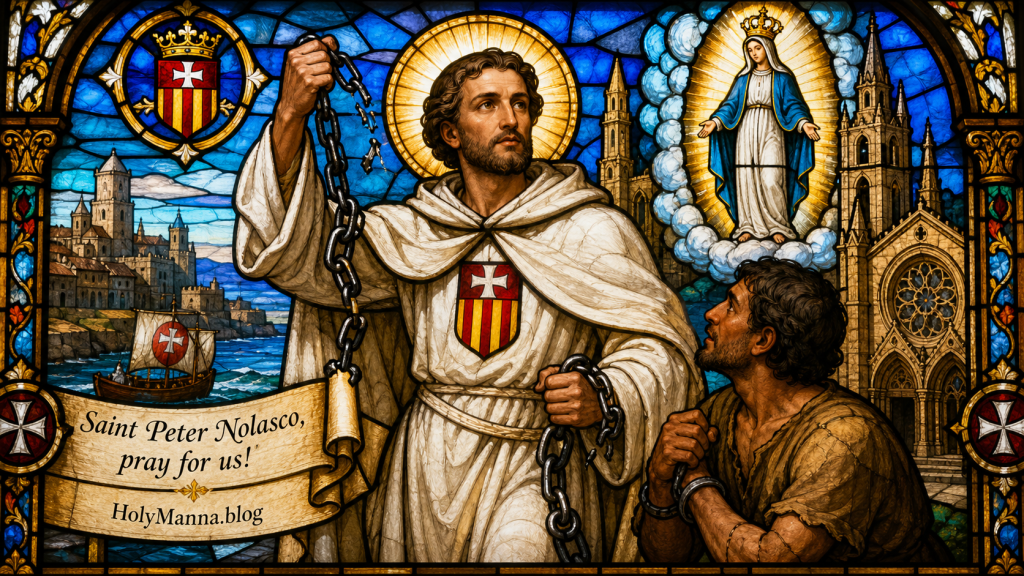
His legacy is also visible in sacred art. The great Spanish painter Francisco de Zurbarán painted scenes from the life and legends of Saint Peter Nolasco, including the apparition of Saint Peter the Apostle to the Mercedarian founder. These paintings helped give Catholic imagination a visual language for his life: the white habit, the chains, the captives, the heavenly visions, and the quiet strength of mercy.
Even the Mercedarian shield tells a story. Its cross points to the Church and to Christ’s redemption. Its red and yellow bars recall the support of the Crown of Aragon. The symbol itself reflects the union of faith, mission, and concrete historical action. The Church blessed the work. The kingdom protected the work. The saint gave his life to the work.
Today, the literal medieval ransom system is no longer the main form of the Mercedarian mission. But the charism remains painfully relevant. There are still prisoners. There are still hostages. There are still trafficked persons. There are still people trapped in addiction, sin, exploitation, pornography, despair, and fear. There are still souls in danger of forgetting their dignity.
Saint Peter Nolasco still speaks.
The Saint Who Teaches Us to Pay Attention
Saint Peter Nolasco teaches that mercy begins when a Christian refuses to look away.
He could have lived a respectable life as a merchant. He could have built wealth, protected his comfort, and offered occasional charity when convenient. Instead, he allowed the suffering of captives to disturb him. That disturbance became prayer. Prayer became action. Action became a religious order. The order became a river of mercy in the Church.
That is how grace often works. God places a wound before a Christian, and the Christian has to decide whether to protect his comfort or respond with love.
The Catechism teaches that charity is the greatest social commandment and that it requires the practice of justice and inspires a life of self-giving. CCC 1889 Saint Peter Nolasco lived that truth with remarkable clarity. His charity was not vague. It had names, faces, chains, journeys, and costs.
His life is especially powerful for modern Catholics because captivity has not disappeared. It has changed forms. Some people are physically imprisoned. Some are held in trafficking. Some are trapped in addiction. Some are enslaved by lust, anger, fear, greed, loneliness, or despair. Some are spiritually captive because they believe they are too far gone for God.
Saint Peter Nolasco reminds the Church that Christ came for captives. He came to redeem. He came to break chains. He came to bring sinners home.
Where are the captives in the world today that Christians have become too comfortable ignoring?
Who in daily life needs someone to fight for them, pray for them, visit them, encourage them, or help carry them back toward freedom?
What would mercy look like if it cost more than convenience?
Saint Peter Nolasco does not let faith remain abstract. He shows that Catholic love must become visible. It must enter real suffering. It must defend human dignity. It must be willing to sacrifice.
And in a world that often talks about freedom while leaving people enslaved to sin, exploitation, and despair, his witness is exactly the kind of holy discomfort the Church still needs.
Engage With Us!
Share your thoughts and reflections in the comments below. Saint Peter Nolasco’s life is a powerful reminder that mercy is not just a feeling. It is a decision to love people who cannot repay us.
- What part of Saint Peter Nolasco’s life challenges you the most?
- Who are the “captives” in today’s world that Catholics are called to notice and serve?
- How can you practice the corporal work of mercy of visiting the imprisoned, either literally or spiritually?
- What is one comfort God may be asking you to sacrifice so someone else can experience freedom, dignity, or hope?
- How does devotion to Our Lady of Mercy help you see suffering people with the eyes of Christ?
May Saint Peter Nolasco teach us to love with courage, to notice the forgotten, and to spend our lives in service of Christ the Redeemer. May we live our faith with mercy that moves, mercy that sacrifices, and mercy that helps set captives free. And may everything we do be done with the love and mercy Jesus taught us.
Saint Peter Nolasco, pray for us!
Follow us on YouTube, Instagram and Facebook for more insights and reflections on living a faith-filled life.


Leave a comment