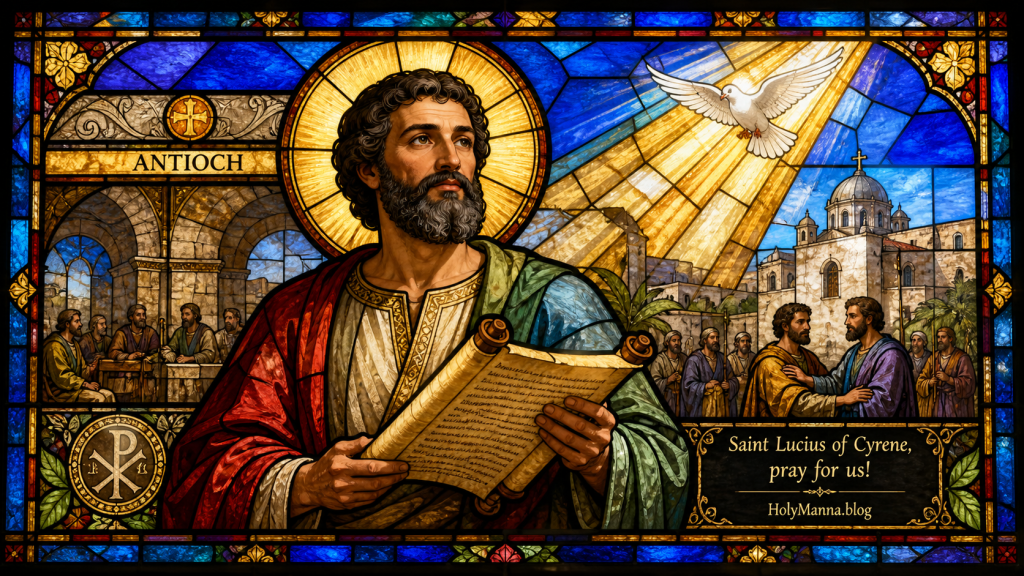
The Hidden Teacher Who Helped Send Saint Paul to the Nations
Saint Lucius of Cyrene is one of those quiet saints who appears for only a moment in Scripture, but that one moment opens a window into the heart of the early Church. He is named in The Acts of the Apostles as one of the prophets and teachers in the Church at Antioch, standing beside Barnabas, Simeon called Niger, Manaen, and Saul before Saul became known to the world as Saint Paul.
The Bible says, “Now there were in the church at Antioch prophets and teachers: Barnabas, Symeon who was called Niger, Lucius of Cyrene, Manaen who was a close friend of Herod the tetrarch, and Saul.” Acts 13:1
That one sentence tells Catholics something beautiful. Lucius was not famous like Paul. He did not leave behind a Gospel, an epistle, or a collection of sermons. Yet he stood at one of the most important missionary turning points in Christian history. He belonged to the praying, fasting, Spirit-listening Church that helped send Barnabas and Saul out to preach the Gospel to the Gentiles.
Saint Lucius is revered because he reminds the Church that hidden faithfulness matters. Not every saint becomes a household name. Some saints serve quietly, teach faithfully, pray deeply, and help others fulfill the mission God has placed before them.
A Son of Cyrene in the Young Church
Saint Lucius came from Cyrene, an ancient city in North Africa, in the region of modern-day Libya. Cyrene was an important city in the ancient world, and it had a significant Jewish population. This matters because the early Church grew through Jewish communities scattered throughout the Roman world, including North Africa.
Scripture does not tell us Lucius’ parents, childhood, education, or the exact moment he came to believe in Christ. That part of his life remains hidden. Still, his name and origin place him within the world of diaspora Judaism, where Jewish families lived outside the Holy Land but still carried the faith of Israel, prayed the Scriptures, and waited for the promises of God.
Cyrene itself had a meaningful place in the New Testament world. Simon of Cyrene carried the Cross of Jesus. People from the region near Cyrene were present at Pentecost. Men from Cyrene later helped bring the Gospel to Antioch. Scripture does not say Lucius was related to Simon of Cyrene, and it does not say Lucius was present at Pentecost. Those would be tempting connections, but they cannot be stated as fact.
What can be said is that Lucius belonged to a region already touched by the mystery of Christ and the missionary movement of the early Church.
By the time he appears in Acts 13:1, Lucius is no longer simply a believer from Cyrene. He is one of the prophets and teachers in Antioch, one of the most important Christian communities of the apostolic age.
The Church at Antioch and the Call of the Spirit
Antioch was a remarkable place. It was there that the disciples were first called Christians. It was there that Jewish and Gentile believers learned to live together in Christ. It was there that the Church began to look outward with a new missionary boldness.
Lucius was part of that world. He stood among men from different backgrounds: Barnabas from Cyprus, Simeon called Niger, Manaen who had connections to Herod’s household, and Saul, the former persecutor who would become the great Apostle to the Gentiles. This was not a comfortable little group of people who all came from the same place and thought the same way. It was a Catholic picture before the word “Catholic” became common in later centuries, a Church gathered from many peoples into one Body in Christ.
Then came the moment that made Lucius’ name unforgettable.
While the Church was worshiping and fasting, the Holy Spirit spoke: “Set apart for me Barnabas and Saul for the work to which I have called them.” Acts 13:2
Lucius was present in that sacred moment. He was part of the Church that fasted, prayed, laid hands on Barnabas and Saul, and sent them out. That means Saint Lucius was connected to the beginning of Saint Paul’s missionary journeys, which carried the Gospel deeper into the Gentile world.
This is what he is most known for. Saint Lucius was a hidden apostolic-era leader, a prophet and teacher, who helped the early Church discern and support the missionary call of Saint Paul and Saint Barnabas.
The Quiet Power of a Prophet and Teacher
The words “prophet” and “teacher” should not be rushed past. In the early Church, prophecy was not merely about predicting the future. It was a gift of the Holy Spirit given for the building up of the Church. Teaching was also a sacred responsibility. A teacher in the apostolic Church helped preserve and hand on the faith received from the apostles.
Saint Lucius was trusted with both.
That makes his life especially meaningful for Catholics today. The Church is not built only by public figures. It is also built by catechists, parents, priests, deacons, religious sisters, godparents, OCIA teachers, youth ministers, and quiet parishioners who help others hear the voice of God.
The Catechism of the Catholic Church teaches, “The Church on earth is by her nature missionary.” CCC 849
Saint Lucius lived that truth before it was ever written in a catechism. He belonged to a Church that worshiped first, fasted seriously, listened carefully, and then acted boldly.
That is a powerful lesson. The mission did not begin with noise. It began with prayer.
Life and Miracles During Life
No verified miracle stories performed by Saint Lucius during his lifetime have been preserved in the standard Catholic tradition. There are no known accounts of him healing the sick, raising the dead, escaping persecution through divine intervention, or working wonders in the way stories are preserved for some other saints.
That does not make him less holy. It simply means his sanctity is remembered differently.
The great supernatural moment associated with his life is the scene in Antioch, where the Holy Spirit speaks to the praying Church. This should not be called “Lucius’ miracle,” because Scripture does not present it that way. It is the work of the Holy Spirit in the Church. Yet Lucius was there, participating in the worship, fasting, discernment, and obedience of that community.
In a world that often wants every holy life to come with dramatic stories, Saint Lucius teaches something quieter. Sometimes holiness looks like being faithful in the room when the Holy Spirit speaks. Sometimes sanctity means helping create the spiritual conditions where others can be sent.
The Tradition That He Became Bishop of Cyrene
Later Catholic tradition often remembers Saint Lucius as the first bishop of Cyrene. This tradition is meaningful, but it should be presented carefully. Scripture does not explicitly say that Lucius became bishop of Cyrene. The Roman Martyrology is also cautious, commemorating him mainly as one of the prophets and teachers of Antioch.
Still, older hagiographical traditions and Catholic devotional sources often call him Bishop of Cyrene. His traditional emblem is the pastoral staff, which reflects that memory of him as a shepherd of the Church.
This is the main legend or traditional story associated with Saint Lucius. It is not a colorful legend filled with dragons, dramatic visions, or miraculous rescues. It is an ecclesial tradition: the man from Cyrene who served the Church at Antioch may have returned to shepherd the Church in his homeland.
If that tradition is true, then Lucius’ life forms a beautiful circle. He came from North Africa, served in the missionary Church of Antioch, helped send Paul and Barnabas to the nations, and then may have returned to guide Christians in Cyrene. That story cannot be fully verified, but it fits the Church’s ancient memory of him.
Hardships and Martyrdom
There is no reliable martyrdom account for Saint Lucius of Cyrene. The Church does not preserve a detailed story of his arrest, torture, execution, or final words. Some saints named Lucius were martyrs, including another Lucius associated with Cyrene in a later period, but that is not the same person as Saint Lucius of Acts 13:1.
This is important because early Christian names can be confusing. “Lucius” was a common name in the Roman world, and different traditions sometimes overlap or become blurred. A faithful Catholic telling of his life should avoid turning him into a martyr unless the evidence clearly supports it.
Still, Lucius lived in the apostolic age, when following Christ could bring real danger. The Church had already experienced persecution after the martyrdom of Saint Stephen. The Gospel was spreading through a world that did not always welcome it. Even if no martyrdom story is preserved for Lucius, he belonged to a generation of Christians who knew that discipleship could cost everything.
His courage was not necessarily shown by dying in a dramatic public execution. It was shown by standing with the Church, teaching the faith, listening to the Holy Spirit, and supporting the mission of the Gospel.
Miracles and Impact After Death
No verified posthumous miracles are preserved for Saint Lucius of Cyrene. There are no widely known Catholic accounts of healings at his tomb, relics connected to miraculous interventions, or major pilgrimage sites dedicated specifically to him.
There also does not appear to be a major national festival or widespread cultural celebration attached to his name. His feast day is May 6, and his veneration belongs to the ancient memory of the Church rather than to a large popular devotional movement.
Yet his impact is still real.
Saint Lucius’ legacy is found in the missionary identity of the Church. He is remembered because he stood at the moment when the Church at Antioch sent Barnabas and Saul into the wider world. That mission helped carry the Gospel to Gentile communities and shaped the future of Christianity.
He also has a special significance as an early North African figure in the New Testament Church. He reminds Catholics that Africa was not an afterthought in Christian history. From the earliest generations, African-linked believers were part of the life and mission of the Church.
That is one of the most surprising and beautiful facts about Saint Lucius. He is a biblical witness to the catholicity of the Church. Before the great African Fathers like Saint Augustine, Saint Athanasius, Saint Cyprian, and Saint Monica became pillars of Christian memory, Lucius of Cyrene was already standing in the pages of Scripture as a teacher and prophet.
A Saint for the Hidden Servant
Saint Lucius teaches a lesson that modern Catholics desperately need. Faithfulness does not always come with attention. Sometimes the holiest people in the room are not the loudest, most famous, or most visible. They are the ones who pray, fast, teach, discern, and help others follow God’s call.
The Church needs people like Saint Paul, but it also needs people like Saint Lucius. It needs missionaries, but it also needs the hidden servants who help send missionaries. It needs preachers, but it also needs teachers who patiently form hearts. It needs public witnesses, but it also needs quiet saints who make the mission possible.
The Catechism teaches, “The communion of saints is the Church.” CCC 946
Saint Lucius shows the beauty of that communion. His good was not locked inside himself. His faithfulness helped strengthen the Church. His prayer helped support mission. His teaching helped form disciples. His obedience helped open the way for the Gospel to spread.
That is not small. That is the Kingdom of God at work.
Reflection: Listening Before Going
Saint Lucius invites Catholics to recover something the early Church understood deeply: mission begins with worship. The Church at Antioch did not rush into activity first. They worshiped. They fasted. They listened. Then they obeyed.
That order matters.
Many people want clarity without prayer, mission without fasting, and purpose without surrender. Saint Lucius points to a better way. He shows that the Holy Spirit speaks to a Church that is gathered, humble, attentive, and ready to be sent.
His life also encourages anyone who feels unseen. Maybe someone teaches a class and wonders if it matters. Maybe someone prays quietly for family members who have left the faith. Maybe someone serves in a parish ministry that few people notice. Maybe someone encourages a friend who later goes on to do great things for God.
Saint Lucius would understand that kind of hidden service.
The point is not to be famous. The point is to be faithful.
Where is God asking you to listen before acting?
Who has God placed in your life that you are called to encourage, form, or send?
Are you willing to serve the mission of the Church even when your name is not the one remembered?
Saint Lucius of Cyrene reminds the faithful that no act of obedience is wasted when it is offered to Christ. A quiet teacher in Antioch became part of the story of Saint Paul’s mission. A hidden servant became a saint of the universal Church.
Engage with Us!
Share your thoughts and reflections in the comments below. Saint Lucius of Cyrene may not have a long biography, but his life opens a powerful conversation about hidden holiness, missionary courage, and listening to the Holy Spirit.
- What stands out to you most about Saint Lucius being remembered for one brief but powerful moment in Scripture?
- How can you become more attentive to the Holy Spirit through prayer, fasting, and worship?
- Who has helped “send” you closer to Christ, even if they were not famous or widely recognized?
- Where might God be asking you to serve quietly, teach faithfully, or encourage someone else’s mission?
- How does Saint Lucius challenge the modern desire to be noticed or celebrated?
May Saint Lucius of Cyrene inspire every Catholic to listen deeply, serve humbly, and trust that hidden faithfulness can help carry the Gospel farther than we may ever see. Live the faith with courage, do the small things with love, and let everything be shaped by the mercy Jesus taught us.
Saint Lucius of Cyrene, pray for us!
Follow us on YouTube, Instagram and Facebook for more insights and reflections on living a faith-filled life.


Leave a comment