Wednesday of the Fifth Week of Easter – Lectionary: 287
Grafted into Christ, Gathered into the Church
There is a quiet question running through today’s readings: What truly keeps a soul alive in God?
In Acts 15:1-6, the young Church faces one of her first major crises. Gentiles are entering the faith, receiving the Gospel, and rejoicing in Christ, but some believers insist that they must first be circumcised and bound to the Mosaic Law in order to be saved. This moment would later be known as the Council of Jerusalem, a decisive gathering where the apostles and presbyters discerned how the grace of Christ fulfilled the Old Covenant and opened salvation to the nations.
Then Psalm 122:1-5 gives the heart of a pilgrim going up to Jerusalem, singing, “Let us go to the house of the Lord.” Jerusalem was the holy city, the place of worship, thanksgiving, unity, and judgment. It was where the tribes of Israel gathered as one people before God. In today’s liturgy, that pilgrimage points beyond the earthly city toward the Church herself, where God gathers His people into communion.
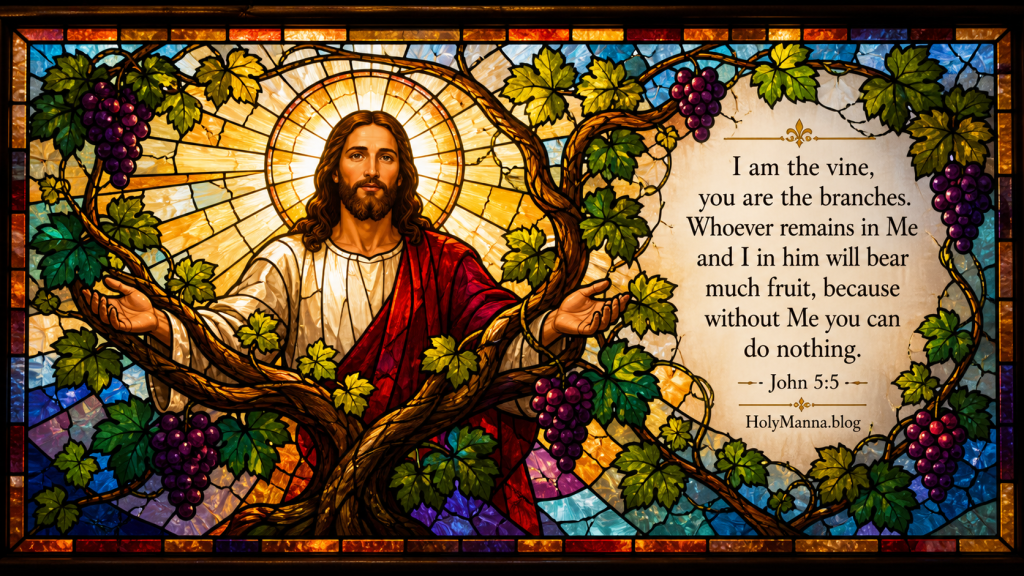
Finally, in John 15:1-8, Jesus reveals the deepest answer to the question raised in Acts and longed for in the Psalm. He says, “I am the true vine, and my Father is the vine grower.” Salvation is not found in ethnic identity, religious performance, or spiritual independence. It is found in remaining in Christ. The branch lives only because it stays united to the vine.
The central theme of today’s readings is communion that bears fruit. The Church must remain united in apostolic truth. The people of God must gather in worship and thanksgiving. Each soul must remain grafted into Christ through grace, prayer, obedience, and the sacraments. As The Catechism teaches, Christ is the true vine who gives life and fruitfulness to His branches, and without Him, His disciples can do nothing.
Today’s readings prepare the heart to see Catholic faith not as a private opinion or a checklist of religious requirements, but as living communion with Jesus Christ in His Church. The Father prunes, the Son gives life, the Church discerns, and the faithful bear fruit.
Where is Christ inviting you to remain more deeply in Him today?
First Reading – Acts 15:1-6
When the Church Goes Up to Jerusalem
The first reading brings the Church into one of the most important family meetings in Christian history. The Gospel has already moved beyond Jerusalem. Gentiles are hearing the word of God, receiving faith, and entering the life of Christ. Paul and Barnabas have seen the Holy Spirit working among people who were not born under the Mosaic Law, and this fills the Church with joy.
Yet a serious question rises like a storm: Must Gentile converts be circumcised and required to observe the Mosaic Law in order to be saved?
This was not a small disagreement about customs. Circumcision was the sign of God’s covenant with Abraham, and the Mosaic Law had shaped Israel’s identity for centuries. For Jewish Christians, this question touched the deepest parts of faith, family, worship, and belonging. But the coming of Christ had changed everything. The Old Covenant had not been thrown away as if it were meaningless. It had been fulfilled in Jesus, the true vine, the source of salvation and grace.
That is why this reading fits so beautifully with today’s theme of communion that bears fruit. The Church does not solve this crisis through private opinion or spiritual individualism. Paul and Barnabas do not split off and start their own movement. The question is brought to Jerusalem, to the apostles and presbyters. The Church gathers, listens, debates, discerns, and seeks the will of God.
This is a deeply Catholic moment. The early Church shows that Christian unity is not built on everyone doing whatever seems right in their own eyes. It is built on Christ, preserved through apostolic authority, and guided by the Holy Spirit.
Acts 15:1-6 – New American Bible (Revised Edition)
Council of Jerusalem. 1 Some who had come down from Judea were instructing the brothers, “Unless you are circumcised according to the Mosaic practice, you cannot be saved.” 2 Because there arose no little dissension and debate by Paul and Barnabas with them, it was decided that Paul, Barnabas, and some of the others should go up to Jerusalem to the apostles and presbyters about this question. 3 They were sent on their journey by the church, and passed through Phoenicia and Samaria telling of the conversion of the Gentiles, and brought great joy to all the brothers. 4 When they arrived in Jerusalem, they were welcomed by the church, as well as by the apostles and the presbyters, and they reported what God had done with them. 5 But some from the party of the Pharisees who had become believers stood up and said, “It is necessary to circumcise them and direct them to observe the Mosaic law.”
6 The apostles and the presbyters met together to see about this matter.
Detailed Exegesis
Verse 1 – “Some who had come down from Judea were instructing the brothers, ‘Unless you are circumcised according to the Mosaic practice, you cannot be saved.’”
The reading begins with a group from Judea teaching that Gentile converts must be circumcised to be saved. Their claim is absolute. They are not merely saying circumcision is meaningful, ancient, or honorable. They are saying salvation depends on it.
This matters because circumcision was the covenant sign given to Abraham in Genesis 17. For centuries, it marked Jewish males as belonging to the people of God. The Mosaic Law also shaped Israel’s worship, moral life, food practices, and identity among the nations. So the concern of these men was not random. They were trying to protect the sacred heritage of Israel.
But their mistake was treating the sign as if it were equal to the Savior. Christ had fulfilled the covenant. Salvation now comes through the grace of Jesus Christ, not through becoming Jewish according to the Mosaic Law. This verse shows the Church facing a question that every generation must confront in some form: Are we placing anything beside Christ as if it were necessary for salvation?
Verse 2 – “Because there arose no little dissension and debate by Paul and Barnabas with them, it was decided that Paul, Barnabas, and some of the others should go up to Jerusalem to the apostles and presbyters about this question.”
The phrase “no little dissension and debate” means the conflict was intense. Paul and Barnabas do not shrug their shoulders because doctrine matters. They know that if circumcision is required for salvation, then the Gospel of grace is being misunderstood.
Yet notice what happens next. The Church does not resolve this by popularity, emotion, or personal charisma. Paul and Barnabas are sent to Jerusalem, where the apostles and presbyters can examine the matter. This reveals the visible, structured, apostolic nature of the Church from the very beginning.
The Church is not a loose collection of isolated believers. She is a communion with authority. Christ entrusted His teaching to the apostles, and the apostles exercised that authority together. This moment anticipates the Catholic understanding of councils, bishops, and the Magisterium. When a serious doctrinal question arises, the Church gathers under apostolic authority to discern faithfully.
Verse 3 – “They were sent on their journey by the church, and passed through Phoenicia and Samaria telling of the conversion of the Gentiles, and brought great joy to all the brothers.”
This verse gives the story a beautiful warmth. Paul and Barnabas travel through Phoenicia and Samaria, telling Christians about the conversion of the Gentiles. Instead of jealousy, fear, or suspicion, many believers respond with joy.
That joy matters. It shows that the Church is already beginning to recognize the fruit of grace among the nations. The Gentiles are not outsiders crashing someone else’s religious home. They are being grafted into Christ. They are becoming branches of the true vine.
Phoenicia and Samaria also carry symbolic weight. Samaria, especially, reminds readers of old divisions between Jews and Samaritans. Yet now the Gospel is creating a new unity in Christ. The same Jesus who spoke with the Samaritan woman at the well is now drawing scattered peoples into one Church.
This verse asks the heart to notice the fruit before judging the branch. God is acting among the Gentiles. Their conversion brings joy because grace is not a private possession. When God brings someone home, the whole Church should rejoice.
Verse 4 – “When they arrived in Jerusalem, they were welcomed by the church, as well as by the apostles and the presbyters, and they reported what God had done with them.”
Paul and Barnabas arrive in Jerusalem and are welcomed by the Church, the apostles, and the presbyters. The scene feels almost like a sacred family gathering. They do not present their mission as personal achievement. They report “what God had done with them.”
That phrase is important. Paul and Barnabas understand themselves as instruments. God is the one acting. God opened hearts. God brought Gentiles to faith. God bore fruit through their missionary work.
This also teaches something essential about evangelization. The Church does not succeed because her ministers are impressive. She bears fruit because Christ gives life. The branch does not congratulate itself for the grapes. It remains in the vine.
Jerusalem, meanwhile, becomes the place where missionary experience is brought into communion with apostolic discernment. Experience matters, but it must be interpreted within the faith of the Church. That is still true today. Personal stories, spiritual experiences, and pastoral needs are important, but they must be brought into harmony with the teaching handed down from the apostles.
Verse 5 – “But some from the party of the Pharisees who had become believers stood up and said, ‘It is necessary to circumcise them and direct them to observe the Mosaic law.’”
This verse gives another important detail. The opposition comes from “the party of the Pharisees who had become believers.” These are not enemies of Christ from outside the Church. They are believers. They have accepted Jesus, but they are still wrestling with how His coming fulfills the Law.
Their concern is understandable, even if their conclusion is wrong. The Pharisees were deeply devoted to the Law, purity, covenant faithfulness, and the distinct identity of Israel. For them, requiring Gentiles to observe the Mosaic Law may have seemed like the safest way to preserve holiness.
But Christ does not merely add Gentiles onto Israel by making them adopt every boundary marker of the Old Covenant. He fulfills Israel’s vocation and opens the covenant to all nations through His death and Resurrection. The question is no longer whether Gentiles can become Jewish enough to belong. The question is whether they belong to Christ.
This verse also warns faithful Catholics against confusing reverence for sacred tradition with resistance to the Holy Spirit. True tradition hands on what Christ has revealed. It does not turn temporary covenant signs into permanent obstacles to grace.
Verse 6 – “The apostles and the presbyters met together to see about this matter.”
The final verse is quiet but powerful. The apostles and presbyters meet together. The Church pauses. The leaders gather. The matter is examined.
This is the beginning of the Council of Jerusalem. It shows the Church acting as the Church. There is debate, but not chaos. There is disagreement, but not abandonment of communion. There is a serious doctrinal question, but it is brought before apostolic authority.
This verse gives Catholics a picture of how Christ protects His people. The Church discerns not by inventing truth, but by receiving and guarding what God has revealed. The apostles and presbyters do not gather to create a new Gospel. They gather to understand how the one Gospel of Jesus Christ applies to the Gentiles who are now being drawn into salvation.
Teachings: Apostolic Authority, Grace, and the Fulfillment of the Law
This reading is one of the clearest biblical roots for the Catholic understanding of apostolic authority and conciliar discernment. The Church did not begin as a collection of independent Bible study groups. The Church began as a visible communion, founded by Christ upon the apostles, guided by the Holy Spirit, and served by ordained leaders.
The Catechism of the Catholic Church teaches, “The task of giving an authentic interpretation of the Word of God, whether in its written form or in the form of Tradition, has been entrusted to the living teaching office of the Church alone.” CCC 85
This is exactly what is happening in Acts 15. A dispute about salvation arises, and the answer is not left to private interpretation. The matter is brought to the apostles and presbyters. This does not diminish Scripture. It shows how Scripture itself presents the Church as the living household where apostolic teaching is guarded and clarified.
The Catechism also teaches, “The college or body of bishops has no authority unless united with the Roman Pontiff, Peter’s successor, as its head.” CCC 883
The Council of Jerusalem is an early seed of this Catholic reality. The apostles gather together, and Peter will later speak decisively in the council. Even though today’s reading stops at verse 6, the larger chapter shows the Church discerning in unity, with Peter, James, Paul, Barnabas, the apostles, and presbyters all involved in the process.
This reading also helps explain the Catholic view of the Old Law. The Mosaic Law was holy because God gave it, but it was a preparation for the fullness of grace in Christ. The Catechism says, “The Old Law is a preparation for the Gospel.” CCC 1964
That simple sentence carries a whole theology of salvation history. God prepared Israel for the Messiah through covenant, law, sacrifice, temple, priesthood, prophecy, and worship. But once Christ comes, the signs find their fulfillment in Him. Circumcision pointed to covenant belonging, but Baptism now grafts believers into the death and Resurrection of Christ. The sacrifices pointed toward atonement, but the Eucharist makes present the one sacrifice of Calvary. The temple pointed toward God dwelling with His people, but Christ is the true Temple, and the Church is His Body.
Saint Augustine’s famous teaching on grace also fits this reading beautifully. Against every temptation toward self-salvation, he taught that human beings cannot heal themselves apart from divine grace. In one of his anti-Pelagian writings, he insists that grace is not merely helpful decoration for naturally strong souls. Grace is necessary because fallen humanity needs God to be healed, lifted, and made fruitful.
That is the same heart beating beneath Acts 15. The question is not whether obedience matters. Of course obedience matters. The question is whether salvation comes through Christ or through human effort marked by external observance. The Church answers by defending the primacy of grace.
Pope Francis, reflecting on the Council of Jerusalem, emphasized that the apostles did not treat the matter as a political compromise between factions. They recognized that the Holy Spirit had already acted among the Gentiles. This is important because the Church’s discernment is never meant to be a parliament of preferences. It is meant to be obedience to God.
The great historical significance of this passage is difficult to overstate. If the Church had required Gentiles to become fully observant of the Mosaic Law, Christianity may have remained bound to one ethnic and ritual identity. Instead, the apostles recognized that the Gospel was truly catholic, meaning universal. In Christ, the nations could enter the covenant family of God.
This does not create a faith without moral demands. It creates a faith where obedience flows from grace rather than replacing it. Catholics are not saved by checking religious boxes. Catholics are saved by Christ, grafted into His life, nourished by His sacraments, taught by His Church, and called to bear fruit in charity.
Reflection: Bringing Hard Questions to the Heart of the Church
This first reading feels surprisingly modern. The early Church is growing, but growth brings tension. New people are coming in. Old assumptions are being tested. Serious believers disagree. The question is not small, and emotions are probably high.
Yet the Church does not break apart. She goes to Jerusalem.
That is a lesson many Catholics need today. When confusion rises, the answer is not to detach from the Church, retreat into private certainty, or let frustration become bitterness. The answer is to remain in communion, seek the truth, listen with humility, and trust that Christ has not abandoned His Bride.
This reading also challenges the heart to examine hidden forms of legalism. Legalism is not the same as loving tradition, revering the Mass, obeying doctrine, or taking sin seriously. Those things are good and necessary. Legalism begins when external signs become substitutes for living union with Christ. It appears when a soul starts trusting its own religious performance more than the mercy of God.
At the same time, this reading does not excuse spiritual laziness. The Council of Jerusalem did not announce that Gentiles could do whatever they wanted. Grace does not erase discipleship. Grace makes discipleship possible.
A practical way to live this reading is to bring hard questions into prayer and into the life of the Church. When a Catholic faces confusion about doctrine, morality, suffering, family conflict, or cultural pressure, the next step should not be outrage or isolation. The next step should be humble return to Christ through Scripture, the sacraments, the teachings of the Church, and wise spiritual counsel.
This passage also invites gratitude. Most Catholics reading this today are Gentiles by ancestry. That means this ancient debate is personal. The apostles’ discernment helped open the visible doors of the Church to the nations. The faith reached homes, families, parishes, and generations because the Church recognized that salvation in Christ was not reserved for one people by blood, but offered to all peoples by grace.
Where do you bring your disagreements, fears, and questions when faith feels complicated?
Do you trust Christ enough to remain in His Church even when discernment takes time?
Are there places where you have confused external religious identity with real surrender to Jesus?
What would it look like this week to rejoice, like the believers in Phoenicia and Samaria, when God’s grace bears fruit in someone else’s life?
The first reading leaves the Church gathered in Jerusalem, ready to discern. That image is worth carrying into prayer. The apostles and presbyters meet because the Gospel matters. Unity matters. Truth matters. The Gentiles matter. Salvation matters.
And above all, Christ matters.
The branch cannot live apart from the vine. The believer cannot thrive apart from grace. The Church cannot bear fruit apart from the Holy Spirit. So today, the faithful are invited to stay close, stay humble, stay teachable, and remain in the communion where Christ continues to guide His people.
Responsorial Psalm – Psalm 122:1-5
A Pilgrim Song for a People Being Gathered
The responsorial psalm sounds like a song sung with tired feet and a full heart. The pilgrim has been traveling toward Jerusalem, the holy city where Israel gathered to worship the Lord, give thanks, and remember that God had made them one people.
Psalm 122 is one of the “songs of ascents,” traditionally associated with pilgrims going up to Jerusalem for the great feasts. That phrase, “going up,” was not only about geography. Jerusalem sits on a hill, but spiritually, the journey was even higher. To go to Jerusalem was to move toward worship, covenant, sacrifice, thanksgiving, and the presence of God among His people.
This psalm fits beautifully between Acts 15:1-6 and John 15:1-8. In Acts, Paul and Barnabas go up to Jerusalem so the Church can discern a serious question under apostolic authority. In the Gospel, Jesus reveals Himself as the true vine, the source of life for every branch. The psalm stands in the middle like a bridge. God’s people are not meant to wander alone. They are gathered into communion, ordered toward worship, and called to bear fruit as one household in the Lord.
Psalm 122:1-5 – New American Bible (Revised Edition)
A Pilgrim’s Prayer for Jerusalem
1 A song of ascents. Of David.
I rejoiced when they said to me,
“Let us go to the house of the Lord.”
2 And now our feet are standing
within your gates, Jerusalem.
3 Jerusalem, built as a city,
walled round about.
4 There the tribes go up,
the tribes of the Lord,
As it was decreed for Israel,
to give thanks to the name of the Lord.
5 There are the thrones of justice,
the thrones of the house of David.
Detailed Exegesis
Verse 1 – “A song of ascents. Of David. I rejoiced when they said to me, ‘Let us go to the house of the Lord.’”
The psalm opens with joy. The pilgrim is not dragged to worship as if going to God’s house were a burden. He rejoices. His heart is lifted because he has been invited to enter the place where the Lord is praised.
For ancient Israel, the “house of the Lord” meant the Temple in Jerusalem, the sacred center of worship, sacrifice, and covenant life. For Catholics, this verse also points toward the joy of entering the Church, especially the joy of coming to the Holy Sacrifice of the Mass. The parish church is not a social club or a religious auditorium. It is a place where heaven touches earth, where Christ gives Himself in the Eucharist, and where the people of God are gathered into one act of worship.
This verse quietly challenges the modern Catholic heart. Many people treat Sunday Mass as an obligation to survive. The psalmist treats worship as a gift to receive. The invitation itself brings joy.
Verse 2 – “And now our feet are standing within your gates, Jerusalem.”
The pilgrim has arrived. The journey is no longer only hope or memory. His feet are standing within the gates of Jerusalem.
This image is simple, but it carries deep meaning. The gates mark entry into the holy city. To stand within them is to belong, to be safe, to be gathered with God’s people. Jerusalem was more than a destination. It was the visible sign that God had chosen a people, given them worship, and called them into covenant communion.
In today’s readings, this verse echoes the movement of Paul and Barnabas in Acts 15. They go up to Jerusalem not to escape conflict, but to bring a serious question into the heart of the Church’s apostolic discernment. The gates of Jerusalem become a sign of communion. Hard questions are not meant to break the Church apart. They are meant to be brought into the household where Christ continues to guide His people.
Verse 3 – “Jerusalem, built as a city, walled round about.”
Jerusalem is described as a city built together, enclosed and strengthened. The image is one of order, unity, and protection.
A city is not a scattered pile of stones. It has structure. It has walls. It has gates. It has a center. In the same way, the Church is not a random collection of private opinions. She is a visible communion built by Christ, guarded by apostolic teaching, and strengthened by the Holy Spirit.
This matters especially in light of Acts 15. When disagreement comes, the early Church does not dissolve into separate camps. She gathers. She listens. She discerns. She remains a city built together. That is not accidental. Christ did not leave behind isolated believers trying to invent Christianity from scratch. He founded a Church.
Verse 4 – “There the tribes go up, the tribes of the Lord, as it was decreed for Israel, to give thanks to the name of the Lord.”
Here the psalm widens from one pilgrim to the whole people. The tribes go up together. Worship gathers what sin and distance scatter.
The reference to the tribes reminds readers of Israel’s covenant identity. God had formed the descendants of Jacob into one people, and Jerusalem became the place where that unity was expressed in worship. They did not go up merely for personal inspiration. They went because thanksgiving to the Lord was part of who they were.
For Catholics, this verse points toward the unity of the Church in the Eucharist. At Mass, people from different families, backgrounds, temperaments, and histories are gathered into one sacrifice of praise. The Church gives thanks through Christ, with Christ, and in Christ. That is why the word “Eucharist” means thanksgiving.
This verse also connects to the Gentile question in Acts 15. In Christ, the nations are being gathered into the worship of the one true God. The old tribal boundaries are being fulfilled in something larger, not erased into meaninglessness, but brought to completion in the catholicity of the Church.
Verse 5 – “There are the thrones of justice, the thrones of the house of David.”
Jerusalem is not only the city of worship. It is also the city of justice. The thrones of the house of David recall the royal line through which God governed His people and promised the Messiah.
This verse points forward to Christ, the Son of David, whose kingdom is not built on worldly power but on truth, mercy, and righteousness. In Him, worship and justice meet perfectly. He is the King who judges rightly, the Shepherd who gathers His flock, and the Vine who gives life to His branches.
In the context of today’s readings, this verse also sheds light on the Council of Jerusalem. The apostles and presbyters gather to seek justice in truth. They must not crush Gentile converts with burdens Christ does not require, but they also must preserve the holiness of the Gospel. True justice in the Church is never separated from worship, truth, or communion with Christ.
Teachings: Jerusalem, the Church, and the Heavenly Homeland
The psalm begins in the earthly Jerusalem, but Catholic tradition helps the reader see more. Jerusalem is a real city with real history, worship, kingship, and conflict. Yet in Scripture and Catholic teaching, Jerusalem also becomes an image of the Church and the heavenly homeland.
The Catechism of the Catholic Church teaches the anagogical sense of Scripture with these words: “The anagogical sense. We can view realities and events in terms of their eternal significance, leading us toward our true homeland: thus the Church on earth is a sign of the heavenly Jerusalem.” CCC 117
That is exactly how Psalm 122 can be prayed as a Christian. The pilgrim going up to Jerusalem becomes an image of every soul journeying toward heaven. The city’s gates become an image of belonging. The tribes gathered in thanksgiving become an image of the Church at worship. The thrones of justice become an image of Christ’s kingdom.
The Catechism also describes the Church as the dwelling place of God using rich biblical images: “Often, too, the Church is called the building of God. The Lord compared himself to the stone which the builders rejected, but which was made into the corner-stone. On this foundation the Church is built by the apostles and from it the Church receives solidity and unity. This edifice has many names to describe it: the house of God in which his family dwells; the household of God in the Spirit; the dwelling-place of God among men; and, especially, the holy temple. This temple, symbolized in places of worship built out of stone, is praised by the Fathers and, not without reason, is compared in the liturgy to the Holy City, the New Jerusalem. As living stones we here on earth are built into it.” CCC 756
This teaching makes the psalm feel close to home. When Catholics pray, “Let us go to the house of the Lord,” they are not only remembering ancient Israel. They are stepping into the mystery of the Church. Every Catholic church building, however simple or grand, points beyond itself. It points toward the heavenly Jerusalem, where the people of God will worship forever.
Saint Augustine loved this image of Jerusalem as the city above. He understood that the Christian is a pilgrim, not a drifter. The soul is traveling somewhere. The destination is not self-expression, comfort, or success. The destination is communion with God and the saints.
This is why the psalm belongs so naturally to the Easter season. Christ has risen. The gates of heaven have been opened. The Church now walks through history as a pilgrim people, carrying the joy of Jerusalem in her song and the life of the risen Christ in her sacraments.
The psalm also deepens the meaning of today’s first reading. In Acts 15, Jerusalem is the place where the Church gathers to discern. That moment shows that Christian unity is not emotional niceness or institutional habit. It is a grace that must be guarded by truth. The same city praised in the psalm becomes the setting for apostolic listening, debate, authority, and communion.
Finally, Psalm 122 prepares the heart for the Gospel. Jesus says, “I am the true vine.” John 15:1 Jerusalem gathered the tribes, but Christ gathers the whole human family. Jerusalem had the Temple, but Christ is the true dwelling of God among men. Jerusalem had the thrones of David, but Christ is the Son of David whose kingdom has no end.
Reflection: Learning to Rejoice in the House of the Lord
This psalm asks a very honest question of the Catholic heart: Do you still rejoice when it is time to go to the house of the Lord?
That question can sting a little. Life gets busy. Sunday mornings can feel rushed. Children need to be dressed. Work stress follows people into the pews. The mind wanders. The music may not be beautiful. The homily may not land. The parish may feel imperfect because every parish is full of sinners still being sanctified.
Yet the psalmist reminds the faithful that worship is not mainly about personal mood. It is about God. The house of the Lord is worth entering because the Lord is there. The Mass is worth attending because Christ is there. The Church is worth loving because Christ loves her.
One practical way to live this psalm is to prepare for Mass before arriving. A Catholic can read the Sunday readings ahead of time, arrive a few minutes early, make a sincere act of contrition, and ask for the grace to worship with attention. This small preparation can turn Mass from a weekly habit into a real pilgrimage.
Another way is to recover gratitude. The tribes went up “to give thanks to the name of the Lord.” Gratitude changes the way a soul enters church. Instead of asking only, “What did this Mass do for me?” the heart begins to ask, How can this Mass teach me to give thanks to God?
This psalm also invites Catholics to love the unity of the Church. In a time when people are quick to divide, criticize, and retreat into their preferred camps, Psalm 122 sings of a people going up together. The Church is not perfect in her members, but she is holy because Christ is holy. The faithful do not remain because everything is easy. They remain because Christ is the vine, and His Church is the city where He gathers His people.
When you go to Mass, do you come as a consumer looking for a religious experience, or as a pilgrim entering the house of the Lord?
Where has frustration with imperfect Catholics made it harder for you to love the Church as the holy city God is building?
What would change this week if you treated every trip to church as a small pilgrimage toward heaven?
The psalm gives the Church a song for the road. It teaches the faithful to walk together, worship together, give thanks together, and long together for the heavenly Jerusalem. It reminds every tired pilgrim that the destination is real, the gates are open, and the Lord is still gathering His people into one.
Holy Gospel – John 15:1-8
The Vine That Gives Life to Every Branch
The Holy Gospel brings the whole day into focus. In Acts 15:1-6, the Church wrestles with a serious question about salvation, belonging, and whether Gentile converts must carry the full burden of the Mosaic Law. In Psalm 122:1-5, the pilgrim rejoices to go up to Jerusalem, the city where God gathers His people in worship and unity. Now, in John 15:1-8, Jesus reveals the deepest truth beneath both readings: the people of God live only by remaining in Him.
This Gospel takes place during the Last Supper discourse, on the night before Christ’s Passion. Judas has gone out into the darkness. Jesus is preparing His disciples for the Cross, the Resurrection, and the mission of the Church. Instead of giving them a strategy built on human strength, He gives them an image rooted in Scripture, soil, and daily life: the vine and the branches.
In the Old Testament, Israel was often described as God’s vineyard or vine. The prophets spoke of God planting, tending, grieving over, and judging His vineyard when it failed to bear good fruit. Now Jesus says something stunning: “I am the true vine.” John 15:1 He is not merely another teacher within Israel. He is the fulfillment of Israel’s calling. He is the source of covenant life. He is the One into whom Jews and Gentiles are grafted by grace.
This is why today’s theme becomes so clear. Christian fruitfulness is not self-made. The Church does not live by argument alone, and the soul does not live by religious effort alone. The branch lives because it remains attached to the vine. The Christian lives because he remains in Christ through faith, grace, prayer, obedience, charity, and the sacraments of His Church.
John 15:1-8 – New American Bible (Revised Edition)
The Vine and the Branches. 1 “I am the true vine, and my Father is the vine grower. 2 He takes away every branch in me that does not bear fruit, and every one that does he prunes so that it bears more fruit. 3 You are already pruned because of the word that I spoke to you. 4 Remain in me, as I remain in you. Just as a branch cannot bear fruit on its own unless it remains on the vine, so neither can you unless you remain in me. 5 I am the vine, you are the branches. Whoever remains in me and I in him will bear much fruit, because without me you can do nothing. 6 Anyone who does not remain in me will be thrown out like a branch and wither; people will gather them and throw them into a fire and they will be burned. 7 If you remain in me and my words remain in you, ask for whatever you want and it will be done for you. 8 By this is my Father glorified, that you bear much fruit and become my disciples.
Detailed Exegesis
Verse 1 – “I am the true vine, and my Father is the vine grower.”
Jesus begins with one of His great “I am” statements in The Gospel of John. He identifies Himself as “the true vine,” the faithful and life-giving fulfillment of everything Israel was called to be. The Father is the vine grower, the divine cultivator who plants, tends, prunes, and brings forth fruit.
This image would have been familiar to the disciples. Vineyards required patience, labor, care, pruning, and time. A vine was not ornamental. It existed to bear fruit. In the same way, the life of grace is not meant to remain hidden as a private religious feeling. Christ gives His life so that His disciples may bear visible fruit in holiness, charity, witness, and obedience.
This verse also reveals the order of salvation. The Father tends. The Son gives life. The disciple receives life by remaining. The branch does not create the vine. The Christian does not create grace. Everything begins with God.
Verse 2 – “He takes away every branch in me that does not bear fruit, and every one that does he prunes so that it bears more fruit.”
This verse is both sobering and hopeful. The Father removes fruitless branches, but He also prunes fruitful ones. That means pruning is not a sign of rejection. It is a sign of divine care.
To prune a vine is to cut away what prevents greater fruitfulness. Spiritually, the Father prunes attachments, sins, distractions, pride, false security, resentment, and selfish desires. Sometimes this pruning feels painful because the soul often clings to what weakens it. Yet the Father’s goal is not humiliation. His goal is fruit.
This matters for anyone trying to follow Christ seriously. The Christian life does not become easier simply because a person is bearing some fruit. In fact, faithful souls are often pruned more deeply because God desires more love, more humility, more purity, and more surrender. The Father does not settle for leaves when He desires grapes.
Verse 3 – “You are already pruned because of the word that I spoke to you.”
Jesus tells the apostles that His word has already pruned them. The word of Christ cleanses, cuts, heals, exposes, and prepares the disciple for fruitfulness.
This is why Scripture is never just information for Catholics. The word of God is living and active. It enters the heart and reveals what must be surrendered. A comfortable lie can survive for years until one sentence from Christ pierces it. A hidden sin can stay defended until the Gospel names it. A fearful heart can remain closed until the word of Jesus opens it.
This verse also connects pruning with teaching. Christ purifies His Church through His word, and the Church continues to guard and proclaim that word through apostolic teaching. The same Lord who pruned the apostles at the Last Supper continues to purify His people through Scripture, Sacred Tradition, the Magisterium, preaching, confession, and the quiet voice of conscience formed by truth.
Verse 4 – “Remain in me, as I remain in you. Just as a branch cannot bear fruit on its own unless it remains on the vine, so neither can you unless you remain in me.”
This is the heart of the passage. Jesus does not say, “Admire me from a distance.” He does not say, “Use me when you need help.” He says, “Remain in me.”
To remain means to abide, stay, dwell, persevere, and live in communion. This is not a temporary religious mood. It is a settled life in Christ. The branch cannot produce fruit through positive thinking, self-discipline, cultural Catholic identity, or moral effort detached from grace. It must remain on the vine.
For Catholics, this remaining is concrete. It includes Baptism, by which the soul is grafted into Christ. It includes the Eucharist, by which Christ’s life nourishes the soul. It includes Confession, by which dead places are restored. It includes prayer, obedience, charity, and fidelity to the Church. Remaining in Christ is personal, but it is not isolated. Christ joins His branches to Himself in His Body, the Church.
Verse 5 – “I am the vine, you are the branches. Whoever remains in me and I in him will bear much fruit, because without me you can do nothing.”
Jesus now makes the image even more direct. He is the vine. His disciples are the branches. Fruitfulness comes from union with Him.
The final line is one of the most humbling sentences in the Gospel: “Without me you can do nothing.” John 15:5 Jesus does not say that without Him a person can do less. He says nothing. That does not mean unbelievers never perform naturally good actions. It means supernatural fruit, the fruit that leads to eternal life, cannot be produced apart from Christ’s grace.
This verse confronts the pride of every age, especially the modern belief that the self can be its own source. A branch detached from the vine may still look green for a moment, but it has already begun to die. The same is true of the soul. A person can look busy, impressive, successful, and even religious while slowly drying up inside if he is not remaining in Christ.
Verse 6 – “Anyone who does not remain in me will be thrown out like a branch and wither; people will gather them and throw them into a fire and they will be burned.”
This verse is serious because Jesus is serious about eternal life. The image of the withered branch warns against separation from Him. A branch cut off from the vine cannot preserve itself. It dries out, loses life, and becomes fit only for fire.
Catholic faith does not treat this as symbolic drama with no consequence. Jesus is warning His disciples that communion with Him must be preserved. Grace can be resisted. Love can grow cold. Faith can become sterile. A soul can detach itself through mortal sin, pride, unbelief, or refusal to repent.
Yet even this warning is merciful. Christ speaks plainly because He wants His disciples to live. The branch does not need to despair. It needs to remain. When a Catholic has fallen away, the answer is not shame-filled hiding. The answer is return, especially through Confession, where Christ restores life to the wounded soul.
Verse 7 – “If you remain in me and my words remain in you, ask for whatever you want and it will be done for you.”
This verse is sometimes misunderstood as if Jesus were offering a blank check for worldly desires. But the condition matters: “If you remain in me and my words remain in you.”
When a soul truly remains in Christ, its desires begin to be purified. Prayer becomes less about bending God to personal preference and more about being conformed to the heart of Jesus. The disciple begins to ask for what leads to holiness, love, mission, repentance, perseverance, and the glory of the Father.
This is why fruitful prayer is inseparable from remaining. A branch attached to the vine receives the life of the vine. A Christian united to Christ begins to desire what Christ desires. Prayer becomes powerful not because the disciple becomes spiritually impressive, but because the disciple is living in communion with the Son.
Verse 8 – “By this is my Father glorified, that you bear much fruit and become my disciples.”
The Gospel ends with the glory of the Father. The Father is glorified when disciples bear much fruit and become true followers of Christ.
This fruit is not merely activity. A person can be busy without being holy. The fruit Jesus desires is the fruit of grace: charity, humility, faithfulness, purity, patience, mercy, courage, evangelization, and obedience. The Father is glorified when the life of His Son becomes visible in His children.
The phrase “become my disciples” also shows that discipleship is not static. A person can belong to Christ and still need to become more deeply His disciple. The Christian life is ongoing conversion. The branch keeps receiving, keeps being pruned, keeps bearing fruit, and keeps becoming what Christ has called it to be.
Teachings: Christ the True Vine and the Life of Grace
This Gospel is one of the clearest passages in Scripture for understanding the Catholic life of grace. Christianity is not merely moral improvement. It is participation in the life of Christ.
The Catechism of the Catholic Church teaches, “The Church is a cultivated field, the tillage of God. On that land the ancient olive tree grows whose holy roots were the prophets and in which the reconciliation of Jews and Gentiles has been brought about and will be brought about again. That land, like a choice vineyard, has been planted by the heavenly cultivator. Yet the true vine is Christ who gives life and fruitfulness to the branches, that is, to us, who through the Church remain in Christ, without whom we can do nothing.” CCC 755
This teaching gathers the whole day together. The reconciliation of Jews and Gentiles recalls the dispute in Acts 15. The cultivated field and vineyard recall Jesus’ words in John 15. The phrase “through the Church remain in Christ” shows the Catholic heart of the passage. The disciple does not remain in Christ as a detached individual floating outside the visible Body. Christ gives life to His branches through His Church.
The Catechism also teaches, “From the beginning, Jesus associated his disciples with his own life, revealed the mystery of the Kingdom to them, and gave them a share in his mission, joy, and sufferings. Jesus spoke of a still more intimate communion between him and those who would follow him: ‘Abide in me, and I in you…. I am the vine, you are the branches.’ And he proclaimed a mysterious and real communion between his own body and ours: ‘He who eats my flesh and drinks my blood abides in me, and I in him.’” CCC 787
This is a profoundly Eucharistic teaching. The vine and branches are not just a metaphor for inspiration. They point to real communion. Christ gives His life to His disciples, especially through the Eucharist, where He feeds His people with His Body and Blood.
Saint Augustine preached this Gospel with a strong emphasis on grace. He taught, “Let no one think that a branch can bear fruit of itself. For unless it remain in the vine, it cannot bear fruit. A great commendation of grace, my brethren! It instructs the humble, it stops the mouths of the proud.”
That line fits the Gospel perfectly. Grace humbles the disciple because it reveals total dependence on Christ. At the same time, grace gives confidence because the soul does not have to manufacture holiness alone. The branch simply has to remain where life flows.
Pope Benedict XVI also reflected on this passage by reminding the Church that fruitfulness comes from deep union with Jesus, not from self-reliance. He explained that Christ is the true vine who gives Himself in love, and disciples bear fruit when they are profoundly united to Him. This is the quiet secret of holiness. Saints are not people who became spiritually impressive apart from Christ. Saints are branches that remained.
This Gospel also helps interpret the Father’s pruning. The Catechism teaches about conversion and purification with these words: “Jesus calls to conversion. This call is an essential part of the proclamation of the kingdom: ‘The time is fulfilled, and the kingdom of God is at hand; repent, and believe in the gospel.’ In the Church’s preaching this call is addressed first to those who do not yet know Christ and his Gospel. Also, Baptism is the principal place for the first and fundamental conversion. It is by faith in the Gospel and by Baptism that one renounces evil and gains salvation, that is, the forgiveness of all sins and the gift of new life.” CCC 1427
Pruning is part of conversion. It is the Father’s loving work of making the branch more fruitful. The Christian who resists pruning resists growth. The Christian who accepts pruning, even through tears, learns that God’s cuts are not cruelty. They are mercy.
Reflection: Staying Attached When Everything Pulls Away
This Gospel speaks directly to the exhausted Catholic trying to live faithfully in a distracted world. Everyone is being pulled in a thousand directions. Work demands attention. Family responsibilities pile up. Screens train the mind to scatter. Politics stirs anxiety. Temptations promise relief. Pride whispers that self-sufficiency is strength.
Then Jesus speaks with stunning simplicity: “Remain in me.” John 15:4
That is the task. Stay attached. Stay close. Stay in grace. Stay near the sacraments. Stay faithful in prayer. Stay obedient when obedience is inconvenient. Stay in the Church when the Church is messy. Stay repentant when sin wounds the soul. Stay humble when spiritual pride begins to grow leaves without fruit.
A practical way to live this Gospel is to examine where life is actually flowing. A soul can ask whether daily habits are keeping it attached to Christ or slowly cutting it away. Prayer, Sunday Mass, Confession, Scripture, the Rosary, silence, charity, and honest repentance keep the branch open to grace. Sin, resentment, impurity, laziness, gossip, cynicism, and spiritual isolation dry the soul out.
This Gospel also gives hope to those experiencing pruning. Not every loss is punishment. Not every discomfort means God is absent. Sometimes the Father is removing what kept the soul smaller than it was created to be. A friendship may need purification. A habit may need to die. A dream may need surrender. A hidden pride may need exposure. A comfort may need to be cut back so love can grow.
The question is not whether pruning hurts. It often does. The better question is whether the branch trusts the vine grower.
What is the Father pruning in your life right now so that you can bear more fruit?
Where have you been trying to produce holiness by your own strength instead of receiving life from Christ?
What habit, sin, resentment, or distraction is quietly cutting you away from the vine?
How can you remain more intentionally in Christ this week through prayer, Confession, the Eucharist, and concrete acts of charity?
The Gospel ends with a promise and a purpose. The promise is that whoever remains in Christ will bear much fruit. The purpose is that the Father will be glorified.
That is the Christian life in one image. The Father tends the vineyard. The Son gives life as the true vine. The Church carries that life through the ages. The disciple remains, receives, is pruned, and bears fruit.
The branch does not need to impress the vine. It needs to stay attached.
Remain, Rejoice, and Bear Fruit
Today’s readings tell one beautiful story about how God keeps His people alive.
In Acts 15:1-6, the young Church faces a serious question about salvation, belonging, and the place of the Mosaic Law. Instead of breaking apart, the believers go up to Jerusalem. Paul and Barnabas bring the matter to the apostles and presbyters, trusting that Christ guides His Church through apostolic authority and the Holy Spirit. The Church does not treat truth like a private opinion. She gathers, listens, discerns, and remains in communion.
In Psalm 122:1-5, the pilgrim rejoices because he is going to the house of the Lord. Jerusalem becomes the place where God’s people gather, give thanks, seek justice, and remember that they belong to something bigger than themselves. The psalm reminds every Catholic that faith is not meant to be lived alone. God calls His people into worship, into the Church, and ultimately toward the heavenly Jerusalem.
Then, in John 15:1-8, Jesus reveals the source of it all: “I am the vine, you are the branches.” The Church can discern because Christ is alive in her. The pilgrim can rejoice because Christ gathers His people. The disciple can bear fruit because Christ gives the life of grace. Without Him, every branch withers. With Him, even a pruned and wounded soul can become fruitful.
The message of the day is simple, but it reaches deep: remain in Christ, remain in His Church, and let the Father make you fruitful. Do not cling to self-made righteousness. Do not drift into spiritual isolation. Do not mistake pruning for abandonment. The Father cuts away what keeps the soul from bearing fruit, not because He is cruel, but because He is a loving vine grower.
This week, take one honest step toward remaining more deeply in Christ. Return to prayer with real attention. Go to Confession if grace has been wounded by sin. Prepare for Mass like a pilgrim going up to Jerusalem. Read the Gospel slowly and let the words of Jesus prune what needs to be purified. Choose one concrete act of charity, especially where love feels inconvenient.
Where is Christ asking you to remain when your heart wants to run?
What fruit does the Father want to bring from your life in this Easter season?
The branch does not need to prove itself. It needs to stay attached. The pilgrim does not need to see the whole road. He needs to keep walking toward the house of the Lord. The Church does not need to fear every hard question. She needs to keep listening to the Holy Spirit.
So remain in Christ. Rejoice in His Church. Let the Father prune. Then bear fruit that gives glory to God.
Engage with Us!
Share your reflections in the comments below. Today’s readings invite the whole Church to remain close to Christ, rejoice in the house of the Lord, and trust the Father’s pruning love. Each passage gives the heart a different doorway into the same mystery: life comes from communion with Jesus.
- First Reading, Acts 15:1-6: When disagreements or hard questions arise in your faith, do you bring them to prayer, Scripture, and the teaching of the Church, or do you tend to carry them alone?
- Responsorial Psalm, Psalm 122:1-5: Do you approach Mass with the joy of a pilgrim saying, “Let us go to the house of the Lord,” or has worship started to feel routine?
- Holy Gospel, John 15:1-8: Where is the Father pruning your life right now so that you can bear more fruit in Christ?
- Today’s Central Theme: What is one concrete way you can remain more deeply connected to Jesus this week through prayer, the Eucharist, Confession, Scripture, or an act of charity?
May today’s readings help every heart stay grafted to Christ, walk faithfully with His Church, and bear fruit that glorifies the Father. Live the faith with courage, humility, and joy, and do everything with the love and mercy Jesus taught us.
Sacred Heart of Jesus, we trust in You!
Immaculate Heart of Mary, pray for us!
Saint Michael the Archangel, defend us in battle!
Follow us on YouTube, Instagram and Facebook for more insights and reflections on living a faith-filled life.


Leave a comment