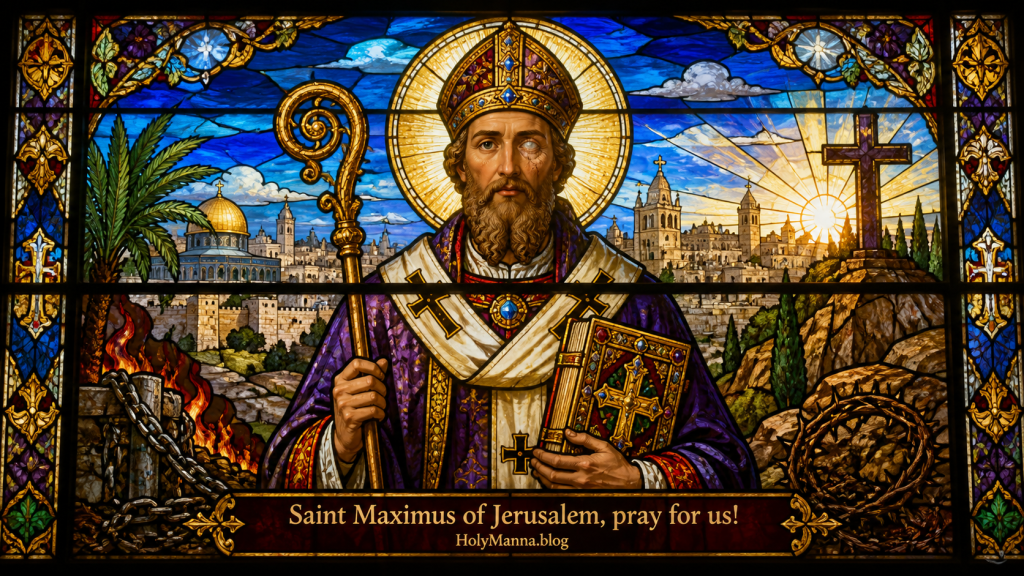
The Wounded Shepherd of the Holy City
Saint Maximus of Jerusalem was one of those early saints whose life feels carved out of fire, iron, and faith. He was a 4th-century bishop, a confessor of the faith, and a shepherd of Jerusalem during one of the most important and turbulent moments in Church history.
He is called a confessor because he suffered for Christ but did not die directly from that persecution. Before he became Bishop of Jerusalem, Maximus endured torture for refusing to deny the Lord. Ancient Christian sources remember that he was blinded in one eye, crippled or burned in the foot, and condemned to hard labor in the mines. His body carried the cost of discipleship.
Later, this wounded man became bishop of the very city where Jesus suffered, died, rose from the dead, ascended into heaven, and sent the Holy Spirit upon the Church. That alone makes his story unforgettable.
Saint Maximus is most known for being a courageous survivor of persecution, Bishop of Jerusalem, and eventual defender of the Nicene faith during the Arian crisis. His life reminds the Church that holiness is not always clean, simple, or untouched by conflict. Sometimes holiness looks like suffering, repentance, correction, and a renewed stand for the truth.
As The Catechism of the Catholic Church teaches, “Witness is an act of justice that establishes the truth or makes it known” (CCC 2472). Saint Maximus gave that witness with his body, his office, and eventually his public support for the truth that Jesus Christ is fully God.
From Unknown Beginnings to a Faith Tested by Fire
Very little is known about the early life of Saint Maximus. His birthplace, family background, and childhood have not been preserved in reliable Catholic tradition. That silence is common with many saints of the early Church. Their private beginnings disappeared into history, but their public witness remained because it mattered to the Church.
What is known is that Maximus became a priest in Jerusalem. He lived during the time when Christianity was moving from the age of brutal Roman persecution into the age of public recognition under Constantine. He likely witnessed both terror and triumph. He saw Christians punished for the faith, and then later saw the Church begin to breathe freely after centuries of bloodshed.
During the persecution under Maximinus Daza, Maximus confessed Christ and paid dearly for it. According to ancient accounts, one of his eyes was gouged out, his foot or leg was burned and crippled, and he was sent to labor in the mines. This was not symbolic suffering. This was the kind of suffering that changes how a person walks, sees, sleeps, prays, and remembers.
Yet Maximus did not abandon the faith. He survived.
That is one of the first great lessons of his life. He did not become holy because life was easy. He became a saint because grace held him when life became almost unbearable.
The Catechism teaches, “Martyrdom is the supreme witness given to the truth of the faith” (CCC 2473). Saint Maximus was not technically a martyr because he did not die from the persecution, but he stood very close to that holy company. He was one of those confessors whose wounds became a living sermon.
The People of Jerusalem Did Not Want to Lose Him
After the persecution ended, Maximus returned to ecclesial life. The Church had entered a new period under Constantine, and many confessors who had been exiled, imprisoned, or condemned to the mines were released. These men were deeply respected because they had already proven that they would rather suffer than deny Christ.
One ancient story says that Saint Macarius, Bishop of Jerusalem, intended to appoint Maximus as bishop of Diospolis, also known as Lydda. But the faithful of Jerusalem did not want to lose him. They loved him, trusted him, and wanted him to remain among them. They saw in him not only a priest, but a man who had suffered for Christ and remained faithful.
This story comes from ancient Church history and is repeated in Catholic reference material, though some details are not perfectly clear. It should be treated as an ancient ecclesiastical tradition rather than a fully verifiable modern biography. Still, the heart of the story is beautiful. The people of Jerusalem wanted a shepherd whose faith had already been tested in suffering.
There is something deeply Catholic about that. The Church has always understood that suffering, when united to Christ, can purify love and deepen spiritual authority. A priest or bishop is not made holy by wounds alone, but wounds offered to Christ can make a man more compassionate, more humble, and more credible.
Eventually, Maximus succeeded Saint Macarius as Bishop of Jerusalem, probably around the mid-330s. This placed him at the center of one of the most sacred Christian communities in the world.
A Shepherd During the Arian Storm
Saint Maximus became bishop during the Arian crisis. This was not a small theological disagreement. It was a battle over the identity of Jesus Christ.
Arius and his followers denied the full divinity of the Son of God. They claimed that the Son was not eternal in the same way as the Father. The Council of Nicaea in 325 condemned this error and confessed that Jesus Christ is true God from true God. The Catechism summarizes the Catholic faith by saying that the Son is “begotten, not made, of the same substance as the Father” (CCC 465).
That phrase mattered then, and it matters now. If Jesus is not truly God, then He cannot truly save. If He is merely the highest creature, then Christianity collapses into something far smaller than the Gospel.
Saint Maximus lived inside that storm. As Bishop of Jerusalem, he had to shepherd the Church while bishops, emperors, theologians, and political factions fought over the Nicene faith. His life shows that early Church history was not always peaceful or tidy. Saints had to navigate pressure, confusion, fear, and sometimes their own mistakes.
One difficult moment in his life came at the Council of Tyre in 335, which was hostile to Saint Athanasius, the great defender of the Nicene faith. Some ancient sources say Maximus consented to the deposition of Athanasius. This is one of the humbling parts of his story. A man who had suffered heroically for Christ may have been pressured, misled, or drawn into a decision he later regretted.
Ancient tradition also preserves a dramatic story involving Saint Paphnutius, another mutilated confessor. According to this story, Paphnutius took Maximus by the hand and drew him away from the party opposing Athanasius, as if to say that men who bore wounds for the faith should not stand with those undermining the truth of the faith. This story is powerful, but because the historical sources differ, it should be presented as an ancient story that cannot be fully verified in every detail.
Still, the message is unforgettable. Wounds suffered for Christ should lead a soul deeper into truth, not into compromise.
The Courage to Correct Course
One of the most moving parts of Saint Maximus’s life is not that he never struggled. It is that he appears to have corrected course.
Ancient Church history says that Maximus later regretted his earlier involvement in the opposition to Athanasius. He avoided further participation in hostile councils and eventually welcomed Athanasius back into communion. When Athanasius passed through Jerusalem after the Council of Sardica, Maximus gathered bishops from Syria and Palestine and restored Athanasius to communion and dignity.
That moment matters. Athanasius was not merely another bishop with strong opinions. He was one of the greatest defenders of the truth that Jesus Christ is fully divine. By receiving him, Maximus publicly aligned himself with the Nicene faith.
This makes Saint Maximus especially relatable. His holiness was not the holiness of someone who never faced confusion. His holiness was the holiness of someone who returned to the truth.
That is a very Catholic lesson. Repentance is not only for dramatic sinners. It is for everyone who discovers that they were wrong, pressured, afraid, passive, or silent when they should have stood firmly. Grace does not merely forgive. Grace strengthens a soul to stand differently next time.
The Catechism teaches, “Dogmas are lights along the path of faith; they illuminate it and make it secure” (CCC 89). Saint Maximus lived at a time when the Church desperately needed those lights. The truth about Christ was not optional. It was the foundation of salvation.
Life, Witness, and the Quiet Miracle of Endurance
No well-attested miracles are clearly attributed to Saint Maximus during his lifetime. Some ancient accounts mention miracles near his story, especially miracles associated with Saint Paphnutius, but those should not be transferred to Maximus.
That does not make his life any less powerful. Sometimes the miracle is not a sudden healing, a vision, or a dramatic sign. Sometimes the miracle is endurance. Sometimes it is the grace to keep believing after torture. Sometimes it is the grace to shepherd after trauma. Sometimes it is the grace to admit error and return to the truth.
Saint Maximus’s life shows faith, courage, and resilience. He was not remembered as a famous miracle worker, a great author, or a saint with a long collection of sayings. He was remembered as a wounded confessor who became bishop of the Holy City and stood with the orthodox faith.
No verified famous quotations from Saint Maximus of Jerusalem are known. This is important because many sayings attributed simply to “Maximus” usually belong to Saint Maximus the Confessor, who lived centuries later. For Saint Maximus of Jerusalem, the most honest thing to say is that his body speaks louder than any surviving words.
His witness says: Christ is worth suffering for. Truth is worth returning to. The Church is worth serving, even when the Church is passing through conflict.
Hardship Without Martyrdom, but Not Without a Cross
Saint Maximus was not martyred, but his life was deeply marked by the cross. He endured persecution under Roman authority, mutilation, forced labor, and later the painful complexity of Church controversy.
His suffering under persecution was physical and public. Losing an eye and being crippled would have been visible every day. People who met him would have seen the cost of his confession. His wounds were not hidden inside a private journal. They were written into his face and body.
His later suffering was different. As bishop, he had to navigate the Arian crisis, the turbulent politics surrounding Saint Athanasius, and the ecclesial tension between Jerusalem and Caesarea. Jerusalem had unique spiritual honor because it was the city of Christ’s Passion and Resurrection, but Caesarea still held metropolitan authority over it. This created tension that continued into the time of Saint Cyril of Jerusalem, Maximus’s successor.
The succession after Maximus was also complicated. Ancient sources disagree about whether Saint Cyril succeeded him peacefully, whether another man named Heraclius had been intended as successor, or whether Acacius of Caesarea played a forceful role in the transition. Because the sources conflict, it is best to avoid making dramatic claims beyond what can be responsibly said. The Church remembers both Maximus and Cyril as saints, but the historical transition between them was marked by controversy.
That should not scandalize faithful Catholics. The Church is holy because Christ is holy, not because every historical moment is neat and painless. Saints often lived through conflict that would exhaust most people today.
Miracles and Impact After Death
No major posthumous miracles, relic traditions, famous healings, or widespread miracle stories are reliably preserved for Saint Maximus of Jerusalem. There are no well-known shrine traditions or national celebrations attached to him in the way there are for saints like Saint George, Saint Nicholas, Saint Athanasius, or Saint Cyril of Jerusalem.
His feast is commemorated on May 5 in the Roman Catholic tradition. His memory is preserved especially through the Roman Martyrology and Catholic saint references. His impact is quieter, but still important.
He represents the generation of confessors who survived persecution and helped guide the Church into the age of councils. These were men who had faced pagan violence and then had to face doctrinal confusion within the Christian world. They remind modern Catholics that defending the faith is not only about surviving attacks from the outside. It is also about remaining faithful when confusion rises inside the Church.
His cultural impact is therefore not found in great festivals or famous pilgrimages. It is found in the Church’s memory of wounded fidelity. He belongs to the story of Jerusalem, the story of Nicaea, and the story of Catholic orthodoxy.
The communion of saints includes not only the most famous names, but also quieter saints whose lives helped hold the line in difficult times. The Catechism teaches, “The communion of saints is the Church” (CCC 946). Saint Maximus belongs to that communion as a wounded witness who reminds Catholics that perseverance is holy, correction is holy, and fidelity to Christ is worth everything.
When Wounds Become Witness
Saint Maximus of Jerusalem teaches a lesson that feels deeply needed today. A person’s wounds do not automatically disqualify them from serving God. In fact, when those wounds are surrendered to Christ, they can become part of the witness.
Maximus had every reason to retreat into bitterness. He had suffered unjustly. He had been physically damaged. He had lived through political pressure, theological chaos, and ecclesial conflict. Yet he continued to serve.
His life also teaches that being wrong once does not have to define the whole story. The more important question is what a person does when the truth becomes clear. Maximus appears to have corrected course, stood with Athanasius, and supported the Nicene faith. That is a lesson every Catholic can take seriously.
There are moments when people realize they have been silent when they should have spoken, passive when they should have acted, or confused when they should have prayed more deeply. Saint Maximus reminds the faithful that grace can still lead a person back into courage.
His story also invites Catholics to remember the full divinity of Jesus Christ with gratitude. The doctrine of Nicaea is not dry history. It is the truth at the center of Christian hope. The One who suffered for humanity is not merely a prophet, teacher, or heavenly messenger. He is the eternal Son of God, true God and true man.
In daily life, Saint Maximus can inspire Catholics to endure suffering without surrendering faith, to correct mistakes without despair, to defend truth without arrogance, and to serve the Church even when the Church is passing through storms.
Where might God be asking for perseverance today?
Is there a truth of the faith that needs to be loved more deeply, not just understood intellectually?
When has grace invited a return to courage after a season of confusion or fear?
Engage with Us!
Share your thoughts and reflections in the comments below. Saint Maximus of Jerusalem may not be one of the most famous saints on the calendar, but his story speaks powerfully to anyone who has suffered, stumbled, corrected course, and kept walking with Christ.
- What part of Saint Maximus’s story speaks most clearly to your own faith journey?
- How can his courage as a confessor help Catholics remain faithful when the culture pressures them to compromise?
- Why do you think it matters that he eventually stood with Saint Athanasius and the truth of the Nicene faith?
- Are there wounds in your own life that God may be inviting you to surrender so they can become part of your witness?
- How can Catholics today defend truth with both courage and humility?
May Saint Maximus of Jerusalem remind every Catholic that Christ can make even wounded lives fruitful. May his example encourage the faithful to suffer with patience, repent with humility, defend truth with courage, and do everything with the love and mercy Jesus taught us.
Saint Maximus of Jerusalem, pray for us!
Follow us on YouTube, Instagram and Facebook for more insights and reflections on living a faith-filled life.


Leave a comment