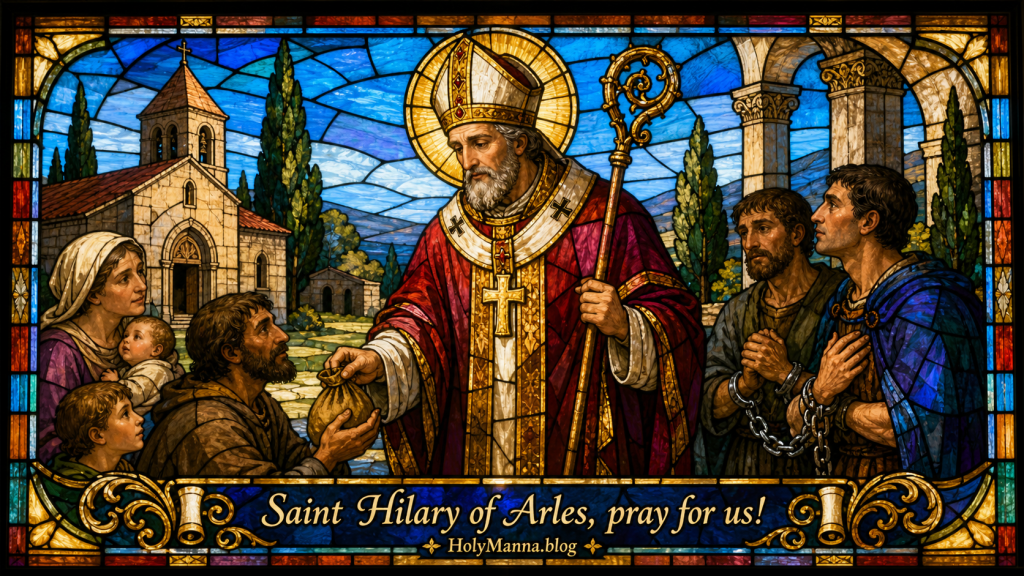
A Firebrand Bishop with a Monk’s Heart
Saint Hilary of Arles was one of those saints who reminds Catholics that holiness does not always look quiet, polished, or predictable. Sometimes holiness looks like a brilliant young man wrestling with ambition. Sometimes it looks like a monk dragged out of solitude to become a bishop. Sometimes it looks like a shepherd who loves the poor so fiercely that he sells church vessels to ransom prisoners. Sometimes it even looks like a saint being corrected by a pope and accepting that correction with humility.
Hilary lived in the fifth century, in what is now southern France. He was Bishop of Arles, a major Christian center in Gaul, and he came from the famous monastic world of Lérins, a place that formed many holy bishops and writers. The Roman Martyrology remembers him on May 5 as a bishop known for poverty, prayer, fasting, preaching, mercy toward sinners, care for orphans, and the ransoming of captives.
He was not a martyr, and he was not a Doctor of the Church like Saint Hilary of Poitiers. Yet Saint Hilary of Arles remains deeply important because he shows something every Catholic needs to learn. Zeal must be purified by humility. Courage must remain obedient. Love for the poor must be real, costly, and practical. Above all, Christ must be allowed to win the heart.
The Young Man Who Fought Grace
Saint Hilary was born around the year 401, probably in northern Gaul, into a wealthy and respected family. He received an excellent education and was trained in the arts of rhetoric, philosophy, and public life. By all appearances, he had everything a young man of noble birth could want. He had intelligence, status, comfort, and a promising future.
But God had placed another man in his life, Saint Honoratus. Honoratus was a relative and spiritual father to Hilary, and he had founded the monastery of Lérins. He saw something in Hilary that Hilary may not have wanted to see yet. Honoratus urged him to leave behind worldly ambition and follow Christ with an undivided heart.
Hilary resisted. That part of his story feels very human. He was not instantly eager to surrender everything. Later, describing that inner struggle, he said, “On one side… I saw the Lord calling me; on the other the world offering me its seducing charms and pleasures.”
That is the battle many souls know well. The Lord calls, but the world still knows how to whisper. Christ invites, but comfort still makes its case. Hilary went back and forth until the prayers of Honoratus helped break open his heart. Looking back on his conversion, Hilary gave the whole victory to Christ: “But in the end Jesus Christ triumphed in me.”
Once grace conquered him, Hilary did not offer God half-measures. He sold his estates, gave his wealth to the poor and to needy monasteries, and entered the monastery of Lérins. There, he took up a life of prayer, discipline, Scripture, fasting, humility, and service.
He had been trained for influence in the world. God retrained him for influence in the Church.
A Bishop Who Walked with the Poor
Hilary loved the hidden life of Lérins, but God did not leave him there. When Saint Honoratus became Bishop of Arles, Hilary followed him for a time, though he longed for monastic solitude. After Honoratus died, Hilary tried to return to Lérins. The people of Arles, however, had other plans. They pursued him, brought him back, and made him bishop while he was still only about twenty-nine years old.
That detail matters. Hilary did not campaign for the episcopacy. He fled from it. Like many saints before and after him, he had to be pulled into the office he did not want.
As bishop, Hilary lived like a monk. The Roman Martyrology says he worked with his hands, wore one tunic in both summer and winter, and traveled on foot. He did not use his office as a ladder into comfort. He used it as a cross.
He preached constantly and powerfully. He could speak to the educated with eloquence, but he also knew how to speak plainly to ordinary people. He believed preaching was not religious entertainment. It was medicine for souls.
One famous story says that some people would leave church after the Gospel and skip the sermon. Hilary rebuked them sharply, warning, “You will not so easily get out of hell, if you are once unhappily fallen into its dungeons.” That sentence sounds severe, but it came from a bishop who believed eternity was real and souls were precious.
Another story tells of a judge whom Hilary had privately corrected for unjust behavior. When the judge later entered the church while Hilary was preaching, Hilary stopped and declared that a man who had refused correction was not worthy to receive the nourishment of God’s word. The judge left in shame, and Hilary resumed preaching. It is a hard story, but it shows the courage of a bishop who did not flatter the powerful.
Yet Hilary was not merely severe. He was tender with sinners. Catholic tradition says that when he placed someone under penance, he himself would weep, praying that God would grant the sinner true sorrow and pardon. He was firm because he believed sin was deadly. He was merciful because he believed Christ came to save sinners.
One of the most beautiful stories about Hilary is that he sold valuable church vessels to ransom captives. Afterward, he used glass chalices and patens for the sacred mysteries. This was not disrespect for the liturgy. It was the Catholic instinct that the treasures of the Church must serve the worship of God and the salvation of souls. Hilary saw Christ in the captive, the orphan, and the poor.
Several miraculous cures were attributed to Saint Hilary during his lifetime in early Catholic tradition. The surviving summaries do not preserve many details about these healings, so they should be mentioned with care. The tradition remembers that God worked through him, but the individual miracle stories cannot be fully verified from the accessible accounts.
What can be said with confidence is that Hilary’s whole life became a kind of living sign. He showed that a bishop’s authority is not meant for self-protection. It is meant for sacrifice.
Corrected by a Pope, Purified by Humility
Saint Hilary was not martyred. He died from exhaustion, austerity, and pastoral labor. But he did suffer real hardship, and the most famous hardship of his life came through conflict inside the Church.
Hilary was a reforming bishop, but his zeal sometimes moved too quickly. In one major dispute, he deposed a bishop named Chelidonius. Chelidonius appealed to Rome, and Pope Saint Leo the Great judged in his favor. Hilary went to Rome to defend himself, but Pope Leo corrected him and restricted some of his authority.
Another difficulty involved a bishop named Projectus. Hilary believed Projectus was dying and appointed a replacement. Projectus recovered, creating a serious canonical problem. Again, Pope Leo judged Hilary’s action irregular.
From a Catholic perspective, this episode is not a stain that cancels Hilary’s sanctity. It is one of the reasons his life is so useful for Catholics. Hilary was intense. He was gifted. He was courageous. He was sometimes too hasty. But when corrected, he did not break communion with the Church. He did not become bitter and separate himself from Peter. He accepted correction.
This is a very Catholic kind of holiness. It is not the holiness of always being right. It is the holiness of remaining faithful when pride is wounded.
After Hilary’s death, Pope Leo himself referred to him as “Hilary of holy memory.” That phrase says a great deal. The pope who corrected him still honored him. The Church did not remember Hilary as a rebel. She remembered him as a saint whose zeal had been purified by obedience.
Saint Hilary died on May 5, 449, still a young man by modern standards, around forty-eight years old. He had burned brightly and spent himself quickly.
A Saint Remembered in Arles and Beyond
After his death, Saint Hilary was venerated in the Catholic tradition as a holy bishop of Arles. His body was remembered as resting in a subterranean chapel beneath the high altar in the church of Saint Honoratus at Arles, with an ancient epitaph marking his memory.
No major, detailed posthumous miracle cycle is widely preserved in the common Catholic summaries of his life. That does not mean no graces were ever associated with his intercession. It simply means that the accessible tradition emphasizes his life, preaching, austerity, pastoral charity, and role in Church history more than a long list of miracles after death.
His lasting impact is especially connected to Arles, Lérins, and the formation of early Catholic Gaul. Lérins was one of the great spiritual schools of the ancient Western Church, and Hilary is one of its most memorable sons. He represents the kind of bishop that monastic life could produce: prayerful, disciplined, poor, courageous, and completely serious about salvation.
He also left a literary legacy. Some writings have been attributed to him, though not all are certain. His sermon or life of Saint Honoratus remains an important witness to the spiritual world of Lérins. Other works, including sermons and an exposition of the Creed, were known in earlier times but have been lost.
Culturally, Hilary is not surrounded today by the same widespread popular devotions as saints like Francis of Assisi or Anthony of Padua. His influence is quieter. He remains a saint for bishops, priests, preachers, religious, reformers, and anyone who struggles to balance zeal with humility.
That is not a small legacy. The Church always needs saints who can teach strong souls how to become obedient souls.
Letting Christ Triumph in the Heart
Saint Hilary’s life begins with a battle and ends with a lesson. At the beginning, he battled between Christ and the world. At the end, he had to let Christ conquer not only his ambition, but also his zeal, his judgment, and his pride.
That is why he matters.
Many Catholics want to serve God, but they also want control. They want to do great things, but they do not always want correction. They want truth, but sometimes forget tenderness. They want mercy, but sometimes avoid sacrifice. Saint Hilary speaks to all of that.
He gave his wealth to the poor. He walked instead of riding. He preached when people did not want to listen. He wept over sinners. He ransomed captives. He defended discipline. He accepted correction from the pope. He stayed in the Church.
That is a full Catholic life. It is not sentimental. It is not soft. It is not proud. It is cruciform.
His famous words belong in the heart of every serious Christian: “But in the end Jesus Christ triumphed in me.”
That is the goal of the spiritual life. Not that personal plans triumph. Not that reputation triumphs. Not that comfort triumphs. Christ must triumph.
Where does Christ still need to triumph in the heart today? Maybe in ambition. Maybe in resentment. Maybe in laziness. Maybe in the fear of giving too much. Maybe in the refusal to be corrected.
Saint Hilary reminds the Church that holiness is not proven by intensity alone. The devil can make people intense. Holiness is proven when intensity becomes charity, when courage becomes obedience, and when sacrifice becomes love.
Engage With Us!
Share your thoughts and reflections in the comments below. Saint Hilary of Arles gives us a powerful example of zeal, humility, poverty, and obedience to the Church.
- What part of Saint Hilary’s story challenges you the most: his poverty, his preaching, his care for captives, or his humility after correction?
- Have you ever felt the struggle Hilary described, with Christ calling on one side and the world pulling on the other?
- What would it look like for Jesus Christ to triumph more fully in your life this week?
- How can you practice mercy in a concrete way, especially toward the poor, the lonely, the imprisoned, or the spiritually wounded?
- When correction comes, do you receive it with humility, or do you immediately defend yourself?
May Saint Hilary of Arles pray for us, that our zeal may be purified, our hearts may be humbled, and our love may become practical and generous. Let us live the faith with courage, serve the poor with tenderness, remain obedient to the Church, and do everything with the love and mercy Jesus taught us.
Saint Hilary of Arles, pray for us!
Follow us on YouTube, Instagram and Facebook for more insights and reflections on living a faith-filled life.


Leave a comment