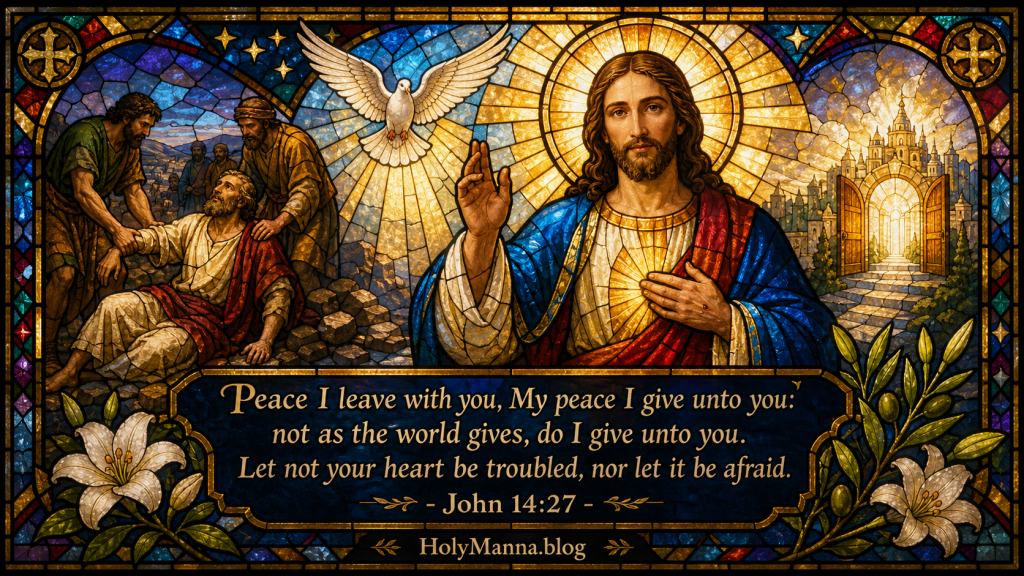
Tuesday of Fifth Week of Easter – Lectionary: 286
Peace for the Road That Still Has Stones
Christ does not promise His disciples a road without suffering. He promises a peace strong enough to keep them walking.
Today’s readings are tied together by one central theme: the peace of Christ strengthens the Church to persevere through hardship and continue proclaiming the Kingdom of God. In Acts 14:19-28, Saint Paul is stoned, dragged out of the city, and left for dead, yet he rises and continues the mission. He does not return to the new disciples with a shallow message of easy religion. He tells them the truth with apostolic courage: “It is necessary for us to undergo many hardships to enter the kingdom of God.” Acts 14:22
That line gives the whole day its spiritual frame. The early Church did not grow because the world was friendly to it. The Church grew because the risen Christ was alive in His apostles, and His grace made wounded men fearless, faithful, and fruitful. Paul and Barnabas strengthen the disciples, appoint presbyters, pray, fast, and entrust the young churches to the Lord. This is the Church taking shape before the reader’s eyes, missionary, sacramental, apostolic, and built for endurance.
The psalm then lifts the heart above the violence and resistance of the world. Psalm 145 proclaims that God’s reign is not fragile, temporary, or threatened by persecution: “Your reign is a reign for all ages, your dominion for all generations.” Psalm 145:13 The Kingdom Paul preached is the same Kingdom the psalm praises, a Kingdom that outlasts every crowd, every hardship, and every earthly power.
Then, in John 14:27-31, Jesus reveals the hidden source of that courage. Before His Passion, He tells the Apostles, “Peace I leave with you; my peace I give to you. Not as the world gives do I give it to you.” John 14:27 This is not the peace of comfort, popularity, or perfect circumstances. It is the peace of the Son who loves the Father, obeys the Father, and walks freely toward the Cross. The Catechism of the Catholic Church teaches that true peace is “the tranquillity of order” and “the work of justice and the effect of charity” CCC 2304. In other words, Christian peace begins when the heart is rightly ordered toward God.
Today’s readings prepare the faithful to see that Easter peace is not escape from the Cross. It is communion with Christ in the middle of it. The same Jesus who tells troubled hearts not to be afraid also sends His Church into a world that may reject her. Yet because His peace is stronger than fear, His disciples can rise, preach, strengthen others, and bless the Lord from generation to generation.
Where does Christ want to give peace today, not by removing every hardship, but by strengthening the heart to remain faithful through it?
First Reading – Acts 14:19-28
The Wounded Apostle and the Church That Keeps Walking
The First Reading brings us near the end of Saint Paul’s first missionary journey with Barnabas. The scene is raw, almost shocking. Paul has been preaching the Gospel to Gentiles in Asia Minor, and the mission has been fruitful, but it has also stirred fierce opposition. In Lystra, the mood of the crowd changes quickly. Earlier in Acts 14, the people had wanted to treat Paul and Barnabas like gods after a miraculous healing. Now, after opponents arrive from Antioch and Iconium, the crowd turns violent.
This reading fits perfectly into today’s theme because it shows what the peace of Christ looks like in real life. It is not comfort. It is not popularity. It is not the absence of suffering. It is the grace to keep following Christ when the road gets painful. Paul is stoned and left for dead, yet he rises, continues the mission, strengthens the disciples, appoints presbyters, and gives the Church one of her clearest teachings about perseverance: “It is necessary for us to undergo many hardships to enter the kingdom of God.” Acts 14:22
This is not a gloomy message. It is an Easter message. The risen Christ has conquered death, and now His apostles can walk through suffering without being conquered by fear.
Acts 14:19-28 – New American Bible (Revised Edition)
19 However, some Jews from Antioch and Iconium arrived and won over the crowds. They stoned Paul and dragged him out of the city, supposing that he was dead. 20 But when the disciples gathered around him, he got up and entered the city. On the following day he left with Barnabas for Derbe.
End of the First Mission. 21 After they had proclaimed the good news to that city and made a considerable number of disciples, they returned to Lystra and to Iconium and to Antioch. 22 They strengthened the spirits of the disciples and exhorted them to persevere in the faith, saying, “It is necessary for us to undergo many hardships to enter the kingdom of God.” 23 They appointed presbyters for them in each church and, with prayer and fasting, commended them to the Lord in whom they had put their faith. 24 Then they traveled through Pisidia and reached Pamphylia. 25 After proclaiming the word at Perga they went down to Attalia. 26 From there they sailed to Antioch, where they had been commended to the grace of God for the work they had now accomplished. 27 And when they arrived, they called the church together and reported what God had done with them and how he had opened the door of faith to the Gentiles. 28 Then they spent no little time with the disciples.
Detailed Exegesis
Verse 19 – “However, some Jews from Antioch and Iconium arrived and won over the crowds. They stoned Paul and dragged him out of the city, supposing that he was dead.”
This verse shows how quickly public opinion can be manipulated. The same crowd that had recently admired Paul now turns against him. The opposition comes from Antioch and Iconium, places where Paul and Barnabas had already faced resistance. Their enemies are not content to reject the Gospel privately. They follow the missionaries and stir up others against them.
Stoning was a brutal form of execution associated with severe religious condemnation. The crowd does not merely disagree with Paul. They treat him as dangerous. Paul is dragged outside the city because they assume he is dead. In this moment, the apostle becomes visibly conformed to Christ, rejected, cast out, and treated as cursed. The Church has always understood that the disciple is not greater than the Master. If Christ was rejected, His apostles should not be surprised when the Gospel provokes hatred.
Verse 20 – “But when the disciples gathered around him, he got up and entered the city. On the following day he left with Barnabas for Derbe.”
This is one of the most powerful images in Acts of the Apostles. Paul lies outside the city, surrounded not by enemies anymore, but by disciples. The Church gathers around the wounded apostle. Then Paul gets up.
The text does not overexplain the moment, which makes it even more striking. Whether Paul had been near death or miraculously preserved, the meaning is clear. The mission continues by the power of God. Paul does not run away in fear. He enters the city again. That detail matters. He goes back into the place where he was almost killed. His courage is not stubborn pride. It is apostolic faith.
The next day, he leaves with Barnabas for Derbe. The Gospel does not stop because Paul has been wounded. In Catholic life, this is a necessary lesson. Faithfulness often means continuing to love, pray, serve, and speak the truth after being hurt.
Verse 21 – “After they had proclaimed the good news to that city and made a considerable number of disciples, they returned to Lystra and to Iconium and to Antioch.”
Paul and Barnabas preach in Derbe, and their work bears fruit. A considerable number become disciples. But instead of moving only toward safer places, they return to the very cities where they had faced danger.
This return journey shows the heart of true pastoral care. Paul and Barnabas are not only interested in conversions. They are interested in forming disciples who can endure. Evangelization is not just getting people emotionally excited about Jesus. It is helping them remain rooted in Christ when suffering comes.
Their return also reveals the missionary shape of the Church. The apostles preach, gather believers, strengthen them, and establish them in the faith. The Church is not a random collection of spiritual individuals. She is a visible communion formed by apostolic teaching and pastoral care.
Verse 22 – “They strengthened the spirits of the disciples and exhorted them to persevere in the faith, saying, ‘It is necessary for us to undergo many hardships to enter the kingdom of God.’”
This verse is the spiritual center of the reading. Paul and Barnabas strengthen the disciples by telling them the truth. They do not promise an easy Christian life. They do not say, “Follow Jesus and everything will be comfortable.” They say that hardships are part of the road to the kingdom.
The word “necessary” is important. Paul is not saying suffering is good in itself. He is saying that union with Christ means sharing the pattern of Christ’s life. Jesus entered glory through the Cross. His disciples enter the kingdom by following Him with perseverance.
This is deeply Catholic. The Christian does not seek suffering for its own sake, but when suffering comes, it can be united to Christ. Hardships become spiritually fruitful when they are carried with faith, charity, and hope.
Verse 23 – “They appointed presbyters for them in each church and, with prayer and fasting, commended them to the Lord in whom they had put their faith.”
Here, the apostolic structure of the Church becomes visible. Paul and Barnabas appoint presbyters, or elders, in each church. This is one of the biblical roots of ordained pastoral leadership. The new Christian communities are not left without shepherds. They are given leaders who will guide, teach, and care for them.
The appointment happens with prayer and fasting. This shows that leadership in the Church is not merely administrative. It is spiritual. The Church does not belong to the presbyters, to Paul, or to Barnabas. She belongs to Christ. That is why the apostles commend the communities to the Lord.
This verse matters for Catholic readers because it shows that the early Church had order, authority, and pastoral leadership from the beginning. The Church was missionary, but she was also structured. She was charismatic, but she was also apostolic.
Verse 24 – “Then they traveled through Pisidia and reached Pamphylia.”
This verse may sound like simple geography, but it reminds the reader that the Gospel spread through real places, real roads, real cities, and real hardships. Pisidia and Pamphylia were regions in Asia Minor, located in what is now modern-day Turkey. Paul and Barnabas were not preaching vague spiritual ideas from a safe distance. They were traveling through difficult terrain, facing opposition, and forming real communities.
The Incarnation teaches Catholics to take geography, history, and human life seriously. God saves real people in real places. The missionary journeys of Paul remind the Church that faith is not an abstract theory. It is lived in homes, roads, cities, churches, families, and communities.
Verse 25 – “After proclaiming the word at Perga they went down to Attalia.”
Paul and Barnabas continue proclaiming the word at Perga, then travel to Attalia, a port city. Their movement toward the coast prepares them to return to Antioch, the community that had sent them out.
This verse quietly shows perseverance in ordinary mission. Not every moment is dramatic like the stoning at Lystra. Some moments are simply faithful movement from one place to another, one sermon to another, one soul to another. The Church grows through martyr-like courage, but also through steady obedience.
Most Christians will not be dragged outside a city and left for dead. But every Christian is called to keep proclaiming the word in the ordinary routes of life, at work, at home, in friendships, in parish life, and in quiet acts of witness.
Verse 26 – “From there they sailed to Antioch, where they had been commended to the grace of God for the work they had now accomplished.”
Paul and Barnabas return to Antioch in Syria, the church community that had originally sent them on mission. The verse says they had been “commended to the grace of God.” That phrase is beautiful because it shows that missionary work begins with grace and ends with gratitude.
The work is now accomplished, but not because Paul and Barnabas were impressive on their own. It was the grace of God working through them. Catholic mission always begins there. God acts first. The Church responds. The apostle cooperates. Grace makes the mission fruitful.
Verse 27 – “And when they arrived, they called the church together and reported what God had done with them and how he had opened the door of faith to the Gentiles.”
When Paul and Barnabas return, they gather the Church and give a report. Notice the humility of the language. They report what God had done with them, not what they had done for God.
This is the heart of apostolic mission. The apostles are real participants, but God is the primary actor. He opens the door of faith to the Gentiles. This is a major moment in salvation history. The covenant promises given to Israel are now being proclaimed to the nations, and Gentiles are entering the Church through faith in Christ.
This verse points toward the great question that will soon arise in Acts 15, when the Church must discern how Gentile converts are to be received. The mission to the Gentiles is not a side story. It is the unfolding of God’s plan to bring all nations into Christ.
Verse 28 – “Then they spent no little time with the disciples.”
The reading ends not with spectacle, but with communion. Paul and Barnabas remain with the disciples. They spend time with the Church. This matters because Christian life is not sustained by dramatic moments alone. It is sustained by fellowship, teaching, worship, prayer, and shared perseverance.
The phrase “no little time” suggests a meaningful period of rest, formation, and communion. After missionary hardship, the apostles return to the life of the Church. This is a gentle but important reminder. Even great missionaries need the community of believers. Even strong Christians need time with the disciples.
Teachings
This reading teaches that Christian suffering is not meaningless when it is united to Christ. Saint Paul’s stoning is not just a story about endurance. It is a living image of the Cross bearing fruit in the life of the Church. The Catechism of the Catholic Church explains this mystery with great depth: “The cross is the unique sacrifice of Christ, the ‘one mediator between God and men.’ But because in his incarnate divine person he has in some way united himself to every man, ‘the possibility of being made partners, in a way known to God, in the paschal mystery’ is offered to all men. He calls his disciples to ‘take up [their] cross and follow [him],’ for ‘Christ also suffered for [us], leaving [us] an example so that [we] should follow in his steps.’ In fact Jesus desires to associate with his redeeming sacrifice those who were to be its first beneficiaries. This is achieved supremely in the case of his mother, who was associated more intimately than any other person in the mystery of his redemptive suffering.” CCC 618
That teaching helps explain Paul’s words in Acts 14:22. Hardship is not proof that God has abandoned the disciple. Sometimes hardship is the very place where the disciple is being conformed more closely to Christ.
This reading also teaches the apostolic nature of the Church. Paul and Barnabas appoint presbyters in each church. They do not leave the new believers as isolated spiritual individuals. They establish ordered communities under pastoral leadership. The Catechism of the Catholic Church teaches: “The Church is apostolic because she is founded on the apostles, in three ways: she was and remains built on ‘the foundation of the Apostles,’ the witnesses chosen and sent on mission by Christ himself; with the help of the Spirit dwelling in her, the Church keeps and hands on the teaching, the ‘good deposit,’ the salutary words she has heard from the apostles; she continues to be taught, sanctified, and guided by the apostles until Christ’s return, through their successors in pastoral office: the college of bishops, ‘assisted by priests, in union with the successor of Peter, the Church’s supreme pastor.’” CCC 857
The appointment of presbyters also points toward the Catholic understanding of ordained ministry. The priesthood is not a human invention or merely a community function. It is ordered toward Christ’s work in the Church. The Catechism of the Catholic Church teaches: “The ordained ministry or ministerial priesthood is at the service of the baptismal priesthood. The ordained priesthood guarantees that it really is Christ who acts in the sacraments through the Holy Spirit for the Church. The saving mission entrusted by the Father to his incarnate Son was committed to the apostles and through them to their successors: they receive the Spirit of Jesus to act in his name and in his person. The ordained minister is the sacramental bond that ties the liturgical action to what the apostles said and did and, through them, to the words and actions of Christ, the source and foundation of the sacraments.” CCC 1120
This is why Acts 14 is such an important Catholic reading. It shows the Church preaching the Gospel, suffering for Christ, forming disciples, appointing ordained shepherds, praying, fasting, and recognizing that God Himself opens the door of faith. This is the Church in motion. This is apostolic Christianity before it has centuries of buildings, councils, universities, and cathedrals. It is already recognizably Catholic in its missionary zeal, its sacramental instinct, its ordained leadership, and its trust in grace.
Saint Paul would later remember his sufferings as part of his apostolic witness. In 2 Corinthians, he writes, “Three times I was beaten with rods, once I was stoned, three times I was shipwrecked, I passed a night and a day on the deep.” 2 Corinthians 11:25 The stoning in today’s reading may be the very event he is remembering. Paul does not boast because suffering makes him impressive. He boasts because weakness reveals the power of Christ.
Reflection
This reading is for anyone who has ever felt spiritually bruised and wondered whether it is worth continuing.
Paul is left for dead, but the disciples gather around him. That image should stay in the heart. The Christian life is not meant to be lived alone. Sometimes the first grace after a hard fall is not an instant answer, but the presence of faithful people who stand near the wound. A parish, a family, a spiritual friend, a confessor, a spouse, a mentor, or a prayer group can become the place where God helps a disciple rise again.
Paul gets up and goes back into the city. That does not mean every Christian must return to every harmful situation without prudence. It means the Gospel cannot be ruled by fear. The enemy wants suffering to turn disciples inward, make them bitter, and convince them to stop serving. Christ gives a different grace. He gives the courage to keep loving without becoming naïve, to keep witnessing without becoming harsh, and to keep walking without pretending the wounds are not real.
This reading also invites Catholics to recover a mature view of faith. Christianity is not a promise that life will become easy. It is the promise that Christ will be faithful in the middle of life’s hardships. Paul strengthens the disciples by telling them the truth. The road to the kingdom includes trials, but those trials do not have the final word.
A simple way to live this reading today is to name one hardship honestly before God and stop pretending it is not heavy. Then unite it to Christ in prayer. The next step is to stay close to the Church, especially through Confession, the Eucharist, spiritual friendship, and faithful Sunday worship. Paul did not rise in isolation. He rose with the disciples gathered around him.
Another way to live this reading is to encourage someone else who is trying to persevere. Paul had just been wounded, yet he strengthened others. Sometimes the people who have suffered most deeply can become the most credible witnesses of hope. Not because they have easy answers, but because they know Christ can keep a soul alive when everything feels shaken.
Where has suffering tempted you to stop following Christ with courage?
Who are the disciples God has placed around you to help you rise again?
Who needs you to be part of the circle around them while they are wounded?
The First Reading leaves the Church with a powerful truth. The mission continues through wounded saints. The Gospel advances through people who have every human reason to quit, but choose to get up by grace. Paul’s body may have carried the marks of stones, but his soul carried the peace of Christ.
That is the kind of peace the world cannot give.
Responsorial Psalm – Psalm 145:10-13, 21
The Kingdom That Keeps Speaking Through Every Generation
After watching Saint Paul rise from violence and continue the mission in Acts 14, the Responsorial Psalm lifts the eyes of the Church from the bruised body of the apostle to the eternal reign of God. Psalm 145 is a hymn of praise traditionally associated with David, and it belongs to the prayer treasury of Israel that the Church has inherited as her own. It is a psalm that teaches the faithful how to praise God not only when life feels peaceful, but also when the Kingdom of God must be proclaimed in a hostile world.
This psalm fits today’s theme beautifully because it reminds the Church that God’s reign is stronger than every earthly resistance. Crowds may turn against Paul. Missionaries may be wounded. Disciples may need strengthening. But the Lord’s kingdom remains steady, trustworthy, loving, and everlasting. The same God who opens “the door of faith to the Gentiles” in Acts 14:27 is the God whose dominion reaches “all generations” in Psalm 145:13.
In today’s readings, Christian peace is not shown as an escape from hardship. It is shown as confidence in the reign of God. The world may shake, but the Kingdom does not.
Psalm 145:10-13, 21 – New American Bible (Revised Edition)
10 All your works give you thanks, Lord
and your faithful bless you.
11 They speak of the glory of your reign
and tell of your mighty works,
12 Making known to the sons of men your mighty acts,
the majestic glory of your rule.
13 Your reign is a reign for all ages,
your dominion for all generations.
The Lord is trustworthy in all his words,
and loving in all his works.21 My mouth will speak the praises of the Lord;
all flesh will bless his holy name forever and ever.
Detailed Exegesis
Verse 10 – “All your works give you thanks, Lord and your faithful bless you.”
This verse begins with the whole created order giving thanks to God. The psalmist does not limit praise to human words. Creation itself bears witness to the goodness of the Lord. The mountains, seas, stars, fields, animals, and seasons all silently proclaim that they come from a wise and loving Creator.
Then the verse becomes more personal: “your faithful bless you.” The faithful are those who recognize God’s goodness and respond with worship. In the context of today’s readings, this matters because the Church praises God even while suffering. Paul’s wounds do not silence praise. The trials of the disciples do not cancel God’s goodness. The faithful bless the Lord because His reign remains true even when the world is unstable.
Verse 11 – “They speak of the glory of your reign and tell of your mighty works.”
Praise becomes proclamation. The faithful do not keep the glory of God’s reign hidden inside their own hearts. They speak. They tell. They announce what God has done.
This connects directly with Paul and Barnabas in Acts 14. After their missionary journey, they gather the Church and report what God has done through them. The psalm gives the spiritual pattern for apostolic mission. Those who have seen the mighty works of God must speak about them.
The “reign” of God is not merely a private feeling. It is His sovereign rule over creation, history, the Church, and the human heart. To speak of His reign is to confess that God is King, even when human powers seem loud and threatening.
Verse 12 – “Making known to the sons of men your mighty acts, the majestic glory of your rule.”
This verse expands the missionary movement. The faithful make God’s mighty acts known “to the sons of men.” In other words, praise becomes evangelization. The greatness of God is meant to be announced to humanity.
For Catholics, this verse resonates deeply with the Church’s mission to bring the Gospel to all nations. In Acts 14, God opens the door of faith to the Gentiles. In Psalm 145, the faithful make His mighty acts known to the sons of men. Both readings point toward the same truth. The Kingdom of God is not reserved for one small corner of the world. God desires all peoples to know His glory.
The phrase “the majestic glory of your rule” reminds the reader that God’s rule is not oppressive. His kingship is beautiful, holy, and life-giving. The Lord does not rule like a tyrant. He rules as Creator, Father, Redeemer, and Shepherd.
Verse 13 – “Your reign is a reign for all ages, your dominion for all generations. The Lord is trustworthy in all his words, and loving in all his works.”
This verse is the heart of the psalm. Human kingdoms rise and fall. Empires expand and collapse. Public opinion changes. Cultures shift. But God’s reign endures “for all ages.”
That is exactly the confidence the early Church needed. Paul and Barnabas were preaching in a world full of local powers, pagan customs, Jewish opposition, Roman authority, and unstable crowds. Yet the Kingdom they proclaimed was not fragile. It belonged to the Lord whose dominion lasts through every generation.
The second half of the verse gives two reasons the faithful can trust God’s reign. The Lord is “trustworthy in all his words” and “loving in all his works.” God does not deceive His people. He does not abandon His promises. His words can be trusted, and His works flow from love.
This also prepares the heart for the Gospel, where Jesus promises peace before His Passion. The disciples can trust His words because the Lord is faithful. When Jesus says, “Do not let your hearts be troubled or afraid,” John 14:27, He is not offering empty comfort. He is speaking with divine authority and love.
Verse 21 – “My mouth will speak the praises of the Lord; all flesh will bless his holy name forever and ever.”
The psalm ends with a personal commitment that becomes universal worship. The psalmist says, “My mouth will speak the praises of the Lord.” Praise begins with one faithful voice. Then it expands outward until “all flesh” is invited to bless His holy name.
This movement from one mouth to all flesh mirrors the missionary life of the Church. One apostle preaches. One community receives the word. One church is strengthened. Then the Gospel spreads. The praise of God moves from person to person, city to city, and generation to generation.
The phrase “forever and ever” points beyond earthly worship to the eternal praise of heaven. Catholic worship on earth is already a participation in the worship of the heavenly kingdom. Every Mass, every psalm, every act of praise joins the Church on earth to the angels and saints who bless the Lord without end.
Teachings
The Responsorial Psalm teaches that praise is not a decorative part of the Christian life. Praise is how the faithful stand inside reality and confess the truth. God is King. His works are good. His words are trustworthy. His dominion endures. His name is holy.
The Catechism of the Catholic Church teaches that the Psalms are central to the prayer of God’s people: “The Psalms both nourished and expressed the prayer of the People of God gathered during the great feasts at Jerusalem and each Sabbath in the synagogues. Their prayer is inseparably personal and communal; it concerns both those who are praying and all men; it rises from the Holy Land and the communities of the Diaspora, but embraces all creation; it recalls the saving events of the past, yet extends into the future, even to the end of history; it commemorates the promises God has already kept, and awaits the Messiah who will fulfill them definitively. Prayed by Christ and fulfilled in him, the Psalms remain essential to the prayer of the Church.” CCC 2586
That teaching helps explain why Psalm 145 fits so naturally between Acts 14 and John 14. The psalm does not interrupt the story. It teaches the Church how to pray inside the story. Paul suffers, the Church grows, Christ promises peace, and the faithful respond by blessing the Lord whose Kingdom lasts forever.
The Catechism also teaches: “The Psalter is the book in which the Word of God becomes man’s prayer. In other books of the Old Testament, the words proclaim God’s works and bring to light the mystery they contain. The words of the Psalmist, sung for God, both express and respond to the saving works of God.” CCC 2587
This is exactly what happens in today’s psalm. God’s works become the reason for human praise. His mighty acts become the message of His faithful ones. His eternal reign becomes the anchor of the suffering Church.
Saint Augustine, who loved the Psalms deeply, taught that Christ prays in the Psalms both as Head and with His Body, the Church. That means when Catholics pray the Psalms, they are not merely reading ancient poetry. They are entering the prayer of Christ and His Church. The wounded missionary, the fearful disciple, the faithful family, the tired priest, the struggling young adult, and the hidden saint all find their voice in the Psalms.
Historically, Psalm 145 has also held a special place in Jewish daily prayer and in the Church’s liturgical life because it is a sweeping hymn of praise. It gathers creation, the faithful, the nations, and all generations into one act of blessing. That makes it especially powerful during Easter. The risen Christ has revealed that God’s Kingdom is not defeated by suffering or death. The Church praises because the King has conquered.
Reflection
This psalm teaches the faithful how to live when circumstances feel uncertain. The first instinct of the heart is often to complain, panic, control, or withdraw. Psalm 145 offers another way. It invites the Christian to praise.
Praise does not mean pretending life is easy. Paul had just been stoned. The disciples needed strengthening. Jesus was preparing His apostles for the Passion. The readings are honest about suffering. But praise teaches the soul to look beyond the wound and remember the King.
A practical way to live this psalm is to begin the day by naming one mighty work of God. It may be creation, the gift of life, the Eucharist, forgiveness in Confession, a prayer answered long ago, a conversion in the family, or simply the grace to keep going. The soul that remembers God’s works becomes harder for fear to dominate.
Another way to live this psalm is to speak of God’s goodness out loud. The psalm says the faithful “speak of the glory” of His reign and “tell of” His mighty works. Catholic faith is not meant to stay hidden as a private comfort. Parents can speak of God’s faithfulness to their children. Friends can encourage one another in faith. Parishioners can share testimonies of grace. Ordinary conversations can become small doors of evangelization.
This psalm also invites Catholics to trust God’s timeline. His reign is “for all ages” and His dominion is “for all generations.” That is a healing word for anyone who wants instant results. God is not in a panic. His Kingdom is not behind schedule. Faithfulness today matters, even when the fruit appears slowly.
What mighty work of God needs to be remembered today?
Where has fear become louder than praise?
Who needs to hear about the goodness of God through your words, your steadiness, or your witness?
The Responsorial Psalm gives the Church a voice strong enough for troubled times. It teaches that praise is not escape. Praise is resistance against despair. Praise is the soul standing beneath the reign of God and saying, even now, the Lord is trustworthy. The Lord is loving. His Kingdom endures forever.
Holy Gospel – John 14:27-31
The Peace That Walks Straight Toward the Cross
The Gospel takes place during the Last Supper, inside what Catholics often call the Farewell Discourse of Jesus in The Gospel of John. Judas has already gone into the night. The Passion is close. The apostles can feel that something heavy is coming, even if they do not yet understand everything. Into that troubled room, Jesus gives them one of His most tender and powerful promises: “Peace I leave with you; my peace I give to you.” John 14:27
This peace is not the peace of the Roman Empire, which often meant order maintained by force. It is not the peace of having everything under control. It is not the fragile calm that depends on circumstances going well. In the biblical world, peace carries the rich meaning of shalom, a deep wholeness, right relationship, covenant blessing, and communion with God.
That is why this Gospel completes today’s theme so beautifully. In the First Reading, Saint Paul is stoned and left for dead, yet he rises and continues the mission. In the Psalm, the Church praises the everlasting reign of God. Now Jesus reveals the hidden source of that courage. The disciple can endure hardship because Christ gives a peace the world cannot manufacture and cannot take away.
John 14:27-31 – New American Bible (Revised Edition)
27 Peace I leave with you; my peace I give to you. Not as the world gives do I give it to you. Do not let your hearts be troubled or afraid. 28 You heard me tell you, ‘I am going away and I will come back to you.’ If you loved me, you would rejoice that I am going to the Father; for the Father is greater than I. 29 And now I have told you this before it happens, so that when it happens you may believe. 30 I will no longer speak much with you, for the ruler of the world is coming. He has no power over me, 31 but the world must know that I love the Father and that I do just as the Father has commanded me. Get up, let us go.
Detailed Exegesis
Verse 27 – “Peace I leave with you; my peace I give to you. Not as the world gives do I give it to you. Do not let your hearts be troubled or afraid.”
Jesus gives peace as a farewell gift, but this is not a sentimental goodbye. He is preparing His apostles for the scandal of the Cross. The peace He gives is His own peace, the peace of the Son who rests completely in the Father’s love.
The phrase “Not as the world gives” is essential. The world gives peace when problems disappear. Jesus gives peace while the storm is still approaching. The world gives peace through control, comfort, distraction, or power. Jesus gives peace through communion with Him.
When He says, “Do not let your hearts be troubled or afraid,” He is not denying that the apostles will suffer. He is commanding their hearts not to surrender to fear. Christian peace is not emotional numbness. It is trust rooted in Christ.
Verse 28 – “You heard me tell you, ‘I am going away and I will come back to you.’ If you loved me, you would rejoice that I am going to the Father; for the Father is greater than I.”
Jesus speaks of His departure and return. He is going away through His Passion, death, Resurrection, and Ascension, yet He will come back to His disciples through the Resurrection, through the sending of the Holy Spirit, and ultimately in glory.
When Jesus says, “the Father is greater than I,” the Church does not read this as a denial of Christ’s divinity. The Son is consubstantial with the Father, true God from true God. Here, Jesus speaks from within His incarnate mission. As the Son made man, He humbles Himself, obeys the Father, and returns to the Father in glory.
This verse teaches the disciples to see the Passion not only as loss, but as Jesus’ return to the Father. If they truly understood His love and His mission, they would rejoice because the Son is completing the work of salvation.
Verse 29 – “And now I have told you this before it happens, so that when it happens you may believe.”
Jesus prepares the apostles before the crisis comes. He tells them what is coming so that the Cross will not destroy their faith. When betrayal, arrest, and death unfold, the apostles will eventually remember that Jesus was not surprised. He was not defeated. He had already spoken of these things.
This verse shows the mercy of Christ as Teacher. He knows the weakness of His disciples. He knows their hearts will be shaken. So He gives them words to hold onto later. Many Catholics experience this in the spiritual life. A Scripture verse, a teaching of the Church, a word from Confession, or a truth learned in prayer becomes an anchor when suffering arrives.
Faith often grows when the believer realizes that Christ was already speaking before the trial began.
Verse 30 – “I will no longer speak much with you, for the ruler of the world is coming. He has no power over me.”
Jesus now names the spiritual battle. The “ruler of the world” refers to Satan, who acts through betrayal, violence, fear, and the sinful systems opposed to God. Jesus does not pretend evil is imaginary. He sees clearly that darkness is approaching.
Yet He immediately says, “He has no power over me.” Satan can stir up Judas, religious opposition, cowardice, mockery, and violence. He can move the machinery of death toward Calvary. But he has no claim on Christ because Christ is without sin. The Passion is not Satan overpowering Jesus. It is Jesus freely offering Himself in obedient love.
This is a crucial Catholic truth. The Cross is not a tragic accident. It is the saving sacrifice of the Son.
Verse 31 – “But the world must know that I love the Father and that I do just as the Father has commanded me. Get up, let us go.”
Here Jesus reveals the heart of His Passion. He goes to the Cross so the world may know that He loves the Father. His obedience is not cold duty. It is love. The Son obeys because He loves, and through that obedience, the world is redeemed.
The final words are striking: “Get up, let us go.” Jesus does not wait passively for suffering to happen to Him. He rises and walks toward His Passion. This is courage beyond human courage. This is divine love moving toward the Cross for the salvation of the world.
These words also speak into the First Reading. Paul, wounded and left for dead, gets up and continues the mission. The apostle’s courage flows from the Master’s courage. Jesus says, “Get up, let us go,” and His Church learns how to rise.
Teachings
This Gospel teaches that true peace comes from Christ and is rooted in right order with God. The Catechism of the Catholic Church explains: “Peace is not merely the absence of war, and it is not limited to maintaining a balance of powers between adversaries. Peace cannot be attained on earth without safeguarding the goods of persons, free communication among men, respect for the dignity of persons and peoples, and the assiduous practice of fraternity. Peace is ‘the tranquillity of order.’ Peace is the work of justice and the effect of charity.” CCC 2304
That teaching helps explain why Jesus can give peace before the Cross. His peace does not depend on outward calm. It comes from perfect charity, perfect justice, and perfect communion with the Father. His heart is rightly ordered in love, so even as the Passion approaches, He is not ruled by fear.
The Gospel also reveals the loving obedience of Christ. The Catechism of the Catholic Church teaches: “Jesus’ prayer, characterized by thanksgiving, reveals to us how to ask: before the gift is given, Jesus commits himself to the One who in giving gives himself. The Giver is more precious than the gift; he is the ‘treasure’; in him abides his Son’s heart; the gift is given ‘as well.’” CCC 2604
Jesus’ heart abides in the Father. That is why His peace is unshakable. He does not cling to earthly security because His treasure is the Father. This is also why Christian prayer is essential. The soul that stops praying becomes easier for fear to dominate. The soul that abides in God learns to receive peace from a source deeper than circumstances.
The Catechism also teaches about Christ’s free acceptance of the Father’s saving will: “The cup of the New Covenant, which Jesus anticipated when he offered himself at the Last Supper, is afterwards accepted by him from his Father’s hands in his agony in the garden at Gethsemani, making himself ‘obedient unto death.’ Jesus prays: ‘My Father, if it be possible, let this cup pass from me . . .’ Thus he expresses the horror that death represented for his human nature. Like ours, his human nature is destined for eternal life; but unlike ours, it is perfectly exempt from sin, the cause of death. Above all, his human nature has been assumed by the divine person of the ‘Author of life,’ the ‘Living One.’ By accepting in his human will that the Father’s will be done, he accepts his death as redemptive, for ‘he himself bore our sins in his body on the tree.’” CCC 612
This makes Jesus’ words in John 14:31 even more powerful. His obedience is not forced. He loves the Father and freely does what the Father commands. The Cross is the place where the world sees the Son’s love for the Father and the Father’s love for the world.
Saint Augustine captures the hunger beneath every human search for peace when he writes in Confessions: “You have made us for yourself, O Lord, and our heart is restless until it rests in you.” Confessions, Book I, Chapter 1
That is why the world cannot give the peace Jesus gives. The world can distract the restless heart, entertain it, flatter it, or numb it for a while. Only God can give it rest.
Reflection
This Gospel is for every heart that feels troubled, anxious, overwhelmed, or tired of pretending everything is fine. Jesus does not shame the apostles for being afraid. He gives them peace before they fully understand the battle ahead.
That is good news for ordinary Catholics trying to live faithfully in a noisy world. Peace does not begin when every problem is solved. Peace begins when Christ is welcomed into the center of the heart. The job may still be stressful. The family situation may still be complicated. The diagnosis may still be frightening. The culture may still be confused. The temptation may still be real. But the heart does not have to be ruled by fear.
A practical way to live this Gospel is to begin by asking whether peace is being sought from Christ or from control. Many people say they want peace, but what they really want is certainty. Jesus does not always give certainty about the future. He gives Himself.
Another way to live this Gospel is to pray slowly with the words of Jesus: “Peace I leave with you; my peace I give to you.” John 14:27 These words can become a daily prayer during anxiety, before difficult conversations, during temptation, or when carrying hidden suffering. The goal is not to force an emotion. The goal is to let Christ order the heart.
This Gospel also invites Catholics to practice obedient love. Jesus says the world must know that He loves the Father and does what the Father commands. Peace grows when the soul stops negotiating with God and begins trusting Him. Obedience is not always easy, but it brings the heart back into order. Confession, Sunday Mass, daily prayer, forgiveness, chastity, honesty, patience, and charity are not burdens that steal peace. They are paths where Christ teaches the soul to live freely.
Finally, the words “Get up, let us go” should not be missed. Jesus speaks them as He moves toward the Cross. Paul lives them when he rises after being stoned. The Christian lives them whenever grace says, “Do not quit here. Get up. Keep walking with Christ.”
Where has fear been louder than the voice of Jesus?
What kind of peace is being sought right now, the peace of control or the peace of Christ?
What act of obedience might restore order to the heart today?
The Gospel leaves the Church with a promise and a command. Christ gives peace, and He calls His disciples to rise. The world cannot give this peace because the world does not possess its source. The source is Jesus Himself, the Son who loves the Father, defeats the ruler of this world, and walks freely toward the Cross so His people can walk through every hardship without being conquered by fear.
When Peace Becomes the Road Home
Today’s readings leave the Church with a clear and steady message. The peace of Christ is not fragile. It does not depend on perfect circumstances, friendly crowds, or a painless road. It is the peace of the Son who loves the Father, obeys the Father, and walks toward the Cross without fear.
In Acts 14:19-28, Saint Paul shows what this peace looks like in the life of an apostle. He is stoned, dragged out of the city, and left for dead, but he rises and continues the mission. His wounds do not end his witness. Instead, he strengthens the disciples and tells them the hard but holy truth: “It is necessary for us to undergo many hardships to enter the kingdom of God.” Acts 14:22 The Christian life was never promised as an easy escape from suffering. It is a path of union with Christ, who turns suffering into a place of grace.
In Psalm 145, the Church learns how to praise while walking that path. God’s reign is not shaken by opposition, weakness, disappointment, or fear. “Your reign is a reign for all ages, your dominion for all generations.” Psalm 145:13 The world changes quickly, but the Kingdom of God remains. That is why the faithful can keep speaking of His glory, telling of His mighty works, and blessing His holy name even when life feels heavy.
Then, in John 14:27-31, Jesus reveals the source of it all: “Peace I leave with you; my peace I give to you. Not as the world gives do I give it to you.” John 14:27 This is the peace that steadies Paul after stones. This is the peace that strengthens the Church through generations. This is the peace that enters anxious hearts and teaches them not to be ruled by fear.
The invitation today is simple, but not small. Let Christ’s peace go deeper than feelings. Let it reorder the heart. Let it shape decisions, relationships, suffering, prayer, and courage. Bring the bruised places to Him. Stay close to the Church. Receive the sacraments with faith. Praise God even before every problem is solved. Then, when life knocks the soul down, listen again to the quiet command of grace.
Get up, and keep walking with Christ.
Where is Jesus asking you to receive His peace today, not as the world gives it, but as only He can give it?
Engage with Us!
Share your reflections in the comments below. Today’s readings are rich with courage, praise, and the deep peace of Christ, so take a moment to sit with them and consider where God may be speaking into your life.
- First Reading, Acts 14:19-28: Where has hardship tempted you to stop serving, praying, forgiving, or witnessing to Christ, and how might Saint Paul’s perseverance encourage you to get back up with grace?
- Responsorial Psalm, Psalm 145:10-13, 21: What mighty work of God do you need to remember and praise today, especially if fear, stress, or discouragement has been louder than gratitude?
- Holy Gospel, John 14:27-31: What kind of peace are you seeking right now, the peace that depends on control and comfort, or the peace Jesus gives through trust, obedience, and love?
- Today’s central theme: How is Christ inviting you to carry your hardships differently, not alone, but with His peace and in communion with His Church?
May today’s readings strengthen every heart that feels weary, wounded, or afraid. Keep walking with Christ, stay close to the sacraments, encourage the people God has placed around you, and live each ordinary moment with the love, mercy, patience, and courage Jesus taught us.
Sacred Heart of Jesus, we trust in You!
Immaculate Heart of Mary, pray for us!
Saint Michael the Archangel, defend us in battle!
Follow us on YouTube, Instagram and Facebook for more insights and reflections on living a faith-filled life.


Leave a comment