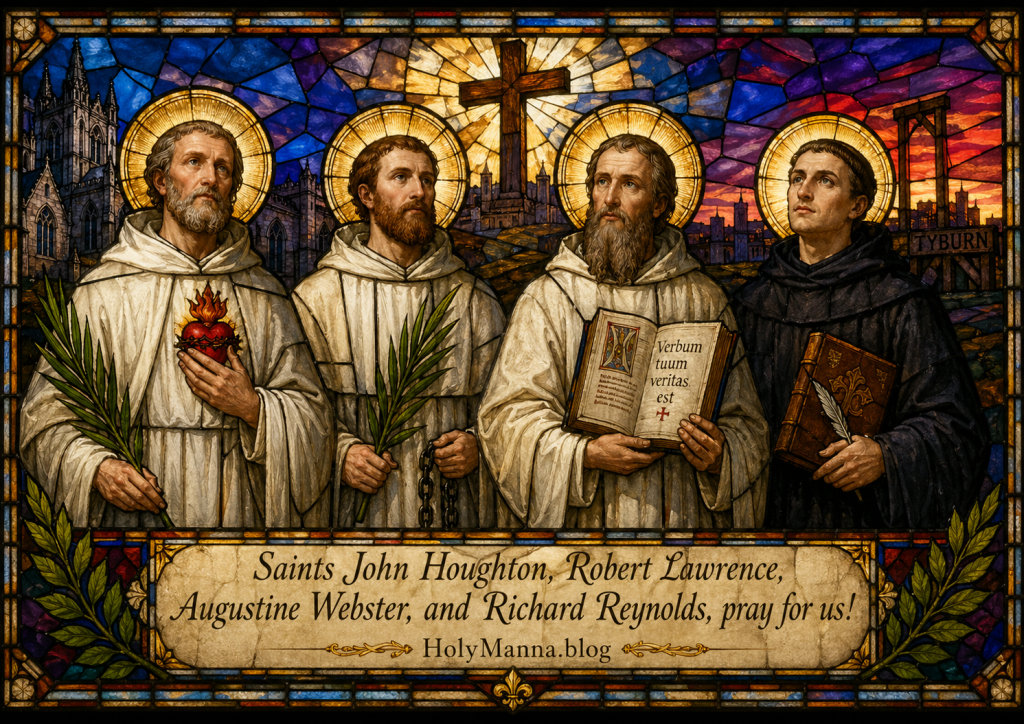
Four Hearts That Would Not Belong to a King
On May 4, the Church remembers Saints John Houghton, Robert Lawrence, Augustine Webster, and Richard Reynolds, four Catholic martyrs who stood at the beginning of one of the darkest chapters in English Catholic history. They were not soldiers. They were not political revolutionaries. Three were Carthusian priors, men formed by silence, prayer, fasting, and hidden union with God. The fourth was a Bridgettine monk of Syon Abbey, a brilliant scholar and preacher known as the “Angel of Syon.”
Their crime was simple in the eyes of the Tudor state: they refused to acknowledge King Henry VIII as supreme head of the Church in England.
From a Catholic perspective, their witness was not rebellion. It was fidelity. They knew that a king may govern a nation, but he cannot replace the authority Christ gave to His Church. The Catechism of the Catholic Church teaches that “Martyrdom is the supreme witness given to the truth of the faith” CCC 2473. These men gave that witness with their bodies, their voices, and finally their blood.
They are remembered among the Forty Martyrs of England and Wales, canonized by Pope Saint Paul VI in 1970. But these four hold a special place because they were among the first to die under Henry VIII’s religious persecution. Their courage opened a long and painful road of Catholic martyrdom in England, and their story still asks a hard question of every believer today: When the world demands the heart, will Christ still receive it whole?
Formed in Silence, Study, and the Old Faith
Saint John Houghton was born in Essex around 1486 or 1487 and was educated at Cambridge. He became a priest and later entered the Carthusian Order, one of the strictest and most contemplative religious orders in the Church. The Carthusians lived lives of silence, solitude, fasting, prayer, and penance. They did not seek attention. They sought God.
John eventually became prior of the London Charterhouse and provincial visitor of the English Carthusians. He was known for holiness, discipline, and leadership. Under his care, the London Charterhouse became a powerful witness to serious Catholic religious life. That mattered greatly because the Carthusians had moral authority. If they submitted to Henry VIII’s claim to be head of the Church, many others might follow. If they resisted, their courage could strengthen the faithful.
Saint Robert Lawrence was also a Carthusian. He had once served as chaplain to the Duke of Norfolk before becoming a monk. He later became prior of Beauvale Charterhouse in Nottinghamshire, succeeding John Houghton there. Less is known about Robert’s personal words and early life, but his witness is no less powerful. Some saints leave behind writings. Others leave behind one unforgettable act of fidelity. Robert Lawrence belongs to the second group.
Saint Augustine Webster was prior of the Carthusian house of Axholme in Lincolnshire. He had previously been a monk of Sheen and was known as a learned man. Like John and Robert, Augustine had given his life to prayer and discipline. He was not a public agitator. He was a monk who understood that obedience to God must come before obedience to any earthly ruler when the two are placed in conflict.
Saint Richard Reynolds was different from the other three because he was not a Carthusian. He was a Bridgettine monk of Syon Abbey, one of the great religious houses of Catholic England. Born in Devon around 1492, he studied at Cambridge and became known for his extraordinary learning. He was skilled in theology, Scripture, Latin, Greek, and Hebrew. He entered Syon Abbey, a community deeply devoted to the Passion of Christ, the Blessed Virgin Mary, solemn liturgy, study, and service to the poor.
Richard became known as the “Angel of Syon” because of his holiness, preaching, and wisdom. He was the kind of man people sought out for counsel because his learning was joined to humility. He did not merely know the faith. He lived it.
Together, these four men represented some of the best of Catholic England: silence and scholarship, prayer and preaching, obedience and courage.
When the King Asked for the Church
The crisis began when Henry VIII broke with Rome and claimed authority over the Church in England. In 1534, the Act of Supremacy declared the king to be supreme head of the Church of England. For Catholics, this was impossible to accept.
The issue was not whether Henry had civil authority. He did. Catholics could honor him as king. The issue was whether he had spiritual authority over the Church in a way that displaced the Pope and contradicted Catholic teaching.
The Catechism teaches that the Pope, as successor of Saint Peter, has “full, supreme, and universal power over the whole Church” CCC 882. That authority does not come from Parliament. It does not come from royal decree. It comes from Christ, who said to Peter, “You are Peter, and upon this rock I will build my church” Matthew 16:18.
John Houghton and his community were first pressured to accept Henry’s marital and succession claims. John tried to act carefully and peacefully. At one point, he accepted an oath only with a limiting phrase, meaning he would obey insofar as it was lawful. This was not cowardice. It was a Catholic conscience trying to obey legitimate authority without betraying divine truth.
But when the oath of supremacy demanded acceptance of Henry as head of the Church, there was no safe Catholic compromise left.
Before confronting Thomas Cromwell, John Houghton and the other Carthusian leaders spent time in prayer. A devout Catholic tradition says that the monks celebrated a Mass of the Holy Spirit and heard a gentle sound like a soft breeze, which they received as consolation from God. This story has been passed down in Catholic memory, but it should be understood as a pious tradition rather than a formally verified miracle.
John Houghton, Robert Lawrence, and Augustine Webster went to Cromwell hoping to explain their position. Instead, they were sent to the Tower of London. Richard Reynolds was also arrested and brought into the same storm. These were men of peace, but the state treated their conscience as treason.
Courage Without Weapons
Their trial took place in 1535. They were accused of denying the king’s title as supreme head of the Church in England. They did not deny the charge in substance because they could not lie. They could not call Henry what he was not.
Saint Augustine Webster’s preserved statement goes straight to the point: “The King our sovereign lord is not supreme head in earth of the Church of England.” It was not a long speech. It was not a political manifesto. It was simply Catholic truth spoken clearly.
The jury reportedly hesitated to convict them. That detail is important. Even in that tense atmosphere, some men knew these monks were not traitors in the ordinary sense. They had not raised an army. They had not plotted violence. They had simply refused to speak falsely about the Church.
But Cromwell pressured the process, and the guilty verdict came.
Saint Thomas More, who was also imprisoned in the Tower, reportedly saw the martyrs being taken to their execution. According to the famous story preserved in Catholic tradition, he said they looked as joyful as bridegrooms going to their wedding. This story beautifully expresses the Catholic understanding of martyrdom. The martyr does not love death. The martyr loves Christ more than life.
That is why their courage matters. They were not fearless because suffering was easy. They were faithful because Christ was worth everything.
The Road to Tyburn
On May 4, 1535, Saints John Houghton, Robert Lawrence, Augustine Webster, and Richard Reynolds were taken to Tyburn. They were executed by hanging, drawing, and quartering, the brutal punishment reserved for traitors.
They went in their religious habits. This detail matters because the state wanted to shame them, but God allowed them to appear as what they truly were: monks, priests, consecrated men, and servants of the Church.
Saint John Houghton was the first to die. Before his execution, he is remembered as saying that he was bound in conscience to suffer rather than deny the teaching of the Church. He prayed with the words of Psalm 31: “Into Thy hands I commend my spirit.”
Then came the famous words that have echoed through Catholic memory for centuries. As the executioner prepared to remove his heart, John Houghton cried out, “Good Jesus, what will you do with my heart?”
That single sentence is one of the most powerful lines in the history of the English martyrs. It is horrifying because of the moment in which it was spoken, but it is also beautiful because it reveals the soul of the saint. His heart belonged to Christ before it was ever touched by the executioner.
Saint Robert Lawrence died after him. No verified famous quote from Robert has been preserved in the major Catholic tradition, but his silence speaks. He watched the horror unfold and still refused to recant. There is a kind of courage that preaches without words, and Robert’s witness was exactly that.
Saint Augustine Webster also remained firm. His life had been shaped by prayer, study, and obedience, and at the end he obeyed God rather than men. His witness reminds Catholics that truth does not become false because powerful people demand it.
Saint Richard Reynolds was the last of the four to die. He had to watch the Carthusians suffer before him. Catholic tradition associates him with words of consolation about the martyrs enduring a “sharp breakfast” of suffering before a heavenly supper, but this saying cannot be treated as fully verified. Still, the tradition captures something true about his spirit. Reynolds saw martyrdom through the lens of eternity.
The Angel of Syon and the Heart of a Scholar
Saint Richard Reynolds deserves special attention because his life shows that Catholic learning is not meant to make a person proud. It is meant to make a person faithful.
He was one of the great scholars of his day. He knew Scripture, the Church Fathers, and Catholic tradition deeply. During his trial, he appealed to the authority of the Church, including councils and Fathers such as Saint Ambrose, Saint Jerome, Saint Augustine, and Saint Gregory.
This is important because Richard Reynolds did not die for a vague religious feeling. He died for the Catholic faith as received, taught, prayed, and defended through the centuries. He understood that the Church was not something a king could redesign because he wanted control.
A line from Psalm 27 is closely associated with his legacy: “I believe to see the good things of the Lord in the land of the living.” That verse fits him beautifully. He saw beyond the scaffold. He saw beyond Tudor politics. He saw beyond the terror of Tyburn. He saw the living God.
Syon Abbey, where Reynolds lived, was later suppressed. The Bridgettine community endured exile and hardship, but the memory of Richard Reynolds remained. A tradition connected to the Bridgettines says that a Tudor gatepost on which parts of his body were displayed was preserved by the sisters during exile and later connected to Catholic memory in England. This story is part of the devotional legacy surrounding him, though details of such relic traditions should be approached carefully.
Miracles, Relics, and the Witness After Death
No well-attested individual miracles during the earthly lives of John Houghton, Robert Lawrence, Augustine Webster, or Richard Reynolds are preserved in the Catholic sources consulted. Their supernatural courage should not be casually called a miracle in the formal sense, but it was certainly a sign of grace.
The most important miracle connected to them came through the canonization cause of the Forty Martyrs of England and Wales. When their cause was examined, multiple reported favors and healings were presented. One healing was accepted in connection with their canonization: the cure of a young mother from a malignant tumor, described as a fibrosarcoma near the left shoulder blade. The cure was judged to be complete, lasting, and inexplicable by natural causes, and it was attributed to God through the intercession of the Forty Martyrs.
Their relics and memory also became part of Catholic devotion. After Saint John Houghton’s death, parts of his body were displayed as a warning to other monks. The government meant this as intimidation. Catholics came to see it as testimony. The body of the martyr, even desecrated, proclaimed that Christ is Lord.
Tyburn itself became a place of sacred memory. What was once a place of execution is now associated with prayer, pilgrimage, and the witness of the martyrs. Tyburn Convent, with its devotion to the martyrs who died there, stands as a powerful sign that cruelty does not get the final word. The scaffold became a seedbed of sanctity.
The English Martyrs are celebrated liturgically in England on May 4. This date is deeply fitting because it marks the martyrdom of these first witnesses under Henry VIII. Their names also live on in churches, schools, stained glass, devotional prayers, and Catholic memory. Saint John Houghton is often depicted holding his heart, especially because of his final words. Saint Richard Reynolds is remembered in Catholic education and in the legacy of Syon Abbey. The Carthusian martyrs remain beloved among those who see in contemplative life a hidden strength the world often underestimates.
Why These Martyrs Still Matter
These saints matter because they expose a temptation that never really disappears: the temptation to give Caesar what belongs to God.
Henry VIII wanted more than political loyalty. He wanted spiritual submission. These men could not give it. They were willing to honor the king as king, but not as head of the Church. Their obedience had limits because their conscience belonged to God.
That is very Catholic. Conscience is not a personal permission slip to do whatever feels right. The Catechism teaches that conscience must be formed and must seek truth. It also teaches that man must not be forced to act against conscience, especially in religious matters CCC 1782. These martyrs show both sides clearly. Their conscience was not rebellious. It was formed by Scripture, tradition, the sacraments, prayer, and the teaching of the Church.
Their witness also speaks directly to modern Catholics. Most believers today will not face Tyburn. But many will face pressure to soften the faith, hide the truth, compromise moral teaching, treat the Church as outdated, or make comfort the highest good.
Saint John Houghton asks, What will Jesus do with your heart?
Saint Robert Lawrence asks, Can fidelity remain strong even when nobody remembers your words?
Saint Augustine Webster asks, Will truth still be spoken plainly when it becomes costly?
Saint Richard Reynolds asks, Will learning lead to holiness, or only to pride?
Their lives remind the Church that courage is not loud by necessity. Sometimes courage looks like a monk walking quietly to death because he refuses to betray the Bride of Christ.
A Catholic Reflection for Today
The most moving image from this whole story is the heart of Saint John Houghton. His final words were not only about physical suffering. They were about surrender. “Good Jesus, what will you do with my heart?”
That is the question every Christian life eventually becomes.
Christ does not want a rented room in the heart. He wants the whole house. He wants the public life and the private life. He wants Sunday worship and weekday decisions. He wants internet habits, family conversations, work pressures, political opinions, friendships, desires, fears, and ambitions. He wants the whole heart because only He can heal the whole heart.
These martyrs show that Catholic faith is not merely cultural identity. It is not nostalgia. It is not a nice tradition kept around for holidays and family milestones. Catholic faith is a total claim on the soul because Jesus Christ is Lord.
The lives of these saints also teach that holiness is formed before the crisis arrives. John Houghton did not become courageous at Tyburn by accident. Robert Lawrence did not become faithful in one dramatic moment without years of hidden obedience. Augustine Webster did not speak clearly without being formed by truth. Richard Reynolds did not defend the faith without years of study, prayer, and discipline.
Daily faithfulness prepares the soul for costly faithfulness.
A Catholic who wants their courage must start where they started: prayer, confession, the Mass, reverence for the Eucharist, love for the Church, study of the faith, and obedience to Christ in ordinary life.
Where is Christ asking for a more complete surrender today?
What part of the heart is still being held back from Him?
If faith became costly, would the habits of daily life be strong enough to stand?
The martyrs do not ask these questions to shame anyone. They ask them like older brothers in the faith, pointing toward freedom.
Engage With Us!
Share your thoughts and reflections in the comments below. The witness of Saints John Houghton, Robert Lawrence, Augustine Webster, and Richard Reynolds is powerful because it forces every Catholic to think about courage, conscience, and love for the Church in a serious way.
- What part of this story challenged you the most: their courage, their silence, their learning, or their willingness to suffer for the authority of the Church?
- How does Saint John Houghton’s final prayer, “Good Jesus, what will you do with my heart?”, speak to your own relationship with Christ?
- Where do Catholics today feel pressure to compromise the faith in order to be accepted?
- How can the quiet courage of Saint Robert Lawrence help ordinary believers stay faithful in daily life?
- What practical step can you take this week to form your conscience more deeply through prayer, Scripture, the sacraments, or the teachings of the Church?
May Saints John Houghton, Robert Lawrence, Augustine Webster, and Richard Reynolds pray for all Catholics who want to remain faithful when faith becomes difficult. May their witness help every heart belong more fully to Jesus Christ, and may their courage inspire lives rooted in truth, mercy, and the love that Jesus taught us.
Saints John Houghton, Robert Lawrence, Augustine Webster, and Richard Reynolds, pray for us!
Follow us on YouTube, Instagram and Facebook for more insights and reflections on living a faith-filled life.

 Holy Manna!
Leave a comment