The Martyr Who Ran Toward the Fire
Saint Florian, celebrated by the Church on May 4, is remembered as one of the great early Christian martyrs of Roman Noricum, the region that includes parts of modern-day Austria. He is especially loved today as the patron saint of firefighters, but his story is much deeper than a holy man holding a bucket of water over a burning building.
Saint Florian was a public servant, likely a Roman military officer or high-ranking administrative official, who lived during the brutal persecution of Christians under Emperor Diocletian. When Christians were being arrested, tortured, and pressured to offer sacrifice to pagan gods, Florian did not hide behind his rank or protect his own comfort. Tradition says he went toward the imprisoned Christians to strengthen them.
That is what makes his story so powerful. Saint Florian was not simply caught being Christian. He chose to stand with the suffering Church. He chose truth when compromise would have been easier. He chose Christ when the empire demanded worship.
The Catechism of the Catholic Church teaches that “Martyrdom is the supreme witness given to the truth of the faith” CCC 2473. Saint Florian gave that witness not with a sermon from a pulpit, but with his life, his body, and his blood.
From Noricum to the Cross
The details of Saint Florian’s early life are limited, and faithful Catholic storytelling should be honest about that. Tradition places him in the Roman province of Noricum, sometimes associating his origins with Aelium Cetium, modern St. Pölten, or with the region around Lauriacum, modern Lorch near Enns in Austria. He likely lived in the late third and early fourth century and died around A.D. 304.
Catholic tradition describes him as a Roman officer or official who served the imperial administration. Some accounts call him a soldier, while others describe him more specifically as a senior official connected to the governor’s chancery. Either way, Saint Florian appears to have been a man with standing, responsibility, and public authority.
That matters. His faith was not lived quietly in private while he went along with everything around him. He had to decide whether his identity came first from Rome or from baptism. When the moment came, Florian showed that his deepest allegiance belonged to Jesus Christ.
There is no surviving personal writing from Saint Florian, and no verified quotation from his own hand. However, the later traditional account of his martyrdom preserves several sayings attributed to him. The most famous is beautifully simple: “I am a Christian.” That was not just a label. It was his identity, his confession, and his death sentence.
The Saint Who Went to Strengthen the Imprisoned
During the Diocletian persecution, Christians across the Roman Empire were commanded to sacrifice to pagan gods. Churches were destroyed, sacred books were seized, clergy were imprisoned, and believers were forced to choose between public apostasy and suffering.
In Noricum, Governor Aquilinus came to Lauriacum and began searching for Christians. Tradition says forty Christians were arrested, tortured, and imprisoned. When Florian heard about their suffering, he went to help them. This detail is one of the most important parts of his story.
He did not run away from the persecution. He ran toward those being persecuted.
That is why Saint Florian is such a fitting patron for firefighters and first responders. His courage was not a love of danger for its own sake. It was charity under pressure. He went where people were suffering because love demanded it.
The Christian life always asks this same question in different ways: When someone else is suffering, does faith move the heart toward them or away from them? Saint Florian’s answer was clear. He moved toward the wounded Body of Christ.
The Bucket, the Flames, and the Legends of His Life
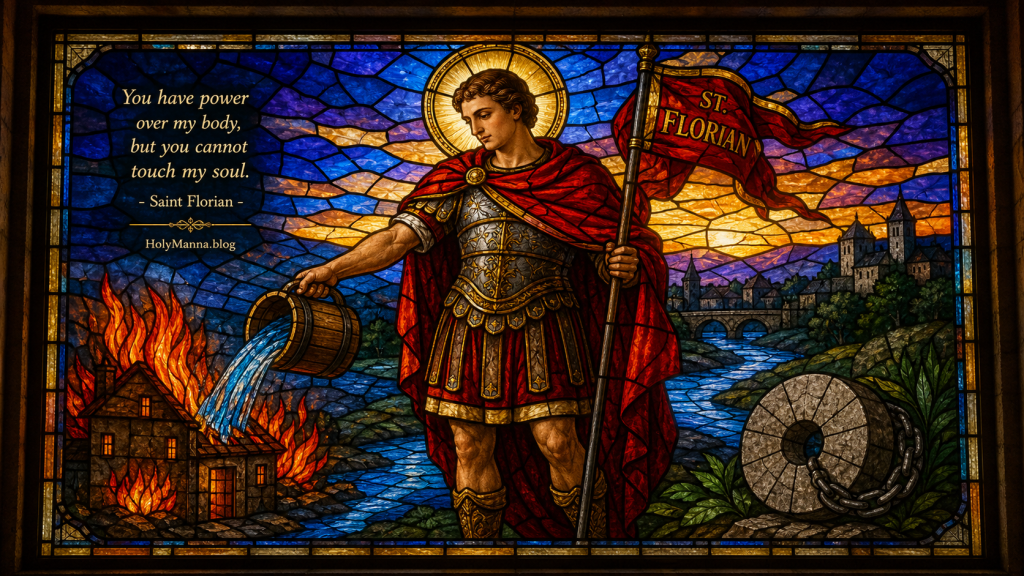
Saint Florian is most often shown in sacred art dressed as a Roman soldier or knight, pouring water from a bucket or pitcher onto a burning building. This image comes from the famous legend that he once extinguished a great fire with only a single bucket of water.
This story cannot be verified as a historical event, but it became one of the most beloved legends associated with him. It explains why generations of Christians have invoked him against fire and why his image appears in fire stations, churches, medals, and roadside shrines across Europe.
The legend works so well because it reflects the spiritual truth of his life. Florian faced the fire of persecution with the living water of faith. He did not put out the flames of hatred with violence. He answered them with courage, mercy, and fidelity to Christ.
He is also invoked against floods, storms, drowning, and sudden danger. This connection comes partly from the manner of his martyrdom, since he was thrown into the River Enns with a stone tied around his neck. In Christian imagination, the martyr drowned in water became an intercessor against both fire and flood.
The Church does not honor saints because every legend around them can be proved like a court document. The Church honors saints because their lives point to Christ. In Saint Florian’s case, even the legends teach something true: courage becomes holy when it is guided by charity.
“You Cannot Touch My Soul”
When Florian reached Lauriacum, tradition says he encountered soldiers who were searching for Christians. Instead of hiding, he openly confessed his faith. He told them “I am a Christian” and asked them to report him to the governor.
Aquilinus tried to force Florian to sacrifice to the pagan gods. Florian refused. The later Passio Floriani, the traditional account of his martyrdom, attributes to him the words: “You have power over my body, but you cannot touch my soul.” This saying should be understood as part of the traditional martyrdom account rather than a historically verified quotation, but it beautifully expresses the Catholic heart of martyrdom.
That line is also deeply biblical. Jesus tells His disciples, “Do not fear those who kill the body but cannot kill the soul” Matthew 10:28. Saint Florian lived that command. Aquilinus could threaten his body, career, reputation, and life, but he could not command Florian’s conscience.
According to tradition, Florian was beaten and tortured. Some later accounts say he was scourged, flayed, or threatened with fire. Finally, he was condemned to be thrown into the River Enns with a stone tied around his neck.
Before his death, the traditional account says he prayed, “Lord Jesus Christ, receive my soul.” Again, this comes from the devotional tradition surrounding his martyrdom, but it echoes the prayer of Saint Stephen, the first martyr, who cried out, “Lord Jesus, receive my spirit” Acts 7:59.
Florian’s death was not defeat. It was witness. He lost his life before the world, but gained the crown of martyrdom before God.
The River, the Eagle, and the Faithful Woman
After Saint Florian was thrown into the Enns, later tradition says his body was carried by the river to the bank. A striking legend tells that an eagle guarded his body with wings spread out in the form of a cross. This story cannot be historically verified, but it became part of the devotional memory surrounding him.
Another tradition says a devout woman, often named Valeria, received a vision from Saint Florian telling her where to find his body and where to bury him. Out of fear of the pagans, she hid his body under branches and leaves, pretending to be doing ordinary work. When the animals carrying his body became exhausted from the heat, she prayed, and a spring of water miraculously appeared so they could drink and continue. This also belongs to the hagiographical tradition and cannot be verified as a modern historical claim, but it reflects the Church’s ancient love for the martyr.
At the place associated with his burial, later tradition speaks of healings, deliverance from demons, recovery from fevers, and other graces given through his intercession. These miracle stories belong to the long devotional life of the Church and should be received as part of the Catholic memory of Saint Florian, while still recognizing that they cannot all be verified by modern standards.
This is the Catholic way of reading the lives of the saints with both faith and honesty. The historical core remains clear. Saint Florian was venerated as a martyr from ancient times. The stories that gathered around him show how deeply Christians trusted his intercession.
Austria, Poland, and a Legacy That Crossed Borders
Saint Florian’s memory became especially strong in Austria. The great Abbey of Saint Florian in Upper Austria developed near the place associated with his burial and became one of the major spiritual and cultural centers connected to his veneration. For centuries, the faithful came to honor the martyr who gave his life for Christ in that land.
His devotion also became deeply important in Poland. In the twelfth century, relics of Saint Florian were brought to Kraków, where a church was built in his honor. Over time, he became one of the important patrons of Poland and Kraków. His feast day was celebrated with processions, hymns, sermons, and public devotion.
One famous Polish tradition says that during a great fire in Kleparz, the church of Saint Florian was preserved through his intercession. This story cannot be verified with modern historical certainty, but it greatly increased devotion to him as a protector against fire.
Saint Florian’s Kraków connection also touches the life of Pope Saint John Paul II. As a young priest, Father Karol Wojtyła served at Saint Florian’s Parish in Kraków. There he ministered to university students, taught the faith, and helped form young Catholics during a time of communist pressure and atheistic ideology. It is a beautiful providence that a parish dedicated to a martyr of conscience helped shape a future pope who would become one of the great witnesses to human dignity and religious freedom.
Today, Saint Florian remains beloved among firefighters around the world. International Firefighters’ Day is observed on May 4, his feast day. Firefighters often carry medals of Saint Florian or place his image in their stations. His patronage speaks to anyone who risks personal safety for the good of others.
A Saint for Courageous Christians
Saint Florian’s life gives the modern Catholic a serious challenge. He did not wait for a safe time to be faithful. He did not say, “This is not my problem.” He did not separate love of God from love of neighbor.
He saw persecuted Christians suffering, and he went to them.
That is the kind of courage the Church still needs. Not only dramatic courage in moments of danger, but daily courage in ordinary decisions. Courage to speak the truth with charity. Courage to defend the vulnerable. Courage to remain Catholic when the culture mocks the faith. Courage to help someone in pain even when it costs time, comfort, or reputation.
The Catechism of the Catholic Church teaches that the saints continue to intercede for us and that their concern helps our weakness CCC 956. This is why Catholics ask Saint Florian to pray for firefighters, first responders, emergency workers, and all people facing danger from fire, flood, violence, or disaster. Asking his intercession does not replace trust in Christ. It expresses the communion of saints, where the family of God in heaven prays for the family of God on earth.
Saint Florian reminds the Church that holiness is not passive. Love acts. Faith moves. Courage runs toward the wounded.
Where is God asking for courage today? Is there someone suffering nearby who needs more than sympathy? Is there a place where comfort has become more important than faithfulness?
Saint Florian’s answer was his life. He belonged to Christ, and because he belonged to Christ, he belonged to those who were suffering.
Engage with Us!
Share your thoughts and reflections in the comments below. Saint Florian’s story is especially powerful because it connects courage, public witness, sacrifice, and service. His life invites every Catholic to ask whether faith is something hidden for convenience or lived boldly in love.
- What part of Saint Florian’s story challenges you the most: his public confession, his care for imprisoned Christians, or his willingness to face martyrdom?
- How can Saint Florian’s courage inspire firefighters, first responders, and everyday Catholics who face danger or pressure in their work?
- Where in your own life is Christ asking you to stop running from difficulty and instead move toward someone who needs help?
- What does it mean today to say with Saint Florian, “I am a Christian”, not only with words, but with choices?
May Saint Florian pray for all firefighters, first responders, public servants, and Christians who are called to stand firm under pressure. May his witness help the faithful live with courage, serve with compassion, and do everything with the love and mercy Jesus taught us.
Saint Florian, pray for us!
Follow us on YouTube, Instagram and Facebook for more insights and reflections on living a faith-filled life.


Leave a comment