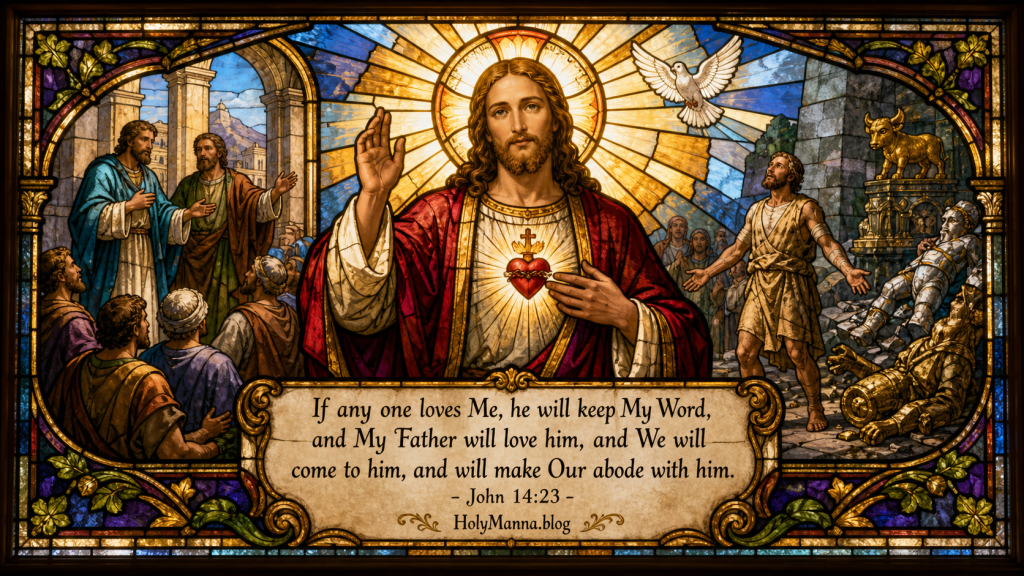
Monday of the Fifth Week of Easter – Lectionary: 285
When the Heart Learns Where Glory Belongs
Every human heart is looking for someone or something worthy of worship, and today’s readings gently but firmly ask whether that worship is being given to the living God.
On this Monday of the Fifth Week of Easter, the Church places before us a powerful contrast between idols made by human hands and the God who wants to make His home in the human soul. In Acts 14:5-18, Paul and Barnabas arrive in Lystra, a Gentile city shaped by pagan religion and myth. After Paul heals a man lame from birth, the crowd misunderstands the miracle and tries to worship the apostles as gods. Instead of accepting praise, Paul and Barnabas tear their garments and cry out that they are only human beings, sent to turn people away from idols and toward the living God, “who made heaven and earth and sea and all that is in them” Acts 14:15.
That same truth becomes the prayer of Psalm 115: “Not to us, LORD, not to us but to your name give glory” Psalm 115:1. The Psalm reminds Israel, and reminds the Church, that idols may look impressive, but they are still the work of human hands. The Lord alone is Creator. He alone blesses. He alone deserves the deepest trust of the soul.
Then the Gospel brings this theme even closer. In John 14:21-26, Jesus teaches that love is not just emotion or admiration. True love keeps His word. The one who loves Him becomes a dwelling place for the Father and the Son, and the Holy Spirit comes as the Advocate who teaches and reminds. This is the great reversal of idolatry. False worship tries to bring God down to something manageable. Christian love allows the living God to lift the soul into communion with Him.
The Catechism of the Catholic Church teaches that idolatry remains a temptation whenever man honors and reveres a creature in place of God. Today’s readings expose that temptation with surprising tenderness. They do not simply condemn pagan sacrifices in an ancient city. They ask every disciple to examine the heart. Where is glory being misplaced? What created thing has been treated as if it could save? Where is Jesus asking love to become obedience?
Together, these readings prepare us to see the Christian life as a movement from false worship to true communion. The apostles refuse stolen glory. The Psalm gives glory back to God. Jesus reveals the reward of obedient love: not applause, not control, not worldly success, but the astonishing promise that God Himself will come and dwell within the faithful heart.
First Reading – Acts 14:5-18
When God Works Through Human Hands, the Glory Still Belongs to Him
The First Reading brings us into the missionary journeys of Saint Paul and Saint Barnabas. They are preaching the Gospel in the ancient region of Lycaonia, especially in the cities of Lystra and Derbe. This is Gentile territory, shaped by pagan religion, local myth, and the worship of many gods. These people do not yet have the formation of Israel, the Law of Moses, or the prophets. They are spiritually hungry, but their imagination has been formed by idols.
That background helps explain the crowd’s strange reaction. When Paul heals a man lame from birth, the people do not immediately understand the miracle as a sign of the living God. Instead, they assume the gods have visited them in human form. In the ancient world, stories circulated about Zeus and Hermes coming down among mortals, including a well-known story preserved in Ovid, Metamorphoses 8. So when the people see a miracle, they interpret it through the religion they already know.
This is where today’s central theme comes into focus. Paul and Barnabas refuse to steal God’s glory. They refuse to let the crowd worship the messenger instead of the One who sent them. Their cry is the living version of today’s Psalm: “Not to us, LORD, not to us but to your name give glory” Psalm 115:1. The apostles redirect wonder away from idols and toward the living God, the Creator of heaven, earth, sea, rain, harvest, food, and gladness.
Acts 14:5-18 – New American Bible (Revised Edition)
5 When there was an attempt by both the Gentiles and the Jews, together with their leaders, to attack and stone them, 6 they realized it and fled to the Lycaonian cities of Lystra and Derbe and to the surrounding countryside, 7 where they continued to proclaim the good news.
Paul and Barnabas at Lystra. 8 At Lystra there was a crippled man, lame from birth, who had never walked. 9 He listened to Paul speaking, who looked intently at him, saw that he had the faith to be healed, 10 and called out in a loud voice, “Stand up straight on your feet.” He jumped up and began to walk about. 11 When the crowds saw what Paul had done, they cried out in Lycaonian, “The gods have come down to us in human form.” 12 They called Barnabas “Zeus” and Paul “Hermes,” because he was the chief speaker. 13 And the priest of Zeus, whose temple was at the entrance to the city, brought oxen and garlands to the gates, for he together with the people intended to offer sacrifice.
14 The apostles Barnabas and Paul tore their garments when they heard this and rushed out into the crowd, shouting, 15 “Men, why are you doing this? We are of the same nature as you, human beings. We proclaim to you good news that you should turn from these idols to the living God, ‘who made heaven and earth and sea and all that is in them.’ 16 In past generations he allowed all Gentiles to go their own ways; 17 yet, in bestowing his goodness, he did not leave himself without witness, for he gave you rains from heaven and fruitful seasons, and filled you with nourishment and gladness for your hearts.” 18 Even with these words, they scarcely restrained the crowds from offering sacrifice to them.
Detailed Exegesis: From False Worship to the Living God
Verse 5 – “When there was an attempt by both the Gentiles and the Jews, together with their leaders, to attack and stone them,”
Paul and Barnabas face opposition from both Gentiles and Jews, along with their leaders. This shows how threatening the Gospel can feel to fallen human structures. The Gospel exposes idols, challenges pride, and calls every person to conversion. Stoning was a violent form of public execution, so this was not mild disagreement. The apostles are facing real danger for proclaiming Christ.
Verse 6 – “they realized it and fled to the Lycaonian cities of Lystra and Derbe and to the surrounding countryside,”
The apostles flee, but not out of cowardice. They act with prudence. Catholic tradition has always understood that martyrdom is holy when God permits it, but Christians are not required to seek death recklessly. Paul and Barnabas preserve their lives so they can continue the mission. This is a good reminder that courage and prudence are not enemies. Sometimes faithfulness means standing firm. Sometimes faithfulness means moving on so the Gospel can continue spreading.
Verse 7 – “where they continued to proclaim the good news.”
This verse is simple, but powerful. Persecution does not silence the apostles. It relocates them. The Gospel keeps moving. Paul and Barnabas do not become bitter, discouraged, or obsessed with the people who rejected them. They continue to proclaim the good news. That is apostolic steadiness. The mission is not controlled by comfort, approval, or favorable circumstances.
Verse 8 – “At Lystra there was a crippled man, lame from birth, who had never walked.”
Saint Luke emphasizes the man’s condition carefully. He was crippled, lame from birth, and had never walked. This was not a temporary injury or a misunderstood illness. His condition was lifelong and humanly impossible to reverse. The detail prepares the reader to see the healing as a true sign of divine power.
Verse 9 – “He listened to Paul speaking, who looked intently at him, saw that he had the faith to be healed,”
The man listens before he walks. Faith comes through hearing. Paul sees something deeper than physical disability. He sees faith. This does not mean the man heals himself by positive thinking. It means grace is stirring in him. His heart is open to the word being preached. The miracle begins not in the legs, but in the soul awakened by the Gospel.
Verse 10 – “and called out in a loud voice, ‘Stand up straight on your feet.’ He jumped up and began to walk about.”
Paul speaks with apostolic authority, and the man responds immediately. The command resembles other biblical healings, especially the healing of the lame man in Acts 3. The physical rising points to something deeper. In Christ, humanity is not meant to remain spiritually crippled by sin, fear, false worship, or despair. Grace raises the human person to walk in newness of life.
Verse 11 – “When the crowds saw what Paul had done, they cried out in Lycaonian, ‘The gods have come down to us in human form.’”
The crowd recognizes power, but misunderstands its source. This is the danger of religious confusion. They see a miracle, but their pagan worldview turns the sign in the wrong direction. Instead of seeing God’s mercy, they see the arrival of their gods. This shows that spiritual experiences must be interpreted through truth. Not every intense religious reaction is holy. Wonder must be purified by revelation.
Verse 12 – “They called Barnabas ‘Zeus’ and Paul ‘Hermes,’ because he was the chief speaker.”
Zeus was considered the chief god in Greek religion, while Hermes was associated with speech, messages, and divine communication. Since Paul is the main speaker, the crowd calls him Hermes. Barnabas, perhaps because of his bearing or presence, is called Zeus. The detail shows how quickly human beings can turn gifted messengers into idols. This temptation is not ancient only. People still do this with leaders, celebrities, influencers, teachers, athletes, priests, and even saints when honor becomes disordered.
Verse 13 – “And the priest of Zeus, whose temple was at the entrance to the city, brought oxen and garlands to the gates, for he together with the people intended to offer sacrifice.”
The misunderstanding becomes liturgical. The priest of Zeus prepares sacrifice. Oxen and garlands show that the crowd is not merely praising Paul and Barnabas. They are preparing an act of worship. This is why the apostles react so strongly. Worship is never a small matter. In Catholic faith, worship belongs to God alone. Saints may be venerated, but adoration is given only to the Most Holy Trinity.
Verse 14 – “The apostles Barnabas and Paul tore their garments when they heard this and rushed out into the crowd, shouting,”
Tearing garments was a biblical sign of grief, horror, or protest, especially in the face of blasphemy. Paul and Barnabas are horrified because the crowd is about to give divine worship to creatures. Their reaction is not false modesty. It is holy fear. They know that to accept worship would be a betrayal of God.
Verse 15 – “Men, why are you doing this? We are of the same nature as you, human beings. We proclaim to you good news that you should turn from these idols to the living God, ‘who made heaven and earth and sea and all that is in them.’”
This is the heart of the reading. The apostles identify themselves clearly: they are human beings. They are not gods. They are servants. Then they preach conversion. The crowd must turn from idols to the living God. Paul begins with creation because he is speaking to Gentiles who do not yet know the Scriptures of Israel. He points to the Creator of heaven, earth, sea, and everything in them. The living God is not one power among many. He is the source of all existence.
Verse 16 – “In past generations he allowed all Gentiles to go their own ways;”
Paul acknowledges that the Gentiles have lived in ignorance of the fullness of revelation. God permitted the nations to go their own ways, but He did not abandon them. This prepares for the next verse, where Paul explains that God still gave signs of His goodness. Catholic teaching recognizes that God can prepare hearts through creation, conscience, and the search for truth, even before a person receives the fullness of the Gospel.
Verse 17 – “yet, in bestowing his goodness, he did not leave himself without witness, for he gave you rains from heaven and fruitful seasons, and filled you with nourishment and gladness for your hearts.”
Paul teaches that creation itself bears witness to God. Rain, fruitful seasons, food, and gladness are not random gifts from blind nature. They are signs of divine goodness. This does not mean nature is God. It means nature points beyond itself to the Creator. The world is full of reminders that life is received, not manufactured. Gratitude is one of the first steps out of idolatry.
Verse 18 – “Even with these words, they scarcely restrained the crowds from offering sacrifice to them.”
Even after Paul and Barnabas preach the truth, the crowd still struggles to let go of its false worship. That is painfully realistic. Idols are not easily surrendered. People can hear the truth and still cling to familiar patterns. Conversion often takes time because the heart must be retrained to love rightly, worship rightly, and trust God above every created thing.
Teachings
This reading is one of the clearest biblical pictures of idolatry and humility. Paul and Barnabas are true instruments of God, but they know they are only instruments. The miracle is real. The apostolic authority is real. The grace is real. But the glory belongs to God.
The Catechism of the Catholic Church teaches this with clarity: “The first commandment condemns polytheism. It requires man neither to believe in, nor to venerate, other divinities than the one true God. Scripture constantly recalls this rejection of ‘idols, [of] silver and gold, the work of men’s hands. They have mouths, but do not speak; eyes, but do not see.’ These empty idols make their worshippers empty: ‘Those who make them are like them; so are all who trust in them.’ God, however, is the ‘living God’ who gives life and intervenes in history” CCC 2112.
That final line perfectly matches Paul’s preaching in Lystra. The apostles are not turning the crowd from one religious option to another. They are turning them from empty idols to the living God. Idols may be visible, impressive, emotional, and socially accepted, but they cannot give life. They cannot save. They cannot dwell in the soul. They cannot forgive sin. They cannot raise the dead.
The Catechism also reminds us that idolatry is not only a problem for ancient pagans: “Idolatry not only refers to false pagan worship. It remains a constant temptation to faith. Idolatry consists in divinizing what is not God. Man commits idolatry whenever he honors and reveres a creature in place of God, whether this be gods or demons, for example satanism, power, pleasure, race, ancestors, the state, money, etc.” CCC 2113.
That is where the reading becomes uncomfortably modern. Very few people today are tempted to sacrifice oxen to Paul and Barnabas, but many are tempted to build altars in the heart. Power can become an idol. Pleasure can become an idol. Money can become an idol. A relationship can become an idol. A political identity can become an idol. A career can become an idol. Even spiritual leaders can become idols when admiration stops pointing to Christ.
The Church’s answer is not to reject created things, but to put them in right order. The Catechism says, “Human life finds its unity in the adoration of the one God. The commandment to worship the Lord alone integrates man and saves him from an endless disintegration.” CCC 2114.
That sentence is deeply important. Idolatry fragments the person. The heart gets pulled in a hundred directions, trying to find salvation in things that cannot save. Worship of the one true God brings the soul back together. It gives life a center.
Paul’s speech also reflects Catholic teaching on knowing God through creation. The Catechism teaches, “The world: starting from movement, becoming, contingency, and the world’s order and beauty, one can come to a knowledge of God as the origin and the end of the universe.” CCC 32.
This is exactly what Paul does. He does not begin with a long explanation of the Law and the prophets because his audience is Gentile. He begins with rain, harvest, food, and gladness. He shows them that the goodness they have received points to the Giver. Creation is not the final destination. It is a signpost.
Saint Augustine understood this ache of the human heart with unforgettable clarity when he wrote, “You have made us for yourself, O Lord, and our heart is restless until it rests in you” Saint Augustine, Confessions, Book I. That is the hidden wound beneath all idolatry. The heart is restless because it is made for God. When it settles for anything less, it becomes disordered, anxious, possessive, and afraid.
Paul and Barnabas show the opposite spirit. They are free because they do not need worship. They can be useful to God without needing to become gods. That is apostolic humility. That is Christian maturity. It is the ability to let grace pass through one’s life without grabbing the glory on the way out.
Reflection
This reading asks every disciple to examine two things: what is being worshiped, and what is being done with the gifts God gives.
The crowd at Lystra makes a mistake that still happens today. They see something powerful, beautiful, or inspiring, and they confuse the instrument with the Source. This can happen with talented people, religious leaders, ministries, artists, influencers, money, success, physical beauty, romance, politics, or personal achievement. The human heart is quick to crown something as ultimate.
Paul and Barnabas teach a better way. When praise comes, they redirect it. When people misunderstand the miracle, they clarify the truth. When glory is offered to them, they give it back to God.
That is a lesson for anyone trying to live faithfully. If God has given a gift, use it. If God opens a door, walk through it. If God works through a person’s words, service, creativity, leadership, parenting, teaching, or sacrifice, receive that with gratitude. But never let the gift become the god.
A practical way to live this reading is to begin the day with an honest offering: “Lord, whatever good comes from this day belongs to You.” Another way is to practice gratitude before achievement turns into pride. When something goes well, pause and thank God before celebrating personal success. When another person helps, thank that person sincerely, then thank God for working through them. When temptation pulls the heart toward an idol, name it clearly and ask whether it is being treated as a servant or a savior.
This reading also invites humility when God works through others. It is easy to admire the messenger more than the message. It is easy to become attached to personalities instead of Christ. A faithful Catholic can love the saints, honor priests, appreciate teachers, and be grateful for holy friends, but all true veneration must lead back to God.
What created thing is most tempted to become too important in the heart? Where has admiration quietly turned into dependence? When God works through personal gifts, is the glory being returned to Him or kept for the self?
The miracle at Lystra began with a man standing up on his feet. That is what grace still does. It raises the soul from false worship. It teaches the heart to walk rightly. It turns restless desire away from idols and toward the living God.
The apostles’ message is still the message of the Church: turn from idols, receive the Gospel, and give glory to the One who made heaven and earth and sea and all that is in them.
Responsorial Psalm – Psalm 115:1-4, 15-16
The Prayer of a Heart That Refuses to Worship Idols
The Responsorial Psalm gives the soul the right response to everything happening in today’s readings. After Paul and Barnabas refuse worship in Acts 14, the Church places these words on our lips: “Not to us, LORD, not to us but to your name give glory” Psalm 115:1. It is the perfect prayer for anyone who has ever been tempted to take credit for God’s grace, trust in created things, or treat human success as if it were salvation.
Psalm 115 belongs to Israel’s great tradition of praise. It contrasts the living God with lifeless idols, especially the idols of the nations made from silver and gold. In the ancient world, pagan worship often centered on visible images, temples, sacrifices, and gods associated with natural forces or local power. Israel’s faith was radically different. The Lord could not be reduced to an image. He was not one god among many. He was the Creator of heaven and earth, the One who blesses, rules, and gives life.
That is why this Psalm fits today’s theme so beautifully. In Acts 14, the people of Lystra try to worship Paul and Barnabas after a miracle. In Psalm 115, the Church answers, “Not to us.” In John 14, Jesus reveals that the living God does not need to be captured in idols because He comes to dwell in the hearts of those who love Him and keep His word. True worship does not shrink God down to something manageable. True worship gives Him glory and lets Him make the soul His home.
Psalm 115:1-4, 15-16 New American Bible (Revised Edition)
The Greatness of the True God
1 Not to us, Lord, not to us
but to your name give glory
because of your mercy and faithfulness.
2 Why should the nations say,
“Where is their God?”
3 Our God is in heaven
and does whatever he wills.4 Their idols are silver and gold,
the work of human hands.15 May you be blessed by the Lord,
maker of heaven and earth.
16 The heavens belong to the Lord,
but he has given the earth to the children of Adam.
Detailed Exegesis
Verse 1: “Not to us, Lord, not to us but to your name give glory because of your mercy and faithfulness.”
This verse is the heartbeat of the Psalm and the spiritual key to today’s readings. The repetition of “Not to us” reveals a soul trained in humility. Glory belongs to God because His mercy and faithfulness come first. Every good work, every miracle, every conversion, every act of courage, and every moment of grace begins with Him. This is why Paul and Barnabas reject the worship of the crowd in Lystra. They know that the healing did not come from their own greatness. It came from the living God.
Verse 2: “Why should the nations say, ‘Where is their God?’”
This verse voices the mockery Israel often heard from surrounding nations. Since Israel’s God could not be seen in a carved image, the nations could ask, “Where is their God?” Pagan religion often expected a god to be represented by something visible, something housed in a temple, something that could be carried or displayed. Israel answers with faith. The Lord is not absent because He is unseen. He is transcendent, living, and sovereign. The Christian still needs this reminder. God is not less real because He cannot be controlled or reduced to an object.
Verse 3: “Our God is in heaven and does whatever he wills.”
This is not a statement of distance, as if God were uninterested in the world. It is a declaration of sovereignty. The Lord is in heaven, not because He is far away from His people, but because He rules over all creation. He is free. He is not made by human hands. He is not dependent on human approval. He does whatever He wills because His will is holy, wise, and good. In light of today’s Gospel, this becomes even more beautiful. The God who reigns in heaven also promises to dwell in the soul that loves Him.
Verse 4: “Their idols are silver and gold, the work of human hands.”
Here the Psalm exposes the emptiness of idolatry. Idols may be made from precious materials, but they are still made. Silver and gold can shine, but they cannot save. Human hands shape them, decorate them, carry them, and guard them. The living God does the opposite. He creates the hands that try to make idols. This verse speaks directly to the crowd in Lystra, who wants to offer sacrifice to Paul and Barnabas. It also speaks to the modern heart, because idols today may not be carved from metal, but they can still be made from money, pleasure, power, reputation, politics, beauty, comfort, or control.
Verse 15: “May you be blessed by the Lord, maker of heaven and earth.”
The Psalm turns from warning to blessing. The Lord is not only the God who must be worshiped. He is the God who blesses. He is the “maker of heaven and earth”, the same truth Paul proclaims in Lystra when he calls the Gentiles to turn to the living God, “who made heaven and earth and sea and all that is in them” Acts 14:15. The blessing comes from the Creator, not from idols. This verse invites the faithful to receive life as a gift from the One who made all things.
Verse 16: “The heavens belong to the Lord, but he has given the earth to the children of Adam.”
This verse reveals both God’s majesty and man’s responsibility. The heavens belong to the Lord. Creation is not independent from Him. Yet the earth is entrusted to the children of Adam. Humanity receives creation as a gift and a responsibility, not as an object of worship. This reflects the Catholic understanding of stewardship. The world is good because God made it, but it is not God. The faithful are called to care for creation, use created goods rightly, and let them lead the heart back to the Creator.
Teachings
This Psalm teaches one of the most important lessons in the spiritual life: the human heart becomes like what it worships. If the heart worships lifeless idols, it becomes empty and divided. If the heart worships the living God, it becomes alive, ordered, and whole.
The Catechism of the Catholic Church speaks directly to the danger of idols: “The first commandment condemns polytheism. It requires man neither to believe in, nor to venerate, other divinities than the one true God. Scripture constantly recalls this rejection of ‘idols, [of] silver and gold, the work of men’s hands. They have mouths, but do not speak; eyes, but do not see.’ These empty idols make their worshippers empty: ‘Those who make them are like them; so are all who trust in them.’ God, however, is the ‘living God’ who gives life and intervenes in history” CCC 2112.
That teaching is almost a commentary on Psalm 115. Idols are empty, and they make their worshipers empty. God is living, and He gives life. That is the difference between false worship and true worship.
The Catechism also warns that idolatry is not only an ancient problem: “Idolatry not only refers to false pagan worship. It remains a constant temptation to faith. Idolatry consists in divinizing what is not God. Man commits idolatry whenever he honors and reveres a creature in place of God, whether this be gods or demons, for example satanism, power, pleasure, race, ancestors, the state, money, etc.” CCC 2113.
This is where the Psalm becomes painfully practical. Most modern people are not tempted to worship a golden statue, but many are tempted to give ultimate trust to money, pleasure, status, politics, romance, personal freedom, physical appearance, or control. The idol changes shape, but the spiritual danger remains the same. A created thing is treated as if it could give what only God can give.
The Catechism gives the remedy: “Human life finds its unity in the adoration of the one God. The commandment to worship the Lord alone integrates man and saves him from an endless disintegration.” CCC 2114.
That sentence beautifully explains why worship matters. God does not command worship because He is needy. He commands worship because the human person falls apart without Him. When the heart gives itself to many false gods, it becomes scattered. When the heart worships the one true God, it becomes integrated. It receives a center.
Saint Augustine captured this truth in one of the most famous lines in Christian history: “You have made us for yourself, O Lord, and our heart is restless until it rests in you” Saint Augustine, Confessions, Book I. That restlessness explains the crowds in Lystra. It also explains the modern heart. Beneath every idol is a deeper hunger for God. The tragedy is not that people desire too much. The tragedy is that people often settle for too little.
The Psalm also deepens Catholic teaching on creation. It calls the Lord the “maker of heaven and earth” Psalm 115:15. The Catechism teaches: “The world: starting from movement, becoming, contingency, and the world’s order and beauty, one can come to a knowledge of God as the origin and the end of the universe.” CCC 32.
That is why creation should lead to worship, not idolatry. Rain, harvest, food, beauty, family, friendship, work, and joy are not rivals to God when they are received rightly. They are signs that point back to the Giver.
Reflection
This Psalm offers a simple but demanding way to live: give God the glory before pride can claim it and before idols can steal it.
The phrase “Not to us, LORD, not to us” Psalm 115:1 can become a daily prayer. It can be prayed after success, so achievement does not become vanity. It can be prayed after failure, so discouragement does not become self-obsession. It can be prayed when someone offers praise, so gratitude remains humble. It can be prayed when the heart begins to cling too tightly to money, approval, comfort, romance, status, or control.
A faithful Catholic can practice this Psalm in very ordinary ways. Begin the morning by offering the day to God. Before work, ask that any good accomplished would glorify Him. When receiving praise, say thank you sincerely, then inwardly return the glory to the Lord. When anxiety rises, ask whether some created thing has been treated as if it were the source of security. When beauty or success attracts the heart, let it become a doorway to gratitude instead of an idol of possession.
This Psalm also invites a healthy examination of modern idols. Not every good thing is an idol. Money is not evil in itself. Beauty is not evil in itself. Work, family, politics, friendship, creativity, and comfort are not evil in themselves. The problem begins when a good thing is treated like the highest thing. Created goods are meant to serve love of God and neighbor. They are not meant to take God’s throne.
What receives the most trust when life feels uncertain? What created thing feels impossible to surrender? Where is the heart tempted to say, “to me be the glory,” instead of, “to your name give glory”?
The Psalm does not leave the soul in fear. It ends with blessing. “May you be blessed by the Lord, maker of heaven and earth” Psalm 115:15. The living God is not competing with human happiness. He is the source of it. He does not empty the heart by asking for worship. He frees the heart from the exhausting burden of worshiping what cannot save.
Today, the Church teaches the heart to pray with Paul, Barnabas, Israel, and every saint who ever refused stolen glory: “Not to us, LORD, not to us but to your name give glory” Psalm 115:1.
Holy Gospel – John 14:21-26
The Love That Becomes a Home for God
The Holy Gospel brings today’s theme to its deepest and most beautiful place. In Acts 14, Paul and Barnabas call the people of Lystra away from idols and toward the living God. In Psalm 115, Israel prays, “Not to us, LORD, not to us but to your name give glory” Psalm 115:1. Now, in John 14:21-26, Jesus reveals what true worship looks like when it matures into love: the faithful soul keeps His word, receives the Father’s love, and becomes a dwelling place for the Most Holy Trinity.
This passage takes place during the Last Supper, on the night before Jesus enters His Passion. The disciples are confused and troubled because Jesus has been speaking about His departure. He is preparing them for the Cross, the Resurrection, the Ascension, and the coming of the Holy Spirit. In that sacred setting, Jesus teaches that love for Him cannot remain vague or sentimental. Love becomes obedience. Obedience opens the soul to communion. Communion becomes divine indwelling.
This is the great answer to idolatry. Idols are made by human hands and placed in temples. The living God makes the human person His temple. False worship tries to bring God down to something controllable. True love allows God to lift the heart into His own life.
John 14:21-26 – New American Bible (Revised Edition)
21 Whoever has my commandments and observes them is the one who loves me. And whoever loves me will be loved by my Father, and I will love him and reveal myself to him.” 22 Judas, not the Iscariot, said to him, “Master, [then] what happened that you will reveal yourself to us and not to the world?” 23 Jesus answered and said to him, “Whoever loves me will keep my word, and my Father will love him, and we will come to him and make our dwelling with him. 24 Whoever does not love me does not keep my words; yet the word you hear is not mine but that of the Father who sent me.
25 “I have told you this while I am with you. 26 The Advocate, the holy Spirit that the Father will send in my name—he will teach you everything and remind you of all that [I] told you.
Detailed Exegesis
Verse 21 – “Whoever has my commandments and observes them is the one who loves me. And whoever loves me will be loved by my Father, and I will love him and reveal myself to him.”
Jesus begins by joining love and obedience. This is not legalism. It is covenant love. To love Christ means to receive His commandments not as burdensome rules, but as the path of life. In Catholic faith, obedience is not the opposite of love. It is love becoming visible. The disciple who keeps Christ’s commandments shows that love has moved from emotion into action.
Jesus also promises that the one who loves Him will be loved by the Father, loved by the Son, and drawn into deeper revelation. Christ reveals Himself to the loving and obedient heart. This does not mean God hides from sincere seekers. It means that intimacy with Christ grows when the soul stops resisting His word.
Verse 22 – “Judas, not the Iscariot, said to him, ‘Master, [then] what happened that you will reveal yourself to us and not to the world?’”
John carefully tells us this is Judas, not Judas Iscariot. This disciple is often identified with Jude, also called Thaddeus. His question is understandable. If Jesus is the Messiah, why will He reveal Himself only to the disciples and not to the whole world in an obvious, public, political way?
The question reveals a common expectation of the Messiah. Many hoped for a visible triumph that would force recognition. Jesus answers by showing that His revelation is not first about spectacle or worldly domination. He reveals Himself through love, obedience, and the interior life of grace. The world may look for power that overwhelms. Jesus offers communion that transforms.
Verse 23 – “Jesus answered and said to him, ‘Whoever loves me will keep my word, and my Father will love him, and we will come to him and make our dwelling with him.’”
This is one of the most tender and profound promises in the Gospel. Jesus repeats the connection between love and obedience, but now He deepens it. The Father and the Son will come and make their dwelling with the one who loves Christ and keeps His word.
The word “dwelling” carries the sense of making a home. God does not merely visit the faithful soul from a distance. He comes to live there by grace. This is the heart of Catholic teaching on divine indwelling. The Christian life is not only moral improvement. It is communion with the living God.
This also connects directly to today’s First Reading. The people of Lystra try to bring the divine into their city through pagan sacrifice. Jesus reveals something far greater: the true God comes to dwell within those who love Him.
Verse 24 – “Whoever does not love me does not keep my words; yet the word you hear is not mine but that of the Father who sent me.”
Jesus now gives the other side of the truth. A refusal to keep His word reveals a lack of love. This can feel uncomfortable, but it is mercy because it tells the truth about discipleship. Love for Christ cannot be separated from obedience to Christ.
Jesus also makes clear that His teaching comes from the Father. To reject the words of Jesus is not merely to reject a teacher or prophet. It is to reject the Father who sent Him. The Son speaks the Father’s word. The Father and the Son are united in divine truth.
Verse 25 – “I have told you this while I am with you.”
Jesus knows the disciples will not understand everything immediately. He speaks these words before His Passion, while He is still visibly present with them. Later, after the Resurrection and the coming of the Holy Spirit, the meaning will become clearer. This verse shows the patience of Jesus. He teaches before the disciples fully understand, because grace often prepares the soul before the soul knows what it is receiving.
Verse 26 – “The Advocate, the holy Spirit that the Father will send in my name, he will teach you everything and remind you of all that [I] told you.”
Jesus promises the Holy Spirit, whom He calls the Advocate. The word Advocate can also carry the meaning of counselor, comforter, intercessor, or helper. The Holy Spirit will not bring a different Gospel. He will teach the disciples and remind them of all that Jesus has spoken.
This is essential for understanding the Church. The Catholic faith is not built on human memory alone. Christ promises the Holy Spirit to guide, teach, and preserve His word in the Church. The Spirit keeps the Church faithful to Christ, not by inventing a new message, but by leading her deeper into the truth already revealed in Jesus.
Teachings
This Gospel is a window into the mystery of the Trinity, the moral life, and the mission of the Holy Spirit. Jesus reveals that love for Him is inseparable from obedience, and that obedience opens the soul to the indwelling of God.
The Catechism of the Catholic Church teaches: “Fruit of the Spirit and fullness of the Law, charity keeps the commandments of God and his Christ: ‘Abide in my love. If you keep my commandments, you will abide in my love’” CCC 1824.
That teaching fits perfectly with Jesus’ words in today’s Gospel. Charity is not just affection. Charity is divine love poured into the heart, and it keeps the commandments because it wants communion with the Beloved. The commandments are not random restrictions. They are the shape of love.
The Catechism also explains the astonishing promise of divine indwelling: “The ultimate end of the whole divine economy is the entry of God’s creatures into the perfect unity of the Blessed Trinity. But even now we are called to be a dwelling for the Most Holy Trinity: ‘If a man loves me,’ says the Lord, ‘he will keep my word, and my Father will love him, and we will come to him, and make our home with him’” CCC 260.
This is one of the most beautiful teachings in the Catholic faith. Salvation is not merely being forgiven from a distance. It is being drawn into the life of the Trinity. The Father, Son, and Holy Spirit do not simply command from heaven. By grace, God makes the faithful soul His home.
The Catechism also teaches about the Holy Spirit’s mission: “The Holy Spirit is the first to awaken faith in us and to communicate to us the new life, which is to ‘know the Father and the one whom he has sent, Jesus Christ.’ But the Spirit is the last of the persons of the Holy Trinity to be revealed” CCC 684.
This helps explain why Jesus promises the Advocate at the Last Supper. The disciples have walked with Jesus, listened to His teaching, and seen His works, but they still need the Holy Spirit to awaken deeper understanding. The Spirit does not replace Christ. The Spirit brings them into the full meaning of Christ’s words.
The Catechism says this even more directly: “Only when the hour has arrived for his glorification does Jesus promise the coming of the Holy Spirit, since his Death and Resurrection will fulfill the promise made to the fathers. The Spirit of truth, the other Paraclete, will be given by the Father in answer to Jesus’ prayer; he will be sent by the Father in Jesus’ name; and Jesus will send him from the Father’s side, since he comes from the Father. The Holy Spirit will come and we shall know him; he will be with us forever; he will remain with us; he will teach us everything and remind us of all that Christ said to us and bear witness to him” CCC 729.
Saint Augustine reflects beautifully on this Gospel. Preaching on John 14, he explains that the Father and the Son make their home in the faithful soul through love, and he insists that the Holy Spirit also dwells there as God in His temple. In his teaching, the promise of Jesus is not symbolic only. It is the real mystery of God dwelling in His people by grace.
Saint Augustine also gives a line that helps unlock the whole passage: “Love, and do what you will” Saint Augustine, Homily 7 on the First Epistle of John. This does not mean that love excuses sin. It means that when charity truly rules the heart, the will becomes ordered toward God. Real love does not rebel against Christ’s commandments. Real love desires what Christ desires.
This Gospel also sheds light on the Church’s teaching authority. Jesus promises that the Holy Spirit will teach and remind the apostles. This promise is not a vague feeling of inspiration. It is the foundation for the Church’s confidence that the apostolic faith can be handed on faithfully. The Spirit protects the Church from losing the words of Christ, even across centuries, cultures, persecutions, councils, saints, sinners, and reformations.
Reflection
This Gospel asks every disciple to move beyond admiration for Jesus and into real love for Jesus. It is possible to respect Christ, quote Christ, feel inspired by Christ, and still resist His commandments. But Jesus speaks plainly: “Whoever loves me will keep my word” John 14:23.
That sentence is not meant to crush the soul. It is meant to free it from pretending. Love becomes real when it reaches daily choices. It becomes real in honesty, chastity, forgiveness, patience, worship, humility, generosity, prayer, and repentance. It becomes real when a person chooses Christ’s word over personal preference, cultural pressure, old habits, or comfortable excuses.
A simple way to live this Gospel is to ask each morning where love needs to become obedience. Perhaps it is in forgiving someone who does not deserve it. Perhaps it is in telling the truth. Perhaps it is in returning to confession. Perhaps it is in guarding the eyes, speaking with charity, honoring marriage, praying when tired, or keeping Sunday holy. The commandment that feels hardest may be the very place where Jesus is asking for deeper love.
This Gospel also offers comfort. Jesus does not leave the disciple alone with a list of commands. He promises the Advocate. The Holy Spirit teaches. The Holy Spirit reminds. The Holy Spirit strengthens the weak places where the heart forgets what Jesus has said.
That means the Christian life is not powered by sheer willpower. The faithful soul can pray, “Holy Spirit, remind this heart of Christ’s words. Teach this heart how to love. Make this heart a dwelling place for God.”
Where has love for Jesus remained mostly emotional instead of obedient? Which commandment is Christ asking to be received as an invitation to communion rather than a burden? What would change today if the soul truly believed that God wants to make His dwelling there?
The people of Lystra tried to worship human beings because they misunderstood the presence of God. Jesus reveals the truth more beautifully than anyone could have imagined. The living God does not need idols of silver and gold. He does not need false sacrifices or stolen glory. He desires the obedient heart.
And when love keeps His word, the Father and the Son come to dwell there, and the Holy Spirit teaches the soul how to remember, how to remain, and how to love.
Let Every Gift Lead Back to the Giver
Today’s readings bring the heart to a simple but life-changing truth: God alone deserves the glory, and the soul becomes free when it gives that glory back to Him.
In Acts 14:5-18, Paul and Barnabas show what holy humility looks like. God works powerfully through them, but they refuse to become the center. When the people of Lystra try to worship them, the apostles tear their garments and point the crowd away from idols and toward “the living God, who made heaven and earth and sea and all that is in them” Acts 14:15. They teach that the messenger is not the Savior. The instrument is not the Source. The miracle belongs to God.
Psalm 115 gives the prayer that should live in every Christian heart: “Not to us, LORD, not to us but to your name give glory” Psalm 115:1. That prayer heals pride, but it also heals fear. It reminds the faithful that life does not depend on becoming impressive, adored, successful, or in control. The Lord is the Maker of heaven and earth. He blesses. He sustains. He gives every good thing.
Then the Holy Gospel reveals the deepest invitation of all. In John 14:21-26, Jesus teaches that love is not merely a feeling. Love keeps His word. Love becomes obedience. Love makes room for God. The promise is astonishing: “Whoever loves me will keep my word, and my Father will love him, and we will come to him and make our dwelling with him” John 14:23. The living God does not want to remain distant. He wants the faithful heart to become His home.
This is the great movement of the day’s readings. Turn from idols. Give God the glory. Keep the word of Christ. Receive the Holy Spirit. Become a dwelling place for the Father and the Son.
The Catechism of the Catholic Church teaches, “Human life finds its unity in the adoration of the one God. The commandment to worship the Lord alone integrates man and saves him from an endless disintegration” CCC 2114. That is the gift being offered today. When the heart stops chasing false gods, it becomes whole. When the heart stops stealing glory, it becomes humble. When the heart stops treating obedience as a burden, it discovers that Christ’s word is the path to communion.
So today, let every blessing become gratitude. Let every talent become service. Let every success become praise. Let every temptation toward pride, control, pleasure, money, approval, or fear be brought honestly before the Lord. The Christian life is not about becoming worthy of worship. It is about becoming a place where God is worshiped rightly.
Where is the Lord asking for glory to be returned to Him today? What idol needs to lose its power over the heart? What command of Christ is waiting to become an act of love?
The apostles’ cry still echoes through the Church: do not worship the gift. Worship the Giver. The Psalm still teaches the soul to pray: “Not to us, LORD, not to us but to your name give glory” Psalm 115:1. And Jesus still gives the promise that no idol can ever offer: love Him, keep His word, and God Himself will come to dwell within.
Engage with Us!
Share your reflections in the comments below. Today’s readings invite every heart to ask where glory is being given, what idols may be competing for trust, and how love for Jesus can become more faithful in daily life.
- In the First Reading from Acts 14:5-18, Paul and Barnabas refuse to accept worship after God works a miracle through them. Where is God asking the heart to redirect praise, attention, or success back to Him?
- In Psalm 115, the Church prays, “Not to us, LORD, not to us but to your name give glory” Psalm 115:1. What would change this week if this prayer became part of daily life?
- In the Holy Gospel from John 14:21-26, Jesus says, “Whoever loves me will keep my word” John 14:23. Which command of Christ is becoming an invitation to deeper love, trust, and obedience right now?
- Across all the readings, where might a created thing, such as comfort, approval, money, control, success, or even a good relationship, be taking a place that belongs only to God?
May these readings help every soul turn away from idols, give glory to the living God, and welcome the Holy Spirit with a humble and obedient heart. Let every gift lead back to the Giver, every act of love become an act of worship, and every day be lived with the faith, love, and mercy Jesus taught us.
Sacred Heart of Jesus, we trust in You!
Immaculate Heart of Mary, pray for us!
Saint Michael the Archangel, defend us in battle!
Follow us on YouTube, Instagram and Facebook for more insights and reflections on living a faith-filled life.


Leave a comment