The Quiet Doorway to Jesus
Saint Philip the Apostle stands in the Gospel like a man holding open a door. He does not dominate the story. He does not leave behind long speeches or dramatic letters. Yet when he appears, he helps people come closer to Jesus.
Philip was one of the Twelve Apostles chosen personally by Christ. He came from Bethsaida in Galilee, the same town associated with Saint Peter and Saint Andrew. His name is Greek in form, which is interesting because one of his most memorable moments happens when Greek seekers approach him and say, “Sir, we would like to see Jesus” John 12:21. In that moment, Philip becomes a bridge. He stands between people who are searching and the Savior they long to meet.
He is most remembered for one simple invitation: “Come and see” John 1:46. That line captures his whole spiritual personality. Philip does not pressure Nathanael. He does not turn faith into a debate. He simply points to Jesus and invites him to encounter the Lord for himself.
That is why Saint Philip matters so much for Catholics today. In a world full of noise, arguments, hot takes, and spiritual confusion, Philip teaches a beautifully simple way to evangelize. Bring people to Christ. Let them see Him. Let grace do what grace does.
Called by Christ, Sent to Invite
Very little is known with certainty about Philip’s early family life. Scripture tells us that he was from Bethsaida, a fishing town in Galilee. Since he was one of the Twelve, he was Jewish, rooted in the hopes of Israel, waiting for the Messiah promised through Moses and the prophets.
His life changed when Jesus found him and said, “Follow me” John 1:43. That call was direct, simple, and life-changing. Philip did not keep it to himself. He immediately went to Nathanael and said, “We have found the one about whom Moses wrote in the law, and also the prophets, Jesus, son of Joseph, from Nazareth” John 1:45.
Nathanael was skeptical. He asked, “Can anything good come from Nazareth?” John 1:46. Philip’s answer was not complicated. He simply said, “Come and see” John 1:46.
That little exchange reveals so much. Philip had enough faith to follow, enough love to invite, and enough humility to let Jesus be the answer. He did not need to be impressive. He needed to be faithful.
Catholic tradition also reminds us to be careful not to confuse Saint Philip the Apostle with Philip the Deacon, also called Philip the Evangelist, who appears in Acts 6, Acts 8, and Acts 21. Philip the Deacon preached in Samaria and baptized the Ethiopian eunuch. Saint Philip the Apostle was one of the Twelve. Because both men were named Philip, some later traditions about daughters, ministry, and burial became difficult to separate with certainty.
The Apostle Who Learned That Grace Is Bigger Than Math
Philip appears again during the feeding of the five thousand. Jesus sees the hungry crowd and asks Philip, “Where can we buy enough food for them to eat?” John 6:5. Saint John tells us that Jesus said this to test him, because Jesus already knew what He was going to do.
Philip answers like a practical man. He says, “Two hundred days’ wages worth of food would not be enough for each of them to have a little” John 6:7.
That answer is not evil. It is realistic. Philip sees the numbers. He sees the crowd. He sees the lack. Anyone who has ever looked at a problem and thought, “There is no way this works,” can understand Philip in that moment.
But Jesus is not limited by Philip’s math. Christ takes the loaves and fish, gives thanks, and feeds the multitude. Philip’s practical concern becomes part of a miracle that reveals divine abundance.
No specific canonical miracle is recorded as being performed by Philip alone. Yet as one of the Twelve, he shared in the apostolic mission Jesus gave them: “Cure the sick, raise the dead, cleanse lepers, drive out demons” Matthew 10:8. The great miracle most closely connected to Philip in the Gospels is the multiplication of the loaves, where Jesus shows that the Kingdom of God is never trapped inside human calculations.
This is one reason Saint Philip is traditionally associated with bakers and pastry chefs. His Gospel moment with the loaves made him a fitting patron for those who prepare bread and food for others.
The Apostle Who Helped the Nations Find Christ
Another powerful scene happens in Jerusalem shortly before the Passion. Some Greeks come to worship at the feast and approach Philip. They say, “Sir, we would like to see Jesus” John 12:21. Philip goes to Andrew, and together they bring the request to Jesus.
That scene is easy to pass over, but it is spiritually huge. These Greeks represent the wider world beginning to seek the Messiah of Israel. The nations are coming. The Gentiles are asking for Christ. And Philip is the one they approach.
Jesus responds by speaking of His hour, His death, and the grain of wheat that must fall to the ground and die in order to bear much fruit. The request of the Greeks points toward the universal mission of the Church. Christ will die and rise not for one town, one tribe, or one nation only, but for the salvation of the world.
Philip becomes a quiet image of Catholic evangelization. He receives seekers and brings them to Jesus. He does not make himself the destination. He becomes the road sign.
When someone comes searching for truth, does your life make it easier for them to find Jesus?
The Question That Opened a Window into the Trinity
Philip’s most theologically famous moment happens at the Last Supper. Jesus tells the apostles, “I am the way and the truth and the life. No one comes to the Father except through me” John 14:6. Then Philip speaks up and says, “Master, show us the Father, and that will be enough for us” John 14:8.
It sounds like a simple request. Maybe even a naïve one. But Jesus answers with one of the most profound revelations in all of Scripture: “Whoever has seen me has seen the Father” John 14:9.
Philip’s question gives Jesus the occasion to reveal His unity with the Father. The Son is not merely a prophet who talks about God. He is God the Son, revealing the face of the Father. The Catholic faith teaches that Jesus Christ is the fullness of Revelation, and The Catechism of the Catholic Church says that Christ’s whole earthly life reveals the Father. In Jesus, the invisible God becomes visible to human eyes.
Philip wanted to see the Father. Jesus teaches him that the Father is seen in the Son. That moment gives every Catholic a deeper reason to gaze at Christ in the Gospels, in the Eucharist, in prayer, and in the life of the Church.
Tradition, Mission, and the Road to Martyrdom
After the Resurrection and Ascension, Philip appears in Acts 1 among the apostles gathered in the upper room with Mary, the Mother of Jesus. They are waiting in prayer for the Holy Spirit. After Pentecost, Scripture does not give a detailed account of Philip’s later ministry.
Catholic tradition says that Philip preached the Gospel in Asia Minor and is especially associated with Hierapolis in Phrygia, in modern-day Turkey. Some traditions say he also preached as far as Scythia. These missionary details come from later tradition, not from the New Testament, so they should be received with reverence but also with historical caution.
The most common tradition says Philip was martyred at Hierapolis. Some accounts say he was crucified, possibly on an X-shaped cross. Other accounts say he was stoned or that crucifixion and stoning were both involved. Since the details vary, the safest Catholic way to tell the story is this: Saint Philip is honored as an apostle and martyr, traditionally associated with Hierapolis, though the exact manner of his death cannot be known with certainty.
This uncertainty does not weaken his witness. The Church venerates him as one of the apostolic foundations on which Christ built His Church. The Catechism of the Catholic Church teaches that the Church is apostolic because she is built on the foundation of the apostles, preserves their teaching, and continues to be taught and guided through their successors, the bishops in communion with the successor of Peter CCC 857.
Philip’s blood, like the blood of the other apostles and martyrs, belongs to that foundation.
Legends, Miracles, Relics, and the Memory of the Church
Several legends grew around Saint Philip after his death. The apocryphal Acts of Philip includes dramatic stories about healings, conversions, conflicts with pagan worship, serpents or dragons, and Philip’s martyrdom. These stories influenced Christian imagination and sacred art, but they are not considered reliable history by the Church. They can be remembered as legends, but they cannot be verified.
One early tradition connected to Philip’s circle speaks of a dead man being raised. Because ancient sources sometimes confuse Philip the Apostle with Philip the Deacon or Evangelist, this story should be treated carefully. It is an early tradition associated with the memory of Philip and Hierapolis, but it cannot be verified as a miracle performed by Saint Philip the Apostle himself.
There is also a fascinating tradition about Philip’s daughters. Some early Christian testimony speaks of Philip being buried at Hierapolis with daughters who lived as virgins. However, Acts 21 says Philip the Evangelist had four prophetic daughters, so Catholic historians have long warned that some traditions may have blended the two Philips. This is a great reminder that Catholic storytelling should love tradition without pretending every detail has the same level of certainty.
Philip’s relics are traditionally said to have been moved from Hierapolis to Constantinople and later to Rome. His relics became associated with the Basilica of the Holy Twelve Apostles in Rome, where Saint Philip and Saint James are remembered together. This is why their feast is celebrated together in the Roman Catholic Church on May 3.
Hierapolis also became an important place of devotion connected to Philip’s memory. Archaeological discoveries there have identified ancient Christian pilgrimage structures and a tomb long associated with the apostle’s veneration. Whether every detail can be proven or not, the site shows that generations of Christians honored Philip’s witness and came there seeking to remember an apostle who gave his life for Christ.
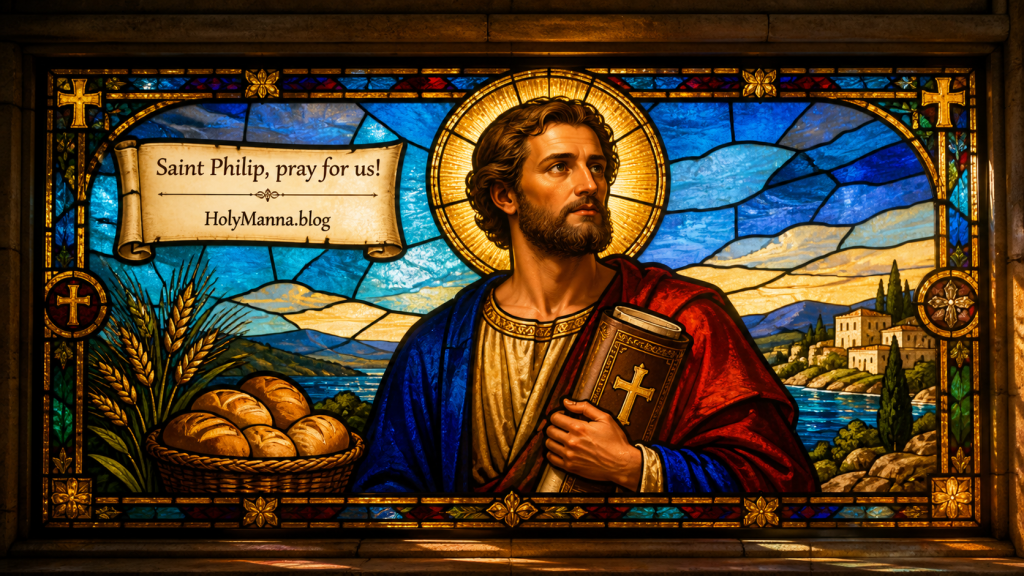
In sacred art, Philip is often shown with loaves, a basket of bread, a cross, an X-shaped cross, or sometimes a serpent or dragon. The bread comes from his role in the feeding of the five thousand. The cross comes from martyrdom tradition. The serpent or dragon usually comes from legendary material and should be understood as symbolic rather than verified history.
Saint Philip is also named in the Roman Canon, also known as Eucharistic Prayer I. That means his name has been spoken at the altar for generations, woven into the Church’s worship and memory.
The Saint Who Teaches Ordinary Catholics How to Evangelize
Saint Philip’s life is not filled with pages and pages of personal details. That may be part of his gift. He is remembered through a few Gospel moments, and each one is enough to form a soul.
He teaches that faith begins with following when Christ says, “Follow me” John 1:43.
He teaches that evangelization can begin with a simple invitation: “Come and see” John 1:46.
He teaches that human limits are real, but grace is greater.
He teaches that seekers should be brought to Jesus, not distracted by the messenger.
He teaches that the deepest desire of the human heart is to see the Father, and that this desire is fulfilled in Christ, who says, “Whoever has seen me has seen the Father” John 14:9.
For everyday Catholics, Philip is a saint for simple courage. Invite the friend. Answer the question. Bring the skeptic closer. Admit when the problem seems too big. Trust Jesus to multiply what looks too small. Let Christ be the center, the answer, and the face of God.
Who in your life needs a gentle invitation to come and see Jesus?
Engage with Us!
Share your thoughts and reflections in the comments below. Saint Philip’s life is simple on the surface, but his witness reaches deeply into the heart of Catholic discipleship.
- When have you needed someone to simply say, “Come and see,” instead of trying to argue you into faith?
- Is there someone in your life who may be waiting for a gentle invitation back to Jesus, the Mass, confession, or prayer?
- Where are you tempted to look only at the numbers, like Philip before the hungry crowd, instead of trusting what Jesus can multiply?
- What does Philip’s request, “Master, show us the Father,” reveal about your own desire to know God more deeply?
- How can your life become a clearer road sign pointing others toward Christ?
Saint Philip reminds the Church that holiness does not always look loud. Sometimes it sounds like three simple words: “Come and see.” May his example help every Christian live with steady faith, humble courage, and generous love, doing all things with the mercy and tenderness Jesus taught us.
Saint Philip, pray for us!
Follow us on YouTube, Instagram and Facebook for more insights and reflections on living a faith-filled life.


Leave a comment