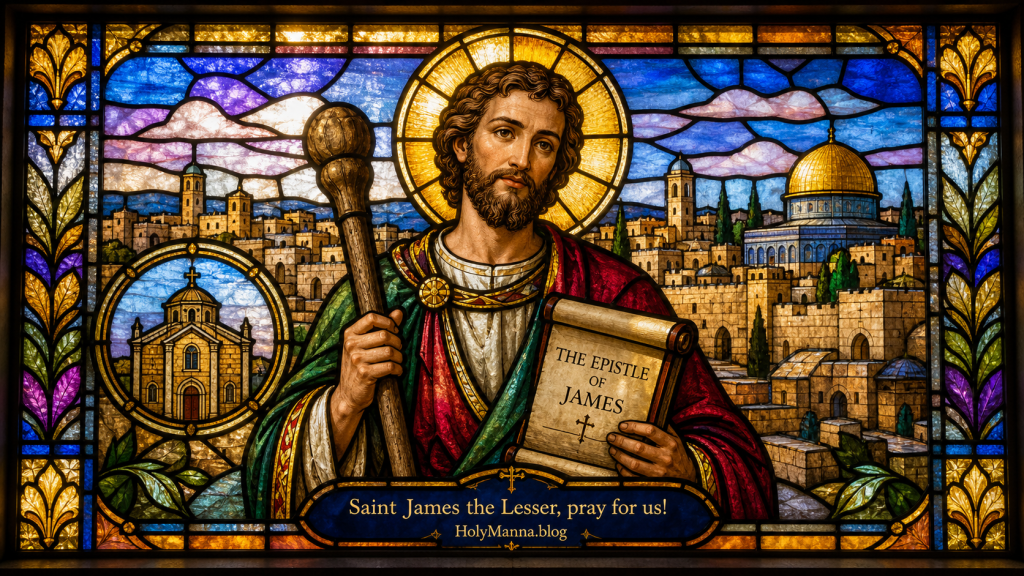
The Quiet Pillar of Jerusalem
Saint James the Lesser is one of those saints who proves that a soul does not need to be loud to be great. He was one of the Twelve Apostles, chosen personally by Jesus Christ, and yet the Gospels do not give him the dramatic scenes given to Peter, Thomas, John, or even Philip. He is quiet in the sacred pages, but after the Resurrection, he becomes one of the great pillars of the early Church.
In the Roman Catholic tradition, Saint James the Lesser is commonly identified with James the Just, the close kinsman of the Lord, the first bishop of Jerusalem, and the traditional author of the Epistle of James. This identification is ancient and deeply rooted in the Latin Catholic tradition, though Catholic scholarship also acknowledges that not every scholar identifies James son of Alphaeus and James the brother of the Lord as the same person.
His feast day is celebrated on May 3, together with Saint Philip the Apostle. That pairing is not random. The relics of Saints Philip and James have long been honored together in Rome, and their shared feast reminds the Church that the Apostles are not merely figures from the past. They are living foundations of the Catholic faith.
The Lesser One Who Was Not Small in Grace
Saint James is called “the Lesser” or “the Less” to distinguish him from Saint James the Greater, the son of Zebedee and brother of Saint John. The title does not mean he was less holy or less loved by Christ. It may refer to his age, his height, or simply his quieter place in the Gospel accounts.
He is named in the lists of the Twelve as James, son of Alphaeus. Catholic tradition often connects him with Mary of Clopas, one of the holy women who stood near the Cross of Jesus. This helps explain why Scripture refers to him as the “brother of the Lord.” From a Catholic perspective, this phrase does not mean that the Blessed Virgin Mary had other children. In the biblical and Semitic world, “brother” could mean a close relative or kinsman.
That detail matters because Saint James stands close to the mystery of Christ’s earthly family and the Church’s earliest days. He was not simply a later preacher or teacher. He was part of the Lord’s own circle, a chosen Apostle, and a witness to the living Christ.
Chosen by Christ, Hidden in the Gospel
The Gospels do not preserve personal speeches or dramatic miracles from Saint James the Lesser during Jesus’ public ministry. That silence can feel surprising, especially when one realizes how important he later became.
Yet his hiddenness is not emptiness. As one of the Twelve, James walked with Jesus, heard His preaching, saw His compassion, witnessed His miracles, and received apostolic authority. He knew the sound of Christ’s voice. He saw the sick healed, sinners forgiven, demons cast out, and the dead raised. He belonged to the small band of men chosen to carry the Gospel into the world.
There is something deeply Catholic about that. Not every saint is called to be famous. Not every apostle is remembered for bold speeches. Some saints are remembered because they remained faithful, steady, prayerful, and obedient when the Church needed pillars more than personalities.
The Risen Lord Appears to James
One of the most important details about Saint James comes from Saint Paul. In 1 Corinthians 15, Paul says that the risen Jesus appeared to James after the Resurrection. This is a powerful moment, even though Scripture does not describe the scene in detail.
Imagine what that encounter must have meant. James had known Jesus in His earthly life. Now he saw Him glorified, risen, victorious over death. That appearance helps explain why James became such a trusted leader in Jerusalem.
The Resurrection did not make James merely enthusiastic. It made him steadfast. He became a man anchored in the truth that Jesus Christ had conquered death.
The First Shepherd of Jerusalem
After the Resurrection and Ascension, Saint James rose to great prominence in the Church of Jerusalem. Christian tradition remembers him as the first bishop of Jerusalem, the mother Church of Christianity.
This role was enormous. Jerusalem was where Christ died, rose, and sent the Holy Spirit upon the Apostles. It was the city of the Temple, the prophets, the Passion, and Pentecost. To shepherd the Church there required courage, wisdom, restraint, and deep holiness.
Saint Paul refers to James, Cephas, and John as pillars of the Church in Galatians 2:9. That one phrase tells us how respected James was in the apostolic age. He was not loud in the Gospel, but he was strong in the Church.
The Council of Jerusalem and the Freedom of the Gentiles
One of Saint James’s most important contributions came at the Council of Jerusalem, described in Acts 15. The early Church faced a serious question. Did Gentile converts need to be circumcised and follow the ceremonial obligations of the Mosaic Law to become Christians?
Saint Peter testified that God had given the Holy Spirit to the Gentiles and that they should not be burdened with a yoke that God had not required of them. Saint James then gave a wise judgment that helped preserve unity in the Church. He supported welcoming Gentile converts without requiring circumcision, while still encouraging them to avoid practices tied to pagan worship and scandal.
This moment shows James at his best. He was faithful to the Jewish roots of Christianity, but he also recognized the freedom Christ had brought to the Gentiles. He helped the Church remain Catholic in the deepest sense, rooted in Israel, open to all nations, and guided by the Holy Spirit.
Faith That Becomes Flesh
Saint James is traditionally associated with the Epistle of James, one of the Catholic Epistles of the New Testament. This letter is short, direct, and deeply practical. It does not let the Christian hide behind nice words or religious appearances.
The most famous teaching associated with Saint James is from James 2:26: “Faith without works is dead.”
That sentence has shaped Catholic teaching for centuries. James does not deny the need for faith. He shows what real faith looks like when it is alive. Real faith feeds the hungry. Real faith controls the tongue. Real faith cares for widows and orphans. Real faith refuses to flatter the rich while ignoring the poor. Real faith prays, forgives, endures suffering, and lives with humility before God.
Saint James gives the Church a Christianity that cannot remain theoretical. He teaches that belief in Jesus must become mercy in action.
The Apostle of the Sick and the Suffering
Saint James also has a special place in Catholic teaching because of his words about the sick. In James 5:14-15, he teaches that the sick should call for the presbyters of the Church, who will pray over them and anoint them with oil in the name of the Lord.
The Catholic Church sees this passage as one of the biblical foundations for the Sacrament of the Anointing of the Sick. This gives Saint James a quiet but beautiful sacramental legacy. He is connected not only with teaching and martyrdom, but also with the bedside of the suffering Christian.
His words still echo whenever a priest anoints the sick, strengthens the dying, and prays for healing, forgiveness, courage, and peace.
The Just Man on His Knees
Ancient Christian tradition calls him James the Just. According to an early story preserved by Eusebius from Hegesippus, James was known for extraordinary holiness, prayer, and austerity. The story says he prayed so often in the Temple that his knees became hardened like a camel’s.
This beautiful image cannot be verified in every detail, so it should be received as ancient Christian tradition rather than strict historical proof. Still, it tells us something important about how the early Church remembered him. They remembered James as a man of prayer. Not a celebrity bishop. Not a political operator. Not a clever religious influencer. A man of prayer.
He was believed to intercede constantly for his people. He was remembered as a living wall of holiness in Jerusalem, a man whose justice was rooted in worship.
No Famous Miracle Worker, Yet Full of Apostolic Power
There are no famous Gospel miracle stories specifically attributed to Saint James the Lesser. Scripture does not tell us that he healed a particular blind man or raised a particular dead person. That may disappoint readers who expect every Apostle to come with a long list of wonders.
But James’s life still shines with apostolic power. His miracle was not spectacle. His miracle was fidelity. He helped hold the early Church together. He defended the unity of Jewish and Gentile believers. He gave the Church a letter that still cuts through hypocrisy. He preserved for the Church a teaching that would become central to the sacramental care of the sick.
Sometimes the greatest miracles are not dramatic scenes but lasting fruits.
The Martyrdom of the Bishop of Jerusalem
Saint James died around A.D. 62 in Jerusalem. The Jewish historian Josephus gives an early account of his death, saying that the high priest Ananus arranged for James and others to be condemned and stoned during a gap in Roman authority.
Christian tradition gives a more dramatic version of his martyrdom. According to the story preserved by Eusebius, religious leaders brought James to the pinnacle of the Temple and asked him to speak against Jesus. Instead, he confessed Christ. The crowd then threw him down, stoned him, and finally a fuller struck him on the head with a club.
That final detail became part of his traditional imagery. In Catholic art, Saint James the Lesser is often shown holding a fuller’s club, the instrument associated with his martyrdom.
The traditional account also says that James prayed for his persecutors before he died. This detail cannot be verified with modern certainty, but it beautifully reflects the Christian memory of him as a just man who followed the mercy of his Lord even in death.
Relics, Rome, and the Memory of the Apostles
After his death, Saint James continued to be honored as an apostolic martyr and shepherd of Jerusalem. His relics came to be venerated with those of Saint Philip in Rome, especially in the Church of the Holy Apostles, later known as the Basilica of the Twelve Holy Apostles.
This shared veneration helps explain why the Church celebrates Saints Philip and James together on May 3. Their feast reminds Catholics that the Church is apostolic not only in doctrine, but in memory, worship, and gratitude.
Saint James is also named in the Roman Canon, Eucharistic Prayer I. That is a powerful sign of his enduring place in the Latin Catholic tradition. His name has been spoken at the altar for centuries, surrounded by the mystery of Christ’s Sacrifice made present in the Mass.
The Patron Who Carries a Club and a Letter
Saint James the Lesser is often invoked as a patron of pharmacists, druggists, fullers, hatmakers, and the dying. His connection with pharmacists may come from the fuller’s club or pestle-like symbol associated with his martyrdom.
But his deeper patronage is spiritual. He is a patron for Catholics who want their faith to become real. He is a patron for quiet leaders, hidden servants, pastors, catechists, caregivers, and anyone tempted to think that holiness must be flashy to matter.
He is also a good saint for Catholics who need help uniting prayer and action. James teaches that kneeling before God and serving one’s neighbor belong together.
A Saint for Catholics Who Want Real Faith
Saint James the Lesser is a saint for an age full of words. He reminds Catholics that faith is not proven by religious talk, online arguments, or public appearances. Faith is proven by charity, patience, humility, truthfulness, prayer, and perseverance.
He also reminds the Church that hidden people can carry great authority when they are rooted in Christ. James did not need to dominate the Gospel pages to become a pillar of the Church. He simply needed to be faithful.
Is there a place in your life where God is asking you to be steady rather than noticed?
Saint James teaches that holiness often looks like showing up, praying hard, speaking truth, caring for the vulnerable, and letting faith become works of mercy.
Engage with Us!
Share your thoughts and reflections in the comments below. Saint James the Lesser gives us a quiet but powerful example of apostolic courage, practical faith, and prayerful leadership.
- How does Saint James’s teaching that faith must be lived through works challenge your own spiritual life?
- Where might God be calling you to serve quietly, without needing recognition?
- What is one concrete act of mercy you can practice this week for someone who is suffering, poor, lonely, or forgotten?
- How can you bring more prayer into your daily responsibilities, like Saint James the Just?
May Saint James the Lesser teach us to live a faith that is steady, humble, and real. May his example help us love Christ with our whole lives, serve others with patience, and do everything with the love and mercy Jesus taught us.
Saint James the Lesser, pray for us!
Follow us on YouTube, Instagram and Facebook for more insights and reflections on living a faith-filled life.


Leave a comment