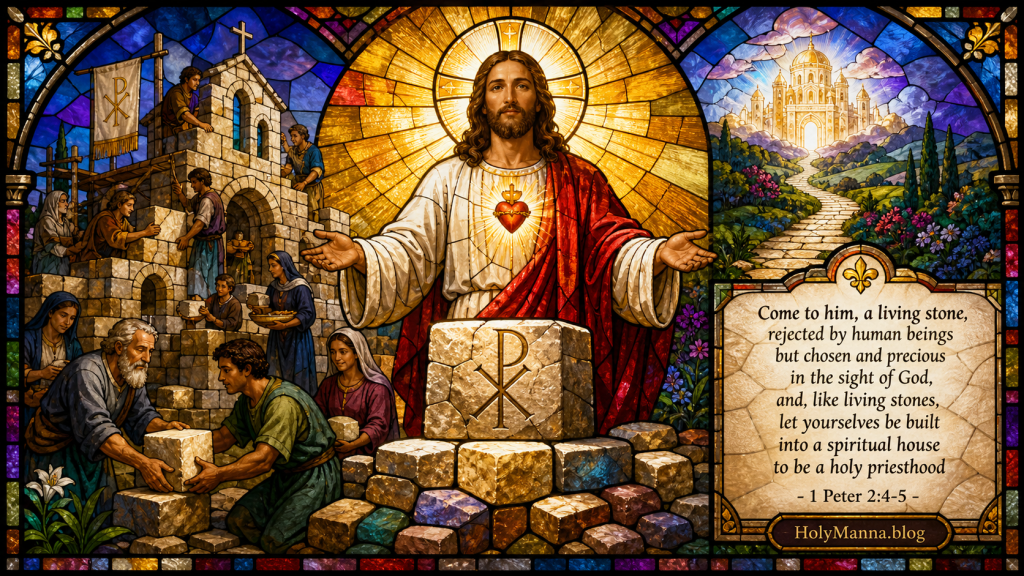
Fifth Sunday of Easter – Lectionary: 52
The Father’s House Is Built with Living Stones
Every troubled heart is looking for a home, and today’s readings show us that the home we are seeking is not built by comfort, popularity, or self-reliance, but by Christ Himself.
On this Fifth Sunday of Easter, the Church invites us to see the Christian life as a journey into the Father’s house and, at the same time, as a mission to help build that house here and now. In Acts 6:1-7, the young Church is growing quickly, but growth brings tension. The Greek-speaking widows are being overlooked, and the apostles respond not with defensiveness, but with prayer, wisdom, and ordered service. The Church must remain faithful to the Word of God while also making sure the vulnerable are not forgotten. This is what apostolic love looks like when it becomes practical.
Then Psalm 33 gives the heart of the matter: God’s house is built on His trustworthy Word and His mercy. The psalmist sings, “The earth is full of the mercy of the Lord” Psalm 33:5. That mercy is not abstract. It becomes food for widows, courage for disciples, hope for the fearful, and life for those who trust in Him.
In 1 Peter 2:4-9, Saint Peter takes the image deeper. Christ is the “living stone”, rejected by men but chosen by God, and believers are called to become “living stones” built into a spiritual house. This is deeply Catholic. The Christian is not saved into isolation, but into the Church, the People of God, the Body of Christ, and the temple of the Holy Spirit. Through Baptism, the faithful share in Christ’s priestly, prophetic, and kingly mission, offering spiritual sacrifices through everyday holiness, mercy, worship, and obedience to God. As The Catechism teaches, the Church is the People of God, called to be “a chosen race, a royal priesthood, a holy nation” CCC 782.
Finally, in John 14:1-12, Jesus speaks to hearts that are afraid. At the Last Supper, with the Cross drawing near, He tells His disciples, “Do not let your hearts be troubled” John 14:1. He is going to prepare a place in the Father’s house, and He reveals the way there with breathtaking clarity: “I am the way and the truth and the life” John 14:6. The Church serves, teaches, worships, and suffers because Christ has opened the way home.
The central theme of today’s readings is that Jesus is building His Church into the Father’s house, one living stone at a time. That house is formed by apostolic teaching, sacrificial service, divine mercy, and faith in Christ as the only Way to the Father. What part of the Father’s house is Christ asking you to help build today?
First Reading – Acts 6:1-7
When the Church Learns to Serve Without Forgetting the Word
The first reading places us inside the young Church of Jerusalem, where the Resurrection has already changed everything, but the daily challenges of human community have not disappeared. The number of disciples is growing, the Gospel is spreading, and the apostles are carrying the mission Christ entrusted to them. Yet in the middle of this holy growth, a painful problem appears: some widows are being overlooked.
In the ancient world, widows were often among the most vulnerable members of society. Without a husband’s protection or income, a widow could easily fall into poverty, isolation, and dependence on the community. Israel’s Scriptures repeatedly commanded care for widows, orphans, and strangers, so this neglect was not a small administrative mistake. It was a wound in the visible charity of the Church.
This reading fits beautifully into today’s central theme: Christ is building His Church as the Father’s house, and that house must be built with apostolic teaching, prayer, mercy, and ordered service. The apostles do not solve the crisis by abandoning prayer and preaching, and they do not solve it by ignoring the poor. Instead, guided by the Holy Spirit, they help the Church become more deeply organized for love.
Acts 6:1-7 – New American Bible (Revised Edition)
The Need for Assistants. 1 At that time, as the number of disciples continued to grow, the Hellenists complained against the Hebrews because their widows were being neglected in the daily distribution. 2 So the Twelve called together the community of the disciples and said, “It is not right for us to neglect the word of God to serve at table. 3 Brothers, select from among you seven reputable men, filled with the Spirit and wisdom, whom we shall appoint to this task, 4 whereas we shall devote ourselves to prayer and to the ministry of the word.” 5 The proposal was acceptable to the whole community, so they chose Stephen, a man filled with faith and the holy Spirit, also Philip, Prochorus, Nicanor, Timon, Parmenas, and Nicholas of Antioch, a convert to Judaism. 6 They presented these men to the apostles who prayed and laid hands on them. 7 The word of God continued to spread, and the number of the disciples in Jerusalem increased greatly; even a large group of priests were becoming obedient to the faith.
Detailed Exegesis
Verse 1 – “At that time, as the number of disciples continued to grow, the Hellenists complained against the Hebrews because their widows were being neglected in the daily distribution.”
The Church is growing, but growth brings pressure. The Hellenists were Greek-speaking Jewish Christians, likely shaped by the wider Greek-speaking world, while the Hebrews were more closely tied to Aramaic-speaking Jewish life in Jerusalem. Both groups belonged to the same Church, but cultural and language differences created real tension.
The complaint centers on widows. This matters because Christian faith is never measured only by words, emotions, or public worship. It is also measured by how the vulnerable are treated. The daily distribution was a practical work of mercy, and when some widows were neglected, the unity of the Church was threatened. This shows that from the beginning, Catholic life has required both doctrine and charity, both worship and justice, both the altar and the table.
Verse 2 – “So the Twelve called together the community of the disciples and said, ‘It is not right for us to neglect the word of God to serve at table.’”
The Twelve act with apostolic authority. They gather the community, name the problem, and clarify the mission. At first, their words can sound as if serving tables is less important, but that is not their meaning. They are not rejecting service. They are protecting the Church from disorder.
The apostles have been entrusted with prayer, preaching, teaching, and guarding the Word of God. If they abandon that mission, the whole Church suffers. At the same time, the widows must not be ignored. The answer is not either the Word or service. The Catholic answer is both, properly ordered. This is how the Church begins to show the structure of apostolic ministry, where different members serve the one Body of Christ in different ways.
Verse 3 – “Brothers, select from among you seven reputable men, filled with the Spirit and wisdom, whom we shall appoint to this task.”
The apostles ask the community to select seven men of good reputation, but the qualifications are spiritual, not merely practical. These men must be “filled with the Spirit and wisdom” Acts 6:3. The Church does not treat charity as simple logistics. Even distributing food requires holiness, prudence, and docility to the Holy Spirit.
The number seven often suggests fullness or completion in Scripture. These seven are chosen to help restore order and fairness in the community. Catholic tradition has often seen this passage as an important biblical foundation for the diaconal ministry, especially because the work involves service, charity, and formal appointment through apostolic prayer and the laying on of hands.
Verse 4 – “Whereas we shall devote ourselves to prayer and to the ministry of the word.”
This verse reveals the apostolic heart of the Church. Prayer comes first, then the ministry of the Word. The apostles do not say, “We will devote ourselves to strategy.” They do not say, “We will devote ourselves to popularity.” They say they will devote themselves to prayer and the Word.
This matters for every age of the Church. Without prayer, ministry becomes activism. Without the Word, charity can lose its supernatural direction. The apostles know that the Church can only serve rightly if she remains rooted in God. The poor need bread, but the whole Church needs the living Word that leads souls to salvation.
Verse 5 – “The proposal was acceptable to the whole community, so they chose Stephen, a man filled with faith and the holy Spirit, also Philip, Prochorus, Nicanor, Timon, Parmenas, and Nicholas of Antioch, a convert to Judaism.”
The community receives the apostles’ proposal with unity. The first man named is Stephen, described as “a man filled with faith and the holy Spirit” Acts 6:5. This detail is powerful because Stephen will soon become the first Christian martyr. The man chosen to serve tables will also witness to Christ with his blood.
Philip is also important. Later in Acts, he becomes a great evangelizer, preaching in Samaria and baptizing the Ethiopian official. This reminds the reader that humble service is often the beginning of great mission. In the Church, no service offered to God is small. The names listed also appear to be Greek names, which may show pastoral wisdom. The community chooses men who can understand and serve the Hellenist Christians whose widows were being neglected.
Verse 6 – “They presented these men to the apostles who prayed and laid hands on them.”
This verse is deeply significant for Catholic understanding of ministry. The community presents the men, but the apostles appoint them through prayer and the laying on of hands. This is not casual volunteering. This is a visible, sacred action connected to apostolic authority.
The laying on of hands has deep biblical roots. It appears in the Old Testament as a sign of blessing, commissioning, and the transmission of responsibility. In the New Testament, it becomes part of the Church’s sacramental and ministerial life. Here, the action shows that service in the Church is not merely functional. It is ecclesial. It belongs to the ordered life of Christ’s Body.
Verse 7 – “The word of God continued to spread, and the number of the disciples in Jerusalem increased greatly; even a large group of priests were becoming obedient to the faith.”
The result of this Spirit-guided solution is growth. Once the Church responds to internal tension with charity, order, prayer, and apostolic authority, the Word of God continues to spread. The mission is not weakened by caring for widows. It is strengthened.
The final detail is striking: even many priests were becoming obedient to the faith. These were likely Jewish priests connected to temple worship. Their conversion shows that the Gospel was penetrating deeply into Jerusalem’s religious life. The Church’s faithful witness, both in preaching and in charity, was becoming a sign that Christ truly had risen.
Teachings
This reading shows the Church becoming more visibly structured for mission. Christ did not leave behind a vague spiritual movement. He founded a Church built on the apostles, guided by the Holy Spirit, nourished by the Word, and organized for the salvation and service of souls.
The Catechism of the Catholic Church teaches that the Church’s ministry has had ordered degrees from ancient times. It says, “The divinely instituted ecclesiastical ministry is exercised in different degrees by those who even from ancient times have been called bishops, priests, and deacons.” CCC 1554
This helps Catholics understand why Acts 6 matters. The apostles are not improvising a temporary fix only for one local problem. The Holy Spirit is forming the Church’s visible life. The ministry of the Word is protected. The vulnerable are cared for. Service is given a sacred shape.
The Church also teaches that the diaconate is especially connected to Christ the Servant. The Catechism says, “Deacons share in Christ’s mission and grace in a special way. The sacrament of Holy Orders marks them with an imprint, ‘character,’ which cannot be removed and which configures them to Christ, who made himself the ‘deacon’ or servant of all. Among other tasks it is the task of deacons to assist the bishop and priests in the celebration of the divine mysteries, above all the Eucharist, in the distribution of Holy Communion, in assisting at and blessing marriages, in the proclamation of the Gospel and preaching, in presiding over funerals, and in dedicating themselves to the various ministries of charity.” CCC 1570
That phrase is beautiful: Christ made Himself the servant of all. The Church’s ministries only make sense because Jesus Himself washed feet, touched lepers, welcomed sinners, preached truth, fed the hungry, and gave His life on the Cross.
This reading also speaks to Catholic social teaching. The Church’s concern for widows in Acts is not an optional side project. It flows from the heart of the Gospel. The Catechism teaches, “The Church’s love for the poor . . . is a part of her constant tradition.” CCC 2444 It also teaches, “This love is inspired by the Gospel of the Beatitudes, of the poverty of Jesus, and of his concern for the poor.” CCC 2444
Saint Ignatius of Antioch, one of the early bishops and martyrs of the Church, also witnessed to the importance of ordered ministry. Writing in the early second century, he said, “Similarly, let all respect the deacons as Jesus Christ, just as they should respect the bishop as a type of the Father and the presbyters as the council of God and college of apostles. Apart from these, there is no Church.” Letter to the Trallians, 3
That early witness matters. It shows that the Church quickly understood ministry not as a power structure, but as a sacred service that protects unity, doctrine, worship, and charity. The apostles in Acts 6 model this beautifully. They do not ignore the complaint. They do not let division grow. They respond with prayer, wisdom, and a structure that allows the Church to love better.
Reflection
This reading has a very practical message for daily Catholic life: holiness must become organized love.
It is easy to say that the Church should care for the poor. It is harder to notice the person who is actually being overlooked. It is easy to admire the apostles. It is harder to accept that prayer and service both need discipline. It is easy to complain when something is wrong. It is harder to become part of the solution with humility, charity, and wisdom.
The neglected widows in Acts 6 invite every Catholic to ask whether someone nearby is quietly being missed. It may be an elderly parishioner who no longer drives. It may be a young adult who feels invisible at Mass. It may be a family under financial pressure. It may be a spouse, parent, coworker, or friend who is physically present but emotionally neglected.
At the same time, the apostles remind the Church that service must remain rooted in prayer and the Word of God. A Catholic can become so busy doing good things that the soul slowly stops listening to God. The reading gently corrects that temptation. The Church serves best when she prays first. A disciple loves best when the heart is anchored in Christ.
A simple way to live this reading is to notice one person who may be overlooked and serve that person quietly this week. Make the phone call. Bring the meal. Send the message. Offer the ride. Pray for the person by name. Then return to prayer and ask Christ to keep that act of charity united to Him.
Who is being neglected in your daily distribution of attention, patience, mercy, or love?
Where is Christ asking you to serve without resentment and pray without distraction?
How can your parish, family, or workplace become more like the Church in Acts, where real problems are met with faith, wisdom, and charity?
The young Church grew because it did not separate truth from love. The apostles preached the Word, the seven served the vulnerable, and the whole community became stronger. That is still the pattern of Catholic life today. Christ builds His Father’s house through people who pray deeply, speak truthfully, serve humbly, and refuse to let anyone be forgotten.
Responsorial Psalm – Psalm 33:1-2, 4-5, 18-19, 22
The Song of a People Who Trust the Mercy of God
The responsorial psalm gives today’s readings their prayerful heartbeat. After hearing in Acts 6:1-7 that the young Church had to care for neglected widows without abandoning prayer and the Word, Psalm 33 teaches the Church how to respond: with praise, trust, and hope in the mercy of the Lord.
In ancient Israel, the psalms were not simply private devotional poems. They were the prayer book of God’s people. They were sung in worship, prayed in suffering, proclaimed in thanksgiving, and carried in the memory of Israel through war, famine, exile, and restoration. This psalm praises God as trustworthy, just, merciful, and watchful over those who fear Him.
That makes it a perfect bridge between the first reading and the rest of today’s theme. The Church is being built into the Father’s house, but that house is not built by human strength alone. It is built by God’s faithful Word and sustained by His mercy. The refrain captures the whole attitude of the Christian soul: “May your mercy, Lord, be upon us; as we put our hope in you” Psalm 33:22.
Psalm 33:1-2, 4-5, 18-19, 22 – New American Bible (Revised Edition)
Praise of God’s Power and Providence
1 Rejoice, you righteous, in the Lord;
praise from the upright is fitting.
2 Give thanks to the Lord on the harp;
on the ten-stringed lyre offer praise.4 For the Lord’s word is upright;
all his works are trustworthy.
5 He loves justice and right.
The earth is full of the mercy of the Lord.18 Behold, the eye of the Lord is upon those who fear him,
upon those who count on his mercy,
19 To deliver their soul from death,
and to keep them alive through famine.22 May your mercy, Lord, be upon us;
as we put our hope in you.
Detailed Exegesis
Verse 1 – “Rejoice, you righteous, in the Lord; praise from the upright is fitting.”
The psalm begins with a summons to joy. The righteous are invited to rejoice, not because life is easy, but because the Lord is faithful. Biblical joy is not shallow positivity. It is the deep confidence of a soul that knows God is still good, still just, and still worthy of praise.
The phrase “praise from the upright is fitting” Psalm 33:1 reminds us that worship belongs naturally to a heart rightly ordered toward God. Praise is not an accessory to faith. It is one of the clearest signs that a soul remembers who God is. In today’s readings, the young Church must solve real problems, but the psalm reminds us that Christian service must remain rooted in worship.
Verse 2 – “Give thanks to the Lord on the harp; on the ten-stringed lyre offer praise.”
This verse places us in the worshiping life of Israel. The harp and lyre were instruments used in sacred praise, especially in the temple tradition associated with David. Worship was embodied, communal, and beautiful. God’s people did not merely think about the Lord. They sang to Him.
Catholic worship continues this biblical instinct. The Church prays with words, gestures, music, incense, silence, kneeling, standing, and sacramental signs. The whole person is invited into praise. In the larger theme of today’s readings, this matters because the Father’s house is not only a place of service. It is a house of worship.
Verse 4 – “For the Lord’s word is upright; all his works are trustworthy.”
Here the psalm gives the reason for praise: God’s Word is true, and His works can be trusted. This connects directly to Acts 6, where the apostles refuse to neglect “the word of God” Acts 6:2. The Church is merciful because God’s Word teaches mercy. The Church is ordered because God’s works are trustworthy. The Church serves because the Lord has first revealed His own faithful love.
This verse also prepares us for the Gospel, where Jesus says, “I am the way and the truth and the life” John 14:6. God’s Word is not merely reliable information. In Christ, the eternal Word becomes flesh. The trustworthy Word of the Lord has a face, a voice, a Cross, and a risen body.
Verse 5 – “He loves justice and right. The earth is full of the mercy of the Lord.”
This verse holds justice and mercy together. God loves what is just and right, and the earth is filled with His mercy. In Catholic teaching, justice and mercy are never enemies. Mercy does not ignore what is right. Justice without mercy becomes cold. Mercy without justice becomes sentimental. In God, both are perfectly united.
This verse also shines light on the neglected widows in Acts 6. If the Lord loves justice and right, then His Church must not tolerate neglect. If the earth is full of His mercy, then the Christian community must become a visible sign of that mercy. The psalm turns theology into action.
Verse 18 – “Behold, the eye of the Lord is upon those who fear him, upon those who count on his mercy.”
This verse is tender and powerful. The Lord sees those who fear Him and hope in His mercy. Biblical fear of the Lord is not terror of a cruel master. It is reverence, awe, humility, and loving obedience before the living God.
The Lord’s eye is not distant surveillance. It is fatherly care. This speaks beautifully to today’s Gospel, where Jesus tells His disciples not to let their hearts be troubled because He is going to prepare a place for them in His Father’s house. The Father sees. The Father knows. The Father is not indifferent to His children.
Verse 19 – “To deliver their soul from death, and to keep them alive through famine.”
The psalm now becomes intensely concrete. God’s mercy is not abstract. He delivers from death and sustains His people through famine. In the world of ancient Israel, famine was not a metaphor. It meant hunger, fear, social breakdown, and dependence on God’s providence.
In the Easter season, Catholics hear this verse in the light of Christ’s Resurrection. God delivers the soul from death most fully through Jesus, who conquers sin and opens the way to eternal life. He also keeps His people alive through famine by feeding them with His Word and, above all, with the Eucharist. The Father’s house is a place where hungry souls are not abandoned.
Verse 22 – “May your mercy, Lord, be upon us; as we put our hope in you.”
The psalm ends as a prayer of trust. The people ask for mercy because they have placed their hope in the Lord. This is not passive waiting. It is faithful surrender. The soul that hopes in God continues to praise, serve, repent, pray, and obey, even when the road is hard.
This verse gathers the whole day together. The Church in Acts hopes in God by caring for the neglected. Saint Peter calls believers to hope by becoming living stones in a spiritual house. Jesus tells troubled hearts to hope because He is the Way to the Father. The psalm teaches the response: Lord, let Your mercy rest upon us, because our hope is in You.
Teachings
The psalms are central to Catholic prayer because they teach the Church to speak to God with the full range of human life: joy, sorrow, fear, gratitude, repentance, longing, and trust. The Catechism of the Catholic Church teaches, “From David to the coming of the Messiah texts appearing in these sacred books show ever more clearly the prayer of Christ, the Messiah and Son of David. The Psalms are gradually gathered into the five books of the Psalter, the masterwork of prayer in the Old Testament.” CCC 2585
That means Psalm 33 is not just an ancient hymn. It is part of the prayer school of Christ Himself. Jesus prayed the psalms. Mary prayed the psalms. The apostles prayed the psalms. The Church still prays them daily in the Liturgy of the Hours. When Catholics pray the psalms, they enter a living stream of worship that flows from Israel into the Church.
The Catechism also teaches, “The Psalms both nourished and expressed the prayer of the People of God gathered during the great feasts at Jerusalem and each Sabbath in the synagogues. Their prayer is inseparably personal and communal; it concerns both those who are praying and all men. The Psalms arose from the communities of the Holy Land and the Diaspora, but embrace all creation. Their prayer recalls the saving events of the past, yet extends into the future, even to the end of history; it commemorates the promises God has already kept, and awaits the Messiah who will fulfill them definitively. Prayed by Christ and fulfilled in him, the Psalms remain essential to the prayer of his Church.” CCC 2586
This explains why today’s psalm fits so well with the Mass readings. It is personal and communal. It speaks to the individual heart and to the whole Church. It remembers God’s mercy in the past and teaches believers to hope in His mercy now.
The psalm’s emphasis on God’s providence also connects to Catholic teaching on the Father’s care. The Catechism says, “With creation, God does not abandon his creatures to themselves. He not only gives them being and existence, but also, and at every moment, upholds and sustains them in being, enables them to act and brings them to their final end.” CCC 301
This is the God praised in Psalm 33. He sees those who hope in Him. He sustains life through famine. He fills the earth with mercy. The same Father whom Jesus reveals in John 14 is the Lord whose eye rests upon His people in the psalm.
Saint Augustine famously taught, “Singing belongs to one who loves.” This short saying captures the Catholic heart of the responsorial psalm. The Church sings because she loves the Lord. She sings because she trusts His mercy. She sings because even in suffering, she knows that the Father’s house is real, Christ is the Way, and the Spirit teaches the Church to hope.
Reflection
Psalm 33 invites Catholics to recover the habit of praise. That may sound simple, but it is deeply countercultural. Modern life trains the heart to complain quickly, worry constantly, and measure everything by control. The psalm teaches another way. Rejoice in the Lord. Give thanks. Trust His Word. Count on His mercy.
This does not mean pretending life is easy. The psalm speaks of death and famine. It knows that life can become frightening and fragile. Yet even there, the believer is invited to hope. The Lord’s eye remains upon those who fear Him. His mercy is not absent when life feels uncertain.
A practical way to live this psalm is to begin the day with one sentence of praise before reaching for the phone. Thank God for His mercy before checking messages, news, responsibilities, or problems. Another way is to bring one real fear into prayer and say slowly, “May your mercy, Lord, be upon us; as we put our hope in you” Psalm 33:22. Let that become a small anchor for the heart.
This psalm also challenges the way Catholics see the world. If “the earth is full of the mercy of the Lord” Psalm 33:5, then mercy is not rare. It is often hidden, but it is everywhere. It is in the sacraments, in answered prayers, in forgiven sins, in meals shared, in quiet acts of service, in the patience of a parent, in the courage of a caregiver, and in the Church’s care for the forgotten.
Where does your heart need to trade anxiety for praise today?
Do you really believe the Lord sees you with fatherly care, or do you live as if you have been forgotten?
How can your words, work, and worship help someone else experience that the earth is full of the mercy of the Lord?
The Church sings Psalm 33 today because the Father’s house is built in mercy. The apostles serve in mercy. The living stones are held together by mercy. Troubled hearts are calmed by mercy. And every soul walking toward the Father learns to pray with confidence: “May your mercy, Lord, be upon us; as we put our hope in you” Psalm 33:22.
Second Reading – 1 Peter 2:4-9
Living Stones in the House Christ Is Building
The second reading brings today’s theme into sharp focus. In 1 Peter 2:4-9, Saint Peter speaks to Christians who know what it feels like to be rejected, misunderstood, and treated like outsiders. Many of the early believers were living as spiritual exiles in a world that did not share their faith, values, or hope. Peter does not tell them to blend in. He reminds them who they are.
They are not spiritual wanderers. They are “living stones” 1 Peter 2:5. They are being built into a spiritual house. They are a holy priesthood. They are a chosen race, a royal priesthood, a holy nation, and a people belonging to God.
This reading fits perfectly with the Father’s house promised by Jesus in today’s Gospel and the ordered service of the Church in Acts 6:1-7. Christ is not merely preparing a place for His people in heaven. He is already building His Church on earth. Every baptized Christian is meant to be joined to Him, the living cornerstone, and built into a holy dwelling place where God is worshiped, mercy is practiced, and the Gospel is proclaimed.
1 Peter 2:4-9 – New American Bible (Revised Edition)
4 Come to him, a living stone, rejected by human beings but chosen and precious in the sight of God, 5 and, like living stones, let yourselves be built into a spiritual house to be a holy priesthood to offer spiritual sacrifices acceptable to God through Jesus Christ. 6 For it says in scripture:
“Behold, I am laying a stone in Zion,
a cornerstone, chosen and precious,
and whoever believes in it shall not be put to shame.”7 Therefore, its value is for you who have faith, but for those without faith:
“The stone which the builders rejected
has become the cornerstone,”8 and
“A stone that will make people stumble,
and a rock that will make them fall.”They stumble by disobeying the word, as is their destiny.
9 But you are “a chosen race, a royal priesthood, a holy nation, a people of his own, so that you may announce the praises” of him who called you out of darkness into his wonderful light.
Detailed Exegesis
Verse 4 – “Come to him, a living stone, rejected by human beings but chosen and precious in the sight of God.”
Saint Peter begins with an invitation: “Come to him” 1 Peter 2:4. Christian life is not first about coming to an idea, a moral system, or a cultural identity. It is about coming to Christ. He is the living stone, a striking image because stones are usually lifeless. Peter is showing that Jesus is the foundation of God’s new temple, but He is not a dead object. He is risen, living, and active.
Christ was rejected by human beings. The religious leaders, political powers, and crowds all had a part in rejecting Him during His Passion. Yet the Father chose Him and declared Him precious. This is a powerful message for Christians who feel rejected for following Jesus. The world’s rejection does not decide a soul’s worth. God does.
Verse 5 – “And, like living stones, let yourselves be built into a spiritual house to be a holy priesthood to offer spiritual sacrifices acceptable to God through Jesus Christ.”
Now Peter applies the image to the baptized. Christians are not only standing on the living stone. They become living stones themselves. This means faith is personal, but it is never isolated. A stone alone is not a house. A Christian cut off from the Church is not living the fullness of what Baptism gives.
Peter says, “let yourselves be built” 1 Peter 2:5. That phrase matters. God is the builder. The Christian must allow Him to shape, place, and join each soul to the rest of the Church. This can be uncomfortable because it requires humility, obedience, forgiveness, and real communion with others.
Peter also calls the faithful “a holy priesthood” 1 Peter 2:5. In Catholic teaching, this refers to the common priesthood of all the baptized. It does not erase the ministerial priesthood of bishops and priests. Instead, it shows that every baptized Christian is called to offer his or her life to God. Daily work, prayer, suffering, family life, acts of mercy, and sacrifices made in love can become spiritual offerings through Jesus Christ.
Verse 6 – “For it says in scripture: ‘Behold, I am laying a stone in Zion, a cornerstone, chosen and precious, and whoever believes in it shall not be put to shame.’”
Peter now quotes the Old Testament, drawing from Isaiah 28:16. Zion refers to Jerusalem, the place associated with the temple, kingship, covenant, and worship. In the original setting, the cornerstone symbolized security, stability, and God’s sure foundation for His people.
For Christians, that cornerstone is Christ. Everything in the Church depends on Him. He is not one stone among many. He is the chosen and precious cornerstone that gives the whole structure its strength and alignment. If the Church is built on personality, politics, trends, or comfort, the house weakens. If the Church remains built on Christ, she stands.
The promise is deeply consoling: “whoever believes in it shall not be put to shame” 1 Peter 2:6. Faith in Christ may bring suffering in this world, but it will never end in ultimate disgrace. The believer who stands on Christ stands on the foundation chosen by the Father.
Verse 7 – “Therefore, its value is for you who have faith, but for those without faith: ‘The stone which the builders rejected has become the cornerstone.’”
Peter now quotes Psalm 118:22, a psalm often connected with victory, deliverance, and the Lord’s saving work. The rejected stone becomes the cornerstone. This is the story of Jesus. The One cast aside becomes the foundation of salvation.
This verse also reveals the difference faith makes. To those who believe, Christ is precious. To those without faith, He appears disposable, inconvenient, or offensive. The same Jesus who is the treasure of the Church can be rejected by those who do not want His truth, His Cross, or His authority.
There is also a warning here. The builders should have recognized the stone. They were responsible for building rightly, yet they rejected the very stone God had chosen. Peter is reminding the Church that human judgment can be tragically wrong when it is not surrendered to God.
Verse 8 – “And ‘A stone that will make people stumble, and a rock that will make them fall.’ They stumble by disobeying the word, as is their destiny.”
Peter continues with another Old Testament image, echoing Isaiah 8:14. Christ is the cornerstone for those who believe, but He becomes a stumbling stone for those who disobey the Word. This does not mean Jesus desires people to fall. It means that He cannot be treated as neutral. Every person must respond to Him.
Christ’s humility, Cross, moral demands, and claim to be the only Way to the Father can become a stumbling block for pride. Some stumble because they want a Messiah without suffering, mercy without repentance, truth without obedience, or salvation without surrender.
The phrase “They stumble by disobeying the word” 1 Peter 2:8 is important. The problem is not a lack of intelligence. It is disobedience. Faith is not merely agreeing that Jesus exists. Faith means trusting Him enough to follow Him.
Verse 9 – “But you are ‘a chosen race, a royal priesthood, a holy nation, a people of his own, so that you may announce the praises’ of him who called you out of darkness into his wonderful light.”
This is one of the most powerful descriptions of the Church in the New Testament. Peter takes language once used for Israel and applies it to the Church in Christ. The baptized are a chosen race, not because of ethnicity or worldly status, but because they have been chosen in Christ. They are a royal priesthood because they share in Christ’s kingship and priestly offering. They are a holy nation because they are set apart for God. They are a people of His own because they belong to Him.
But this identity has a mission. The Church exists “so that you may announce the praises” 1 Peter 2:9 of God. Catholics are not chosen for spiritual arrogance. They are chosen for witness. They are called out of darkness into light so that their lives can point others to the mercy, truth, and beauty of God.
Teachings
This reading is deeply Catholic because it shows the dignity of Baptism and the beauty of the Church as God’s spiritual house. Every baptized person has a real vocation. Every soul joined to Christ has a place in the house He is building.
The Catechism of the Catholic Church teaches, “Christ, high priest and unique mediator, has made of the Church ‘a kingdom, priests for his God and Father.’ The whole community of believers is, as such, priestly. The faithful exercise their baptismal priesthood through their participation, each according to his own vocation, in Christ’s mission as priest, prophet, and king. Through the sacraments of Baptism and Confirmation the faithful are ‘consecrated to be . . . a holy priesthood.’” CCC 1546
This quote helps explain Saint Peter’s words. The faithful really do share in Christ’s priestly mission. This common priesthood is lived through holiness, worship, prayer, witness, charity, and the offering of daily life to God.
At the same time, Catholic teaching protects the distinction between the common priesthood of the faithful and the ministerial priesthood of the ordained. The Catechism teaches, “The ministerial or hierarchical priesthood of bishops and priests, and the common priesthood of all the faithful participate, ‘each in its own proper way, in the one priesthood of Christ.’ While being ‘ordered one to another,’ they differ essentially.” CCC 1547
This is why 1 Peter 2:4-9 should not be read as a rejection of ordained priesthood. It is a proclamation of baptismal dignity. The ordained priesthood serves the faithful by preaching the Word, celebrating the sacraments, especially the Eucharist, forgiving sins in Christ’s name, and shepherding the Church. The common priesthood of the baptized responds by offering life as a spiritual sacrifice and joining that offering to Christ.
The Catechism also explains what those spiritual sacrifices look like in daily life. It says, “Hence the laity, dedicated as they are to Christ and anointed by the Holy Spirit, are marvelously called and prepared so that even richer fruits of the Spirit may be produced in them. For all their works, prayers, and apostolic undertakings, family and married life, daily work, relaxation of mind and body, if they are accomplished in the Spirit, indeed even the hardships of life if patiently borne, all these become spiritual sacrifices acceptable to God through Jesus Christ.” CCC 901
This is the practical heart of the reading. A Catholic does not have to leave ordinary life to become holy. Ordinary life must be offered through Christ. The commute, the dishes, the job, the family tension, the unseen sacrifice, the late-night prayer, the difficult forgiveness, and the small act of mercy can become spiritual sacrifices when offered in union with Jesus.
Saint Leo the Great captures the dignity of this calling with a famous exhortation quoted in The Catechism: “Christian, recognize your dignity and, now that you share in God’s own nature, do not return to your former base condition by sinning. Remember who is your head and of whose body you are a member. Never forget that you have been rescued from the power of darkness and brought into the light of the Kingdom of God.” CCC 1691
That is exactly the message of Saint Peter. The baptized have been called out of darkness into wonderful light. To live like a Christian is to remember who Christ is, who the Church is, and who Baptism has made each believer to be.
Reflection
The second reading asks a very honest question: Are you letting Christ build you, or are you trying to remain a loose stone?
A loose stone may seem free, but it cannot become a house. Many people today want spirituality without commitment, faith without obedience, community without responsibility, and Jesus without the Church. Saint Peter gives a better vision. Come to Christ. Let yourself be built. Become part of the spiritual house. Offer your life as a sacrifice. Announce the praises of God.
This reading is especially powerful for anyone who feels rejected, overlooked, or out of place. Christ Himself was rejected by human beings, yet chosen and precious to the Father. If a Christian belongs to Christ, then rejection does not have the final word. The Father knows the value of every stone He chooses for His house.
A simple way to live this reading is to make an intentional offering of the day each morning. Before work, school, errands, or responsibilities begin, offer everything to God through Jesus Christ. Offer the good and the frustrating. Offer the visible and the hidden. Offer the moments that feel holy and the moments that feel painfully ordinary.
Another way is to reconnect with the Church in a concrete way. Attend Mass with more attention. Go to Confession. Serve in the parish. Pray for priests and deacons. Encourage someone whose faith is weak. Stop treating Catholic life as a private possession and start living it as membership in the household of God.
Where is Christ asking you to be shaped instead of staying spiritually independent?
What ordinary part of your life could become a spiritual sacrifice if it were offered through Jesus today?
Do your words, choices, and relationships announce the praises of the One who called you out of darkness into His wonderful light?
Saint Peter is reminding the Church that Christian identity is not fragile. The world may reject Christ, but the Father has chosen Him as the cornerstone. The world may misunderstand the faithful, but God is building them into something holy. Every baptized Catholic is called to stand on Christ, remain in the Church, offer daily life to the Father, and become a living stone in the house that will never fall.
Holy Gospel – John 14:1-12
The Way Home When the Heart Is Troubled
The Holy Gospel brings today’s readings to their deepest center. Jesus is speaking during the Last Supper, on the night before His Passion. Judas has gone out into the darkness. Peter’s denial has been foretold. The apostles can sense that something painful is coming, but they do not yet understand the Cross, the Resurrection, or the Ascension.
Into that fear, Jesus speaks words that have consoled Christians for centuries: “Do not let your hearts be troubled” John 14:1. He does not promise the disciples an easy road. He promises Himself. He reveals that He is going to the Father, that He is preparing a place for them, and that He Himself is the Way.
This Gospel completes the theme running through today’s readings. In Acts 6:1-7, the Church is ordered for service. In Psalm 33, the people of God place their hope in the Lord’s mercy. In 1 Peter 2:4-9, believers are called living stones built into a spiritual house. Now, in John 14:1-12, Jesus reveals the destination of that house: communion with the Father through the Son. The Church is not built for itself. The Church is built to bring souls home.
John 14:1-12 – New American Bible (Revised Edition)
Last Supper Discourses. 1 “Do not let your hearts be troubled. You have faith in God; have faith also in me. 2 In my Father’s house there are many dwelling places. If there were not, would I have told you that I am going to prepare a place for you? 3 And if I go and prepare a place for you, I will come back again and take you to myself, so that where I am you also may be. 4 Where [I] am going you know the way.” 5 Thomas said to him, “Master, we do not know where you are going; how can we know the way?” 6 Jesus said to him, “I am the way and the truth and the life. No one comes to the Father except through me. 7 If you know me, then you will also know my Father. From now on you do know him and have seen him.” 8 Philip said to him, “Master, show us the Father, and that will be enough for us.” 9 Jesus said to him, “Have I been with you for so long a time and you still do not know me, Philip? Whoever has seen me has seen the Father. How can you say, ‘Show us the Father’? 10 Do you not believe that I am in the Father and the Father is in me? The words that I speak to you I do not speak on my own. The Father who dwells in me is doing his works. 11 Believe me that I am in the Father and the Father is in me, or else, believe because of the works themselves. 12 Amen, amen, I say to you, whoever believes in me will do the works that I do, and will do greater ones than these, because I am going to the Father.
Detailed Exegesis
Verse 1 – “Do not let your hearts be troubled. You have faith in God; have faith also in me.”
Jesus begins by speaking directly to the fear in the disciples’ hearts. Their world is about to be shaken, but He calls them to faith. This is not a vague emotional comfort. It is a command to trust. Faith in God and faith in Jesus cannot be separated, because Jesus is the eternal Son sent by the Father.
The troubled heart is one of the great human realities. Fear of suffering, fear of loss, fear of failure, fear of death, and fear of abandonment can all disturb the soul. Jesus does not tell His disciples to pretend they are not afraid. He tells them to place their faith in Him.
Verse 2 – “In my Father’s house there are many dwelling places. If there were not, would I have told you that I am going to prepare a place for you?”
Jesus speaks of the Father’s house. This is the language of belonging, family, communion, and eternal security. The phrase “many dwelling places” John 14:2 reveals the generous love of God. Heaven is not cramped. The Father is not reluctant to receive His children.
Jesus says He is going to prepare a place. In the light of the whole Gospel, this preparation happens through His Passion, Death, Resurrection, and Ascension. The Cross is not a tragic interruption of the plan. It is the way Christ opens the Father’s house to sinners.
Verse 3 – “And if I go and prepare a place for you, I will come back again and take you to myself, so that where I am you also may be.”
The goal of salvation is not merely a location. It is communion with Christ. Jesus says, “so that where I am you also may be” John 14:3. Heaven is being with Him.
This verse also points toward Christian hope. Jesus will not abandon His disciples. He will come again. This promise looks toward His Resurrection appearances, His presence in the Church, His coming at the hour of death, and His final return in glory. The Christian life is lived between promise and fulfillment, always trusting that Christ will bring His people to Himself.
Verse 4 – “Where I am going you know the way.”
Jesus tells the disciples that they know the way because they know Him. They may not understand the full mystery yet, but they have been walking with the Way Himself.
This verse reveals something beautiful about discipleship. Often, the believer does not understand every step ahead. The apostles did not. But knowing Christ is already the beginning of knowing the road. The Christian does not need total control to keep walking. The Christian needs faithfulness to Jesus.
Verse 5 – “Thomas said to him, ‘Master, we do not know where you are going; how can we know the way?’”
Thomas asks the honest question. He does not pretend to understand what he does not understand. His confusion gives Jesus the opportunity to reveal one of the greatest truths in Scripture.
Thomas represents every disciple who has ever prayed, “Lord, where are You leading me?” His question is not rebellion. It is the cry of a sincere heart trying to follow but struggling to see the path.
Verse 6 – “Jesus said to him, ‘I am the way and the truth and the life. No one comes to the Father except through me.’”
This is the heart of the Gospel. Jesus does not say, “I show you the way.” He says, “I am the way” John 14:6. He does not say, “I teach some truth.” He says, “I am the truth” John 14:6. He does not say, “I offer a better life.” He says, “I am the life” John 14:6.
This is why Catholic faith is centered on a Person, not merely a system. Jesus is the only mediator between God and man because He is true God and true man. To come to the Father, one must come through the Son. This does not make Christ narrow. It makes Him necessary. He is the bridge between heaven and earth, the door of salvation, and the living road to the Father’s house.
Verse 7 – “If you know me, then you will also know my Father. From now on you do know him and have seen him.”
Jesus now reveals the unity between Himself and the Father. To know Jesus is to know the Father. This does not mean the Son and the Father are the same Person. Catholic faith professes the mystery of the Most Holy Trinity: one God in three divine Persons, Father, Son, and Holy Spirit.
The Son reveals the Father perfectly because He is eternally begotten of the Father and consubstantial with Him. In Jesus, the invisible God becomes visible. The Father’s mercy, truth, holiness, tenderness, and authority are revealed in the face of Christ.
Verse 8 – “Philip said to him, ‘Master, show us the Father, and that will be enough for us.’”
Philip’s request is deeply human. He wants clarity. He wants to see God. Like Moses, who asked to see God’s glory, Philip longs for direct vision. His desire is not wrong, but he has not yet realized that the Father has already been revealed in Jesus.
This verse speaks to every soul that thinks, “If God would just show Himself, faith would be easier.” Jesus’ answer shows that God has shown Himself, not as an abstract force, but in the flesh of His Son.
Verse 9 – “Jesus said to him, ‘Have I been with you for so long a time and you still do not know me, Philip? Whoever has seen me has seen the Father. How can you say, “Show us the Father”?’”
There is tenderness and sorrow in Jesus’ response. Philip has been with Him, listened to Him, watched His miracles, seen His compassion, and heard His teaching. Yet he still does not fully recognize who stands before him.
“Whoever has seen me has seen the Father” John 14:9 is one of the clearest revelations of Christ’s divinity. Jesus is not merely a prophet pointing toward God. He is the Son who reveals the Father perfectly. The Christian who wants to know what God is like must look at Jesus: His mercy toward sinners, His authority over evil, His compassion for the suffering, His obedience to the Father, and His self-giving love on the Cross.
Verse 10 – “Do you not believe that I am in the Father and the Father is in me? The words that I speak to you I do not speak on my own. The Father who dwells in me is doing his works.”
Jesus describes the mutual indwelling of the Father and the Son: “I am in the Father and the Father is in me” John 14:10. This points into the mystery of the Trinity. The Son is distinct from the Father, yet perfectly one with Him in divine being.
Jesus’ words and works are not independent from the Father. Everything He says and does reveals the Father’s will. His miracles, teachings, mercy, and coming sacrifice are the Father’s works made visible through the Son.
Verse 11 – “Believe me that I am in the Father and the Father is in me, or else, believe because of the works themselves.”
Jesus calls for faith. If the disciples struggle to understand His words, they should look at His works. The blind see. The lame walk. Sinners are forgiven. The dead are raised. Demons flee. The hungry are fed. These works reveal that the Father is acting in the Son.
Faith is not blind irrationality. It is trust in the One who has revealed Himself by words and works. The miracles of Jesus are signs. They point beyond themselves to His identity as the Son of God.
Verse 12 – “Amen, amen, I say to you, whoever believes in me will do the works that I do, and will do greater ones than these, because I am going to the Father.”
Jesus ends with a stunning promise. Those who believe in Him will continue His works, and even do greater ones, because He is going to the Father. This does not mean the disciples become greater than Christ. It means His saving mission will spread through the Church by the power of the Holy Spirit.
After the Resurrection, Ascension, and Pentecost, the apostles will preach to nations, baptize converts, forgive sins, heal the sick, establish churches, and bring the Gospel far beyond Galilee and Jerusalem. The greater works continue in the sacraments, the preaching of the Church, the witness of the saints, the conversion of sinners, and the quiet holiness of believers who make Christ visible in ordinary life.
Teachings
This Gospel is one of the Church’s great windows into the mystery of Christ, heaven, and the Holy Trinity. Jesus is not merely a guide to the Father. He is the Son who reveals the Father and brings us into communion with Him.
The Catechism of the Catholic Church teaches, “For a Christian, believing in God cannot be separated from believing in the One he sent, his ‘beloved Son,’ in whom the Father is ‘well pleased’; God tells us to listen to him. The Lord himself said to his disciples: ‘Believe in God, believe also in me.’ We can believe in Jesus Christ because he is himself God, the Word made flesh: ‘No one has ever seen God; the only Son, who is in the bosom of the Father, he has made him known.’ Because he ‘has seen the Father,’ Jesus Christ is the only one who knows him and can reveal him.” CCC 151
This teaching fits directly with Jesus’ words to Philip. The Father is not fully known apart from the Son. Jesus is the visible revelation of the invisible God.
The Church also teaches that Christ is the fullness of divine revelation. The Catechism says, “Christ, the Son of God made man, is the Father’s one, perfect and unsurpassable Word. In him he has said everything; there will be no other word than this one.” CCC 65
That is why the words “I am the way and the truth and the life” John 14:6 are so decisive. Jesus is not one religious option among many equal paths. He is the Father’s definitive Word, the Truth in person, and the Life that conquers death.
This Gospel also teaches the Catholic hope of heaven. The Catechism says, “Those who die in God’s grace and friendship and are perfectly purified live for ever with Christ. They are like God for ever, for they ‘see him as he is,’ face to face.” CCC 1023
Then The Catechism continues, “This perfect life with the Most Holy Trinity, this communion of life and love with the Trinity, with the Virgin Mary, the angels and all the blessed is called ‘heaven.’ Heaven is the ultimate end and fulfillment of the deepest human longings, the state of supreme, definitive happiness.” CCC 1024
This is the Father’s house Jesus promises. Heaven is not merely clouds, comfort, or reunion with loved ones, although the communion of saints is part of its joy. Heaven is perfect life with the Most Holy Trinity. It is being with Christ.
Saint Augustine, preaching on this passage, beautifully explained why Jesus calls Himself the Way, the Truth, and the Life. He taught, “The Lord said, ‘I am the way, and the truth, and the life.’ By the man you go, to God you go. By him you go, to him you go.” Saint Augustine, Tractates on the Gospel of John
That is the Catholic road. In His humanity, Christ walks with us. In His divinity, Christ brings us to the Father. The Way became visible, touchable, crucified, risen, and Eucharistic.
Reflection
This Gospel speaks directly to the anxious heart. Jesus does not shame the disciples for being troubled. He gives them faith, hope, and Himself. That matters because many believers love Christ and still feel afraid. Faith does not mean the heart never trembles. Faith means the heart keeps turning toward Jesus when it trembles.
The first invitation is to bring troubled thoughts honestly to Christ. Thomas admitted he did not know the way. Philip admitted he wanted to see the Father. Jesus did not reject them. He taught them. Prayer can begin the same way: “Lord, the road is unclear. Show me how to stay close to You.”
The second invitation is to trust that Jesus is not merely giving directions. He is the Way. The Christian life is not solved by having every answer in advance. It is lived by staying close to Christ through Mass, Confession, Scripture, prayer, and obedience to His Church.
The third invitation is to remember the Father’s house. So many people live as if this world is the only home they will ever have. That makes every loss feel final, every disappointment feel crushing, and every fear feel ultimate. Jesus lifts the eyes of His disciples toward eternity. He is preparing a place. He will come again. He wants His people with Him.
A practical way to live this Gospel is to repeat slowly in prayer: “Jesus, You are the way and the truth and the life” John 14:6. Say it when the heart is anxious. Say it before a difficult decision. Say it before Confession. Say it before Mass. Let the soul remember that Christianity is not first about figuring everything out. It is about belonging to the One who knows the way home.
Where is your heart troubled today, and have you actually brought that fear to Jesus?
Are you asking Christ only for directions, or are you allowing Him to be the Way Himself?
If someone watched your life closely, would they see a person walking toward the Father’s house?
The Gospel ends with a promise of greater works, and that promise still lives in the Church. Every act of mercy, every confession of faith, every Eucharist received with love, every sin repented of, every person brought from darkness into light becomes part of Christ’s ongoing work. The Father’s house is being prepared, and the road is already open. Jesus Himself is the Way.
Come Home by Becoming a Living Stone
Today’s readings tell one beautiful story: Christ is building His Church into the Father’s house, and every disciple has a place in that house.
In Acts 6:1-7, the young Church learns that holiness must become practical charity. The apostles protect prayer and the ministry of the Word, but they also make sure the neglected widows are not forgotten. The Church grows when truth and mercy are held together. She becomes stronger when real problems are met with wisdom, order, and love.
In Psalm 33, the Church learns how to sing while she serves. God’s Word is trustworthy, His works are faithful, and “the earth is full of the mercy of the Lord” Psalm 33:5. This mercy is the atmosphere of the Father’s house. It is the reason the Church can hope even in hunger, suffering, fear, and uncertainty.
In 1 Peter 2:4-9, Saint Peter reminds believers who they are. Christians are not loose stones scattered across the world. They are “living stones” 1 Peter 2:5, built upon Christ, the rejected cornerstone. Through Baptism, they belong to a chosen people, a royal priesthood, a holy nation, and a people called out of darkness into God’s wonderful light.
Then in John 14:1-12, Jesus speaks to the troubled heart and reveals the road home: “I am the way and the truth and the life” John 14:6. The Father’s house is not reached by self-reliance, vague spirituality, or human achievement. It is reached through Christ, who prepares a place for His people by His Cross, Resurrection, and Ascension.
The invitation today is simple, but it reaches deep. Stay close to Jesus. Let Him calm the troubled heart. Let Him place you firmly in His Church. Let Him turn ordinary service into holy sacrifice. Let Him teach you to see the forgotten, trust the Father’s mercy, and walk the road that leads home.
Where is Christ asking you to become more firmly built into His Church today?
Who around you needs to experience the mercy of the Father’s house through your words, patience, or service?
This week, choose one concrete act of faith. Return to Confession. Spend time before the Blessed Sacrament. Serve someone who feels overlooked. Pray Psalm 33 slowly. Offer your work, family responsibilities, and hidden sacrifices through Jesus. The Father’s house is being built one faithful yes at a time, and Christ Himself is the Way home.
Engage with Us!
Share your reflections in the comments below. Today’s readings give the Church a beautiful path to pray with: serve the forgotten, trust the Lord’s mercy, become a living stone in Christ’s Church, and follow Jesus as the Way home to the Father.
- First Reading, Acts 6:1-7: Who might be quietly overlooked in your family, parish, workplace, or community, and how can you serve that person with the wisdom and charity of Christ?
- Responsorial Psalm, Psalm 33:1-2, 4-5, 18-19, 22: Where do you need to place deeper trust in the mercy of the Lord, especially when life feels uncertain or spiritually dry?
- Second Reading, 1 Peter 2:4-9: What part of your daily life can become a spiritual sacrifice offered to God through Jesus Christ?
- Holy Gospel, John 14:1-12: When your heart is troubled, do you turn to Jesus as “the way and the truth and the life”, or do you try to find peace apart from Him?
- Today’s central theme: How is Christ asking you to become a more faithful living stone in the Father’s house?
May these readings help every heart walk more closely with Jesus, serve with humility, trust the Father’s mercy, and live each day with the love and mercy Christ taught us.
Sacred Heart of Jesus, we trust in You!
Immaculate Heart of Mary, pray for us!
Saint Michael the Archangel, defend us in battle!
Follow us on YouTube, Instagram and Facebook for more insights and reflections on living a faith-filled life.


Leave a comment