A Lion for the Divinity of Christ
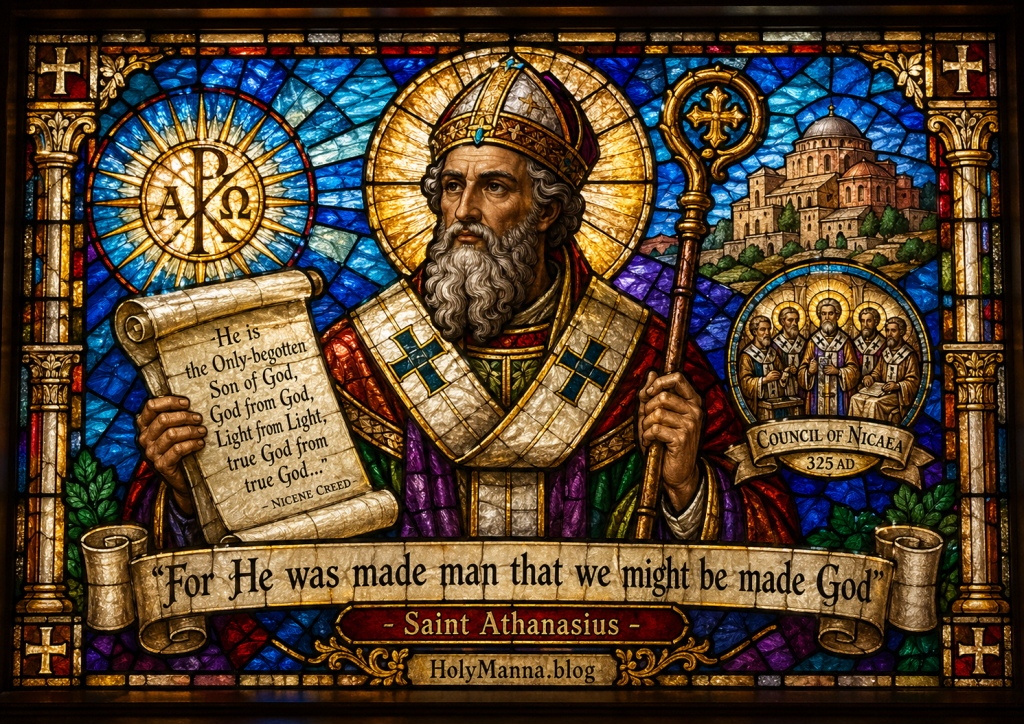
Saint Athanasius of Alexandria was one of the greatest defenders of the Catholic faith the Church has ever known. He was a bishop, confessor, Doctor of the Church, and one of the great Fathers of the Church. His name is forever tied to the Council of Nicaea and to the defense of one essential truth: Jesus Christ is truly God.
That may sound obvious to Catholics today, especially every Sunday when the faithful profess that Jesus is “God from God, Light from Light, true God from true God, begotten, not made, consubstantial with the Father.” But in the fourth century, that truth was under attack. A priest named Arius taught that the Son of God was created, meaning Jesus was not fully equal to the Father. Saint Athanasius understood immediately that this was not a small theological mistake. If Christ is not truly God, then He cannot truly save.
This is why Athanasius is often called the “Father of Orthodoxy.” He defended the truth of Christ when bishops, emperors, and political powers pressured the Church to compromise. The phrase “Athanasius contra mundum,” meaning “Athanasius against the world,” became attached to him because his life looked like one long stand for truth when truth seemed badly outnumbered.
The Catechism of the Catholic Church teaches that the Council of Nicaea confessed the Son as “begotten, not made, of the same substance as the Father” and condemned the claim that the Son was a creature. CCC 465 Saint Athanasius spent his life defending that faith, not as a cold argument, but as the very heart of Christian worship, salvation, and hope.
A Young Man Formed in Alexandria
Saint Athanasius was born in Alexandria, Egypt, around A.D. 296 to 300. Alexandria was one of the great intellectual cities of the ancient world. It was a place of libraries, philosophy, Scripture, Christian theology, and intense debate. Athanasius grew up in a world where ideas mattered, and where false teaching could spread quickly.
He received a strong education and was formed deeply by Sacred Scripture, Catholic doctrine, and the spiritual world of Egyptian monasticism. As a young man, he came under the guidance of Bishop Alexander of Alexandria. He eventually became Alexander’s deacon and secretary, which placed him close to one of the most important theological battles in Church history.
A famous story says that when Athanasius was still a boy, Bishop Alexander saw him playing near the seashore with other children. Athanasius was pretending to be a bishop and was “baptizing” the other boys. According to the tradition, Alexander questioned the children and found that the baptisms had been performed seriously enough to be considered valid. This is a beloved story from Christian tradition, but it cannot be fully verified as historical fact. Still, it beautifully captures how Catholics remembered Athanasius: marked from youth for the service of Christ and His Church.
Before becoming bishop, Athanasius had already written major works such as Against the Gentiles and On the Incarnation. These writings show that his heart was already fixed on the mystery that would define his whole life: the eternal Word of God truly became man for the salvation of the world.
Nicaea and the Battle for the Creed
In A.D. 325, Athanasius attended the Council of Nicaea as a young deacon and adviser to Bishop Alexander. He was not yet a bishop, but his clarity and courage made him one of the great voices associated with the council’s legacy.
The crisis was Arianism. Arius claimed that the Son of God was not eternal like the Father, but created by the Father. This meant that Jesus was more than man, but less than God. Athanasius saw the danger clearly. A created Christ cannot unite humanity to God. A lesser Christ cannot conquer sin and death. Only God can save, and if Jesus saves, then Jesus is truly God.
The Council of Nicaea responded by confessing that the Son is homoousios, meaning “of the same substance” or “consubstantial” with the Father. This word protected the Church’s faith that Jesus Christ is not a creature, but the eternal Son of the eternal Father.
This teaching remains at the center of Catholic faith. The Catechism teaches that Jesus Christ is true God and true man, one divine Person with both a divine nature and a human nature. CCC 464-469 Athanasius defended that truth because he knew the Christian life depended on it. The Mass, the sacraments, prayer, the Cross, and the Resurrection all depend on the truth that the Word made flesh is truly God.
The Bishop Who Would Not Bend
In A.D. 328, Athanasius became Bishop of Alexandria. He was still a young man, but he had already been shaped by Nicaea and by the fight against Arianism. As bishop, he refused to compromise with Arius or with those who wanted to soften Catholic teaching for the sake of political peace.
That refusal came at a high cost.
Athanasius served as bishop for about forty-six years, but he spent roughly seventeen of those years in exile. He was exiled five times by emperors who were influenced by Arian or semi-Arian politics. He was accused, slandered, threatened, and forced to flee. Yet every time his enemies thought he was finished, he returned.
His first exile sent him to Trier in Gaul, in modern-day Germany. His second exile brought him to Rome, where Pope Julius I defended him. His third exile began in dramatic fashion when soldiers entered a church during worship to arrest him. The faithful helped him escape, and he spent years hidden among the monks of the Egyptian desert. His fourth exile came under Julian the Apostate, who tried to revive paganism and weaken Christianity. His fifth exile came under Emperor Valens, and tradition says Athanasius hid for a time in his father’s tomb.
Athanasius was not a martyr by blood, but he was a confessor. He suffered for Christ without being killed for the faith. His whole life became a testimony that fidelity to Christ is worth losing comfort, safety, reputation, and power.
Stories of Slander, Escape, and Providence
Some of the most famous stories about Saint Athanasius show just how far his enemies were willing to go.
One story says that his opponents once brought forward a woman who accused him of violating her. According to the tradition, one of Athanasius’s priests, Timothy, pretended to be Athanasius and asked the woman if he was the man who had harmed her. She said yes, and the accusation was exposed as false. This story comes from older Catholic hagiographical tradition and should be treated as a traditional story rather than a fully verified historical event.
Another story says that Athanasius’s enemies accused him of murdering a bishop named Arsenius and cutting off his hand for magical purposes. Then Arsenius appeared alive, exposing the charge as a lie. This also belongs to the dramatic hagiographical tradition surrounding Athanasius, and while the exact details cannot be verified with certainty, the story reflects a real pattern in his life: his enemies repeatedly used false accusations to try to remove him.
Another famous legend says that while Athanasius was fleeing by boat, imperial officers came searching for him. Athanasius supposedly turned his boat around and sailed toward them. When they asked whether Athanasius was nearby, he answered, “He is not far off.” The officers continued in the wrong direction, and he escaped. This story cannot be fully verified, but it remains one of the most memorable legends attached to his courage and quick wit.
These stories matter because they show how the Church remembered him. Athanasius was not remembered as a comfortable scholar writing from a safe office. He was remembered as a hunted bishop, a clever defender, and a man protected by Providence while he defended the truth about Christ.
The Saint of the Incarnation
Saint Athanasius’s most famous work is On the Incarnation. In that book, he explains why the Word of God became man, why Christ took on a real human body, why the Cross was fitting, and why the Resurrection reveals Christ’s victory over death.
His most famous verified quotation comes from that work: “For He was made man that we might be made God.”
That line can sound shocking at first, but it is deeply Catholic when understood correctly. Athanasius was not saying that human beings become God by nature. He was teaching that through Christ, human beings are invited to share in God’s divine life by grace. The Catechism teaches the same truth when it says that the Word became flesh to make humanity “partakers of the divine nature.” CCC 460
This is one of the most beautiful parts of Athanasius’s teaching. Salvation is not merely being forgiven from a distance. Salvation is communion with God. The Son of God became man so that sons and daughters of Adam could become children of God by grace.
Athanasius also wrote against the Arians, defended the divinity of the Holy Spirit in letters to Serapion, wrote pastoral letters, and sent Festal Letters to announce the date of Easter. One of those letters, his Thirty-Ninth Festal Letter in A.D. 367, is famous because it lists the twenty-seven books of the New Testament as Catholics know them today. Athanasius did not “create” the Bible, because the canon was discerned by the Church through apostolic Tradition, but his letter is one of the most important early witnesses to the New Testament canon.
The Friend of Monks and the Voice of the Desert
Saint Athanasius was also closely connected to Saint Anthony of the Desert, one of the great fathers of Christian monasticism. Athanasius wrote The Life of Anthony, a spiritual biography that became one of the most influential Christian books of the ancient world.
Through this work, Athanasius helped introduce the wider Church to the holiness of the desert monks. These men left comfort behind to seek God through prayer, fasting, silence, spiritual battle, and radical trust. Athanasius did not see doctrine and holiness as separate things. He knew that true teaching should lead to true worship, and true worship should lead to a transformed life.
His connection to Saint Anthony also helped spread monastic spirituality in the West. During his exiles in places like Rome and Trier, Athanasius brought stories of Egyptian monastic life with him. Those stories helped inspire Christians far beyond Egypt to take holiness seriously.
This is one of the surprising parts of Athanasius’s legacy. He was not only a defender of doctrine. He was also a bridge between the theological battles of the bishops and the hidden holiness of the desert.
Miracles, Protection, and the Mystery of Grace
Saint Athanasius is not mainly remembered in Catholic tradition as a miracle-worker in the same way as some other saints. His most important legacy is his teaching, courage, perseverance, and defense of Christ’s divinity.
Still, older Catholic traditions say that his life and death were honored by miracles. The details of these miracles are not usually preserved in a long, verifiable catalog, so they should be presented with care. The most common miracle-like stories associated with him involve divine protection: his escapes from arrest, his survival through repeated exiles, his protection among monks, and his return again and again to Alexandria when his enemies expected him to disappear.
There is also a tradition that two hermits told Athanasius of the death of Emperor Julian at the very time it happened, allowing him to return from exile. This story cannot be verified with certainty, but it reflects the Catholic memory of Athanasius as a man guided and protected by God during a dangerous time.
It is also important not to confuse Saint Athanasius of Alexandria with other saints named Athanasius. Some miracle stories attached to “Saint Athanasius” belong to other saints, not to the Doctor of the Church who defended Nicaea.
A Death That Looked Like Victory
After decades of exile, slander, danger, and controversy, Saint Athanasius died peacefully in Alexandria on May 2, 373. That detail is striking. This bishop had been hunted, accused, and driven out again and again. Yet after all of that, he died in his own city, still bishop, still Catholic, still faithful.
He did not live to see the full triumph of Nicene orthodoxy. That came more clearly after his death, especially at the First Council of Constantinople in 381. But his life helped prepare that victory. The Church eventually confirmed the faith Athanasius defended at such great personal cost.
He is honored in the Roman Catholic Church on May 2 as Saint Athanasius, Bishop and Doctor of the Church. He is also one of the great Eastern Doctors recognized in the Catholic tradition. His memory remains especially powerful because every time Catholics profess the Nicene Creed, they are praying the truth he defended with his life.
There is also a creed called the Athanasian Creed, but Catholic writers should be careful here. It bears his name because it expresses the Trinitarian and Christological faith he defended, but modern scholarship generally does not believe Athanasius personally wrote it.
The Legacy of a Saint Who Refused to Make Jesus Smaller
Saint Athanasius’s legacy is enormous. He defended the truth that Christ is fully God. He helped preserve the Church’s faith in the Incarnation. He wrote one of the great Christian works on salvation, On the Incarnation. He helped spread the witness of monastic holiness through The Life of Anthony. He gave the Church an important early witness to the New Testament canon. He suffered exile after exile and still refused to compromise.
His life also offers a warning. Sometimes the greatest danger to faith does not come from people who openly reject Jesus. Sometimes it comes from those who try to make Jesus smaller, more manageable, more acceptable, or less divine. Athanasius knew that a smaller Christ cannot save. A Christ who is merely inspiring cannot redeem the world. A Christ who is less than God cannot bring humanity into communion with God.
The Catholic faith does not worship an idea, a symbol, or a spiritual teacher. The Church worships Jesus Christ, the eternal Son of God, who became man for our salvation.
That is why Athanasius still matters.
Standing Firm Without Losing Charity
Saint Athanasius teaches that truth and love belong together. He was firm because Christ is worth defending. He endured hardship because the faithful needed clear teaching. He suffered exile because compromise would have wounded the Church’s worship and endangered souls.
His example is especially needed in a world that often treats doctrine as unkind, clarity as arrogance, and conviction as intolerance. Athanasius reminds Catholics that truth is not the enemy of love. Truth protects love. Doctrine protects worship. The Creed protects the faithful from worshiping a false image of Christ.
For everyday Catholics, his life offers a simple but serious challenge. Hold fast to Christ when faith becomes unpopular. Learn what the Church teaches. Pray the Creed slowly. Do not make Jesus smaller in order to fit into the world. Let Christ be Lord in the home, in work, in friendships, in suffering, and in private choices.
Where is Christ being made smaller in your own life?
Is Jesus treated as Lord, or merely as a comforting idea?
What truth of the faith needs to be defended with more courage, patience, and love?
Saint Athanasius shows that one faithful Catholic, rooted in Christ, can stand firm even when the world seems to move in the opposite direction.
Engage With Us!
Share your thoughts and reflections in the comments below. Saint Athanasius lived in a time of confusion, pressure, and compromise, yet he remained faithful to Christ and His Church.
- What part of Saint Athanasius’s life challenges you the most?
- How does his defense of Christ’s divinity help you appreciate the Nicene Creed more deeply?
- Where do you feel pressure today to make the Catholic faith more “acceptable” by watering it down?
- How can you defend truth with courage while still speaking with charity?
- What practical step can you take this week to grow in knowledge and love of Jesus Christ?
May Saint Athanasius inspire every Catholic heart to stand firm in the truth, love Christ without compromise, and live the faith with courage, mercy, and joy. May everything be done with the love and mercy Jesus taught, because the Word truly became flesh, and in Him, the faithful are invited into the very life of God.
Saint Athanasius, pray for us!
Follow us on YouTube, Instagram and Facebook for more insights and reflections on living a faith-filled life.

 Holy Manna!
Leave a comment