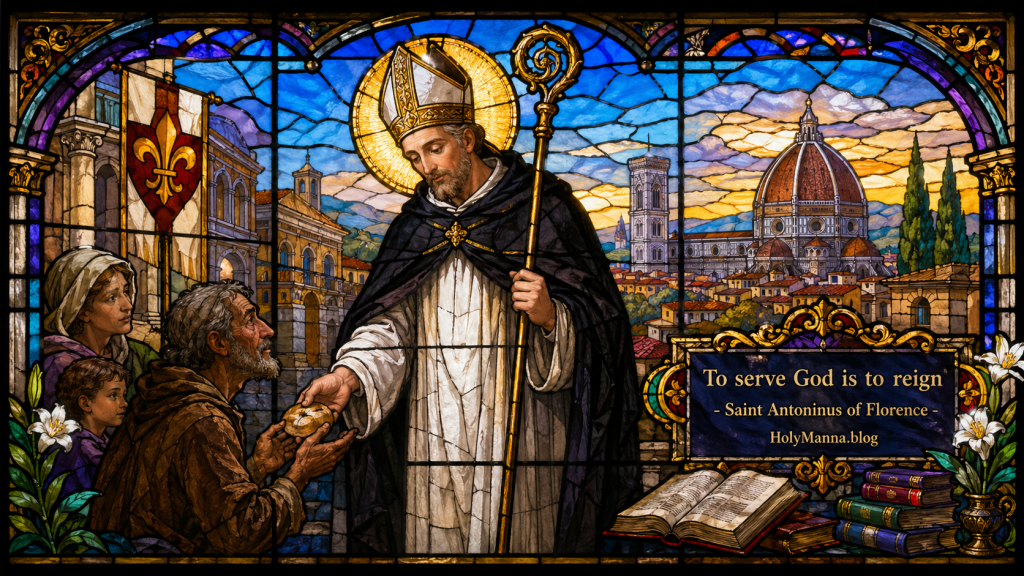
The Bishop Who Ruled by Serving
Saint Antoninus of Florence was the kind of saint the Church needs in every age, especially when money, politics, ambition, and public reputation start pulling hearts away from God. He was a Dominican friar, a brilliant moral theologian, a reformer, and the Archbishop of Florence during the Italian Renaissance. Yet for all his learning and authority, he is remembered most tenderly as a father to the poor and a counselor to troubled souls.
He lived in one of the most influential cities in Europe, surrounded by power, wealth, banking, politics, and artistic genius. Florence was a city of beauty, but also a city of temptation. Into that world, God placed a small, humble Dominican who would become known as the “Angel of Counsel.” Saint Antoninus taught that holiness does not mean running away from complicated life. It means bringing Christ into business, family, politics, suffering, charity, conscience, and the hidden places of the heart.
His life can be summed up in the saying traditionally remembered as his final words: “To serve God is to reign.” That one sentence captures the soul of Saint Antoninus. He did not seek worldly power. He served God, and in that service, he became truly free.
A Small Boy With a Giant Soul
Saint Antoninus was born in Florence on March 1, 1389. His baptismal name was Anthony, but he became known as Antoninus, meaning “Little Anthony,” likely because he was small in stature or physically frail. His father, Niccolò Pierozzi, was a notary in the Florentine Republic, and Antoninus grew up in a respectable family during a time when Florence was becoming one of the great centers of Renaissance culture.
From childhood, Catholic tradition remembers him as unusually serious, prayerful, and drawn to the things of God. While other children were absorbed in games, Antoninus was attracted to churches, holy books, the lives of the saints, prayer before the crucifix, and devotion to Our Lady. His faith was not loud or showy. It was steady, disciplined, and deep.
As a teenager, he asked Blessed John Dominic, a Dominican reformer, to receive him into the Order of Preachers. Blessed John Dominic hesitated. Antoninus was young and physically weak, and Dominican life demanded study, prayer, preaching, discipline, and sacrifice. So, according to the famous story, Blessed John gave him what seemed like an impossible task. He told Antoninus to memorize Gratian’s Decretum, one of the great medieval collections of canon law.
Most young men would have taken that as a polite rejection. Antoninus took it as obedience. Within about a year, he returned and was able to answer questions on the text. This story is not usually presented as a miracle, but it shows something remarkable about his soul. He was not merely intelligent. He was obedient, patient, humble, and willing to do hard things for God.
Around the age of sixteen, he entered the Dominican Order. He was formed in a circle of holy men, including Blessed John Dominic, Blessed Lawrence of Ripafratta, and Fra Angelico, the future Blessed Angelico, whose sacred art would become one of the treasures of Catholic history. This matters because Saint Antoninus was not formed in isolation. He grew in a Dominican world where truth, beauty, prayer, study, reform, and holiness were meant to belong together.
The Friar Who Helped Renew Florence
Before becoming Archbishop of Florence, Antoninus spent many years as a Dominican reformer. He served in leadership roles in several Dominican houses, including Cortona, Rome, Naples, Gaeta, Siena, Fiesole, and Florence. He was part of a movement that sought to renew Dominican life through stricter observance, deeper prayer, serious study, and faithful community discipline.
In 1436, he helped establish the famous Dominican convent of San Marco in Florence. This became one of the great religious and artistic centers of the Renaissance. With the support of Cosimo de’ Medici, the convent and church were rebuilt, and Fra Angelico painted sacred frescoes throughout the monastery. In that holy place, art was not treated as decoration. It was a path to contemplation.
Saint Antoninus also helped make San Marco a place of learning. The convent became associated with one of the great public libraries of Europe, showing that Catholic reform was never meant to despise learning. True reform purifies intelligence and beauty so they can serve God.
Antoninus also participated as a theologian at the Council of Florence in 1439, a major Church council connected to efforts toward reunion between the Latin and Greek Churches. Even if his exact role in the debates is not fully clear, his presence shows the respect he had earned as a theologian and man of the Church.
What made him so trustworthy was not only his knowledge. It was his character. People knew that Antoninus was not seeking himself. He sought the truth, the salvation of souls, and the glory of God.
The Reluctant Archbishop With a Dominican Habit
In 1446, Pope Eugene IV appointed Antoninus Archbishop of Florence. Antoninus did not want the honor. Catholic tradition consistently remembers him as reluctant to accept ecclesiastical dignity. He preferred the life of a simple Dominican friar. But the pope saw what Florence needed, and Antoninus obeyed.
There is a pious tradition that Pope Eugene IV first considered Fra Angelico for the archbishopric, and that Fra Angelico recommended Antoninus instead. This story cannot be verified with certainty, but it beautifully reflects the esteem holy men had for Antoninus. Whether every detail is historically certain or not, the tradition captures a real truth: Antoninus was the kind of man other saints trusted.
Once he became archbishop, he refused to live like a prince. He kept wearing his Dominican habit. He lived simply. He avoided luxury. He kept a modest household. He did not use his office to build a comfortable life. In a Renaissance city filled with wealth and status, this was a quiet but powerful sermon.
His episcopal life reflected the teaching of The Catechism of the Catholic Church, which reminds the faithful that the goods of creation are meant for all and that ownership carries responsibility before God. The Church teaches in CCC 2404 that “In his use of things man should regard the external goods he legitimately owns not merely as exclusive to himself but common to others also.” Saint Antoninus lived that teaching long before modern Catholic social doctrine took its later formal shape.
The Angel of Counsel
Saint Antoninus became famous as the “Angel of Counsel.” Princes, bishops, clergy, religious, merchants, families, and ordinary Catholics came to him with difficult questions. His wisdom was especially trusted in matters of conscience.
That is one of the most important parts of his legacy. Antoninus understood that Catholic morality is not vague inspiration. It is truth applied to real life. He wrote about sin, justice, contracts, business, profit, wealth, restitution, confession, conscience, and the obligations of Christian life. His great work, the Summa Moralis, became an important guide for confessors and pastors.
He is especially fascinating because he wrote seriously about economic life. He did not condemn business simply because it involved profit. Instead, he taught that profit must be moderate, just, and ordered toward worthy ends, such as supporting one’s family, serving the poor, and contributing to the common good. One teaching attributed to him says: “The object of gain is that by its means man may provide for himself and others.”
That is a deeply Catholic way to think about money. Wealth is not evil in itself, but it is dangerous when it becomes an idol. Business is not automatically sinful, but it must be governed by justice. Profit is not the highest good. Eternal life is.
This fits beautifully with CCC 2426, which teaches that economic activity is meant to serve the human person and the whole human community. Money must serve man. Man must not serve money.
The Bishop Who Found the Hidden Poor
Saint Antoninus loved the poor with a very practical charity. He did not only wait for beggars to come to the door. He organized help. He founded or supported the Good Men of Saint Martin, also known as the Buonomini di San Martino, a lay group that quietly assisted the “shamefaced poor.”
These were people who had fallen into poverty but were too ashamed to beg. Some had once been stable families. Some had social standing. Some may have looked fine from the outside but were suffering in silence. Saint Antoninus understood that poverty can wound more than the stomach. It can wound dignity.
This is one of the most beautiful parts of his life. He saw the poor whom everyone else missed.
His charity reflects CCC 2447, which teaches that the works of mercy are charitable actions by which Christians come to the aid of their neighbor in spiritual and bodily necessities. Feeding the hungry, clothing the naked, visiting the sick, comforting the sorrowful, counseling the doubtful, and helping the weak were not theories for Antoninus. They were his daily life.
Florence suffered terribly during his years as archbishop. There were outbreaks of plague, earthquakes, storms, and famine. Antoninus responded not as a distant administrator, but as a father. Catholic tradition remembers him moving through the city with food, medicine, supplies, comfort, and the sacraments. He encouraged priests and religious to serve the sick, even at great personal risk. Many friars died while caring for plague victims.
He also sold or gave away what he could. One well-loved story says that he had a mule, and sometimes he sold it to help the poor. Wealthy Florentines would then buy it back and return it to him, only for him to continue giving whatever he could. Whether every detail has been polished by later storytelling or not, the point is clear: Antoninus treated Church resources as belonging to God and the poor.
Miracles, Mercy, and Holy Stories From His Life
Saint Antoninus is not remembered primarily as a wonder-worker in the dramatic sense. His greatest miracle was the steady holiness of a bishop who lived the Gospel in public. Still, Catholic tradition preserves several miracle stories and pious accounts connected with him.
One story says that a young girl once broke a vase and could not be consoled. Antoninus prayed, and the broken pieces came back together. This story is part of the hagiographical tradition surrounding him, but it cannot be verified with certainty.
Another story says that he used bread to teach the seriousness of excommunication. According to the tradition, he pronounced words of excommunication over the bread, and it became black and shriveled. Then he blessed it, and it became white again. This story cannot be verified with certainty, but it reflects how seriously Catholic tradition remembered his teaching on Church discipline and the state of the soul.
Another pious account says that a lemon tree he cared for bore unusually green leaves out of season while nearby trees were barren. This story cannot be verified with certainty, but it fits the spiritual symbolism often attached to Antoninus, who compared the soul to a garden that must be cultivated by grace.
A more dramatic story concerns a man named Ciardi, who reportedly tried to assassinate him. The dagger struck the back of Antoninus’ chair, but Antoninus escaped harm. Instead of seeking revenge, he forgave the man and prayed for his conversion. The man later repented and entered a Franciscan way of life. This story is traditionally associated with Antoninus and shows the mercy that marked his soul.
There is also a saying attributed to him when someone called him a saint. He reportedly answered: “Saints live in heaven; we sinners live on earth.” It is a simple line, but it reveals his humility. Holy people rarely think of themselves as holy. They are too busy looking at God.
Trials Without Martyrdom
Saint Antoninus was not a martyr in the sense of shedding his blood for the faith, but his life was not easy. His suffering came through responsibility, reform, disaster, public pressure, and the burdens of shepherding souls.
He had to correct clergy who had grown lax or worldly. He had to preach against public sins like gambling, usury, and scandal. He had to guide a wealthy city without being captured by its wealth. He had to care for plague victims while disease threatened the city. He had to respond to famine and disaster while people were afraid, hungry, and grieving.
Reform always brings resistance. A bishop who corrects abuse is rarely loved by everyone. Yet Antoninus balanced firmness with mercy. He was not harsh because he enjoyed conflict. He corrected because souls mattered.
This is important for Catholics today. Charity is not weakness. Mercy is not pretending sin does not matter. Real pastoral love tells the truth and stays close enough to help people carry it.
Saint Antoninus lived the truth of Hebrews 12:11, which says, “At the time, all discipline seems a cause not for joy but for pain, yet later it brings the peaceful fruit of righteousness to those who are trained by it.” His discipline was not cold. It was ordered toward peace, repentance, and salvation.
The Saint Who Continued to Serve After Death
Saint Antoninus died in Florence on May 2, 1459. He was about seventy years old and had served as Archbishop of Florence for thirteen years. Pope Pius II was in Florence at the time and took part in honoring him after death. Antoninus had desired to be buried at San Marco among his Dominican brothers, and that wish was respected.
He was canonized by Pope Adrian VI on May 31, 1523. His feast is associated with May 2 in the Roman Martyrology, the day of his death, while Dominican calendars commonly celebrate him on May 10.
Catholic tradition says that miracles were associated with his relics after death, including through his hair-shirt and other objects connected to him. These miracle accounts belong to the devotional tradition surrounding the saint, and individual stories cannot always be verified in detail. Still, the Church’s canonization of Antoninus confirms that his life was recognized as one of heroic virtue.
In 1559, about a century after his death, his body was found entire and was solemnly translated to a chapel in the church of San Marco in Florence. His tomb and relics became part of Florence’s sacred memory.
His cultural impact continued through San Marco, the memory of his charity, the Good Men of Saint Martin, his moral writings, and his connection to Fra Angelico and the Dominican renewal of Florence. In sacred art, he is often shown as a Dominican bishop, sometimes with a lily, scales, a mitre, or in the act of blessing or giving alms. These images tell the story well. He was pure in heart, just in judgment, humble in authority, and generous to the poor.
Florence remembered him not only as a churchman, but as one of the city’s great sons. His life became part of the Catholic soul of the city.
A Saint for Anyone Trying to Live Faithfully in a Complicated World
Saint Antoninus is a surprisingly modern saint. He lived in a world of wealth, politics, status, art, finance, public pressure, and moral confusion. That sounds familiar.
He teaches that Christians do not need to choose between holiness and practical life. A person can be serious about prayer and still understand business. A person can love beauty and still embrace poverty of spirit. A person can hold authority and still live humbly. A person can correct sin and still be merciful. A person can serve the poor without humiliating them.
For anyone who works with money, manages people, raises a family, leads in the Church, teaches the faith, or tries to make moral decisions in a complicated world, Saint Antoninus is a powerful intercessor.
His life also challenges the comfortable Catholic conscience. It is easy to admire the poor in theory. Antoninus sought them out in reality. It is easy to speak about justice. Antoninus wrote about it, preached it, and practiced it. It is easy to say that God matters more than money. Antoninus lived like it was true.
Where does money quietly compete with God in the heart? Where is there a hidden poor person nearby who needs help but is too ashamed to ask? Where is God calling for more courage, more discipline, and more mercy?
Saint Antoninus does not let the faithful separate doctrine from daily life. He shows that Catholic truth must enter the marketplace, the home, the parish, the workplace, the city, and the conscience.
His final saying remains the key to his whole life: “To serve God is to reign.” The world says reigning means control, comfort, influence, and recognition. Saint Antoninus says reigning means belonging completely to God.
Engage With Us!
Share your thoughts and reflections in the comments below. Saint Antoninus lived in a wealthy and complicated city, yet he chose humility, truth, and mercy. His life gives Catholics today a beautiful model for living faithfully in a world that often confuses success with holiness.
- What part of Saint Antoninus’ life challenges you the most: his poverty, his courage, his wisdom, or his care for the hidden poor?
- How can you use your work, money, talents, or influence more intentionally for God and the good of others?
- Is there someone in your life who may be suffering quietly and needs help without embarrassment or judgment?
- What would change this week if you truly believed that “to serve God is to reign”?
May Saint Antoninus pray for all who are trying to live faithfully in a complicated world. May his example help Catholics seek wisdom, serve the poor, reform what is broken, and do everything with the love and mercy Jesus taught us.
Saint Antoninus of Florence, pray for us!
Follow us on YouTube, Instagram and Facebook for more insights and reflections on living a faith-filled life.

 Holy Manna!
Leave a comment