Memorial of Saint Athanasius, Bishop and Doctor of the Church – Lectionary: 284
The Face of the Father and the Light Sent to the Nations
Every human heart eventually asks the same question Philip asks Jesus: “Master, show us the Father, and that will be enough for us” John 14:8.
Today’s readings gather around one radiant truth: God has revealed His face in Jesus Christ, and those who receive Him are sent to carry His light to the ends of the earth. In the Gospel, Jesus tells Philip, “Whoever has seen me has seen the Father” John 14:9. This is not just a comforting line. It is the heart of the Christian faith. Jesus does not merely teach about God. He reveals God. He is the eternal Son, one with the Father, speaking the Father’s words and doing the Father’s works.
That truth becomes especially powerful on the Memorial of Saint Athanasius, the great bishop and Doctor of the Church who defended the full divinity of Christ against the Arian heresy. Athanasius understood that if Jesus is not truly God, then He cannot truly reveal the Father or bring humanity into communion with Him. The Church still confesses this mystery with clarity: the Son is consubstantial with the Father, true God from true God, and through Him we are invited into the life of the Blessed Trinity, as taught in The Catechism of the Catholic Church CCC 253, CCC 262, CCC 265.
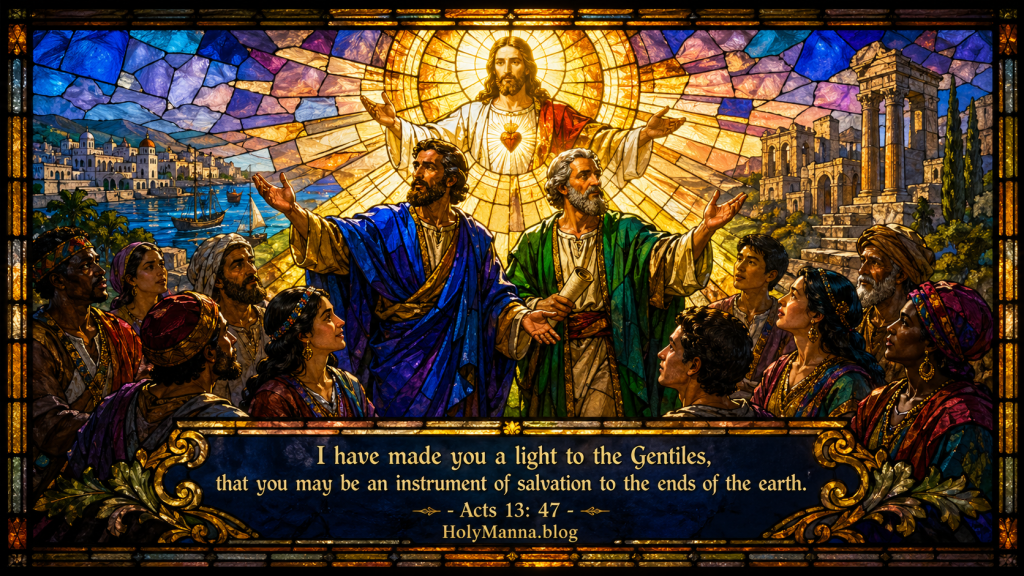
In the First Reading, Paul and Barnabas proclaim this saving word in Antioch, and almost the whole city gathers to listen. Some reject the message, but the rejection does not stop the mission. Instead, the Gospel bursts outward toward the Gentiles, fulfilling the ancient promise: “I have made you a light to the Gentiles, that you may be an instrument of salvation to the ends of the earth” Acts 13:47. The Responsorial Psalm answers with the joy of a world finally seeing God’s victory: “All the ends of the earth have seen the victory of our God” Psalm 98:3.
The readings remind us that Catholic faith is never meant to remain private, timid, or hidden. The Father reveals Himself in the Son. The Son sends His disciples in the power of the Holy Spirit. The Church carries that light into every nation, every home, every workplace, and every wounded corner of the human heart. If Christ has shown us the face of the Father, how can that light remain only for us?
First Reading – Acts 13:44-52
The Word Rejected by Some Becomes Light for the Nations
The First Reading takes us into the missionary journey of Saint Paul and Saint Barnabas in Antioch of Pisidia, a city in the Roman province of Galatia. They have entered the synagogue, as Paul often did first, because the Gospel was proclaimed first to Israel, the people prepared by God through the covenants, the prophets, the Law, and the promises.
This moment is deeply important. Paul is not abandoning Israel. He is showing that the mission promised through Israel is now expanding to the Gentiles. The same God who called Abraham so that all nations would be blessed now sends the Gospel beyond one people and into the whole world. The rejection Paul and Barnabas face becomes the doorway for a wider mission.
This fits beautifully with today’s central theme. In the Gospel, Jesus reveals the Father. In the First Reading, the Church reveals Christ to the nations. The light of God cannot be contained. When some refuse it, the light does not disappear. It travels farther.
Acts 13:44-52 – New American Bible (Revised Edition)
Address to the Gentiles. 44 On the following sabbath almost the whole city gathered to hear the word of the Lord. 45 When the Jews saw the crowds, they were filled with jealousy and with violent abuse contradicted what Paul said. 46 Both Paul and Barnabas spoke out boldly and said, “It was necessary that the word of God be spoken to you first, but since you reject it and condemn yourselves as unworthy of eternal life, we now turn to the Gentiles. 47 For so the Lord has commanded us, ‘I have made you a light to the Gentiles, that you may be an instrument of salvation to the ends of the earth.’”
48 The Gentiles were delighted when they heard this and glorified the word of the Lord. All who were destined for eternal life came to believe, 49 and the word of the Lord continued to spread through the whole region. 50 The Jews, however, incited the women of prominence who were worshipers and the leading men of the city, stirred up a persecution against Paul and Barnabas, and expelled them from their territory. 51 So they shook the dust from their feet in protest against them and went to Iconium. 52 The disciples were filled with joy and the holy Spirit.
Detailed Exegesis
Verse 44 – “On the following sabbath almost the whole city gathered to hear the word of the Lord.”
The scene begins with a powerful response. Almost the whole city gathers, not merely to hear Paul and Barnabas as interesting speakers, but to hear “the word of the Lord” Acts 13:44. This phrase reminds us that apostolic preaching is not human opinion. The apostles are witnesses. Christ is speaking through His Church. The Gospel has begun to attract not only Jews and God-fearing Gentiles connected to the synagogue, but the wider city. The word of God is moving from the synagogue into the public life of the nations.
Verse 45 – “When the Jews saw the crowds, they were filled with jealousy and with violent abuse contradicted what Paul said.”
This verse must be read with care and charity. Saint Luke is describing particular opponents in a particular place, not condemning the Jewish people as a whole. The Church teaches that the Jewish people remain deeply connected to God’s saving plan. The tragedy here is jealousy. The crowds should have been a reason for joy, because the God of Israel was drawing the nations to Himself. Instead, some see the Gentiles coming in and react with resentment. Jealousy turns into contradiction, and contradiction turns into abuse. This is what sin often does. It begins as interior resistance, then becomes speech that wounds, divides, and rejects grace.
Verse 46 – “Both Paul and Barnabas spoke out boldly and said, “It was necessary that the word of God be spoken to you first, but since you reject it and condemn yourselves as unworthy of eternal life, we now turn to the Gentiles.“
Paul and Barnabas do not answer rejection with fear. They answer with clarity. Their boldness is not arrogance. It is apostolic courage. They recognize that the word of God had to be preached first to Israel because Israel was the people of the covenant, the people prepared by God through Abraham, Moses, David, and the prophets. Salvation comes from the Jews, as Jesus Himself says in John 4:22, but salvation is not meant to stop there.
When Paul says, “since you reject it and condemn yourselves as unworthy of eternal life” Acts 13:46, he is not saying God wanted them excluded. He is saying they are freely rejecting the gift being offered. This is a sobering reminder that grace can be resisted. God offers eternal life, but He does not force the human heart to receive it. The Gospel is a gift, but love must be freely welcomed.
Then Paul says, “we now turn to the Gentiles” Acts 13:46. This is one of the great missionary turning points in Acts of the Apostles. The Church is beginning to be visibly catholic, meaning universal. The promise given to Israel is now being proclaimed to all nations.
Verse 47 – “For so the Lord has commanded us, ‘I have made you a light to the Gentiles, that you may be an instrument of salvation to the ends of the earth.’”
Paul and Barnabas quote the prophet Isaiah, showing that the mission to the Gentiles is not a backup plan. It was hidden in God’s plan from the beginning. Israel was chosen so that the nations could be blessed. The Messiah comes from Israel, and through Him the light of salvation reaches the whole world.
This verse connects directly to today’s Psalm: “All the ends of the earth have seen the victory of our God” Psalm 98:3. The Gospel is not tribal. It is not limited to one culture, language, or social class. Christ is the light for every nation. The Church’s mission is to carry Him everywhere, not as a political project, but as the saving presence of God’s mercy.
Verse 48 – “The Gentiles were delighted when they heard this and glorified the word of the Lord. All who were destined for eternal life came to believe.”
The Gentiles respond with joy because they realize they are not outsiders to God’s mercy. They are being welcomed into the saving plan of God. They glorify the word of the Lord because the Gospel has revealed something they may never have imagined: the God of Israel has come for them too.
The phrase “all who were destined for eternal life came to believe” Acts 13:48 points to the mystery of God’s grace and human response. Catholic teaching holds both truths together. God acts first. Grace precedes faith. Yet human beings truly respond in freedom. Faith is not merely a human achievement. It is a grace received, welcomed, and lived.
Verse 49 – “And the word of the Lord continued to spread through the whole region.”
The opposition does not stop the Gospel. In fact, rejection often becomes the strange soil where mission grows. Paul and Barnabas are resisted, but the word continues to spread. This is a recurring pattern in Acts of the Apostles. Persecution scatters believers, and scattered believers carry the Gospel farther.
The Church has seen this again and again throughout history. The blood of martyrs becomes seed. The courage of confessors strengthens the faithful. The witness of saints opens hearts that arguments alone could never reach. God’s word is not chained by human hostility.
Verse 50 – “The Jews, however, incited the women of prominence who were worshipers and the leading men of the city, stirred up a persecution against Paul and Barnabas, and expelled them from their territory.”
Again, this verse must be read without contempt or prejudice. Saint Luke is describing a local conflict involving particular opponents, not giving Christians permission to despise the Jewish people. The Church rejects antisemitism and teaches that the Jewish people remain beloved because of God’s covenantal faithfulness.
This verse also shows how opposition to the Gospel can become organized through social influence. Prominent women and leading men are stirred up against Paul and Barnabas. Religion, politics, reputation, and public pressure begin to work together. The apostles are not simply disagreed with. They are expelled.
Yet the Gospel does not depend on social approval. Paul and Barnabas lose access to that territory, but they do not lose their mission.
Verse 51 – “So they shook the dust from their feet in protest against them and went to Iconium.”
This gesture echoes the instruction Jesus gave His disciples when a town refused to receive them. Shaking the dust from their feet is not a petty insult. It is a solemn sign that the apostles have fulfilled their responsibility. They preached the word. They offered the gift. They bore witness. Now those who rejected the message must answer for their response.
There is a spiritual maturity here. Paul and Barnabas do not stay trapped in bitterness. They do not obsess over rejection. They do not water down the message to win approval. They leave, and they continue the mission. Sometimes Christian faithfulness means speaking clearly, accepting rejection peacefully, and moving forward without resentment.
Verse 52 – “The disciples were filled with joy and the holy Spirit.”
This final verse is quietly stunning. The disciples have witnessed conflict, persecution, and expulsion. Yet they are not filled with fear. They are not filled with rage. They are filled with joy and the Holy Spirit.
This is not ordinary happiness. Ordinary happiness depends on circumstances. Christian joy depends on communion with Christ. The disciples can rejoice because the Gospel is spreading, the Gentiles are receiving the word, and the Spirit is confirming the mission of the Church.
This verse also reminds readers that the Holy Spirit does not always remove suffering. Sometimes He fills the disciple with joy in the middle of suffering. That joy becomes a sign that Christ is alive and the mission is real.
Teachings
The Gospel Is First a Gift, Then a Mission
This reading shows the Church becoming visibly catholic, universal, and missionary. Paul and Barnabas begin in the synagogue because God’s covenant with Israel is real and holy. But the promise made to Israel was always meant to overflow into the nations. The Gospel moves from Jerusalem, to Judea, to Samaria, and then to the ends of the earth.
The Catechism of the Catholic Church teaches this beautifully when it speaks about Abraham’s call: “In order to gather together scattered humanity God calls Abram from his country, his kindred and his father’s house, and makes him Abraham, that is, ‘the father of a multitude of nations.’ ‘In you all the nations of the earth shall be blessed.’” CCC 59
That is exactly what is unfolding in Acts 13. The blessing promised through Abraham is now reaching the Gentiles through Christ and His apostles.
The Church also teaches that the Jewish people remain deeply connected to God’s saving plan. The Catechism says: “When she delves into her own mystery, the Church, the People of God in the New Covenant, discovers her link with the Jewish People, ‘the first to hear the Word of God.’ The Jewish faith, unlike other non-Christian religions, is already a response to God’s revelation in the Old Covenant.” CCC 839
This matters because Catholics must read this passage with reverence, not contempt. The rejection in Antioch was real, but it does not erase Israel’s dignity, calling, or place in salvation history.
The missionary heart of this reading is also captured in The Catechism: “The Church, sent by God to the nations to be ‘the universal sacrament of salvation,’ strives to preach the Gospel to all men.” CCC 849
Paul and Barnabas are living that teaching before it was ever written in a catechism. They preach boldly. They endure rejection. They carry Christ outward. They understand that the word of God is not private property. It is light for the nations.
Saint John Paul II taught this same missionary urgency when he wrote in Redemptoris Missio: “The mission of Christ the Redeemer, which is entrusted to the Church, is still only beginning.” Redemptoris Missio 1
That line still hits hard. After two thousand years, the mission is not finished. Every generation has to receive the Gospel again. Every culture has to be evangelized again. Every Catholic heart has to decide whether faith will remain comfortable and private or become living witness.
This reading also speaks powerfully on the Memorial of Saint Athanasius. Athanasius defended the truth about Christ because he knew that salvation depends on who Jesus truly is. If Christ is not truly God, then He cannot truly save. If Christ is not the eternal Son, then He cannot fully reveal the Father. The missionary preaching of Paul and Barnabas only makes sense because Jesus is not merely one religious figure among many. He is the light of the nations.
The Catechism teaches: “The Word became flesh to make us ‘partakers of the divine nature’: ‘For this is why the Word became man, and the Son of God became the Son of man: so that man, by entering into communion with the Word and thus receiving divine sonship, might become a son of God.’” CCC 460
That is the heart of the Gospel Paul and Barnabas proclaim. God became man so that sinners, Jews and Gentiles alike, could become sons and daughters in the Son.
Reflection
Receiving the Word Without Jealousy, Fear, or Delay
This First Reading asks a very direct question: What happens when God’s grace blesses someone unexpected?
The opponents of Paul and Barnabas see crowds gathering to hear the word of the Lord, but instead of rejoicing, they become jealous. That temptation is still very real. It can happen in parish life, family life, ministry, work, friendships, and even online. Someone else receives attention. Someone else grows quickly in faith. Someone else is welcomed with mercy after years away from God. Someone else’s gifts bear fruit. Suddenly, instead of glorifying God, the heart starts comparing.
This reading invites Catholics to trade jealousy for joy. When grace reaches another person, heaven rejoices. The Church should rejoice too.
It also teaches how to handle rejection. Paul and Barnabas are contradicted, abused, and expelled, but they do not become bitter. They remain bold. They move forward. They keep preaching. Their confidence is not in popularity, comfort, or control. Their confidence is in Christ.
That is a needed lesson for modern Catholic life. Faithfulness will not always be applauded. Speaking the truth with charity may cost relationships, status, opportunities, or approval. But rejection does not mean failure. Sometimes rejection simply means the seed has been planted, and the disciple must entrust the rest to God.
A practical way to live this reading is to ask for the grace to rejoice when God works through others. Another way is to speak one clear word of faith this week, not aggressively, not awkwardly, but sincerely. Invite someone to Mass. Share a Scripture passage. Encourage someone who feels far from God. Defend the dignity of the faith without becoming harsh. Let the light move outward.
The reading ends with the disciples “filled with joy and the holy Spirit” Acts 13:52. That is the real test. Not whether life is easy. Not whether everyone agrees. Not whether faith wins public approval. The test is whether the heart remains open enough for the Holy Spirit to fill it with joy.
Where is God asking you to rejoice instead of compare?
Who in your life needs to hear that the mercy of Christ is also for them?
When rejection comes, will you let it make you bitter, or will you let the Holy Spirit make you bold?
Responsorial Psalm – Psalm 98:1-4
The New Song of a World That Has Seen God’s Victory
The Responsorial Psalm gives the Church her response to the missionary fire of the First Reading. In Acts 13, Paul and Barnabas announce that Christ has become “a light to the Gentiles” Acts 13:47. Then Psalm 98 lifts up its voice and shows what that mission sounds like when it becomes worship: “All the ends of the earth have seen the victory of our God” Psalm 98:3.
This psalm belongs to the royal and victory songs of Israel. It celebrates the Lord as King, Savior, and Judge, the God who has acted publicly for His people and revealed His saving power before the nations. In its original setting, it sings of God’s faithfulness to Israel. In the light of Christ, the Church hears even more. The “new song” becomes the song of the Resurrection, the song of Easter, the song of a people who know that Jesus has conquered sin and death.
That is why this psalm fits today’s theme so beautifully. The Father reveals Himself in the Son. The Son sends His Church to the nations. The nations receive the word with joy. Then the whole earth is invited to sing.
Psalm 98:1-4 – New American Bible (Revised Edition)
The Coming of God
1 A psalm.
Sing a new song to the Lord,
for he has done marvelous deeds.
His right hand and holy arm
have won the victory.
2 The Lord has made his victory known;
has revealed his triumph in the sight of the nations,
3 He has remembered his mercy and faithfulness
toward the house of Israel.
All the ends of the earth have seen
the victory of our God.4 Shout with joy to the Lord, all the earth;
break into song; sing praise.
Detailed Exegesis
Verse 1 – “Sing a new song to the Lord, for he has done marvelous deeds. His right hand and holy arm have won the victory.”
The psalm begins with an invitation to sing, not because life is easy, but because God has acted. The phrase “new song” Psalm 98:1 often appears in Scripture when God’s people have witnessed a fresh act of divine salvation. Israel sang after deliverance. The Church sings after Easter. Every time God rescues, restores, forgives, and renews, His people discover that old words are not enough. A new mercy calls for a new song.
The psalm says the Lord’s “right hand and holy arm” have won the victory. This is biblical language for God’s saving power. Israel did not save itself. The nations do not save themselves. The Church does not save herself. God saves. In the Christian reading, this victory reaches its fullness in Jesus Christ, whose Cross looked like defeat but became the triumph of divine love.
This verse prepares the heart to understand why Paul and Barnabas can keep preaching even after rejection. The victory belongs to God. The apostles are servants of a conquest already won in Christ.
Verse 2 – “The Lord has made his victory known; has revealed his triumph in the sight of the nations.”
God’s salvation is not hidden. The Lord makes His victory known. He reveals His triumph before the nations. In the Old Testament, this meant that Israel’s deliverance showed the surrounding peoples that the Lord is the true God. In the New Testament, this becomes even clearer. Jesus Christ is crucified publicly, rises from the dead, and sends His apostles to proclaim salvation to every people.
This verse connects directly with Paul and Barnabas turning to the Gentiles in Acts 13. The Gospel is not private information for a spiritual elite. It is public good news. The nations are meant to see, hear, believe, and rejoice.
It also connects with the Gospel, where Jesus tells Philip, “Whoever has seen me has seen the Father” John 14:9. God’s victory is revealed most fully not in raw power, but in the face of Christ, the Son who makes the Father known.
Verse 3 – “He has remembered his mercy and faithfulness toward the house of Israel. All the ends of the earth have seen the victory of our God.”
This verse holds together two truths that Catholics must never separate. God is faithful to Israel, and God’s salvation reaches the nations. The Lord remembers His mercy and faithfulness toward the house of Israel. He does not discard His covenant people. He fulfills His promises through Christ, the Son of David and the Messiah of Israel.
Then the psalm widens: “All the ends of the earth have seen the victory of our God” Psalm 98:3. This is the same movement seen in Acts 13. The word is spoken first to Israel, then carried to the Gentiles. God’s covenant faithfulness becomes universal mercy.
This matters because Catholic evangelization is never about replacing Israel with contempt. It is about proclaiming that the promises of God have reached their fullness in Jesus Christ, and that the blessing promised to Abraham now extends to all nations.
Verse 4 – “Shout with joy to the Lord, all the earth; break into song; sing praise.”
The psalm ends with an invitation that leaves no one out. “All the earth” Psalm 98:4 is called to worship. Not just one city. Not just one people. Not just one language. The whole earth is summoned into praise.
This is what missionary success ultimately means. The goal of evangelization is not numbers, influence, or cultural dominance. The goal is worship. The nations are invited to know the living God, receive His mercy, and sing His praise.
That is why the disciples in Acts 13 can be “filled with joy and the holy Spirit” Acts 13:52, even after persecution. Their joy is not based on comfort. Their joy is rooted in the fact that God’s victory is spreading.
Teachings
The Church’s Song Is the Voice of Salvation Remembered
Psalm 98 teaches that worship is memory made musical. God’s people sing because God has acted. The psalm remembers His mercy to Israel, His victory before the nations, and His invitation to the whole earth. In the liturgy, this becomes the Church’s own voice. The Church does not merely read the psalms as ancient poetry. She prays them in Christ.
The Catechism of the Catholic Church teaches: “The Psalms both nourished and expressed the prayer of the People of God, gathered during the great feasts at Jerusalem and each Sabbath in the synagogues. Their prayer is inseparably personal and communal; it concerns both those who are praying and all men. The Psalms arose from the communities of the Holy Land and the Diaspora, but embrace all creation. Their prayer recalls the saving events of the past, yet extends into the future, even to the end of history; it commemorates the promises God has already kept, and awaits the Messiah who will fulfill them definitively. Prayed and fulfilled in Christ, the Psalms are an essential and permanent element of the prayer of the Church.” CCC 2586
That teaching fits today’s psalm perfectly. The psalm recalls what God has done, looks outward to all nations, and finds its deepest fulfillment in Christ. The “new song” is not only ancient Israel’s song of deliverance. It becomes the Church’s Easter song.
The Church also teaches that sacred song belongs deeply to Christian worship. The Catechism says: “The musical tradition of the universal Church is a treasure of inestimable value, greater even than that of any other art. The main reason for this pre-eminence is that, as sacred song united to the words, it forms a necessary or integral part of solemn liturgy.” CCC 1156
This is why the Responsorial Psalm is not a filler between readings. It is the prayerful response of the people of God. After hearing the Lord speak, the Church sings back. The heart receives the word, then gives praise.
Saint Augustine, who loved the psalms deeply, famously taught: “Singing belongs to one who loves.” This short teaching captures the soul of Psalm 98. The Church sings because she loves the God who has saved her. She sings because Christ has conquered. She sings because the Father’s mercy has been revealed. She sings because the Holy Spirit turns faith into joy.
On the Memorial of Saint Athanasius, this psalm also reminds the Church why doctrine leads to worship. Athanasius defended the truth that the Son is fully God because only the true Son can reveal the Father and save the world. If Christ is truly God, then the nations have truly seen the victory of God. If Christ is truly risen, then the Church has every reason to sing a new song.
Reflection
Learning to Sing When God’s Victory Is Still Unfolding
This psalm invites believers to become people of praise. Not shallow praise that ignores suffering. Not forced positivity that pretends everything is fine. Real praise remembers that God has acted, God is faithful, and God’s victory in Christ is stronger than whatever darkness is currently making noise.
That matters in daily life because many people live spiritually forgetful. They remember wounds more easily than graces. They replay insults more often than blessings. They notice what is missing before they notice what God has already done. Psalm 98 gently calls the heart back to memory: “He has remembered his mercy and faithfulness” Psalm 98:3.
A simple way to live this psalm is to begin the day by naming one marvelous deed God has done. It may be forgiveness after a bad confession avoided for too long. It may be peace in a hard season. It may be a family member returning to prayer. It may be the quiet grace of still believing when life feels heavy. Gratitude trains the soul to sing.
Another way to live this reading is to make worship less passive. At Mass, the Responsorial Psalm is not background music. It is the voice of the Church. Sing it. Pray it. Let it answer the First Reading from inside the heart. When the psalm says, “Shout with joy to the Lord, all the earth” Psalm 98:4, it is inviting every believer to stop watching faith from a distance and join the song.
This psalm also challenges Catholics to become part of the mission it celebrates. If all the ends of the earth are meant to see the victory of God, then every Christian life should reveal something of that victory. A patient word can reveal it. A forgiven enemy can reveal it. A faithful marriage can reveal it. A reverent Mass can reveal it. A Catholic who refuses despair can reveal it.
What “new song” is God asking your life to sing right now?
Where has God already shown His mercy, even if you have been too distracted to notice?
Does your daily life help others see the victory of God, or does it hide the joy of the Gospel?
The Church sings today because Christ has won the victory, and that victory is not meant to stay locked inside church walls. It is meant to reach the ends of the earth, beginning with the heart that chooses to praise Him today.
Holy Gospel – John 14:7-14
The Son Who Shows Us the Father
The Holy Gospel brings us into the Upper Room, during Jesus’ farewell discourse on the night before His Passion. The disciples are confused, anxious, and beginning to feel that something is changing. Jesus has washed their feet. Judas has gone out into the night. Peter has been told that he will deny the Lord. Then Jesus begins to speak with deep tenderness about the Father, the Son, the Holy Spirit, faith, prayer, and the mission that will continue after His Ascension.
Philip’s request speaks for every soul that has ever longed for certainty: “Master, show us the Father, and that will be enough for us” John 14:8. He wants God to be visible. He wants the ache of searching to end. Jesus answers with one of the clearest revelations of His divinity in the Gospel: “Whoever has seen me has seen the Father” John 14:9.
This reading fits perfectly with today’s theme. In the First Reading, Paul and Barnabas carry the light of Christ to the nations. In the Psalm, all the earth is invited to sing because God’s victory has been revealed. In the Gospel, Jesus shows why that mission matters. The Church does not proclaim a vague spirituality. She proclaims Jesus Christ, the eternal Son, who reveals the Father and draws believers into the life of God.
On the Memorial of Saint Athanasius, this Gospel becomes even more powerful. Athanasius spent his life defending the truth that Jesus is not a creature, not merely a messenger, and not less than God. Jesus is true God from true God. Because of that, when the Church looks at Christ, she truly sees the face of the Father.
John 14:7-14 – New American Bible (Revised Edition)
7 If you know me, then you will also know my Father. From now on you do know him and have seen him.” 8 Philip said to him, “Master, show us the Father, and that will be enough for us.” 9 Jesus said to him, “Have I been with you for so long a time and you still do not know me, Philip? Whoever has seen me has seen the Father. How can you say, ‘Show us the Father’? 10 Do you not believe that I am in the Father and the Father is in me? The words that I speak to you I do not speak on my own. The Father who dwells in me is doing his works. 11 Believe me that I am in the Father and the Father is in me, or else, believe because of the works themselves. 12 Amen, amen, I say to you, whoever believes in me will do the works that I do, and will do greater ones than these, because I am going to the Father. 13 And whatever you ask in my name, I will do, so that the Father may be glorified in the Son. 14 If you ask anything of me in my name, I will do it.
Detailed Exegesis
Verse 7 – “If you know me, then you will also know my Father. From now on you do know him and have seen him.”
Jesus begins by linking knowledge of Himself with knowledge of the Father. This is not simply emotional closeness or moral admiration. To know Jesus is to enter the mystery of God’s own life. The Son is not separate from the Father in nature. He is eternally from the Father, one with Him in divine glory.
When Jesus says, “From now on you do know him and have seen him” John 14:7, He is revealing that the Father is made visible in the Son. The invisible God has drawn near in the Incarnation. This does not mean the Father became incarnate. It means the Son, who is one in being with the Father, reveals the Father perfectly.
This verse is the foundation for Christian confidence. God is not a distant mystery left to human guessing. In Christ, God has made Himself known.
Verse 8 – “Philip said to him, ‘Master, show us the Father, and that will be enough for us.’”
Philip’s request is honest and deeply human. He wants to see the Father directly. He wants the final proof, the visible glory, the answer that will settle every longing.
His words echo the desire of Moses, who asked to see God’s glory in Exodus 33. They also echo the longing of Israel throughout salvation history. Humanity wants to see God, but fallen human nature cannot grasp Him by its own strength.
Philip is standing before the answer and does not yet recognize Him fully. That is often the human condition. People ask God to show up while missing the ways He has already come near, especially in Christ, the Eucharist, Scripture, the sacraments, and the life of the Church.
Verse 9 – “Jesus said to him, ‘Have I been with you for so long a time and you still do not know me, Philip? Whoever has seen me has seen the Father. How can you say, “Show us the Father”?’”
Jesus responds with tenderness, but also with correction. Philip has walked with Jesus, heard His teaching, seen His miracles, watched His mercy, and still does not fully understand who is before him.
The words “Whoever has seen me has seen the Father” John 14:9 are central to Catholic faith. Jesus is not saying He is the same Person as the Father. The Church does not teach that. The Father and the Son are distinct divine Persons. Jesus is saying that He perfectly reveals the Father because He shares the same divine nature.
This is why the teaching defended by Saint Athanasius matters so much. If Jesus were not truly God, this statement would be impossible. But because the Son is consubstantial with the Father, to see the Son is to encounter the perfect revelation of the Father.
Verse 10 – “Do you not believe that I am in the Father and the Father is in me? The words that I speak to you I do not speak on my own. The Father who dwells in me is doing his works.”
Jesus now speaks of mutual indwelling: “I am in the Father and the Father is in me” John 14:10. This reveals the profound unity of the Father and the Son. The Son does not act apart from the Father. The words of Jesus are the words of the Father. The works of Jesus reveal the action of the Father.
This verse also shows that Christ’s miracles are not random displays of power. They reveal divine communion. When Jesus heals, forgives, raises, feeds, and teaches, the Father is working through Him. The Son is not a rival to the Father. He is the perfect image and revelation of the Father.
For the believer, this means the heart of God is revealed in the life of Jesus. To know how the Father looks upon sinners, watch Jesus forgive. To know how the Father sees the suffering, watch Jesus touch the sick. To know how far the Father’s love goes, look at the Cross.
Verse 11 – “Believe me that I am in the Father and the Father is in me, or else, believe because of the works themselves.”
Jesus invites faith. First, He asks the disciples to believe His word. Then, for those who struggle, He points to His works. The miracles are signs. They are not tricks to impress crowds. They are visible witnesses to His divine identity and mission.
This verse also teaches that faith is not blind irrationality. Jesus gives reasons to believe. His words, His works, His holiness, His authority, and ultimately His Resurrection all bear witness to who He is.
The Catholic life rests on this faith. Believers do not merely admire Jesus. They trust Him. They confess that He is the Son of God. They place their lives under His Lordship because His words and works reveal the Father.
Verse 12 – “Amen, amen, I say to you, whoever believes in me will do the works that I do, and will do greater ones than these, because I am going to the Father.”
The phrase “Amen, amen” signals a solemn teaching. Jesus promises that believers will continue His works. This does not mean disciples become greater than Christ by nature or power. It means that after Jesus returns to the Father and sends the Holy Spirit, His saving mission will spread through the Church to the ends of the earth.
The “greater works” can be seen in the worldwide mission of the Church. During His earthly ministry, Jesus preached in a limited geographical area. After His Resurrection and Ascension, the Gospel goes to Jews and Gentiles, kings and servants, cities and villages, every continent and generation.
This connects directly with the First Reading. Paul and Barnabas are doing the works of Christ by preaching salvation to the Gentiles. Through the Holy Spirit, Christ continues His mission through His Church.
Verse 13 – “And whatever you ask in my name, I will do, so that the Father may be glorified in the Son.”
Jesus now teaches the power of prayer in His name. This is not a promise that every personal desire will be granted exactly as requested. To ask in the name of Jesus means to pray in communion with Him, according to His will, His heart, and His mission.
The purpose is clear: “so that the Father may be glorified in the Son” John 14:13. Christian prayer is ordered toward the glory of the Father through the Son. It is not magic. It is not control. It is not using God as a tool for personal success. It is the prayer of sons and daughters who have been united to Christ.
This verse teaches the soul how to pray more deeply. The question is not only, What do you want God to do for you? The deeper question is, What would glorify the Father through the Son?
Verse 14 – “If you ask anything of me in my name, I will do it.”
Jesus repeats the promise, making it personal and direct. The disciple may ask Jesus. This matters because prayer to Jesus is part of the Church’s faith from the beginning. Christians do not treat Jesus as merely an intercessor outside the divine life. They pray to Him as Lord.
Again, this promise must be understood through union with Christ. Prayer in Jesus’ name means prayer shaped by faith, obedience, humility, and love. It means asking as someone who belongs to Him.
This final verse brings the Gospel back to mission. The Church can preach boldly, suffer faithfully, and sing joyfully because Christ is not absent. He has gone to the Father, but He continues to act. He hears. He responds. He works through His disciples for the glory of the Father.
Teachings
Christ Reveals the Father Because He Is True God
This Gospel stands at the center of Catholic faith. Jesus does not simply point toward God as one teacher among many. He reveals the Father because He is the eternal Son. That is why the Church guards the doctrine of the Trinity and the divinity of Christ so carefully. If Christ is misunderstood, the Father is obscured. If Christ is reduced, salvation is reduced.
The Catechism of the Catholic Church teaches: “Christ, the Son of God made man, is the Father’s one, perfect and unsurpassable Word. In him he has said everything; there will be no other word than this one.” CCC 65
This helps explain Jesus’ answer to Philip. Philip asks to see the Father, but the Father has already spoken His perfect Word in the Son. There is no deeper revelation than Jesus Christ.
The Church’s confession of the Son’s divinity was defended with special courage by Saint Athanasius during the Arian crisis of the fourth century. Arianism claimed that the Son was not eternal God, but a created being. The Council of Nicaea rejected that error and confessed the Son as consubstantial with the Father. The Catechism summarizes this history clearly: “Following this apostolic tradition, the Church confessed at the first ecumenical council at Nicaea in 325 that the Son is ‘consubstantial’ with the Father, that is, one only God with him. The second ecumenical council, held at Constantinople in 381, kept this expression in its formulation of the Nicene Creed and confessed ‘the only-begotten Son of God, eternally begotten of the Father, light from light, true God from true God, begotten not made, consubstantial with the Father.’” CCC 242
This is exactly the truth shining through John 14. Jesus can say, “Whoever has seen me has seen the Father” John 14:9, because He is not less than God. He is the Son, eternally begotten of the Father, one in being with Him.
Saint Athanasius expressed the saving purpose of the Incarnation with one of the most famous lines in Christian theology. The Catechism quotes him directly: “The Word became flesh to make us ‘partakers of the divine nature’: ‘For this is why the Word became man, and the Son of God became the Son of man: so that man, by entering into communion with the Word and thus receiving divine sonship, might become a son of God.’ ‘For the Son of God became man so that we might become God.’ ‘The only-begotten Son of God, wanting to make us sharers in his divinity, assumed our nature, so that he, made man, might make men gods.’” CCC 460
This does not mean human beings become God by nature. It means that by grace, through Christ, believers are brought into communion with God’s own life. That is why Jesus’ revelation of the Father is not merely information. It is invitation.
This Gospel also teaches the Catholic meaning of prayer in Jesus’ name. The Catechism says: “When Jesus openly entrusts to his disciples the mystery of prayer to the Father, he reveals to them what their prayer and ours must be, once he has returned to the Father in his glorified humanity. What is new is to ‘ask in his name.’ Faith in the Son introduces the disciples into the knowledge of the Father, because Jesus is ‘the way, and the truth, and the life.’ Faith bears its fruit in love: it means keeping the word and the commandments of Jesus, it means abiding with him in the Father who, in him, so loves us that he abides with us. In this new covenant the certitude that our petitions will be heard is founded on the prayer of Jesus.” CCC 2614
This makes prayer both bold and humble. The Christian can ask with confidence because Jesus has opened access to the Father. But the Christian asks in Jesus’ name, meaning with Jesus’ heart, under Jesus’ authority, and for the Father’s glory.
Saint Augustine, reflecting on the mystery of seeing the Father through the Son, taught that the disciples still needed purification of heart to understand what had been revealed. The desire to see God is holy, but it must be healed and elevated by faith. That is why Philip’s request is not mocked. It is purified. Jesus teaches him that the Father is already being revealed in the Son standing before him.
Reflection
Seeing the Father in the Face of Christ
This Gospel speaks to the ache underneath so much modern restlessness. People want God, even when they do not know how to name that desire. They want to be seen, forgiven, guided, protected, and loved. Philip says the quiet part out loud: “Show us the Father, and that will be enough for us” John 14:8.
Jesus answers by turning Philip’s eyes back to Himself. That is where the Christian life must always return. When the heart wonders what God is like, look at Jesus. When guilt says the Father must be disgusted, look at Jesus forgiving sinners. When suffering says the Father must be distant, look at Jesus weeping at Lazarus’ tomb. When fear says God has abandoned the world, look at Jesus crucified and risen.
This matters in daily life because many people carry distorted images of God. Some imagine the Father as cold, impatient, impossible to please, or ready to punish. But Jesus reveals the Father. The mercy of Christ is not hiding the Father’s anger. The mercy of Christ is revealing the Father’s heart.
A practical way to live this Gospel is to spend time each day looking at Jesus in the Gospels. Not scrolling for religious inspiration, not rushing through a verse, but actually staying with Him. Watch how He speaks. Notice what moves Him. Listen to what He promises. Let His face correct every false image of God.
Another way to live this reading is to pray more intentionally in Jesus’ name. Before asking for something, pause and ask whether the request is shaped by Christ’s heart. Pray for healing, yes. Pray for help, yes. Pray for work, family, peace, conversion, and protection, yes. But also pray that the Father may be glorified in the Son. That one desire changes everything.
This Gospel also calls Catholics to trust that Christ continues His works through the Church. The Lord says believers will do His works because He is going to the Father. That means ordinary disciples are not useless spectators. A faithful Catholic can become an instrument of Christ’s mercy in a home, a parish, a workplace, a classroom, or a hospital room. The works of Christ continue wherever His people love, forgive, teach, serve, suffer faithfully, and proclaim the Gospel.
On this Memorial of Saint Athanasius, the invitation is clear. Do not settle for a smaller Jesus. Do not reduce Him to a life coach, a moral example, or a comforting symbol. He is Lord. He is the eternal Son. He is the One in whom the Father is revealed.
When you picture God the Father, does your image match the face of Jesus in the Gospel?
What false image of God needs to be healed by Christ’s words today?
Where is Jesus asking you to continue His works in your ordinary life?
The Gospel leaves the Church with a promise and a mission. The Father is revealed in the Son. Prayer in Jesus’ name is heard. The works of Christ continue through believers. And the light that Paul and Barnabas carried to the Gentiles still has somewhere to go, beginning with the heart that believes Jesus enough to follow Him today.
Carry the Light Until the Whole Earth Sings
Today’s readings bring the heart to one clear invitation: see the Father in Jesus Christ, receive His word with joy, and carry His light without fear.
In the First Reading, Paul and Barnabas show what faithful discipleship looks like when the Gospel is welcomed by some and rejected by others. They preach boldly, endure opposition, and keep moving forward. The word of God is not stopped by jealousy, persecution, or public pressure. What begins in the synagogue moves outward to the Gentiles, fulfilling the promise: “I have made you a light to the Gentiles, that you may be an instrument of salvation to the ends of the earth” Acts 13:47.
The Responsorial Psalm gives that mission its song. God’s victory is not meant to be hidden. His mercy is not meant to stay locked inside one nation, one parish, or one private heart. The whole earth is invited to praise Him because “all the ends of the earth have seen the victory of our God” Psalm 98:3. The Church sings because Christ has conquered sin and death, and every disciple is called to let that victory become visible in daily life.
Then the Gospel reveals the source of everything. Philip asks the question every restless soul eventually asks: “Master, show us the Father, and that will be enough for us” John 14:8. Jesus answers with the mystery Saint Athanasius defended so courageously: “Whoever has seen me has seen the Father” John 14:9. Jesus is not merely a messenger from God. He is the eternal Son, true God from true God, the perfect revelation of the Father.
That truth changes how Catholics live. If Jesus reveals the Father, then the Father is not distant, cold, or impossible to please. He is merciful, patient, holy, and near. If Jesus sends His disciples, then faith cannot remain quiet and hidden forever. If the Holy Spirit fills the Church with joy, then rejection does not have to become bitterness. It can become the place where courage grows.
The call today is simple, but not small. Receive the word of God with humility. Rejoice when grace reaches people who seem unexpected. Pray in the name of Jesus with confidence and surrender. Look at Christ whenever the heart feels confused about the Father. Then carry His light into ordinary places, into family conversations, work decisions, friendships, struggles, and quiet acts of mercy.
Where is Christ asking you to become a light today?
What false image of the Father needs to be healed by looking again at Jesus?
Who around you needs to hear, through your words or your witness, that the mercy of God is also for them?
May Saint Athanasius pray for the Church to remain faithful to the full truth of Christ. May Paul and Barnabas teach every disciple to keep going when the Gospel is resisted. May the song of Psalm 98 become the song of every Catholic heart. And may the Father be glorified in the Son through lives filled with joy, courage, and the Holy Spirit.
Engage with Us!
Share your reflections in the comments below. Today’s readings invite every Catholic heart to ask whether Christ is truly being received, trusted, praised, and shared with the world.
- First Reading, Acts 13:44-52
When Paul and Barnabas faced rejection, they continued the mission with courage and joy. Where is God asking you to stay faithful even when your witness is misunderstood or resisted?
How can you rejoice more sincerely when God’s grace reaches people you did not expect? - Responsorial Psalm, Psalm 98:1-4
The psalm proclaims, “All the ends of the earth have seen the victory of our God” Psalm 98:3. Where have you seen God’s victory in your own life, even in a small or hidden way?
What “new song” of gratitude, praise, or trust is the Lord inviting you to sing today? - Holy Gospel, John 14:7-14
Jesus says, “Whoever has seen me has seen the Father” John 14:9. When you look at Jesus in the Gospel, what does He reveal to you about the Father’s heart?
How can your prayer become more deeply rooted in Jesus’ name, seeking not only your own needs, but the glory of the Father through the Son?
May these readings strengthen every reader to live a life of faith with courage, joy, and trust. Carry the light of Christ into the ordinary places of daily life, and do everything with the love and mercy Jesus taught us.
Sacred Heart of Jesus, we trust in You!
Immaculate Heart of Mary, pray for us!
Saint Michael the Archangel, defend us in battle!
Follow us on YouTube, Instagram and Facebook for more insights and reflections on living a faith-filled life.

 Holy Manna!
Leave a comment