When the Workshop Became Holy
The Feast of Saint Joseph the Worker is one of the most practical and quietly powerful feasts in the Catholic calendar. It tells every Catholic who has ever punched a clock, worked a trade, raised a family, managed a household, studied for a future career, worried about bills, or wondered whether ordinary work really matters that God sees it all.
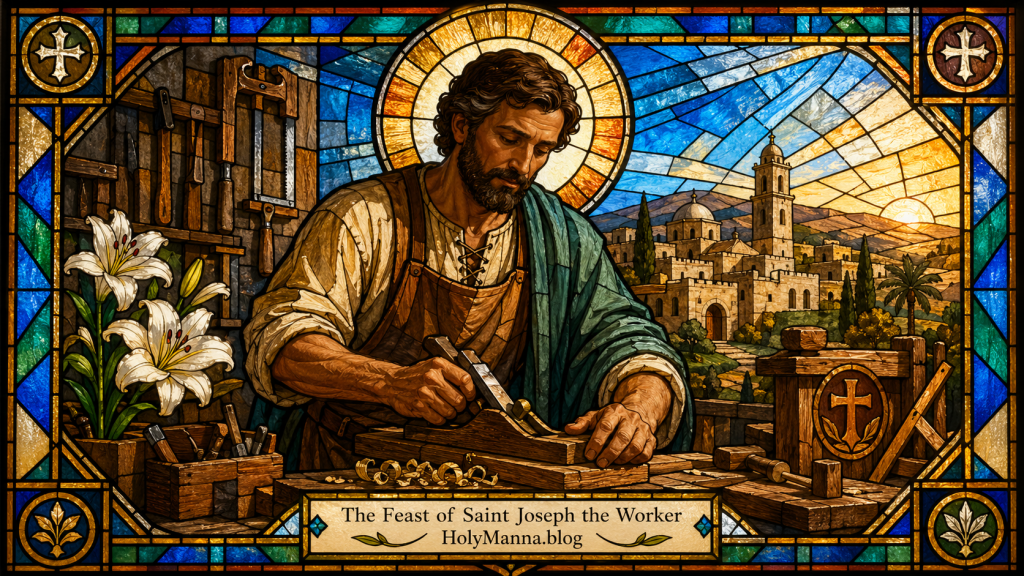
This feast is celebrated on May 1, and it honors Saint Joseph under one of his most relatable titles: worker. Joseph was the just man chosen by God to be the husband of the Blessed Virgin Mary and the earthly father of Jesus. He was also a craftsman, traditionally called a carpenter, who provided for the Holy Family through honest labor.
That detail matters more than most people realize. The Son of God did not grow up in a palace. He grew up in Nazareth, in a working family, under the care of a man whose hands were shaped by labor, sacrifice, and love. The people of Nazareth even identified Jesus through Joseph’s trade when they asked, “Is he not the carpenter’s son?” Matthew 13:55.
The Feast of Saint Joseph the Worker reminds the Church that work is not beneath holiness. Work can become a path to holiness when it is ordered toward God, family, justice, service, and love.
The Day May First Was Given a Catholic Soul
The Feast of Saint Joseph the Worker was instituted by Pope Pius XII on May 1, 1955. That date was not accidental. May 1 was already widely associated with labor movements, workers’ demonstrations, and political ideologies that often interpreted work through class struggle, materialism, or revolution.
Pope Pius XII wanted Catholic workers to see May 1 through the eyes of the Church. He gave the day a Christian meaning by placing it under the patronage of Saint Joseph, the humble worker of Nazareth. The Church was not denying the real sufferings of workers. In fact, Catholic social teaching had long defended workers against exploitation, unjust wages, unsafe conditions, and economic systems that treated human beings like tools. But Pius XII wanted to make clear that the dignity of the worker comes first from God, not from ideology.
This feast was the Church’s way of saying that labor is sacred because the human person is sacred. The worker is not merely a unit of production. The worker is a person made in the image and likeness of God.
The feast also stands in continuity with a much older devotion to Saint Joseph. Pope Pius IX had proclaimed Saint Joseph the Patron of the Universal Church in 1870. Pope Leo XIII later encouraged deep devotion to Saint Joseph in his encyclical Quamquam Pluries. Then, in the modern age, Pope Pius XII placed the dignity of work under Joseph’s fatherly protection.
This is important because the Church does not honor Joseph only as a statue in a quiet corner of a church. She honors him as a real father, a real husband, a real protector, and a real worker whose hidden life reveals how ordinary duties can become extraordinary offerings to God.
Nazareth, the Hidden School of Holy Work
The story behind this feast takes us to Nazareth, not to a battlefield, throne room, or public miracle. That is part of its beauty.
Joseph’s life was hidden. Scripture records no words from him. Yet his silence is not emptiness. It is obedience. It is strength under control. It is a life shaped by action more than speeches.
Joseph listened when the angel told him not to fear taking Mary into his home. He protected Mary and Jesus when Herod threatened the Child. He led the Holy Family into Egypt. He brought them back when danger had passed. He settled in Nazareth and provided a stable home where Jesus could grow in wisdom, age, and favor before God and man.
That hidden home became a school of holiness. It was there that Jesus, true God and true man, entered the rhythm of ordinary human life. He lived in a family. He prayed. He obeyed. He worked.
Pope Saint John Paul II reflected on this in Redemptoris Custos, teaching that “work was the daily expression of love in the life of the Family of Nazareth.” That line is worth sitting with. Joseph’s work was not just about income. It was love made visible. Every board he shaped, every repair he completed, every exhausting day of labor became part of his fatherly care for Jesus and Mary.
The Gospel calls Joseph a craftsman. The Greek word often associated with this trade, tekton, can refer to a carpenter, builder, or artisan. Pope Francis has noted that this was hard, physical work and not a path to wealth. Joseph was not a powerful man in worldly terms. He was a poor working man entrusted with the richest responsibility in history: to guard the Redeemer and His Mother.
That is the heart of this feast. God entrusted His Son to a worker.
The Dignity of Labor and the Image of God
The theological meaning of this feast begins in Genesis. Human beings are created in the image and likeness of God, and God gives them a share in His creative work. Work existed before sin entered the world. This means work is not merely a punishment. Sin makes work burdensome, frustrating, and painful, but work itself belongs to the original dignity of the human person.
The Catechism of the Catholic Church teaches, “Human work proceeds directly from persons created in the image of God and called to prolong the work of creation.” Catechism of the Catholic Church, 2427.
That teaching is essential. A Catholic does not see work as meaningless drudgery. Nor does a Catholic worship work as the highest good. Work is good because man is made for love, service, stewardship, and communion with God. Work becomes holy when it is done in justice, humility, charity, and obedience to the Lord.
The Catechism also teaches that work can be redemptive when it is united to Christ, “the carpenter of Nazareth and the one crucified on Calvary.” Catechism of the Catholic Church, 2427. That connection is powerful. Jesus sanctified human work in Joseph’s workshop, and He redeemed human suffering on the Cross. So the Catholic worker does not labor alone. Every burden, every sacrifice, every unnoticed act of responsibility can be offered to Christ.
This feast also protects Catholics from two dangerous errors. The first is laziness, where a person avoids responsibility and refuses the dignity of honest effort. The second is workaholism, where a person turns productivity, money, success, or career status into an idol. Saint Joseph corrects both. He worked faithfully, but he did not worship work. He provided for his family, but his heart belonged to God.
The Church’s teaching is beautifully balanced: work is for the person, not the person for work. The Catechism says, “Work is for man, not man for work.” Catechism of the Catholic Church, 2428.
That one sentence challenges every economy, every employer, every employee, every family, and every Catholic conscience.
Saint Joseph and the Church’s Social Teaching
The Feast of Saint Joseph the Worker is not just a devotional feast. It belongs to the heart of Catholic social teaching.
Pope Leo XIII’s Rerum Novarum defended the dignity of workers during the industrial age. He addressed unjust labor conditions, the rights and duties of workers and employers, the importance of private property, the need for just wages, and the protection of the family. He rejected class hatred while still insisting that the working poor must not be abandoned.
Pope Saint John Paul II continued this teaching in Laborem Exercens, where he called work a key to the whole social question. He taught that work is not merely about production or economics. It is about the person. The human person is the subject of work, not an object to be used.
Pope Francis brought this teaching back to Saint Joseph in Patris Corde, calling Joseph “a working father.” He wrote that Jesus learned from Joseph the value, dignity, and joy of eating bread that is the fruit of one’s own labor. Francis also asked a piercing question: “How can we speak of human dignity without working to ensure that everyone is able to earn a decent living?” Patris Corde.
This feast, then, asks Catholics to think seriously about labor justice. It calls for fair wages, safe working conditions, respect for workers, concern for the unemployed, protection for families, and an economy that serves human dignity rather than crushing it.
It also calls workers themselves to holiness. Work should be honest. It should not be lazy, corrupt, exploitative, dishonest, or driven by greed. Saint Paul gives the Christian rule beautifully: “Whatever you do, do from the heart, as for the Lord and not for others.” Colossians 3:23.
That verse is not a slogan for burnout. It is a call to sanctify daily life.
Prayers, Shrines, and the Fatherly Protection of Joseph
Devotion to Saint Joseph has always had a warm place in Catholic life because Joseph feels so close to ordinary people. He is the patron of the Universal Church, fathers, workers, families, craftsmen, the dying, and all who need quiet strength.
On the Feast of Saint Joseph the Worker, Catholics often pray the Litany of Saint Joseph. This litany honors him with titles that fit this feast beautifully: “Model of workers,” “Glory of domestic life,” “Pillar of families,” “Support in difficulties,” and “Patron of the afflicted.”
Another fitting devotion is the prayer to Saint Joseph after the Rosary, promoted by Pope Leo XIII. This prayer asks Joseph to protect the Church with the same fatherly care with which he protected Jesus and Mary. It is especially powerful because it reminds Catholics that Joseph’s fatherhood did not end in Nazareth. From heaven, he continues to guard the Church.
There are also traditional devotions such as the Seven Sundays or Seven Wednesdays of Saint Joseph, which meditate on his sorrows and joys. Many Catholics dedicate Wednesdays to Saint Joseph, just as Saturdays are often dedicated to Our Lady.
One of the great pilgrimage sites dedicated to Saint Joseph is Saint Joseph’s Oratory of Mount Royal in Montreal. Founded through the devotion and ministry of Saint Brother André Bessette, the Oratory has become one of the most famous shrines to Saint Joseph in the world. Pilgrims come there to pray, seek healing, light candles, give thanks, and entrust their families and burdens to Joseph’s intercession.
What makes these devotions so meaningful is that they do not pull Catholics away from daily life. They send Catholics back into daily life with more courage. Saint Joseph does not teach escape from responsibility. He teaches faithfulness inside responsibility.
How Catholics Celebrate the Worker of Nazareth
The Feast of Saint Joseph the Worker is celebrated in the Church’s liturgical calendar on May 1 as an optional memorial. In many places, Catholics attend Mass, pray for workers, ask blessings on workplaces, and remember those who are unemployed, underemployed, exploited, or anxious about providing for their families.
The readings for the feast carry the whole theology of work. In Genesis, man and woman are created in God’s image and entrusted with creation. In Colossians, Saint Paul teaches Christians to do everything in the name of the Lord Jesus. In the Gospel from Matthew, Jesus is recognized as the carpenter’s son. The Psalm prays, “Lord, give success to the work of our hands.” Psalm 90:17.
In some Catholic communities, May 1 includes special Masses for workers, laborers, craftsmen, tradesmen, farmers, first responders, teachers, healthcare workers, parents, and all who serve through daily labor. Some parishes pray for the unemployed or bless tools and symbols of work. Catholic labor groups and communities may hold gatherings rooted in prayer, justice, and the dignity of the worker.
It is important not to confuse this feast with the March 19 Solemnity of Saint Joseph, Husband of the Blessed Virgin Mary. Many beloved traditions, such as Saint Joseph tables in Sicilian and Italian Catholic communities, are more closely associated with March 19. May 1 has its own focus: Joseph as worker, patron of laborers, and model of sanctified daily work.
Still, both feasts belong together. March 19 honors Joseph in the mystery of the Holy Family. May 1 shows how that mystery was lived in the rhythm of labor, poverty, responsibility, and love.
The Holiness Hidden in Ordinary Mondays
The Feast of Saint Joseph the Worker is a feast for anyone who has ever felt unseen.
Joseph knew hiddenness. He did not need applause to be faithful. He did not need public recognition to obey God. He simply received the mission in front of him and did it with love.
That is a very Catholic lesson for modern life. So much of holiness is hidden. Parents sacrifice in ways children may not understand for years. Workers do honest jobs that no one celebrates. Caregivers pour themselves out quietly. Students study when no one is watching. Priests, religious, teachers, tradesmen, nurses, farmers, office workers, and business owners all face the daily question of whether ordinary work can become an offering.
Saint Joseph answers yes.
The workshop can become holy. The desk can become holy. The kitchen can become holy. The classroom can become holy. The truck, the hospital room, the job site, the office, the field, and the home can become places where God forms saints.
This does not mean pretending that work is always easy. Work can be exhausting. It can be unfair. It can be stressful. Sometimes it can be deeply discouraging. Catholic faith does not romanticize suffering or excuse injustice. The Church calls for justice because the worker has dignity. At the same time, Catholic faith teaches that even difficult labor can be united to Christ.
A Catholic can begin the workday with a simple offering: “Lord, this work is for You. Help this labor serve my family, my neighbor, and my salvation.”
That prayer changes the day.
Saint Joseph teaches Catholics to work without ego, rest without guilt, provide without fear, lead without harshness, obey without weakness, and trust God without needing to control every outcome.
Bringing Saint Joseph Into Daily Life
The Feast of Saint Joseph the Worker gives families and individuals a simple spiritual path.
A worker can begin each day by asking Saint Joseph for patience, discipline, humility, and honesty. A parent can ask Joseph to help provide not only materially, but spiritually and emotionally. An employer can ask Joseph to help make decisions that honor human dignity. A student can ask Joseph to make study a preparation for service rather than just success. Someone who is unemployed can ask Joseph for hope, perseverance, and open doors.
This feast also invites Catholics to examine their relationship with ambition. Ambition is not automatically sinful. It can be good to develop talents, provide well, build something excellent, and serve society. But ambition becomes dangerous when it forgets God, neglects family, uses people, or measures human worth by status.
Joseph’s greatness came from obedience, not self-promotion. He was entrusted with Jesus because he was just, humble, courageous, and faithful.
That is still the kind of worker the Church needs today.
Engage with Us!
Share your thoughts and reflections in the comments below. The Feast of Saint Joseph the Worker is one of those feasts that touches real life immediately because everyone knows the weight of responsibility, the need for honest work, and the desire to know that daily effort matters to God.
- How does Saint Joseph change the way you think about ordinary work and daily responsibilities?
- Where do you most need Saint Joseph’s help right now: patience, provision, humility, courage, or trust?
- Has work become a healthy offering in your life, or has it started to become an idol?
- How can you better honor the dignity of the people you work with, serve, manage, or depend on?
- What is one simple way you can offer your work to God this week?
May Saint Joseph the Worker teach every Catholic to labor with love, rest with gratitude, protect the vulnerable, honor the dignity of every person, and do all things with the mercy and love Jesus taught us.
Saint Joseph, pray for us!
Follow us on YouTube, Instagram and Facebook for more insights and reflections on living a faith-filled life.


Leave a Reply