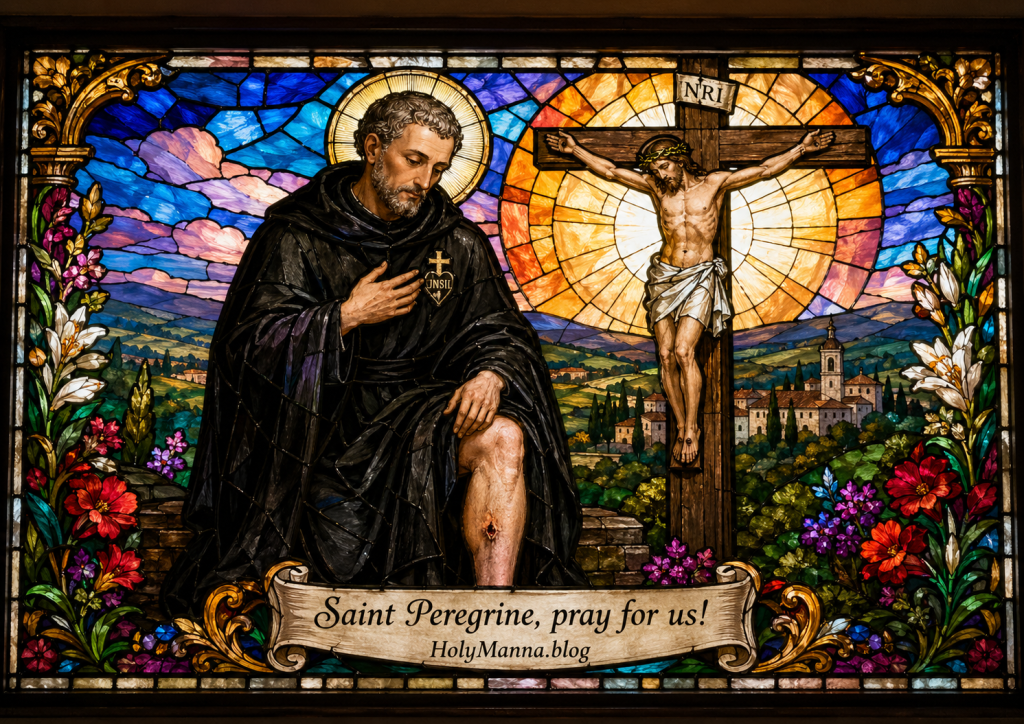
The Rebel Who Became the Cancer Saint
Saint Peregrine Laziosi is one of those saints whose life feels almost too dramatic to be true, but in the best Catholic way. He began as a hot-blooded young man from Forlì, Italy, caught up in political anger and resistance against the Church. He later became a Servite friar, a man of prayer, penance, compassion, and deep trust in Christ Crucified.
Today, Saint Peregrine is most known as the patron saint of those suffering from cancer, serious illness, incurable disease, leg ailments, chronic wounds, and other grave physical suffering. His life is especially powerful because he was not only a man who prayed for the sick. He was a man who became sick, faced the possibility of amputation, and received a miraculous healing through Christ.
His story is a reminder that holiness is not reserved for people who had a perfect beginning. Sometimes the saints are people whose early lives were messy, angry, and proud, but who allowed the mercy of God to completely remake them.
The Catechism of the Catholic Church teaches that the saints in heaven “do not cease to intercede with the Father for us” and that their concern for us helps our weakness. That is why Catholics ask Saint Peregrine to pray for the sick, not because he replaces Christ, but because he leads suffering souls back to Christ, the Divine Physician. CCC 956
From Forlì’s Streets to the Mercy of God
Saint Peregrine was born around 1265 in Forlì, Italy, into the noble Laziosi family. His city was caught in the political and religious tensions of medieval Italy, especially the conflict between factions loyal to the pope and factions opposed to papal authority. Forlì had strong anti-papal sympathies, and young Peregrine appears to have been shaped by that environment.
As a young man, Peregrine was known for his fiery spirit. Catholic tradition remembers him as a rebel against the Church, and one of the most famous stories of his life involves Saint Philip Benizi, the Prior General of the Servants of Mary. Saint Philip had come to Forlì to preach peace and call the people back to obedience to the Church. According to the traditional story, Peregrine was among those who mocked and resisted him. Some accounts say Peregrine struck Saint Philip in the face.
What happened next changed everything.
Saint Philip did not strike back. He did not curse Peregrine. He responded with meekness, patience, and forgiveness. That mercy pierced Peregrine’s heart. The young man who had acted with violence was conquered by Christian humility.
This story is deeply loved in Servite tradition, though some details come to us through later devotional accounts rather than the earliest surviving life of Peregrine. Still, the Catholic meaning of the story is clear and beautiful. A proud young man encountered the mercy of God through the patience of a saint, and that encounter became the beginning of his conversion.
Peregrine repented. He sought forgiveness. He began to pray. Tradition says he developed a deep devotion to the Blessed Virgin Mary, and another beloved story says that Our Lady appeared to him holding a black habit like the Servites wore. She told him to go to Siena, where he would find men who called themselves her servants. Whether every detail can be historically verified or not, the story expresses something true about his life. Peregrine became a Servant of Mary, and he spent the rest of his life following Christ in humility, penance, and charity.
The Servant of Mary Who Learned to Stand Before God
After entering the Order of the Servants of Mary, Peregrine eventually returned to Forlì. He lived in the Servite community of Santa Maria di Campostrino, where he became known for prayer, penance, and service to the poor and sick.
One important historical note is that Catholic sources do not always agree on whether Peregrine was a priest. Some popular accounts call him a priest, but stronger historical sources describe him more carefully as a Servite friar or religious, and some say he was not ordained. The safest and most accurate way to speak of him is as a Servite friar, a religious of the Order of the Servants of Mary.
Peregrine’s holiness was not flashy. He did not leave behind famous theological writings. He was not known primarily as a preacher. He became holy through repentance, prayer, self-denial, compassion, and daily fidelity.
One of the most striking traditions about him says that for thirty years he was never seen sitting down. He stood while eating, knelt in prayer, and rested only by leaning against a stone or choir bench. That kind of penance sounds extreme to modern ears, and ordinary Catholics are not asked to imitate it literally. But it reveals something about his soul. Peregrine wanted to give his whole body to God. The man who once used his strength in anger now used his strength in prayer.
He became known for wise counsel and charity. Some devotional traditions call him the “Angel of Good Counsel” because people came to him for spiritual guidance. He was also remembered for his care for the poor, his compassion toward the suffering, and his willingness to serve those who were most vulnerable.
That is what makes Saint Peregrine so relatable. He did not become a saint by pretending his past never happened. He became a saint by letting grace transform his past into humility.
What part of your past still needs to be surrendered to the mercy of Christ?
The Night Christ Came Down from the Cross
The most famous miracle in Saint Peregrine’s life happened when he was around sixty years old.
After years of severe penance and standing, Peregrine developed a terrible disease in his leg. Catholic sources describe it in different ways, including cancer, gangrene, a severe wound, or a malignant disease. The wound became so serious that it gave off a terrible odor, and the doctor believed the only way to save Peregrine’s life was to amputate the leg.
The doctor’s name is traditionally given as Paolo Salaghi. He examined Peregrine and determined that the diseased leg had to be removed.
The night before the operation, Peregrine did what saints do when they have nowhere else to turn. He went before Christ Crucified.
He dragged himself to a place where there was an image of Jesus on the Cross. There, in pain and fear, he prayed to the Lord who had healed lepers, restored sight to the blind, and raised the dead. Peregrine entrusted himself to the Divine Physician.
Then, according to the traditional account, he fell asleep and saw Christ descend from the Cross. Jesus touched Peregrine’s diseased leg. When Peregrine awoke, his leg was completely healed.
The next morning, the doctor arrived with the instruments for the amputation. Peregrine told him that another Physician had come first. The traditional saying preserved from this moment is beautiful: “Look, and know what physician I have had!”
Another traditional phrase connected to the miracle refers to Christ as “the Prince of medicine and the Author of human salvation.”
The doctor examined the leg and found no trace of the disease. The wound was gone. The cancerous sickness had disappeared. What had seemed hopeless the night before had become a testimony to the mercy and power of Christ.
This is why Saint Peregrine became the patron saint of cancer patients. He is not simply a saint people pray to because he was healed. He is a saint people trust because he knew the fear of illness from the inside. He knew the dread of a doctor’s final recommendation. He knew what it meant to suffer in the body and still cling to Christ.
The Catechism of the Catholic Church teaches that Christ’s compassion toward the sick is a sign of the Kingdom of God, and that His suffering and death give new meaning to human suffering. CCC 1503-1505 Saint Peregrine’s miracle points directly to that truth. The sick are not forgotten by Jesus. The wounded body matters to Him. The suffering person is never invisible before the Crucified Lord.
Suffering Without Losing Hope
Saint Peregrine was not a martyr in the traditional sense. He was not executed for the faith. His martyrdom was different. It was the long martyrdom of repentance, sickness, discipline, and surrender.
He faced the hardship of his own past. He had to live with the memory of having once opposed the Church and, according to tradition, having struck a saint. He faced the hardship of bodily suffering, especially through the disease in his leg. He faced the hardship of a life of strict penance, prayer, and service. He faced the hardship of becoming humble after having once been proud.
That kind of suffering is not always dramatic from the outside, but it can be deeply purifying.
His life teaches that not every saint is called to shed blood, but every saint is called to die to sin. Peregrine died to pride. He died to violence. He died to rebellion. He died to the illusion that strength means domination. He learned that true strength is found in mercy, patience, and surrender to God.
This is especially important for anyone suffering from illness. Catholic faith does not teach that sickness is easy, nor does it tell the sick to pretend they are fine. The Church teaches that suffering can be united to Christ. The Anointing of the Sick is one of the great sacraments of mercy, given to strengthen, comfort, forgive, and, if God wills, heal the sick. CCC 1499, CCC 1520-1522
Saint Peregrine does not offer a shallow message like, “Everything will instantly get better.” His life says something deeper. Stay close to Christ Crucified. Bring Him the wound. Bring Him the fear. Bring Him the diagnosis. Bring Him the part of life that feels impossible to carry alone.
What wound in your life needs to be brought before the Cross instead of hidden in shame or fear?
The Saint Who Kept Healing After Death
Saint Peregrine died in Forlì on May 1, 1345, after a fever. He was around eighty years old, or possibly a little older, depending on the source. By the time of his death, he was already loved by the people of Forlì.
Tradition says that when news of his death spread, crowds came from every direction. So many people wanted to venerate him that the city gates could not be closed. His body was honored with deep devotion, and the faithful quickly associated him with miracles.
Several miracle stories are connected to his death and funeral. Catholic tradition says that a blind man was healed through Saint Peregrine’s intercession. Another story says that a woman afflicted by demonic possession was delivered. Some accounts describe the blind man being healed when Peregrine, already dead, rose from the bier to bless him. That specific detail belongs to hagiographical tradition and cannot be verified with modern historical certainty, but it has remained part of the devotional memory surrounding the saint.
His body was not treated like the body of an ordinary man. It was preserved and venerated, and Catholic tradition has often described it as incorrupt. Today, his body is kept in the Basilica of Saint Peregrine Laziosi in Forlì, Italy. Pilgrims continue to visit the shrine, especially those praying for healing from cancer and serious illness.
His devotion eventually spread far beyond Italy. The Servite Order helped carry his memory throughout the world. Shrines and parishes dedicated to Saint Peregrine can be found in several countries. In the United States, devotion to him is especially associated with the National Shrine of Saint Peregrine at Our Lady of Sorrows Basilica in Chicago. In the Philippines, Saint Peregrine is deeply loved, and a shrine in Muntinlupa City is known for its devotion to him and for preserving a first-class relic traditionally described as a rib bone from his body.
Pope Paul V approved his public cult in 1609, and Pope Benedict XIII canonized him on December 27, 1726. His feast is commonly celebrated on May 1, though some Servite communities observe him on May 4.
In Forlì, Saint Peregrine remains a beloved patron. An annual celebration known as the Fiera di San Pellegrino is held in his honor. One unique custom connected with the feast involves citrons, a fruit traditionally associated with healing properties. The people bring citrons to be blessed and then share them at table, a local sign of the saint’s connection with healing, blessing, and the life of the community.
A Saint for Hospitals, Waiting Rooms, and Anxious Hearts
Saint Peregrine is remembered most as the patron saint of cancer patients, but his witness reaches even further. He is a saint for anyone who has ever waited for test results. He is a saint for anyone who has sat beside a hospital bed. He is a saint for anyone who has prayed through fear, pain, and uncertainty.
He is also a saint for people with a past.
That may be one of the most surprising and comforting parts of his story. Before he became a saint of healing, he had to become a man of repentance. Before he became a Servant of Mary, he had to stop being a servant of anger. Before he became a companion to the sick, he had to receive mercy himself.
The Catholic life is not about pretending wounds do not exist. It is about letting Christ enter them.
Saint Peregrine’s life reminds the faithful that God can heal in more than one way. Sometimes God heals the body. Sometimes He strengthens the soul. Sometimes He gives courage for treatment, peace before surgery, patience in chronic pain, or hope in a diagnosis that feels overwhelming. The miracle may be visible to everyone, or it may happen quietly in the heart.
His story also reminds us that the saints are family. The Church is not only made up of the people seen at Mass on Sunday. It includes the souls in heaven who pray with us and for us. As The Catechism of the Catholic Church teaches, the Communion of Saints means that the faithful are united in Christ across earth, purgatory, and heaven. CCC 946-962
So when Catholics ask Saint Peregrine to pray for the sick, they are not turning away from Jesus. They are asking a healed man in heaven to bring their suffering to Jesus.
Who in your life needs the intercession of Saint Peregrine today?
Walking with Saint Peregrine Today
Saint Peregrine teaches that conversion is possible, even after serious sin. He teaches that illness does not erase dignity. He teaches that penance can purify the heart when it is rooted in love. He teaches that prayer before the Crucifix is not a last resort, but the safest place for a wounded soul.
His life invites Catholics to become more compassionate toward the sick. A parish, family, or friend group should never allow someone with cancer or chronic illness to feel forgotten. A text message, a meal, a ride to treatment, a prayer card, a Rosary, or simply sitting quietly with someone in pain can become a real act of Christian love.
He also invites each person to examine anger. Peregrine’s conversion began when he encountered mercy instead of retaliation. That matters in a world where outrage is easy and forgiveness feels weak. Saint Philip Benizi’s forgiveness helped make Saint Peregrine possible. One saint’s patience became another saint’s conversion.
That should make every Catholic pause.
The next act of patience, forgiveness, or mercy might become the doorway through which someone else returns to God.
The life of Saint Peregrine is a story of a rebel who became a servant, a sinner who became a saint, a sick man who became a patron of the sick, and a wounded soul who found healing at the feet of Christ Crucified.
Engage with Us!
Share your thoughts and reflections in the comments below. Saint Peregrine’s life touches so many real struggles: illness, fear, repentance, anger, healing, and trust in God when life feels uncertain.
- What part of Saint Peregrine’s story speaks most deeply to your own faith journey?
- Have you ever experienced God’s mercy through the patience or forgiveness of another person?
- Who in your life needs prayers for healing, strength, or peace right now?
- What wound, fear, or burden do you need to bring before Christ Crucified this week?
- How can you show practical compassion to someone who is sick, lonely, or carrying a hidden cross?
May Saint Peregrine pray for all who suffer in body, mind, or spirit. May his life remind every wounded heart that Jesus is still the Divine Physician, still merciful, still near, and still able to turn pain into grace. Live with faith, love with courage, forgive with mercy, and do everything with the love and mercy Jesus taught us.
Saint Peregrine, pray for us!
Follow us on YouTube, Instagram and Facebook for more insights and reflections on living a faith-filled life.

 Holy Manna!
Leave a comment