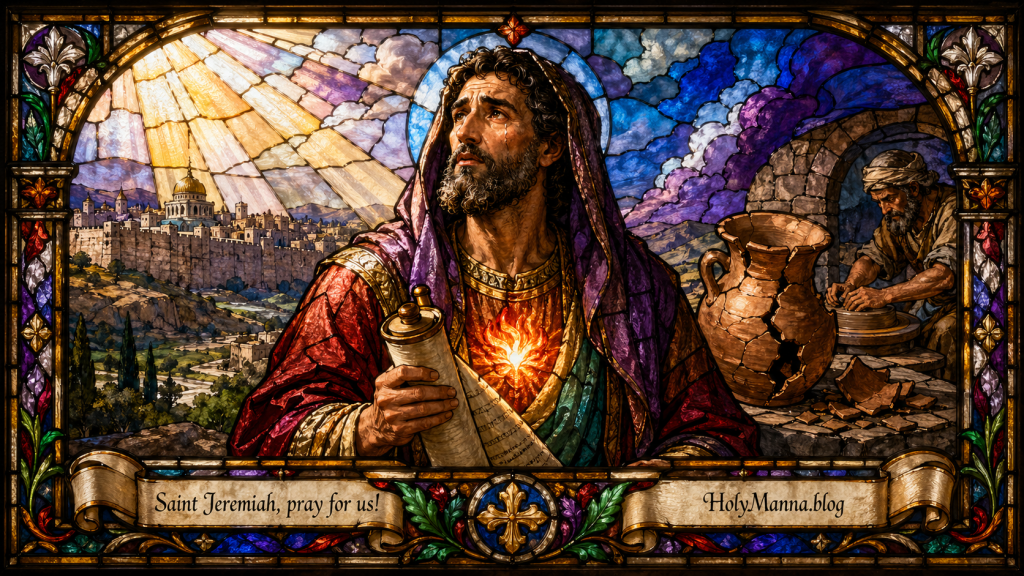
The Fire in the Bones of the Weeping Prophet
Saint Jeremiah stands as one of the most powerful and sorrowful voices in all of Sacred Scripture. The Catholic Church honors him as a saint because the holy men and women of the Old Testament prepared the world for Christ. As The Catechism of the Catholic Church teaches, “the patriarchs, prophets and certain other Old Testament figures have been and always will be honored as saints in all the Church’s liturgical traditions.” CCC 61
Jeremiah is remembered as the “weeping prophet,” not because he was weak, but because he loved God’s people enough to tell them the truth when the truth broke his heart. He warned Jerusalem that sin, idolatry, injustice, and empty religious confidence would lead to destruction and exile. Yet he also gave one of the most beautiful promises in the Old Testament, the prophecy of the New Covenant: “I will place my law within them, and write it upon their hearts.” Jeremiah 31:33
In Catholic tradition, Jeremiah is a prophet of repentance, suffering love, interior conversion, and hope after judgment. He is also a deeply Christlike figure. He was rejected by his own people, accused, persecuted, imprisoned, lowered into a pit, and still remained faithful to the Word of God.
A Child Known Before the Womb
Jeremiah was born around 650 B.C. in Anathoth, a village in the territory of Benjamin, not far from Jerusalem. Scripture tells us he was the son of Hilkiah and came from a priestly family. He lived during one of the most dangerous and heartbreaking periods in Israel’s history, as the Kingdom of Judah was collapsing under the weight of spiritual infidelity and political disaster.
Because Jeremiah lived centuries before Christ, his story is not a conversion to Christianity in the later sense. His conversion was his surrender to God’s call. The Lord chose him before he ever had a chance to choose comfort, popularity, or safety.
His calling is one of the most famous in the Bible. God told him, “Before I formed you in the womb I knew you, before you were born I dedicated you, a prophet to the nations I appointed you.” Jeremiah 1:5
Jeremiah resisted. He knew he was young. He knew he was not powerful. He knew the mission would cost him. He answered, “Ah, Lord GOD! I do not know how to speak. I am too young!” Jeremiah 1:6
But God did not let fear have the final word. The Lord answered, “Do not say, ‘I am too young.’ To whomever I send you, you shall go; whatever I command you, you shall speak.” Jeremiah 1:7
Then the Lord touched Jeremiah’s mouth and said, “See, I place my words in your mouth!” Jeremiah 1:9
That moment shaped the rest of his life. Jeremiah did not become a prophet because it looked impressive. He became a prophet because God placed His Word inside him like fire.
The Prophet Who Told Jerusalem the Truth
Jeremiah’s mission began around 627 B.C., during the reign of King Josiah. Josiah had attempted religious reform, but after his death Judah quickly returned to idolatry, political compromise, and moral corruption. The nation was trapped between powerful empires, especially Egypt and Babylon, but Jeremiah knew the deeper crisis was not military. It was spiritual.
Jeremiah warned the people that the Temple would not save them if their hearts remained far from God. In his famous Temple Sermon, he cried out, “Do not put your trust in these deceptive words: ‘The temple of the LORD! The temple of the LORD! The temple of the LORD!’” Jeremiah 7:4
That warning still cuts deep. Jeremiah was not attacking true worship. He was attacking false religion, the kind that uses holy things as a cover for unholy living. He called Judah to stop oppressing the stranger, the orphan, and the widow. He called them away from idolatry and back to covenant faithfulness.
This is why Jeremiah matters so much for Catholics today. He reminds the Church that devotion must lead to conversion. Sacraments, prayers, feast days, and religious identity are precious gifts, but they are never meant to replace repentance, mercy, justice, and love of God.
The Signs That Became His Sermons
Jeremiah’s life was filled with prophetic signs. Scripture does not present him primarily as a miracle-worker like Moses, Elijah, or Elisha. His wonders were signs of divine meaning, visible actions that revealed God’s judgment and mercy.
God showed him an almond branch, a sign that the Lord was watching over His word to fulfill it. He saw a boiling pot tilted from the north, symbolizing the coming disaster through Babylon. He went to the potter’s house and watched clay being reshaped, revealing that God could reshape Israel if the people repented. He shattered a clay flask to show how Jerusalem would be broken if it refused God.
Jeremiah also wore a yoke to symbolize submission to Babylon. When the false prophet Hananiah broke the yoke and promised easy deliverance, Jeremiah warned that Hananiah had made the people trust in a lie. Hananiah died that same year, just as Jeremiah had foretold. This was not a flashy miracle, but it was a powerful fulfillment of prophecy.
One of Jeremiah’s most surprising signs came during the siege of Jerusalem. While the city was collapsing, Jeremiah bought a field in Anathoth. To everyone else, that must have looked absurd. Why buy land when the country is being conquered? But Jeremiah’s purchase was a sign of hope. One day, houses, fields, and vineyards would again be bought in the land. God’s judgment would not erase His mercy.
The Lord also commanded Jeremiah not to marry or have children. This was not because marriage was bad. It was because Jeremiah’s own celibate life became a living sign of the suffering about to fall upon Judah. His body, choices, tears, and loneliness became part of the message.
The Scroll That Could Not Be Burned
One of the most famous stories in Jeremiah’s life is the burning of the scroll. God commanded Jeremiah to write down His words. Jeremiah dictated them to Baruch, his faithful scribe and companion.
When the scroll was read before King Jehoiakim, the king responded with cold arrogance. As the scroll was read, he cut pieces from it and threw them into the fire.
It is one of the most chilling scenes in the Old Testament. A king sits in comfort while the Word of God burns before him. Yet the king could only burn parchment. He could not destroy the truth.
God commanded Jeremiah to dictate the words again, and more words were added. That story is a powerful reminder for every Catholic writer, preacher, teacher, parent, and catechist. The world can mock the Word. It can ignore the Word. It can try to erase the Word. But the Word of God does not die.
The Prophet in the Mud
Jeremiah’s faithfulness made him hated. He was accused of discouraging the people. He was called a traitor for warning Jerusalem not to rebel against Babylon. He was threatened, imprisoned, beaten, and rejected.
One of the darkest moments came when officials threw him into a cistern. There was no water in it, only mud, and Jeremiah sank down into the mire. It is hard not to see the spiritual image there. The prophet who carried God’s Word was pushed beneath the surface by the very people he was trying to save.
But God did not abandon him. Ebed-melech, an Ethiopian official, courageously appealed to King Zedekiah and arranged Jeremiah’s rescue. In a story filled with cowardice, a foreign servant becomes the unexpected witness of justice.
Jeremiah’s suffering was not only physical. It was interior. He felt the burden of being mocked and rejected, yet he could not stop speaking. He confessed, “But then it is as if fire is burning in my heart, imprisoned in my bones; I grow weary holding back, I cannot!” Jeremiah 20:9
That line may be the key to Jeremiah’s soul. He did not speak because he enjoyed conflict. He spoke because God’s Word burned inside him.
The New Covenant Written on the Heart
Jeremiah’s greatest prophecy is the New Covenant. After so much warning, sorrow, and judgment, God gave Jeremiah words of breathtaking hope: “I will place my law within them, and write it upon their hearts; I will be their God, and they shall be my people.” Jeremiah 31:33
For Catholics, this prophecy points directly to Jesus Christ. Christ fulfills the New Covenant through His Passion, Death, Resurrection, and the gift of the Holy Spirit. The Catechism of the Catholic Church teaches that the New Law is the grace of the Holy Spirit given through faith in Christ, an interior law of love that fulfills what Jeremiah foresaw. CCC 1965
Jeremiah saw that God did not want a merely external religion. He wanted hearts transformed by grace. He wanted His law not only written on stone or scrolls, but living inside His people.
That is why Jeremiah is not only a prophet of sorrow. He is a prophet of hope. He knew that sin brings consequences, but he also knew that God’s mercy reaches deeper than the ruins.
The Death of the Prophet and the Legend of Martyrdom
After Jerusalem fell to Babylon in 587 B.C., Jeremiah remained among the remnant of Judah. He warned the people not to flee to Egypt, but they refused to listen. They forced Jeremiah to go with them, and even there he continued to speak the Word of the Lord.
Scripture does not record the exact details of Jeremiah’s death. Catholic tradition, however, says that he was stoned to death in Egypt by his own countrymen because they could no longer bear his warnings. This tradition cannot be verified from Scripture, but it is ancient and fits the tragic pattern of his life.
Jeremiah gave everything to the people who rejected him. He loved them enough to suffer for the truth. In that way, his life points forward to Christ, the Prophet rejected by His own, who wept over Jerusalem and gave His life for sinners.
The Ark, the Golden Sword, and the Prophet Who Still Interceded
Jeremiah’s legacy after death is especially rich in Catholic Scripture. In 2 Maccabees 2, a tradition says that Jeremiah hid the tent, the Ark of the Covenant, and the altar of incense in a cave on the mountain where Moses had seen the promised land. He declared that the place would remain unknown until God gathered His people again and showed mercy.
This story belongs to Catholic Scripture, though its precise historical details remain mysterious. It has stirred the Catholic imagination for centuries because the Ark was the great sign of God’s presence among His people. The hidden Ark becomes a symbol of waiting, mercy, and the mystery of God’s plan.
Even more striking is the vision in 2 Maccabees 15. Judas Maccabeus sees the deceased high priest Onias and the prophet Jeremiah. Onias says of Jeremiah, “This is a man who loves his fellow Jews and fervently prays for the people and the holy city, the prophet of God, Jeremiah.” 2 Maccabees 15:14
Then Jeremiah gives Judas a golden sword as a gift from God. From a Catholic perspective, this passage beautifully supports the communion of saints. Jeremiah is not pictured as gone, silent, or useless after death. He is alive in God, praying for the people and encouraging them in battle.
Later Eastern Christian tradition says that Jeremiah was honored in Egypt because, through his prayers, he killed crocodiles and harmful creatures. Another tradition says dust from his tomb was believed to heal snakebite. These are devotional legends and cannot be verified with certainty, but they show how deeply generations of believers remembered Jeremiah as a powerful servant of God even after death.
The Legacy of the Weeping Prophet
Jeremiah’s influence only grew after his death. His words shaped the exiled people of God and helped them understand their suffering. Sirach praises him as one who had been consecrated from the womb and appointed “to root out, pull down, and destroy, and then to build and to plant.” Sirach 49:7
Jeremiah’s memory also appears in the New Testament. When Jesus asked who people said the Son of Man was, some answered Jeremiah. That detail matters. Jeremiah was remembered as such a powerful image of prophetic suffering, divine truth, and holy sorrow that some people saw his shadow in Christ.
The Gospel of Matthew also applies Jeremiah’s words about Rachel weeping for her children to the massacre of the Holy Innocents. In that moment, Jeremiah’s lament over Israel’s suffering becomes part of the story of Christ’s infancy.
Catholic tradition honors Jeremiah on May 1. He is also remembered in Eastern Christian traditions, including Byzantine Catholic devotion. In art, he is famously depicted by Michelangelo in the Sistine Chapel as a sorrowful, contemplative prophet. Even language bears his mark. The word “jeremiad” comes from his name and refers to a sorrowful warning or lament over moral decline.
Jeremiah is known for courage, tears, truth, suffering, and hope. He is the saint for anyone who has had to say the hard thing with love. He is the saint for anyone who has watched people reject what would heal them. He is the saint for anyone who feels the Word of God burning inside and cannot remain silent.
A Fire That Still Speaks
Saint Jeremiah teaches that faithfulness is not always popular, comfortable, or immediately successful. Sometimes holiness looks like being misunderstood. Sometimes love sounds like warning. Sometimes hope begins by telling the truth about sin.
He also teaches that sorrow can be holy when it flows from love. Jeremiah did not weep because he lacked faith. He wept because he saw clearly. He saw the beauty of God’s covenant, the danger of sin, and the mercy waiting on the other side of repentance.
For Catholics today, Jeremiah is a reminder that religious identity must become conversion of heart. It is not enough to say the right words, attend the right places, or claim the right heritage. God wants the heart. He wants the law of love written within.
Practical devotion to Jeremiah’s example can begin in simple ways. Speak the truth without cruelty. Refuse false comfort when someone needs real conversion. Pray for those who reject God. Stay faithful when obedience feels lonely. Let Scripture become a fire in the bones, not just words on a page.
Where is God asking for deeper conversion of heart today?
Is there a truth that needs to be spoken with courage, humility, and love?
Has religious routine become a substitute for real repentance?
Saint Jeremiah reminds every believer that God can build again after tearing down, plant again after uprooting, and write His law on hearts that once seemed hardened.
Engage With Us!
Share your thoughts and reflections in the comments below. Saint Jeremiah’s life is challenging because he shows that love and truth cannot be separated. His story invites every Catholic to ask whether faith is being lived only on the surface, or whether God’s Word is truly being allowed to reshape the heart.
- What part of Saint Jeremiah’s life speaks most clearly to your own faith journey right now?
- Have you ever had to speak the truth even when it cost you approval or comfort?
- What does Jeremiah’s prophecy of the New Covenant teach you about the kind of heart God wants to form in you?
- Where might God be asking you to move from outward religious habit into deeper interior conversion?
- How can Saint Jeremiah’s courage help you live your faith more boldly this week?
May Saint Jeremiah, inspire hearts to love the truth, repent with humility, trust God in seasons of loss, and live with the fire of His Word within. May every word, every sacrifice, and every hidden act of faith be done with the love and mercy Jesus taught us.
Saint Jeremiah, pray for us!
Follow us on YouTube, Instagram and Facebook for more insights and reflections on living a faith-filled life.

 Holy Manna!
Leave a comment