Friday of the Fourth Week of Easter – Lectionary: 283
The Road Home Is a Person
Every troubled heart wants to know two things: where is home, and how does the soul get there?
Today’s readings answer with one clear Easter truth: Jesus Christ is the promised Son, the risen King, and the living Way back to the Father. In Acts 13:26-33, Saint Paul stands in the synagogue and announces that everything God promised to Israel has now been fulfilled in Jesus. The leaders in Jerusalem failed to recognize Him, condemned Him, and saw Him placed in a tomb, but God overturned the sentence of death with the victory of the Resurrection. Paul’s message is not vague encouragement. It is the proclamation of the Gospel: “But God raised him from the dead.” Acts 13:30.
The responsorial psalm deepens that proclamation by revealing the royal identity of Christ. Psalm 2 speaks of the Lord’s anointed King, the Son installed on Zion, whose inheritance reaches to the ends of the earth. What Israel once heard as a royal psalm finds its fullness in the risen Jesus. He is not simply a teacher with comforting words. He is the Son of God, the King who rules through sacrificial love, and the refuge of every soul that turns to Him. That is why the psalm can end with both reverence and hope: “Blessed are all who take refuge in him!” Psalm 2:11.
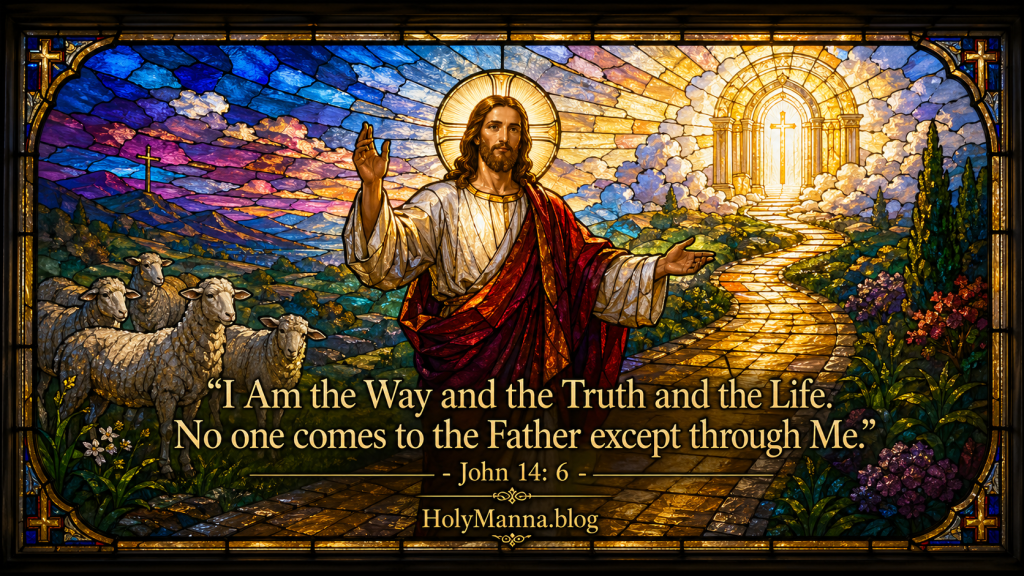
Then, in John 14:1-6, Jesus brings this whole mystery close to the human heart. He speaks at the Last Supper, as betrayal, suffering, and the Cross draw near. His disciples are confused and afraid, yet He tells them, “Do not let your hearts be troubled.” John 14:1. He does not give them a map, a theory, or a religious slogan. He gives them Himself. When Thomas asks how they can know the way, Jesus answers with words that stand at the center of Christian life: “I am the way and the truth and the life.” John 14:6.
The Church reads these passages during Easter because the Resurrection is not only something Jesus accomplished long ago. It is the open door into the Father’s house. The Catechism teaches that the Resurrection is “the crowning truth of our faith in Christ” and that heaven is life with Christ, the fulfillment of the deepest human longing. CCC 638, CCC 1024-1025. Today’s readings prepare the soul to see that salvation is not simply escape from trouble. Salvation is communion with the risen Lord, who has gone before His people, prepared a place for them, and still says to every anxious disciple, “Have faith also in me.” John 14:1.
Where is the heart looking for direction today, and is it willing to let Christ Himself become the road home?
First Reading – Acts 13:26-33
The Promise Fulfilled in the Risen Son
The first reading brings readers into one of the great missionary sermons of Saint Paul. He is preaching in the synagogue at Antioch in Pisidia, speaking first to “children of the family of Abraham” and also to the “God-fearing” Gentiles who worshiped with Israel. This setting matters. Paul is not presenting Christianity as a new religion disconnected from Israel. He is showing that Jesus is the fulfillment of everything God had promised through Abraham, Moses, David, and the prophets.
This reading fits perfectly with today’s central theme: the way home to the Father has been opened by the crucified and risen Christ. In Acts 13, Paul proclaims the Resurrection as the fulfillment of God’s covenant promises. In Psalm 2, the Church hears the Father declare the royal Sonship of Christ. In John 14, Jesus reveals that He Himself is “the way and the truth and the life.” John 14:6. Saint Paul’s sermon gives the foundation for that hope. Jesus can prepare a place in the Father’s house because He has conquered the grave.
Acts 13:26-33 – New American Bible (Revised Edition)
26 “My brothers, children of the family of Abraham, and those others among you who are God-fearing, to us this word of salvation has been sent. 27 The inhabitants of Jerusalem and their leaders failed to recognize him, and by condemning him they fulfilled the oracles of the prophets that are read sabbath after sabbath. 28 For even though they found no grounds for a death sentence, they asked Pilate to have him put to death, 29 and when they had accomplished all that was written about him, they took him down from the tree and placed him in a tomb. 30 But God raised him from the dead, 31 and for many days he appeared to those who had come up with him from Galilee to Jerusalem. These are [now] his witnesses before the people. 32 We ourselves are proclaiming this good news to you that what God promised our ancestors 33 he has brought to fulfillment for us, [their] children, by raising up Jesus, as it is written in the second psalm, ‘You are my son; this day I have begotten you.’
Detailed Exegesis
Verse 26 – “My brothers, children of the family of Abraham, and those others among you who are God-fearing, to us this word of salvation has been sent.”
Saint Paul begins with affection and urgency. He speaks as a Jew to fellow Jews, calling them “children of the family of Abraham.” He also includes the Gentile worshipers known as “God-fearing,” those who revered the God of Israel but had not fully entered the covenant through circumcision. This shows the Catholic breadth of the Gospel. Salvation comes through Israel, but it is meant for all nations. The “word of salvation” is not merely a message about moral improvement. It is the announcement that God has acted in Jesus Christ to save His people from sin and death.
Verse 27 – “The inhabitants of Jerusalem and their leaders failed to recognize him, and by condemning him they fulfilled the oracles of the prophets that are read sabbath after sabbath.”
This verse is both tragic and mysterious. The leaders in Jerusalem heard the prophets every Sabbath, yet they failed to recognize the One to whom the prophets pointed. Their blindness did not defeat God’s plan. Even their condemnation of Jesus fulfilled what had been foretold. This does not excuse sin, but it shows the providence of God. Human rejection becomes the path through which divine mercy is revealed. The Cross was not an accident in salvation history. It was the place where God transformed human injustice into redemption.
Verse 28 – “For even though they found no grounds for a death sentence, they asked Pilate to have him put to death.”
Paul emphasizes the innocence of Jesus. No true grounds for death were found, yet He was handed over to Pilate. This recalls the Passion narratives, where Jesus stands silent, innocent, and obedient before worldly power. Theologically, this verse points to Christ as the spotless Lamb. He does not die for His own sins. He dies for ours. The innocent One accepts the sentence of the guilty so the guilty may receive mercy.
Verse 29 – “And when they had accomplished all that was written about him, they took him down from the tree and placed him in a tomb.”
The phrase “the tree” refers to the Cross and echoes the Old Testament language of curse. In Deuteronomy 21:23, a man hanged on a tree is described as accursed. Saint Paul later explains in Galatians 3:13 that Christ took this curse upon Himself for us. His burial confirms the reality of His death. Jesus did not appear to die. He truly entered the silence of the tomb. Yet Paul says all of this happened according to what had been written. Scripture had prepared Israel to recognize a suffering Messiah, even if many could not yet understand how the Anointed One could reign through death.
Verse 30 – “But God raised him from the dead.”
This is the turning point of the whole reading. Human beings condemned Jesus, but God raised Him. The tomb did not have the final word. Pilate did not have the final word. The leaders in Jerusalem did not have the final word. Sin, violence, betrayal, and death did not have the final word. God did. The Resurrection is the Father’s vindication of the Son and the definitive sign that Jesus is Lord. This is why Easter is not merely a season of religious happiness. It is the center of Christian faith.
Verse 31 – “And for many days he appeared to those who had come up with him from Galilee to Jerusalem. These are now his witnesses before the people.”
Paul points to witnesses. The Resurrection was not a private feeling or a symbolic idea. The risen Jesus appeared for many days to those who had followed Him. These witnesses became the foundation of apostolic preaching. The Church is apostolic because her faith is rooted in the testimony of those chosen by Christ and sent to proclaim what they had seen and heard. Catholic faith is not built on spiritual guesswork. It is built on the witness of the apostles, preserved and handed on through the Church.
Verse 32 – “We ourselves are proclaiming this good news to you that what God promised our ancestors”
Here Paul makes clear that the Gospel is “good news.” It is not first a command, a burden, or a religious system. It is an announcement that God has kept His promises. The phrase “what God promised our ancestors” places Jesus within the whole story of salvation history. God promised blessing to Abraham, kingship to David, restoration through the prophets, and salvation for His people. In Jesus, those promises are not abandoned. They are fulfilled.
Verse 33 – “He has brought to fulfillment for us, their children, by raising up Jesus, as it is written in the second psalm, ‘You are my son; this day I have begotten you.’”
Paul identifies the Resurrection as the fulfillment of God’s promise. By quoting Psalm 2:7, he shows that Jesus is the royal Son, the true King, and the Messiah in whom the covenant with David reaches its fullness. The words “this day I have begotten you” do not mean that Jesus became the Son of God only at the Resurrection. Catholic faith teaches that the Son is eternally begotten of the Father. Rather, the Resurrection publicly manifests His Sonship in glory. The crucified Jesus is revealed as the risen Son, enthroned in victory.
Teachings
This reading is one of the clearest examples of apostolic preaching in the New Testament. Saint Paul proclaims three essential truths: Jesus was rejected and crucified, God raised Him from the dead, and this Resurrection fulfills the promises made to Israel. That pattern is at the heart of Catholic faith. The Church does not preach a vague spirituality. She preaches Christ crucified and risen.
The Catechism of the Catholic Church directly connects the Resurrection with this apostolic proclamation: “‘We bring you the good news that what God promised to the fathers, this day he has fulfilled to us their children by raising Jesus.’ The Resurrection of Jesus is the crowning truth of our faith in Christ, a faith believed and lived as the central truth by the first Christian community; handed on as fundamental by Tradition; established by the documents of the New Testament; and preached as an essential part of the Paschal mystery along with the cross.” CCC 638.
That teaching helps explain why Paul’s sermon has such force. The Resurrection is not an optional doctrine. It is the crown of Christian faith. Without the Resurrection, the Cross would look like defeat. With the Resurrection, the Cross is revealed as victory.
The Catechism also teaches: “Christ’s Resurrection is the fulfillment of the promises both of the Old Testament and of Jesus himself during his earthly life. The phrase ‘in accordance with the Scriptures’ indicates that Christ’s Resurrection fulfilled these predictions.” CCC 652. This is exactly what Paul is teaching in Antioch. The death and Resurrection of Jesus are not disconnected from the Old Testament. They are the fulfillment of it.
The Church also sees in this passage the revelation of Christ’s divine identity. The Catechism says: “The truth of Jesus’ divinity is confirmed by his Resurrection. He had said: ‘When you have lifted up the Son of man, then you will know that I am he.’ The Resurrection of the crucified one showed that he was truly ‘I AM,’ the Son of God and God himself.” CCC 653. Paul’s quotation from Psalm 2 points toward this mystery. Jesus is not merely a holy man whom God rewarded. He is the eternal Son made flesh, revealed in power through the Resurrection.
Saint Augustine, reflecting on Psalm 2, understood the King installed on Zion as Christ, and Zion as connected to the Church. This matters because Paul quotes that psalm to show that Jesus is the promised Son and King. Christ does not reign like earthly rulers. He reigns through the Cross, the Resurrection, the Sacraments, and the Church He established. His kingdom gathers people from Abraham’s descendants and from the nations, just as Paul’s audience included both Jews and God-fearing Gentiles.
This reading also helps Catholics understand the Mass. At every Mass, the Church does what Paul did in Antioch. She proclaims the Scriptures, announces Christ crucified and risen, and shows that the promises of God are fulfilled in Jesus. The Eucharist makes present the one sacrifice of Christ and feeds the faithful with the life of the risen Lord. The same Jesus proclaimed by Paul is the same Jesus received at the altar.
Reflection
This first reading speaks strongly to anyone who has ever wondered whether God is still faithful when life looks confusing, unjust, or painfully unfinished. Saint Paul does not hide the darkness. Jesus was not recognized. He was condemned unjustly. He was handed over to death. He was placed in a tomb. Then comes the line that changes everything: “But God raised him from the dead.” Acts 13:30.
That is the Christian pattern. God does not always prevent the tomb, but He is Lord even there. He does not promise that every path will make sense in the moment, but He promises that death does not get the last word. For the Catholic soul, this becomes a way of living with hope. The difficult diagnosis, the broken relationship, the unanswered prayer, the hidden sacrifice, and the long season of waiting can all be brought under the light of Easter.
This reading also invites a deeper trust in the Church’s apostolic witness. Faith is not something each person invents from scratch. It is received. The witnesses saw the risen Lord, the apostles preached Him, the Church preserved that proclamation, and Catholics today stand inside that living Tradition. In a world full of opinions, algorithms, influencers, and spiritual confusion, there is something steady and beautiful about belonging to the faith of the apostles.
A practical way to live this reading is to return each day to the basic proclamation of Paul: Jesus died, Jesus was buried, Jesus rose, and Jesus is Lord. Begin prayer there. Bring anxiety there. Bring guilt there. Bring confusion there. Let the Resurrection become more than a doctrine memorized long ago. Let it become the lens through which daily life is interpreted.
Another way to live this reading is to read the Old Testament with Catholic eyes. Paul shows that the story of Israel points to Christ. The promises, the psalms, the prophets, the sacrifices, and the kingship of David all find their fulfillment in Him. The more a Catholic learns to read Scripture as one united story, the more the heart begins to see the patience and faithfulness of God.
Where does life currently feel like Good Friday, and what would it mean to believe that God is still able to speak an Easter word there?
Is the Resurrection being treated as the center of faith, or merely as a beautiful idea remembered once a year?
How can the witness of the apostles strengthen faith when emotions feel weak or the path ahead feels unclear?
What promise of God needs to be trusted again today?
Responsorial Psalm – Psalm 2:6-11
The King Who Becomes Our Refuge
The responsorial psalm places the Church before the royal mystery of Christ. Psalm 2 was originally understood as a coronation psalm, a sacred hymn connected to the Davidic king in Jerusalem. In ancient Israel, the king was not meant to be a political celebrity or a self-made ruler. He was the Lord’s anointed servant, entrusted with shepherding God’s people and defending justice under God’s authority.
But the Church reads this psalm in the full light of Easter. What was spoken first in the language of Davidic kingship finds its deepest fulfillment in Jesus Christ, the Son of David and the eternal Son of the Father. This is why Saint Paul quotes this psalm in today’s first reading from Acts 13:33: “You are my son; this day I have begotten you.” In Paul’s preaching, the Resurrection reveals Jesus as the promised Son and King. In the Gospel, that same King speaks tenderly to His frightened disciples and says, “Do not let your hearts be troubled.” John 14:1.
So this psalm ties today’s readings together beautifully. The risen Jesus is not only the One who prepares a place in the Father’s house. He is also the King installed by the Father, the Son to whom all nations belong, and the refuge for every soul that chooses to trust Him.
Psalm 2:6-11 – New American Bible (Revised Edition)
6 “I myself have installed my king
on Zion, my holy mountain.”
7 I will proclaim the decree of the Lord,
he said to me, “You are my son;
today I have begotten you.
8 Ask it of me,
and I will give you the nations as your inheritance,
and, as your possession, the ends of the earth.
9 With an iron rod you will shepherd them,
like a potter’s vessel you will shatter them.”
10 And now, kings, give heed;
take warning, judges on earth.
11 Serve the Lord with fear;
exult with trembling,
Accept correction
lest he become angry and you perish along the way
when his anger suddenly blazes up.
Blessed are all who take refuge in him!
Detailed Exegesis
Verse 6 – “I myself have installed my king on Zion, my holy mountain.”
This verse begins with God’s authority, not human ambition. The king is not self-appointed. God says, “I myself have installed my king.” In the Old Testament setting, Zion refers to Jerusalem, the holy mountain where the Lord chose to dwell among His people. The Davidic king ruled from Zion as a visible sign that God had not abandoned Israel.
In Christ, this verse reaches its fullness. Jesus is the King installed not by armies, money, or political manipulation, but by the Father’s will. His throne is first revealed on the Cross, where the title above His head declares Him King even as He suffers. His victory is revealed in the Resurrection. Zion, seen through Catholic faith, also points toward the Church, the holy people gathered around the risen Lord. Christ reigns from heaven, but His kingship is made present in His Body, the Church, through the Word, the Sacraments, and the life of grace.
Verse 7 – “I will proclaim the decree of the Lord, he said to me, ‘You are my son; today I have begotten you.’”
This is the verse Saint Paul quotes in Acts 13:33. In its original setting, it expressed the special covenant relationship between God and the Davidic king. The king was called God’s son because he represented the Lord’s rule among the people.
But Jesus is not the Son by adoption in the same way an earthly king was. He is the eternal Son of the Father. He is “begotten, not made,” as the Nicene Creed professes. The Resurrection does not make Jesus divine. Rather, it reveals His divine Sonship in power and glory. When Paul applies this psalm to Jesus, he is proclaiming that the crucified One is the promised Son, the true King, and the fulfillment of Israel’s hope.
Verse 8 – “Ask it of me, and I will give you the nations as your inheritance, and, as your possession, the ends of the earth.”
The promise expands beyond Jerusalem, beyond Israel, and beyond one nation. The King’s inheritance reaches “the ends of the earth.” This verse prepares the heart for the Catholic nature of the Church. Catholic means universal. The mission of Christ is not tribal, narrow, or temporary. He comes to gather all nations into the family of the Father.
This connects directly with Saint Paul’s sermon in Acts 13. Paul speaks to the children of Abraham and to God-fearing Gentiles. The Gospel begins with Israel, but it is meant for the whole world. Jesus is the King whose kingdom includes every people, language, and nation. His inheritance is not won through conquest in the worldly sense. It is won through the Cross, the Resurrection, and the mission of the Church.
Verse 9 – “With an iron rod you will shepherd them, like a potter’s vessel you will shatter them.”
This verse can sound severe to modern ears, but it reveals the seriousness of Christ’s kingship. The Messiah is not weak, sentimental, or symbolic. He is the true ruler before whom false powers eventually fall. The “iron rod” represents strength, judgment, and unshakable authority.
Yet from a Catholic perspective, Christ’s rule must be understood through the whole mystery of His life. He is strong, but His strength is holy. He judges, but He also saves. He shatters not because He is cruel, but because every false kingdom, every idol, every injustice, and every proud rebellion against God must eventually give way before the truth. For the disciple, this verse is an invitation to let Christ break what is false within the heart before those false things destroy the soul.
Verse 10 – “And now, kings, give heed; take warning, judges on earth.”
The psalm now turns from proclamation to warning. Earthly leaders are told to listen. Kings and judges are accountable to God. Their authority is real, but it is not ultimate. This would have been a powerful message in the ancient world, where rulers were often treated as unquestionable.
The Catholic tradition has always held that earthly authority must serve truth, justice, and the common good. No ruler, government, or cultural power stands above God. In today’s readings, this verse also echoes the tragedy of Jerusalem’s leaders in Acts 13. They had religious authority, knew the Scriptures, and heard the prophets read Sabbath after Sabbath, yet they failed to recognize Christ. Authority without humility can become spiritually blind.
Verse 11 – “Serve the Lord with fear; exult with trembling, Accept correction lest he become angry and you perish along the way when his anger suddenly blazes up. Blessed are all who take refuge in him!”
This verse holds together reverence, correction, judgment, and mercy. “Serve the Lord with fear” does not mean living in panic before God. It means living with holy reverence. It means remembering that God is God, and the human soul is not. “Exult with trembling” captures the Catholic balance of joy and awe. The believer rejoices because God is merciful, but never treats His mercy casually.
The call to “Accept correction” is especially important. A soul that refuses correction refuses healing. A disciple cannot take refuge in Christ while clinging stubbornly to sin, pride, or self-rule. Yet the psalm ends not with terror, but blessing: “Blessed are all who take refuge in him!” The King who judges is also the Savior who shelters. The Son who reigns is the same Lord who says in the Gospel, “Do not let your hearts be troubled.” John 14:1.
Teachings
The great teaching of this psalm is the kingship and Sonship of Christ. The Church sees in Psalm 2 a prophecy fulfilled in Jesus, especially through His Resurrection. This is why Saint Paul uses it in Acts 13. The rejected and crucified Jesus is not a failed messiah. He is the Son enthroned by the Father.
The Catechism of the Catholic Church explains the title Christ in a way that helps open this psalm: “The word ‘Christ’ comes from the Greek translation of the Hebrew Messiah, which means ‘anointed.’ It became the name proper to Jesus only because he accomplished perfectly the divine mission that ‘Christ’ signifies. In effect, in Israel those consecrated to God for a mission that he gave were anointed in his name. This was the case for kings, for priests and, in rare instances, for prophets. This had to be the case all the more so for the Messiah whom God would send to inaugurate his kingdom definitively. It was necessary that the Messiah be anointed by the Spirit of the Lord at once as king and priest, and also as prophet. Jesus fulfilled the messianic hope of Israel in his threefold office of priest, prophet and king.” CCC 436.
That teaching matters because Psalm 2 is not simply about power. It is about the Messiah. Jesus is the anointed King, but His kingship cannot be separated from His priestly sacrifice and prophetic truth. He reigns by offering Himself. He rules by revealing the Father. He conquers by love.
The Catechism also teaches: “Christ, high priest and unique mediator, has made of the Church ‘a kingdom, priests for his God and Father.’ The whole community of believers is, as such, priestly. The faithful exercise their baptismal priesthood through their participation, each according to his own vocation, in Christ’s mission as priest, prophet, and king.” CCC 1546.
This means the kingship of Christ is not distant from daily Catholic life. Through Baptism, the faithful share in Christ’s royal dignity. That does not mean domination over others. It means learning to rule one’s own passions, serve others in charity, defend truth, and live under the authority of Christ.
Saint Augustine, reflecting on Psalm 2, saw Zion as connected to the Church and Christ as the King established by the Father. In his reading, the psalm is not merely ancient poetry. It is the living voice of Christ and His Body. The nations become Christ’s inheritance as the Gospel spreads through the apostolic mission of the Church. That is exactly what begins to unfold in Acts. Paul stands in the synagogue and proclaims that the promise has been fulfilled. The King has come. The Son has risen. The nations are being invited into refuge.
There is also a serious moral teaching here. “Accept correction” is not a minor spiritual suggestion. The Catholic life requires conversion. Christ the King is merciful, but He is not permissive. He welcomes sinners, but He also calls sinners to repentance. To take refuge in Him means allowing Him to correct the heart, purify desires, and reorder life according to the Father’s will.
Reflection
This psalm speaks powerfully to modern Catholics because so many people live as if no one has the right to rule them. The culture often treats freedom as doing whatever the heart wants, whenever the heart wants it. Psalm 2 gently but firmly says something different. The heart was made to be ruled by God. When Christ reigns, the soul is not crushed. It is finally set in order.
The question is not whether something will rule the heart. Something always does. Fear can rule. Pride can rule. Lust can rule. Anxiety can rule. Ambition can rule. Resentment can rule. The good news of this psalm is that Christ the King wants to rule not as a tyrant, but as a refuge. His authority heals. His correction saves. His commands are not chains. They are guardrails on the road home.
A practical way to live this psalm is to examine where Christ’s kingship is still being resisted. There may be an area of life where the soul says the right Catholic words but still keeps control locked away from God. It may be money, sexuality, anger, entertainment, family wounds, politics, reputation, or the need to always be right. The psalm’s call to “Accept correction” is an invitation to open that locked room to the King.
Another way to live this psalm is to practice reverent joy. “Serve the Lord with fear; exult with trembling” means Catholic life should be joyful, but never careless. God is not a hobby. The Mass is not background noise. Confession is not emotional self-help. Scripture is not religious decoration. These are encounters with the living God, the King installed by the Father, the Son who has inherited the nations, and the Savior who shelters those who take refuge in Him.
What part of the heart still resists the kingship of Christ?
Where is the Lord offering correction, and is the soul willing to receive it as mercy rather than punishment?
What false ruler has been stealing peace, and how can that area be surrendered to Jesus today?
How would daily life change if Christ were treated not only as Savior, but also as King?
Holy Gospel – John 14:1-6
The Way Home Has a Voice
The Holy Gospel brings readers into the upper room on the night before Jesus suffers. This passage comes from the Last Supper Discourses in The Gospel of John, where Jesus speaks to His apostles with the tenderness of a shepherd and the authority of the eternal Son. Judas has already begun his path of betrayal. Peter’s denial has been foretold. The Cross is close enough to cast its shadow across the room. The apostles do not fully understand what is happening, but they can feel that everything is changing.
Into that fear, Jesus speaks words that have comforted Christians for centuries: “Do not let your hearts be troubled.” John 14:1. This is not shallow comfort. Jesus does not pretend suffering is unreal. He does not tell the apostles that the road ahead will be easy. Instead, He tells them to trust Him because He is going to the Father, preparing a place for them, and revealing that the way home is not a map but a Person.
This Gospel completes the movement of today’s readings. In Acts 13:26-33, Saint Paul proclaims that God fulfilled His promise by raising Jesus from the dead. In Psalm 2:6-11, the Church hears the voice of the Father declaring the Son’s kingship. Now, in John 14:1-6, the risen King speaks to the anxious heart and reveals the destination of salvation: communion with the Father through the Son. Jesus is not only the promised Messiah. He is the road, the truth, the life, and the homeward path of every soul.
John 14:1-6 – New American Bible (Revised Edition)
Last Supper Discourses. 1 “Do not let your hearts be troubled. You have faith in God; have faith also in me. 2 In my Father’s house there are many dwelling places. If there were not, would I have told you that I am going to prepare a place for you? 3 And if I go and prepare a place for you, I will come back again and take you to myself, so that where I am you also may be. 4 Where [I] am going you know the way.” 5 Thomas said to him, “Master, we do not know where you are going; how can we know the way?” 6 Jesus said to him, “I am the way and the truth and the life. No one comes to the Father except through me.
Detailed Exegesis
Verse 1 – “Do not let your hearts be troubled. You have faith in God; have faith also in me.”
Jesus begins by addressing the heart. He knows the apostles are afraid, confused, and shaken. Their world is about to be overturned by the Passion. Yet He does not begin with an explanation of every detail. He begins with trust. The command “Do not let your hearts be troubled” is not a denial of sorrow. It is an invitation to anchor sorrow in faith.
When Jesus says, “You have faith in God; have faith also in me,” He places faith in Himself alongside faith in God. This is a stunning claim. Jesus is not speaking as a mere prophet who points away from himself. He is speaking as the Son who reveals the Father. Catholic faith sees here the divine identity of Christ. The troubled heart is not healed by vague optimism. It is steadied by personal trust in Jesus.
Verse 2 – “In my Father’s house there are many dwelling places. If there were not, would I have told you that I am going to prepare a place for you?”
Jesus now speaks of the Father’s house. This image is deeply personal. Heaven is not described as an abstract spiritual zone or a distant reward. It is the Father’s house. It is home. The phrase “many dwelling places” suggests abundance, welcome, and permanence. God is not stingy with mercy. The Father’s house is not overcrowded. There is room for those who belong to Christ.
Jesus also says He is going “to prepare a place.” This preparation is not like arranging furniture in a heavenly mansion. He prepares the place through His Passion, Death, Resurrection, and Ascension. By passing through death and rising in glory, Jesus opens the way for humanity to enter communion with the Father.
Verse 3 – “And if I go and prepare a place for you, I will come back again and take you to myself, so that where I am you also may be.”
This verse reveals the heart of Christian hope. Jesus does not merely promise that His disciples will survive death. He promises communion with Himself. The goal is not only to reach a place. The goal is to be with Christ. The words “take you to myself” are tender and deeply personal. Salvation is not impersonal rescue. It is being gathered into the life of the Son.
This also points toward the final coming of Christ and the hope of eternal life. The Christian does not walk toward an unknown future alone. Jesus goes ahead. Jesus returns. Jesus brings His people to Himself. This is why Catholic hope is not wishful thinking. It rests on the promise of the risen Lord.
Verse 4 – “Where I am going you know the way.”
Jesus tells the apostles that they know the way, even though they do not yet understand what He means. In one sense, they do know the way because they know Him. They have walked with Him, listened to Him, eaten with Him, watched Him heal sinners, and seen His love for the Father. They may not know the full meaning of the Cross and Resurrection yet, but the Way is standing in front of them.
This verse speaks to every disciple who feels uncertain. A Catholic does not need to understand every turn of the road in order to stay faithful. The soul needs to remain close to Jesus. Knowing Him is the beginning of knowing the way.
Verse 5 – “Thomas said to him, ‘Master, we do not know where you are going; how can we know the way?’”
Thomas gives voice to the honest confusion of the apostles. His question is not rebellion. It is the prayer of a disciple who wants clarity. Thomas is willing to admit what he does not understand, and that humility becomes a gift to the whole Church. Because Thomas asks, Jesus gives one of the clearest revelations of His identity in all of Scripture.
There is comfort here for believers who struggle with questions. Honest questions brought to Christ can become doorways into deeper faith. Thomas does not walk away from Jesus because he is confused. He speaks to Jesus from inside the relationship. That is the Catholic way to wrestle with mystery: not outside the Church in cynicism, but near the Lord in trust.
Verse 6 – “Jesus said to him, ‘I am the way and the truth and the life. No one comes to the Father except through me.’”
This is the center of the Gospel passage and one of the most important declarations of Christ in The Gospel of John. Jesus does not simply say that He teaches the way. He says He is the Way. He does not merely reveal truths. He is the Truth. He does not simply offer a better life. He is the Life.
The phrase “No one comes to the Father except through me” is not arrogance. It is divine mercy. Humanity is lost, so God comes personally as the road. Humanity is deceived, so God comes personally as truth. Humanity is wounded by death, so God comes personally as life. Jesus is the mediator between God and man because He is true God and true man. He alone can bring humanity into the Father’s house because He alone comes from the Father and returns to the Father.
Teachings
The great teaching of this Gospel is that Jesus Christ is not merely a guide to God. He is God the Son, the mediator, the Savior, and the living path into communion with the Father. Catholic faith does not reduce Jesus to a moral teacher or spiritual inspiration. He is the Way, the Truth, and the Life.
The Catechism of the Catholic Church teaches this clearly when explaining why the Word became flesh: “The Word became flesh to be our model of holiness: ‘Take my yoke upon you, and learn from me.’ ‘I am the way, and the truth, and the life; no one comes to the Father, but by me.’ On the mountain of the Transfiguration, the Father commands: ‘Listen to him!’ Jesus is the model for the Beatitudes and the norm of the new law: ‘Love one another as I have loved you.’ This love implies an effective offering of oneself, after his example.” CCC 459.
This teaching matters because Jesus is not only the destination. He is also the pattern of the journey. To walk the way means to become like Him. The Catholic life is not simply believing correct doctrines while remaining unchanged. It is following Christ into holiness, obedience, sacrificial love, and communion with the Father.
This Gospel also opens the Church’s teaching on heaven. The Catechism says: “This perfect life with the Most Holy Trinity, this communion of life and love with the Trinity, with the Virgin Mary, the angels and all the blessed, is called ‘heaven.’ Heaven is the ultimate end and fulfillment of the deepest human longings, the state of supreme, definitive happiness.” CCC 1024.
That line helps explain why Jesus speaks of the Father’s house. Heaven is not boredom. It is not an endless religious waiting room. It is perfect communion with the Trinity, with Mary, the angels, and all the saints. It is the fulfillment of every holy longing the human heart has ever carried.
The Catechism continues: “To live in heaven is ‘to be with Christ.’ The elect live ‘in Christ,’ but they retain, or rather find, their true identity, their own name.” CCC 1025. This beautifully echoes Jesus’ promise: “I will come back again and take you to myself, so that where I am you also may be.” John 14:3. Heaven is being with Christ, and in Him, becoming fully who God created the soul to be.
The Church also teaches that Jesus opened heaven through His saving work: “By his death and Resurrection, Jesus Christ has ‘opened’ heaven to us. The life of the blessed consists in the full and perfect possession of the fruits of the redemption accomplished by Christ.” CCC 1026. This connects the Gospel directly to today’s first reading. Saint Paul proclaims, “But God raised him from the dead.” Acts 13:30. Because Jesus rose, the Father’s house is open.
Saint Augustine gives a beautiful explanation of Christ’s words in this Gospel. Reflecting on “I am the way and the truth and the life,” he teaches: “I am the way, whereby thou wouldest go; I am the truth, whereto thou wouldest go; I am the life, in which thou wouldest abide.” He also gives a practical line for every disciple who feels weak on the journey: “It is better to limp on the right way, than to walk ever so stoutly by the wrong.”
That is a deeply Catholic way to understand discipleship. The Lord does not ask every soul to feel strong. He asks every soul to stay on the right road. A limping disciple who clings to Christ is safer than a confident soul running in the wrong direction.
Reflection
This Gospel speaks straight into the anxieties of ordinary life. Many people know what it feels like to have a troubled heart. There is the trouble that comes from grief, bills, family tension, uncertainty, temptation, loneliness, sin, or fear about the future. Jesus does not shame the troubled heart. He speaks to it.
But He also redirects it. He does not say, “Trust your feelings.” He says, “Have faith also in me.” John 14:1. Feelings matter, but they are not the foundation. Christ is. The Catholic soul learns peace not by controlling every outcome, but by entrusting every outcome to the One who has gone ahead to the Father.
A practical way to live this Gospel is to bring one specific anxiety to Jesus in prayer and name it honestly. Not vaguely. Not politely. Honestly. The apostles were confused, and Thomas said so. That honesty opened the door for one of the greatest revelations in Scripture. Prayer becomes real when the soul stops performing and starts speaking to Christ from the truth.
Another way to live this Gospel is to return to the Sacraments as the road signs of the Way. Jesus is not an idea to admire from a distance. He gives Himself through His Church. In Confession, He restores the soul to the road when sin has pulled it off course. In the Eucharist, He feeds the soul with His own life, the life that leads to the Father. In the Mass, the troubled heart learns again that Christ has died, Christ is risen, and Christ will come again.
This Gospel also asks for a decision. If Jesus is “the way and the truth and the life,” then He cannot be treated as one small compartment in life. He must become the center. His truth must shape choices. His way must shape habits. His life must become the soul’s deepest desire. That does not happen all at once for most people. Often it happens step by step, confession by confession, Mass by Mass, prayer by prayer, and surrender by surrender.
The good news is that Jesus is patient with those who are confused but still seeking Him. Thomas did not know the way, but he brought his confusion to the Lord. That is where every disciple can begin. The path home is not hidden from the humble. The path home has a name, a face, a voice, and a pierced heart. His name is Jesus Christ.
Where is the heart troubled right now, and has that trouble been brought honestly to Jesus?
Is Christ being followed as the Way, or merely admired as a comforting religious figure?
What truth of Jesus is asking to shape a concrete decision today?
What would it look like this week to walk toward the Father’s house through prayer, Confession, the Eucharist, and daily obedience?
Walk the Road Home with the Risen King
Today’s readings gather around one beautiful truth: the way home to the Father has a name, and His name is Jesus Christ.
In Acts 13:26-33, Saint Paul proclaims that God fulfilled His promises by raising Jesus from the dead. The leaders in Jerusalem failed to recognize Him, condemned Him, and saw Him placed in a tomb, but the Father answered death with Resurrection. The Christian heart can never forget that sentence: “But God raised him from the dead.” Acts 13:30. That is the foundation of hope.
In Psalm 2:6-11, the Church hears the royal identity of Jesus. He is the Son, the Anointed One, the King installed by the Father. His reign is not built on fear, manipulation, or worldly power. His kingdom is the reign of truth, mercy, justice, and holy love. The psalm ends with an invitation that still speaks to every anxious soul: “Blessed are all who take refuge in him!” Psalm 2:11.
Then, in John 14:1-6, Jesus speaks directly to the troubled heart. He does not give His disciples a complicated map. He gives them Himself. He says, “Do not let your hearts be troubled.” John 14:1. He promises the Father’s house. He prepares a place. He reveals the road by saying, “I am the way and the truth and the life.” John 14:6.
Together, these readings remind the soul that Catholic faith is not built on vague inspiration. It is built on the risen Christ. He is the promise fulfilled, the King enthroned, and the Way who leads His people home. The Resurrection means sin does not get the last word. The kingship of Christ means the chaos of the world is not ultimate. The Gospel promise means the troubled heart does not have to walk alone.
The call today is simple but deep. Trust Jesus again. Bring Him the places where the heart feels troubled. Let Him correct what needs healing. Let Him reign where fear, pride, resentment, or confusion have taken too much space. Return to prayer. Return to the Sacraments. Return to the quiet confidence that the Father’s house is real, Christ has opened the way, and every faithful step toward Him matters.
Where is Christ inviting the soul to stop wandering and begin walking home with Him?
Engage with Us!
Share your reflections in the comments below. Today’s readings invite every heart to look honestly at where it is placing its trust, who it is allowing to reign, and whether it is truly walking with Jesus as “the way and the truth and the life.” John 14:6.
- First Reading – Acts 13:26-33: Where does life feel sealed in a tomb right now, and how can the Resurrection of Jesus renew hope in that place? How does Saint Paul’s proclamation that God fulfilled His promise in Christ strengthen trust in God’s timing?
- Responsorial Psalm – Psalm 2:6-11: What part of the heart still needs to accept Christ more fully as King? Where might the Lord be offering correction, not as punishment, but as mercy meant to lead the soul back to refuge in Him?
- Holy Gospel – John 14:1-6: What trouble of the heart needs to be brought honestly to Jesus today? Is Christ being followed as the Way, or only admired from a safe distance?
May this Easter season deepen faith in the risen Lord, strengthen trust in the Father’s house, and inspire every soul to walk the road home with courage. Live with faith, choose mercy, speak truth with charity, and do everything with the love and compassion Jesus taught us.
Sacred Heart of Jesus, we trust in You!
Immaculate Heart of Mary, pray for us!
Saint Michael the Archangel, defend us in battle!
Follow us on YouTube, Instagram and Facebook for more insights and reflections on living a faith-filled life.

 Holy Manna!
Leave a comment