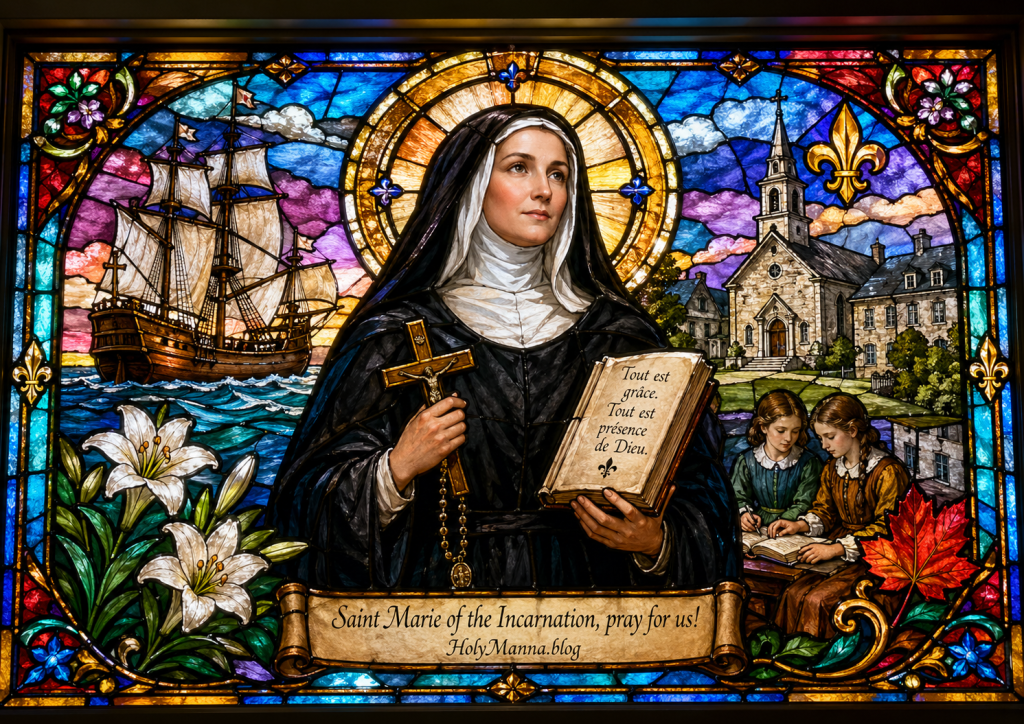
The Mother of New France Who Gave God Everything
Saint Marie of the Incarnation, born Marie Guyart, is one of the most fascinating women in Catholic history. She was a wife, mother, widow, businesswoman, Ursuline nun, mystic, missionary, teacher, writer, linguist, and foundress of the Ursulines of Québec. The Church remembers her as one of the great spiritual mothers of Canada, sometimes called the “Mother of the Catholic Church in Canada,” because her life helped shape the Catholic roots of New France.
She was born in France, but her heart was stretched across the ocean. She lived in the world, managed practical responsibilities, raised a son, carried deep grief, entered religious life, and then crossed the Atlantic in 1639 to help bring Catholic education and missionary life to Québec. She taught French and Indigenous girls, learned Indigenous languages, wrote catechetical materials, helped build a monastery, rebuilt it after fire, and left behind spiritual writings so profound that she was later called the “Teresa of New France.”
Her life matters because she shows that holiness is not only for people with quiet lives. Holiness can grow in family life, financial stress, widowhood, motherhood, business, grief, prayer, leadership, sacrifice, and mission. Her life beautifully reflects what The Catechism of the Catholic Church teaches about the missionary nature of the Church: the Church is sent by Christ to all nations, and every Christian life is called to become a witness to Him. CCC 849 teaches that the Church is missionary by her very nature because she draws her origin from the mission of the Son and the Holy Spirit.
Saint Marie lived that mission with courage. She did not keep her faith as a private comfort. She let Christ turn her whole life into a gift.
The Little Girl Who Said Yes to Jesus
Marie Guyart was born on October 28, 1599, in Tours, France. Her father, Florent Guyart, was a master baker, and her mother, Jeanne Michelet, raised Marie in a Catholic home. From childhood, Marie showed a lively intelligence, a strong memory, and a deep attraction to prayer. She listened carefully to sermons and could repeat much of what she heard. Even as a little girl, her heart seemed unusually open to God.
One of the most famous stories from her childhood happened when she was about seven years old. Catholic tradition says she had a dream or vision in which Our Lord came toward her and asked, “Do you want to be mine?” Marie answered, “Yes.”
That simple yes became the pattern of her entire life.
Because this story involves a private mystical grace, it should be treated with Catholic care. The Church does not require the faithful to believe private revelations as part of the deposit of faith. The Catechism teaches in CCC 67 that private revelations do not improve or complete Christ’s definitive Revelation, but they may help the faithful live the Gospel more fully in a particular moment of history. In Marie’s life, this childhood encounter became a kind of spiritual seed. Everything that followed looked like one long answer to Christ’s question.
As a young girl, Marie felt drawn toward religious life. Around the age of fourteen, she desired to give herself completely to God. Her parents, however, believed marriage was the proper path for her. In obedience to them, she married Claude Martin, a silk worker, when she was still very young.
This did not mean God had forgotten her vocation. It meant He was forming her through real life.
Wife, Mother, Widow, and Woman of Conversion
Marie’s married life was short and difficult. Her husband died after only about two years of marriage, leaving her a widow around the age of nineteen. She was also the mother of an infant son, Claude. To make things harder, her husband’s business was in serious financial trouble, and Marie had to help settle its affairs.
This is where her sanctity begins to look very practical. She was not yet a missionary foundress. She was a grieving young widow with a baby, debts, and responsibilities. Yet God was already shaping her into a woman of strength.
On March 24, 1620, Marie experienced a profound conversion. As she went about her day, she suddenly saw her sins and imperfections with painful clarity. She understood them in the light of Christ’s Blood and mercy. She went to confession and came away changed. This was not a shallow emotional moment. It became a turning point in her soul.
She later made a vow of chastity and continued to deepen her prayer life under spiritual direction. Her conversion reminds us that saints are not people who never needed mercy. Saints are people who let mercy tell the truth about their souls and then let grace rebuild them.
Marie’s life also shows the dignity of ordinary work. Her brother-in-law later entrusted her with major responsibilities in his transportation business. She supervised workers, managed accounts, oversaw loading and unloading, handled practical disputes, and showed remarkable judgment. She could pray deeply and still deal with money, contracts, horses, goods, and tired workers.
This is one of the most surprising parts of her story. Before she became known as a mystic of New France, she was a highly capable businesswoman. She learned leadership in the middle of noise, pressure, and responsibility. She also cared for the workers, corrected blasphemy, and tried to bring Christian charity into a rough working environment.
Saint Marie reminds modern Catholics that holiness does not begin only when life becomes quiet. It begins when ordinary duties are offered to God.
The Mother Who Entered the Convent
In 1631, Marie entered the Ursuline monastery in Tours and took the religious name Marie of the Incarnation. This decision was deeply painful because her son Claude was about twelve years old. She entrusted him to family and to proper care, but the separation wounded him greatly.
A famous story says that Claude came to the monastery crying out, “Give me my mother back!” Some retellings even say he and other boys tried to get her out of the convent. This story is often repeated in Catholic accounts of her life, though the details are difficult to verify completely. What can be said with certainty is that the separation was real, painful, and human.
This part of her story should never be flattened into something easy. Marie was not escaping motherhood. She was following a radical call from God, and that call cost her dearly. Her son eventually became a Benedictine monk, Dom Claude Martin, and later helped preserve and publish her writings. Near the end of her life, Marie sent him a tender message: “I am carrying him with me in my heart.”
That line reveals the truth of her motherhood. Her vocation did not erase her love for her son. It purified it, stretched it, and placed it inside the Heart of Christ.
Her life also reflects the Catholic meaning of consecrated life. The Catechism teaches in CCC 916 that the consecrated state is one way of living a more intimate dedication to God, rooted in baptism and ordered toward the Kingdom. Marie’s vocation was not a rejection of the world because the world was bad. It was a total gift of herself to Christ for the salvation of souls.
The Dream of Canada and the Call Across the Sea
While living as an Ursuline, Marie began to sense a missionary call. One of the most famous stories associated with her is a prophetic dream of a vast country filled with mountains, valleys, and thick fog. She later recognized this land as Canada. She came to believe that God was calling her to New France to establish a house dedicated to Jesus and Mary.
This dream is another private mystical story, not something Catholics are required to believe as doctrine. Still, it became deeply important in her discernment and is part of the Catholic memory of her life.
Her desire was also strengthened by the missionary reports coming from New France, especially through the Jesuit missions. Eventually, she met Madeleine de la Peltrie, a wealthy widow who wanted to use her fortune for the mission in Canada. Together with other Ursulines and Hospital Sisters, Marie sailed from Dieppe on May 4, 1639, and arrived in Québec on August 1, 1639.
The crossing was dangerous. One famous story says their ship came close to striking an iceberg. Whether every detail can be verified or not, the danger of the voyage itself was real. These women were leaving the world they knew for a fragile colony across the ocean. They were not chasing comfort. They were going because they believed Christ had called them.
That is missionary courage. Not recklessness. Not adventure for its own sake. Missionary courage is love willing to cross an ocean.
The “Louvre” of Québec and the School of Souls
When Marie arrived in Québec, the settlement was small, poor, and vulnerable. The first Ursuline dwelling was so rough that Marie jokingly called it her “Louvre.” The sisters lived in poverty, endured the cold, and began their work with very little.
Their mission was education and evangelization. Marie helped establish a school for girls, serving both French and Indigenous children. The Ursulines taught reading, writing, sewing, Christian doctrine, and practical skills. They also welcomed adults who came for food, counsel, catechesis, or help.
Marie’s work was deeply Catholic because it joined truth and charity. She wanted souls to know Christ, but she also fed bodies, taught skills, listened to people, and created a place of stability in a fragile new world.
She also learned Indigenous languages after the age of forty, which is astonishing. She worked on catechisms, dictionaries, grammars, and prayer materials in First Nations languages. Many of these works were later lost, but her effort reveals her missionary seriousness. She wanted people to hear the Gospel in words they could understand.
A careful Catholic account should also speak honestly about the colonial setting. Some ideas common in seventeenth-century missionary culture, especially around “civilizing” Indigenous peoples, must not be repeated uncritically today. Marie herself came to understand that Indigenous girls could not simply be made into French girls. Yet her better legacy is clear: she loved, taught, welcomed, translated, served, and gave herself for the salvation and education of those entrusted to her.
Her life is a reminder that the Gospel must be preached with conviction, but also with humility, patience, and respect for the dignity of every person made in the image of God. CCC 1700 teaches that the dignity of the human person is rooted in being created in the image and likeness of God. Marie’s mission, at its best, sought to serve that dignity through faith, education, and charity.
The Mystic Who Managed Contracts
Saint Marie’s life in Québec was full of hardship. There were harsh winters, poverty, illness, danger, hunger, and war. Iroquois attacks brought fear and suffering to the colony. Farms were destroyed. Friends and servants were killed. At times, the convent itself was threatened.
Then, on December 31, 1650, disaster struck when fire destroyed the Ursuline monastery. For many communities, that could have been the end. For Marie, it became another act of trust.
She helped lead the rebuilding. She handled finances, contracts, correspondence, practical decisions, and daily needs. She encouraged the sisters, reached out for help, and kept the mission alive. By May 1651, the new monastery was opened.
This is why she is such a powerful saint for modern Catholics. She was a mystic, but she was not vague. She was spiritual, but she was not impractical. She knew how to pray, and she knew how to build.
One of her most famous sayings captures her spirituality beautifully: “God never led me by a spirit of fear, but by love and trust.”
That line could summarize her whole life. She crossed the ocean in love and trust. She surrendered her son in love and trust. She rebuilt after fire in love and trust. She faced danger in love and trust.
She also wrote of her relationship with God, “My life consists of this exchange.” In context, this “exchange” meant the movement of love between God and the soul. She received from God, then gave herself back to God through prayer, sacrifice, service, and mission.
Stories of Heavenly Help and Private Graces
Several mystical stories are associated with Saint Marie during her lifetime. Catholic tradition remembers her childhood vision of Christ, her deep conversion experience in 1620, her prophetic dream of Canada, and her sense of divine guidance in mission.
There are also stories of Marian closeness. During the rebuilding of the convent, tradition says Marie spoke to the Blessed Virgin Mary with simple affection, praying words like, “Come, Blessed Mother, let’s go see our workers.” This story reflects her Marian confidence, though it should be understood as a devotional tradition rather than a public miracle formally required for belief.
Another story says Saint Joseph appeared to her and offered to guide her steps in Canada. Again, this belongs to the realm of private mystical favors and cannot be treated as public revelation. Still, it fits the devotional pattern of her life. Marie had great trust in the Holy Family, and she saw her mission as a house built for Jesus and Mary under the providence of God.
When speaking of miracles during her life, it is important to be precise. Saint Marie is not mainly remembered for public miracle-working in the way some saints are. She is remembered for mystical graces, prophetic dreams, spiritual insight, heroic perseverance, and the providential survival of her mission through danger, poverty, fire, and war. These are not all “miracles” in the formal canonization sense, but they are part of the Catholic memory of her holiness.
A Saint Who Suffered Without Becoming Bitter
Saint Marie was not a martyr in the sense of dying violently for the faith. She died after years of exhausting labor, illness, and sacrifice. But her life included real suffering.
She suffered the death of her husband, financial anxiety, separation from her son, the pain of misunderstanding, the hardships of religious life, the danger of sea travel, the poverty of New France, the destruction of the convent by fire, threats of war, illness, and the heavy burden of leadership.
Yet she did not become bitter.
That is one of her quiet miracles. She kept saying yes.
Her courage was not loud or dramatic. It was steady. She did the next faithful thing. She prayed. She taught. She wrote. She rebuilt. She corrected. She comforted. She trusted.
This is the kind of holiness most Catholics need to see. Not every saint dies in an arena. Some saints become holy by staying faithful when life keeps asking for more.
The Letter of James teaches, “Blessed is the man who remains steadfast under trial.” James 1:12. Saint Marie lived that kind of steadfastness.
Death, Veneration, and the Long Memory of the Church
Saint Marie of the Incarnation died in Québec on April 30, 1672. She was seventy-two years old. She had spent more than three decades in New France, forming the Ursuline mission, teaching, writing, praying, leading, and serving.
After her death, she was quickly venerated by many as a saintly woman. Objects associated with her were sought as relics, and her memory remained strong among the Ursulines and the Catholic people of Québec. Her son Dom Claude Martin helped preserve her story by publishing her life and writings.
Her cause moved slowly through history. Political changes after the British conquest of Canada delayed parts of the process, but devotion to her endured. Her heroic virtues were recognized in 1911. Pope Saint John Paul II beatified her on June 22, 1980. Pope Francis canonized her on April 3, 2014.
One important detail should be understood. Saint Marie was canonized by equivalent canonization. That means Pope Francis extended her veneration to the universal Church based on her ancient and continuous reputation for holiness, heroic virtue, orthodox faith, and long-standing devotion. Public Catholic sources do not present her canonization as depending on one newly approved medical miracle in the usual modern process.
So, when discussing miracles after her death, the most honest Catholic answer is this: the Church recognized her enduring fame of sanctity and miracles, and many have sought her intercession, but the public record does not center on one easily named, modern, medically verified miracle. Her after-death impact is seen especially in her continued veneration, the preservation of her writings, the endurance of the Ursuline mission, the devotion of pilgrims, and the Church’s formal recognition of her sanctity.
Her tomb and memory remain honored in Québec. The Ursuline monastery became one of the great religious, educational, and cultural landmarks of Catholic Canada. The Centre Marie-de-l’Incarnation and the Ursuline heritage in Québec continue to preserve her story, writings, and spiritual influence. Her feast day is celebrated on April 30.
A moving sign of her cultural impact came long after her death. In the nineteenth century, members of the Huron-Wendat community of Lorette supported her cause for beatification in gratitude for what the Ursulines had done for their ancestors. That detail shows how her life remained part of the memory of both Catholic Canada and the peoples touched by the early mission.
The Teresa of New France
Saint Marie left behind a remarkable body of writing. Nearly 300 of her letters have survived, and she likely wrote many more. Her letters describe spiritual experiences, missionary challenges, daily life in New France, the education of girls, relationships with Indigenous peoples, practical problems, and the deep movements of grace in her soul.
Her mystical writings were so respected that Bishop Jacques-Bénigne Bossuet famously called her the “Teresa of New France,” comparing her spiritual depth to Saint Teresa of Ávila.
That comparison matters. Saint Teresa of Ávila was a great reformer, mystic, and Doctor of the Church. Saint Marie was not declared a Doctor of the Church, but her life carries a similar combination of prayer and reforming energy. She knew the heights of contemplation, but she also knew how to organize a community and solve practical problems.
She is a saint for anyone who thinks they are too busy to pray, and for anyone who thinks prayer makes practical responsibility less important. In her life, prayer made action stronger, and action became a place where prayer bore fruit.
What Saint Marie Teaches Today
Saint Marie of the Incarnation teaches that God can use every chapter of a life. Childhood longing, marriage, motherhood, widowhood, work, grief, religious life, mission, failure, rebuilding, and old age can all become holy when surrendered to Christ.
She teaches that faith is not fear. Her words are worth carrying into everyday life: “God never led me by a spirit of fear, but by love and trust.”
That does not mean life becomes easy. It means fear does not get to be the master.
She teaches parents that love is not possession. She teaches workers that business and responsibility can become places of sanctification. She teaches religious men and women that consecration must become service. She teaches teachers that education is a work of mercy. She teaches missionaries that the Gospel must be preached with courage, patience, humility, and love.
She also teaches modern Catholics that the Church is built by people who say yes in hidden ways. A monastery, a school, a mission, a family, a parish, or a vocation is rarely built by dramatic gestures alone. It is built by daily surrender.
What part of life is God asking to receive as a gift today? What responsibility might become holy if it were offered to Christ instead of carried alone? Where is fear being invited to give way to love and trust?
Saint Marie’s life gives a simple answer: say yes, and then keep saying yes.
Engage With Us!
Share your thoughts and reflections in the comments below. Saint Marie of the Incarnation lived an extraordinary life, but her holiness was built through very ordinary things: work, motherhood, prayer, sacrifice, teaching, leadership, grief, and trust.
- What part of Saint Marie’s life speaks most powerfully to your own faith journey?
- Where do you need to hear her reminder that God leads not by fear, but by love and trust?
- How can ordinary responsibilities, family duties, work, or hardship become a place of holiness in your life?
- What would it look like to say yes to Christ with the same courage Saint Marie showed?
May Saint Marie of the Incarnation pray for all who teach, all who lead, all who are rebuilding after loss, all mothers, all missionaries, and all who want to belong more completely to Christ. May her life encourage every Catholic heart to live with courage, serve with mercy, and do everything with the love and compassion Jesus taught us.
Saint Marie of the Incarnation, pray for us!
Follow us on YouTube, Instagram and Facebook for more insights and reflections on living a faith-filled life.


Leave a Reply