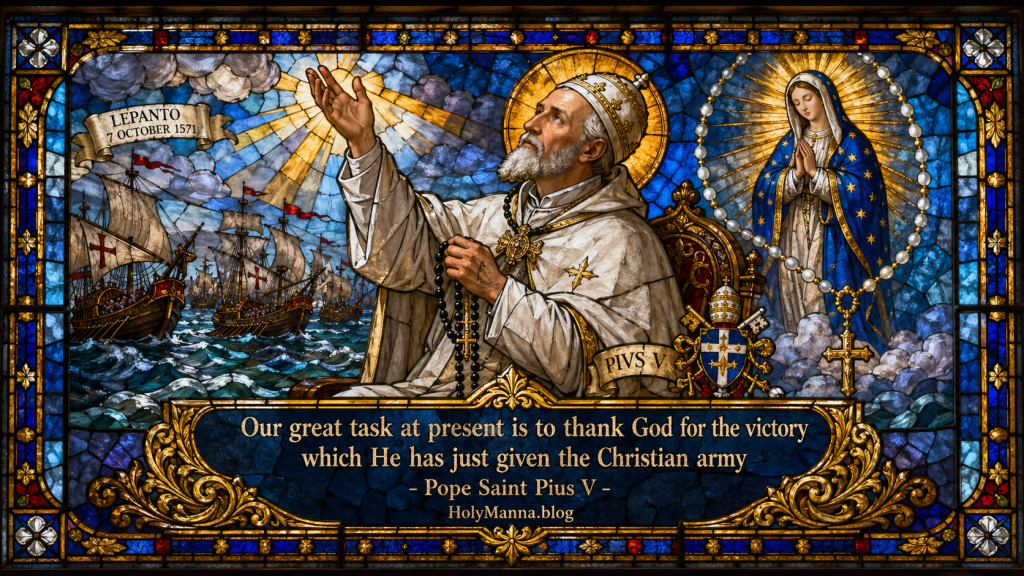
The Friar Pope Who Armed the Church with the Rosary
Pope Saint Pius V was not the kind of pope who entered history quietly. He lived during one of the most dangerous and confusing periods in Catholic history, when the Protestant Reformation had torn through Europe, many clergy needed reform, Catholic doctrine was under attack, and the Ottoman Empire threatened Christian Europe from the East.
Yet this pope did not respond first with comfort, diplomacy, or worldly strategy. He responded like a Dominican friar. He prayed. He fasted. He taught. He reformed. He disciplined. He trusted Our Lady.
Born Antonio Ghislieri, he became one of the great popes of the Catholic Reformation. As pope, he implemented the reforms of the Council of Trent, helped publish the Roman Catechism, revised the Roman Breviary, promulgated the Roman Missal of 1570, defended Catholic doctrine, promoted Saint Thomas Aquinas, and called Catholics to pray the Rosary before the famous Battle of Lepanto.
He is most remembered as the pope of reform, the pope of the Rosary, and the pope who helped steady the Church when she seemed surrounded by confusion inside and danger outside.
The Catechism of the Catholic Church teaches that the Church is always in need of purification and renewal, and that Christians are called to holiness in every state of life. As CCC 2013 says, “All Christians in any state or walk of life are called to the fullness of Christian life and to the perfection of charity.” Pope Saint Pius V shows what that looks like when the call to holiness reaches the Chair of Peter.
A Poor Boy Formed by Saint Dominic
Pope Saint Pius V was born on January 17, 1504, in Bosco Marengo, near Alessandria in northern Italy. His baptismal name was Antonio Ghislieri. His family was poor, though of noble background, and young Antonio grew up knowing work, sacrifice, and simplicity.
At the age of fourteen, he entered the Dominican Order, also known as the Order of Preachers. There he received the religious name Michele. This was not just a new name. It was the beginning of a whole new life.
The Dominicans formed him in prayer, study, discipline, preaching, Sacred Scripture, the Fathers of the Church, and the theology of Saint Thomas Aquinas. He was ordained a priest in 1528 and spent many years teaching philosophy and theology. He also served as novice master and prior, helping form younger friars in the same disciplined Catholic life that had shaped him.
Long before he became pope, Michele Ghislieri was known for austerity. He fasted. He prayed at night. He practiced penance. He preferred silence. He traveled on foot when possible. He spoke often of God and little of himself.
That matters because he did not suddenly become a reformer when he became pope. His public reform came from private conversion. His authority was rooted in the fact that he first tried to master himself before he tried to govern others.
His personal motto was often remembered as “walk in the truth.” That phrase fits him beautifully. He was a Dominican to the core, convinced that truth was not an idea to admire from a distance, but a path to walk with discipline, courage, and love.
The Reluctant Pope with a Friar’s Heart
Michele Ghislieri’s reputation for doctrinal clarity and moral seriousness led him into difficult offices. He served as an inquisitor, then as bishop, then as cardinal, and eventually as Grand Inquisitor. These roles can sound harsh to modern ears, and they belong to a very different historical world. But from a Catholic perspective, his concern was the preservation of souls and the defense of the faith during a time of real religious upheaval.
He became Bishop of Sutri and Nepi in 1556. In 1557, he was made a cardinal. Later, he was transferred to Mondovì, a diocese weakened by war and disorder. There he worked to restore Catholic faith, discipline, and pastoral life.
When Pope Pius IV died, Saint Charles Borromeo supported Ghislieri’s election. Ghislieri did not seek the papacy. Catholic tradition remembers him as reluctant, even tearful, before accepting the office. But once he accepted, he gave himself completely to the mission.
He was elected pope in 1566 and took the name Pius V.
Even as pope, he continued living like a friar. He wore the white Dominican habit, a practice often associated with the later custom of popes wearing white. He reduced luxury in the papal court. He gave generously to the poor. He visited hospitals. He comforted the dying. He washed the feet of the poor. One famous story says that an English nobleman converted after seeing Pius V kiss the ulcerated feet of a poor beggar.
That is the heart of this saint. He could confront kings, reform clergy, and govern the Church, but he could also kneel before the wounds of the poor and see Christ there.
As Jesus teaches in Matthew 25:40, “Whatever you did for one of these least brothers of mine, you did for me.” Pope Saint Pius V believed that with his whole life.
The Pope Who Put Trent into Motion
Pope Saint Pius V became pope after the Council of Trent, one of the most important councils in Church history. Trent had clarified Catholic doctrine against Protestant errors and called for deep reform in the Church. But a council does not implement itself. The Church needed leaders who would turn teaching into action.
Pius V became one of those leaders.
He required bishops to live in their dioceses instead of treating their office like an honorary title. He called priests to celibacy, discipline, reverence, and holiness. He pushed religious communities to return to the seriousness of their vows. He supported missions in the New World. He worked closely with Saint Charles Borromeo, another towering figure of Catholic reform.
He also promoted Saint Thomas Aquinas and helped ensure that Catholic theology remained rooted in clear, faithful, disciplined reasoning. In 1567, he declared Saint Thomas Aquinas a Doctor of the Church, giving even greater authority to the Angelic Doctor’s work.
This was not reform as marketing. This was reform as conversion.
Pius V understood something Catholics still need to remember. The Church is renewed when Catholics become holy. Structures matter. Teaching matters. Liturgy matters. Leadership matters. But without prayer, penance, truth, and charity, reform becomes only noise.
The Catechism teaches in CCC 827 that the Church is holy, yet made up of sinners, and therefore “is always in need of purification.” Pope Saint Pius V took that seriously. He did not want a comfortable Church. He wanted a faithful Church.
The Catechism, the Breviary, and the Roman Missal
One of the most lasting contributions of Pope Saint Pius V was his work in Catholic teaching and worship.
Under his authority, the Roman Catechism, also known as the Catechism of the Council of Trent, was published to help parish priests teach the Catholic faith clearly. This was especially important because many ordinary Catholics were confused by the religious arguments of the age. The Church needed priests who could explain the faith with clarity, confidence, and fidelity.
He also revised the Roman Breviary, the official prayer of the Church prayed especially by priests and religious. This helped restore order and unity to the Church’s daily prayer.
Then came one of his most famous acts: the promulgation of the Roman Missal of 1570.
This Missal shaped the Roman Rite for centuries. It is often associated with what many Catholics call the Tridentine Mass. Pius V did not invent the Mass. He did not create worship from nothing. Rather, he sought to preserve, purify, and standardize the Roman liturgy according to ancient and approved sources after the Council of Trent.
For Pius V, the Mass was not a religious performance. It was the worship of Almighty God. It was the Sacrifice of Christ made present sacramentally on the altar.
The Catechism teaches in CCC 1324, “The Eucharist is the source and summit of the Christian life.” Pius V’s liturgical reforms were rooted in that truth. If the Eucharist is the source and summit, then worship must be reverent, faithful, and protected from confusion.
The Pope of the Rosary and the Battle of Lepanto
The most famous event associated with Pope Saint Pius V is the Battle of Lepanto on October 7, 1571.
At that time, the Ottoman Empire posed a serious threat to Christian Europe. Pius V helped organize the Holy League, a coalition of Catholic forces. But he knew that ships, soldiers, and strategy were not enough. He called Catholics throughout Europe to pray the Rosary.
This is where history and Catholic memory meet in a powerful way.
As the Christian fleet faced the Ottoman navy, Pius V asked the faithful to turn to Our Lady. The Rosary became the spiritual weapon of the Church. On October 7, 1571, the Christian fleet won a stunning victory at Lepanto.
Catholic tradition says that Pius V received mystical knowledge of the victory before official messengers arrived. According to the famous story, he was meeting with cardinals when he suddenly stopped, opened a window, looked toward heaven, and said, “A truce to business; our great task at present is to thank God for the victory which He has just given the Christian army.”
This story is one of the most beloved traditions associated with him. It is rooted in Catholic devotional memory, though the exact details belong to the realm of sacred tradition and hagiographical storytelling rather than modern battlefield reporting.
After the victory, Pius V established the Feast of Our Lady of Victory. Later, this feast became known as Our Lady of the Rosary.
This is why Pope Saint Pius V is so deeply connected to the Rosary. He did not treat Marian devotion as decoration. He saw it as a powerful part of Catholic life. He reportedly prayed the whole Rosary daily, even with the immense burdens of the papacy.
The lesson is still timely. Catholics do not pray the Rosary because life is easy. Catholics pray the Rosary because life is a battle, and Our Lady leads souls to Jesus.
As Mary says in John 2:5, “Do whatever he tells you.” That is the whole purpose of Marian devotion. Mary does not distract from Christ. She brings souls to Him.
Miracles, Legends, and Signs of Divine Protection
Several miracle stories and legends are associated with Pope Saint Pius V. Some are more firmly rooted in Catholic historical memory, while others should be treated as devotional legends that cannot be fully verified.
The victory at Lepanto is the most important miracle-like event connected to him. The Church remembers it not simply as a military victory, but as a providential victory connected to prayer, the Rosary, and the intercession of the Blessed Virgin Mary. Catholics do not have to deny the courage of sailors or the skill of commanders to recognize the deeper spiritual meaning. God works through human means, and Pius V believed that victory belonged first to God.
Another famous legend is the story of the poisoned crucifix. According to devotional tradition, enemies of Pius V poisoned the feet of a crucifix that he was accustomed to kiss. When he approached to kiss the crucifix, the feet of Christ withdrew or detached, saving him from death. This story cannot be verified with the certainty of official historical documentation, but it has remained part of the devotional memory surrounding the saint.
There are also traditions of healings and divine favors associated with blessed objects connected to him, including Agnus Dei sacramentals made of blessed wax. These stories belong to traditional Catholic hagiography and should be treated carefully as pious traditions rather than fully verified miracles.
After his death, miracles were attributed to his intercession. Early Catholic biographers recorded many such accounts, and miracles connected to his cause were examined before his beatification and canonization. He was beatified by Pope Clement X in 1672 and canonized by Pope Clement XI in 1712.
The larger Catholic point is not that every legend can be proven by modern standards. The point is that the Church recognized heroic sanctity in him and, after careful discernment, raised him to the altars as a saint.
The Crosses He Carried in a Violent Century
Pope Saint Pius V lived in a hard age, and his papacy reflected that. He governed during the Protestant Reformation, the Catholic Reformation, Ottoman expansion, religious wars, political instability, and conflict between Catholic rulers.
He was severe. He strengthened the Roman Inquisition. He opposed Protestantism. He excommunicated Queen Elizabeth I of England in 1570. He supported Catholic causes across Europe. These actions belong to a sixteenth-century world where religion, politics, monarchy, rebellion, and national identity were deeply entangled.
A Catholic storyteller should not pretend these hard edges do not exist. Saints are not canonized because every political decision they made must be copied in every age. They are canonized because they practiced heroic virtue and now share in the glory of God.
Pius V was a saint in a dangerous century. He acted with the tools and assumptions of his time. His enduring witness is not a call to imitate every political action of the sixteenth century, but to imitate his courage, prayer, discipline, love for truth, reverence for the Eucharist, devotion to Mary, and commitment to reform beginning with personal holiness.
The Catechism teaches in CCC 946 that “the communion of saints is the Church.” That is the right lens. Catholics honor Pius V as a member of Christ’s Body whose holiness continues to strengthen the faithful.
A Holy Death and a Lasting Legacy
Pope Saint Pius V died on May 1, 1572, after suffering painful illness. Near death, he is remembered as praying, “O Lord, increase my sufferings and my patience!”
That prayer says so much about him. He did not ask first for comfort. He asked for patience. He wanted to suffer as a Christian, united to Christ.
He was buried in Rome, and his relics are venerated in the Basilica of Saint Mary Major. His feast is celebrated on April 30.
His legacy is enormous. He helped shape Catholic worship for centuries through the Roman Missal. He strengthened Catholic teaching through the Roman Catechism. He gave momentum to the Catholic Reformation. He promoted Saint Thomas Aquinas. He helped restore clerical discipline. He called the Church to pray the Rosary in a moment of crisis. He left Catholics with a model of reform rooted not in trendiness, but in truth.
Pope Saint Pius V reminds the Church that holiness is not passive. Sometimes holiness reforms. Sometimes holiness confronts. Sometimes holiness fasts, teaches, corrects, prays, and suffers. But authentic holiness always leads back to Jesus Christ.
When the Church Needs Reform, Saints Must Rise
Pope Saint Pius V’s life speaks powerfully to Catholics today. The Church still faces confusion. Families still need formation. Parishes still need reverence. Catholics still need courage. The world still tempts believers to compromise truth for comfort.
Pius V would likely remind modern Catholics that reform begins close to home.
Pray the Rosary. Go to Mass with reverence. Learn the faith. Read the Catechism. Study Scripture. Make a good confession. Practice penance. Serve the poor. Speak the truth with charity. Do not wait for the whole Church to become perfect before becoming serious about holiness.
His life also reminds Catholics that Marian devotion is not weakness. It is trust. A child who runs to his mother in danger is not foolish. He is wise. The Rosary forms the heart to meditate on the mysteries of Christ through the eyes of Mary.
What battles in life need to be brought to Our Lady through the Rosary?
What part of the heart needs reform before asking God to reform the world?
Where is Christ asking for more courage, more discipline, and more love?
Pope Saint Pius V was a poor boy, a Dominican friar, a reforming pope, and a saint of the Rosary. His life tells every Catholic that the Church is renewed when souls return to Christ with humility, truth, and perseverance.
Engage with Us!
Share your thoughts and reflections in the comments below. Pope Saint Pius V lived in a time of crisis, but his response was prayer, reform, truth, and trust in Our Lady. His life gives Catholics today plenty to reflect on, especially when the world feels confused and the Church feels tested.
- What part of Pope Saint Pius V’s life challenges you the most: his discipline, his courage, his prayer, or his devotion to the Rosary?
- How can you make the Rosary a stronger part of your daily or weekly spiritual life?
- Where might God be asking you to begin reform in your own life before looking at the problems around you?
- How can reverence for the Eucharist shape the way you attend Mass, pray, and live during the week?
- What does it mean for you personally to “walk in the truth” in a world that often prefers comfort over conviction?
May Pope Saint Pius V pray for all Catholics to love the truth, honor the Eucharist, trust Our Lady, and live with holy courage. May his example inspire a deeper faith, a stronger prayer life, and a greater desire to do everything with the love and mercy Jesus taught us.
Pope Saint Pius V, pray for us!
Follow us on YouTube, Instagram and Facebook for more insights and reflections on living a faith-filled life.


Leave a Reply