Thursday of the Fourth Week of Easter – Lectionary: 282
The Promise Kept by the Servant King
God’s faithfulness is not a vague feeling in Scripture. It is a story, a covenant, a kingdom, and finally, a Person.
Today’s readings invite us to follow that story from Israel’s long memory to the Upper Room where Jesus reveals the heart of His mission. In Acts 13:13-25, Saint Paul stands in the synagogue at Antioch in Pisidia and retells salvation history as a story of divine patience. God chose Israel, led His people out of Egypt, endured their wandering in the desert, gave them the land, raised up David, and from David’s descendants brought forth the promised Savior, Jesus Christ. Paul is showing that Christianity is not a break from Israel’s hope, but its fulfillment.
The Responsorial Psalm, Psalm 89, gives the prayerful heartbeat of that promise: “I will sing of your mercy forever, Lord.” God’s covenant with David was never merely about earthly power. It pointed forward to Christ, the true Son of David, the Anointed One, the King whose strength is mercy and whose throne is the Cross. As The Catechism of the Catholic Church teaches, Jesus fulfills Israel’s messianic hope as priest, prophet, and king.
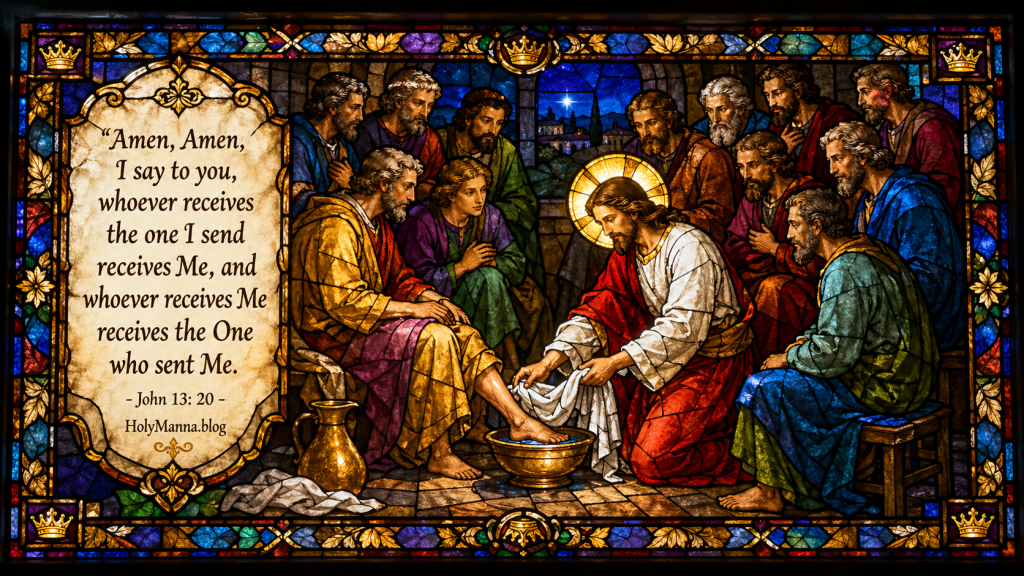
Then the Gospel from John 13:16-20 reveals what kind of King this promised Savior truly is. Jesus has washed His disciples’ feet, and now He tells them, “No slave is greater than his master nor any messenger greater than the one who sent him.” The King promised through David is also the humble Servant. The One sent by the Father now sends His apostles, and through them His Church, to carry His presence into the world.
The central theme is clear: God keeps His promises in Jesus Christ, and those who receive Him are sent to serve in His name.
Today’s readings prepare the heart to see Catholic discipleship as something both ancient and deeply practical. The faith is apostolic, rooted in God’s covenant promises, fulfilled in Christ, and lived through humble service. If Jesus reigns by serving, what should His followers look like in everyday life?
First Reading – Acts 13:13-25
The Long Road of Mercy That Leads to Jesus
The First Reading brings us into one of the most important missionary moments in the early Church. Paul and his companions have traveled from Cyprus into Asia Minor, and they arrive at Antioch in Pisidia, a Roman colony with a Jewish synagogue and a community of Gentile “God-fearers.” These God-fearers were non-Jews who worshiped the God of Israel, respected the Jewish Scriptures, and were drawn to the moral and spiritual beauty of the covenant, even if they had not fully entered Judaism.
On the Sabbath, Paul enters the synagogue, listens to the reading of the Law and the Prophets, and is invited to speak. He does not begin with a sales pitch or a personal testimony. He begins with salvation history. He retells the story of Israel as one long act of God’s mercy, moving from the patriarchs, through Egypt, the wilderness, the judges, Saul, David, John the Baptist, and finally to Jesus Christ.
This fits beautifully with today’s central theme: God keeps His promises in Jesus Christ, and those who receive Him are sent to serve in His name. Paul shows that Jesus is not an unexpected interruption in history. He is the promised Savior, the Son of David, the fulfillment of everything God had been preparing from the beginning.
Acts 13:13-25 – New American Bible (Revised Edition)
Paul’s Arrival at Antioch in Pisidia. 13 From Paphos, Paul and his companions set sail and arrived at Perga in Pamphylia. But John left them and returned to Jerusalem. 14 They continued on from Perga and reached Antioch in Pisidia. On the sabbath they entered [into] the synagogue and took their seats. 15 After the reading of the law and the prophets, the synagogue officials sent word to them, “My brothers, if one of you has a word of exhortation for the people, please speak.”
Paul’s Address in the Synagogue. 16 So Paul got up, motioned with his hand, and said, “Fellow Israelites and you others who are God-fearing, listen. 17 The God of this people Israel chose our ancestors and exalted the people during their sojourn in the land of Egypt. With uplifted arm he led them out of it 18 and for about forty years he put up with them in the desert. 19 When he had destroyed seven nations in the land of Canaan, he gave them their land as an inheritance 20 at the end of about four hundred and fifty years. After these things he provided judges up to Samuel [the] prophet. 21 Then they asked for a king. God gave them Saul, son of Kish, a man from the tribe of Benjamin, for forty years. 22 Then he removed him and raised up David as their king; of him he testified, ‘I have found David, son of Jesse, a man after my own heart; he will carry out my every wish.’ 23 From this man’s descendants God, according to his promise, has brought to Israel a savior, Jesus. 24 John heralded his coming by proclaiming a baptism of repentance to all the people of Israel; 25 and as John was completing his course, he would say, ‘What do you suppose that I am? I am not he. Behold, one is coming after me; I am not worthy to unfasten the sandals of his feet.’
Detailed Exegesis
Verse 13 – “From Paphos, Paul and his companions set sail and arrived at Perga in Pamphylia. But John left them and returned to Jerusalem.”
This verse quietly shows the human side of apostolic mission. Paul and his companions are traveling through difficult terrain, bringing the Gospel into new regions. John Mark leaves them and returns to Jerusalem, which later becomes a point of tension between Paul and Barnabas. The mission of the Church is holy, but it is also carried by real people with real limits, fears, disagreements, and weaknesses.
There is comfort in that. The Church’s mission does not depend on flawless personalities. It depends on the grace of Christ working through fragile disciples. Even when someone leaves, struggles, or fails to continue, God’s plan does not collapse.
Verse 14 – “They continued on from Perga and reached Antioch in Pisidia. On the sabbath they entered into the synagogue and took their seats.”
Paul follows a pattern that appears often in Acts of the Apostles. He begins in the synagogue because the Gospel is first proclaimed to Israel, the people of the covenant. This is not accidental. Catholic faith recognizes that Christianity is rooted in God’s promises to Israel. The Church does not erase Israel’s story. She receives its fulfillment in Christ.
By entering the synagogue on the Sabbath, Paul honors the rhythm of Jewish worship. He listens before he speaks. He enters the sacred setting where the Scriptures are read, and then he shows how those Scriptures lead to Jesus.
Verse 15 – “After the reading of the law and the prophets, the synagogue officials sent word to them, ‘My brothers, if one of you has a word of exhortation for the people, please speak.’”
The synagogue service included readings from the Law and the Prophets, followed by teaching or exhortation. Paul is invited to give a word of encouragement. What follows is one of the great apostolic sermons in Acts of the Apostles.
This matters because Paul’s preaching is not detached from Scripture. He reads Israel’s history as a Catholic should read Scripture: as a unified story fulfilled in Christ. The Old Testament prepares for the New, and the New Testament reveals the full meaning of the Old.
Verse 16 – “So Paul got up, motioned with his hand, and said, ‘Fellow Israelites and you others who are God-fearing, listen.’”
Paul addresses both Jews and God-fearing Gentiles. This already hints at the widening mission of the Church. The Gospel comes from Israel, but it is meant for all nations.
His word “listen” is more than a request for attention. In Scripture, listening means opening the heart to God’s action. Faith begins with hearing, and hearing becomes fruitful when it leads to obedience.
Verse 17 – “The God of this people Israel chose our ancestors and exalted the people during their sojourn in the land of Egypt. With uplifted arm he led them out of it.”
Paul begins with divine election. Israel did not choose itself into existence. God chose, formed, and rescued His people. The phrase “with uplifted arm” recalls the Exodus, when God delivered Israel from slavery with power and mercy.
This is the foundation of biblical faith. Salvation is not first about human achievement. It begins with God’s initiative. The same God who delivered Israel from Egypt now offers definitive deliverance from sin and death through Jesus Christ.
Verse 18 – “And for about forty years he put up with them in the desert.”
The forty years in the desert were a time of testing, purification, rebellion, mercy, and formation. Israel struggled to trust God, yet God remained faithful. Paul is reminding his listeners that God’s patience has always been part of the story.
This verse also speaks to every believer who has known spiritual wandering. God does not abandon His people because they are slow to trust Him. He disciplines, provides, forgives, and keeps leading them toward the promise.
Verse 19 – “When he had destroyed seven nations in the land of Canaan, he gave them their land as an inheritance.”
Paul moves from Exodus to the Promised Land. The inheritance of the land was a sign that God keeps His covenant promises. In the Old Testament, the land represented stability, worship, belonging, and blessing.
From a Catholic perspective, this inheritance points beyond itself. The earthly Promised Land prepares the imagination for the fuller inheritance offered in Christ: communion with God, life in the kingdom, and ultimately eternal life.
Verse 20 – “At the end of about four hundred and fifty years. After these things he provided judges up to Samuel the prophet.”
Paul compresses centuries of history into one sweeping movement of grace. The period of the judges was marked by cycles of sin, oppression, repentance, and deliverance. Again and again, Israel turned away from God. Again and again, God raised up deliverers.
Samuel stands at a turning point. He is both prophet and judge, the one through whom Israel moves toward monarchy. Paul is guiding his hearers toward David, because David’s line will become essential to understanding Jesus as the promised Messiah.
Verse 21 – “Then they asked for a king. God gave them Saul, son of Kish, a man from the tribe of Benjamin, for forty years.”
Israel’s request for a king was complicated. On one hand, kingship would become part of God’s providential plan. On the other hand, the request revealed Israel’s temptation to imitate surrounding nations rather than trust God as King.
Saul’s reign shows the tragedy of leadership without deep obedience. He had stature and authority, but he did not remain faithful to the Lord. Paul mentions Saul briefly because the main point is not Saul’s failure. The main point is what God does next.
Verse 22 – “Then he removed him and raised up David as their king; of him he testified, ‘I have found David, son of Jesse, a man after my own heart; he will carry out my every wish.’”
David becomes the key figure in Paul’s sermon because God makes a covenant with David, promising that his throne will endure. David is called “a man after my own heart” not because he was sinless, but because he returned to God with repentance and desired the Lord’s will.
This is important for Catholic spirituality. Holiness is not pretending to have no wounds or failures. Holiness is having a heart that turns back to God, seeks mercy, and wants to obey. David’s kingship points forward to Christ, the true Son of David, whose obedience is perfect and whose kingdom will never end.
Verse 23 – “From this man’s descendants God, according to his promise, has brought to Israel a savior, Jesus.”
This is the center of the reading. Everything Paul has said leads here. God chose Israel, rescued His people, endured their weakness, gave them leaders, raised up David, and kept His promise by bringing forth Jesus.
Jesus is not simply a teacher, prophet, or moral example. He is “a savior.” He is the fulfillment of the Davidic promise and the answer to Israel’s hope. The title Savior means that humanity does not merely need advice. Humanity needs rescue.
Verse 24 – “John heralded his coming by proclaiming a baptism of repentance to all the people of Israel.”
John the Baptist appears as the final prophetic witness before Christ’s public ministry. His baptism of repentance prepared Israel to receive the Messiah. John did not draw attention to himself. He prepared the way for Another.
Repentance is essential because the Savior must be received with a converted heart. Grace is offered freely, but the heart must turn toward God. John’s mission reminds every Catholic that preparation matters. Confession, prayer, humility, and conversion make room for Christ.
Verse 25 – “And as John was completing his course, he would say, ‘What do you suppose that I am? I am not he. Behold, one is coming after me; I am not worthy to unfasten the sandals of his feet.’”
John’s humility is stunning. He knows his mission, and he knows he is not the Messiah. He points away from himself and toward Jesus. In the ancient world, unfastening sandals was the work of a servant. John says he is not even worthy to perform that humble service for the One who is coming.
This completes Paul’s movement from promise to fulfillment. Israel’s history leads to David. David’s line leads to Jesus. John’s prophetic witness points directly to Him. The Savior has come, and the only fitting response is faith, repentance, and humble service.
Teachings
This reading teaches that salvation history is not random. God acts through time, through covenants, through chosen servants, and through real historical events. Paul’s sermon shows that the Old Testament is not merely background information for Christians. It is the sacred story that prepares for Christ.
The Catechism of the Catholic Church teaches this clearly in CCC 128: “The Church, as early as apostolic times, and then constantly in her Tradition, has illuminated the unity of the divine plan in the two Testaments through typology, which discerns in God’s works of the Old Covenant prefigurations of what he accomplished in the fullness of time in the person of his incarnate Son.”
That is exactly what Paul is doing. He is reading the Old Covenant in light of Christ. The Exodus, the wilderness, the judges, Samuel, Saul, David, and John the Baptist are not disconnected religious episodes. They are part of one divine plan fulfilled in Jesus.
The reading also reveals Jesus as the Christ, the Anointed One promised through David. The Catechism of the Catholic Church explains in CCC 436: “The word ‘Christ’ comes from the Greek translation of the Hebrew Messiah, which means ‘anointed.’ It became the name proper to Jesus only because he accomplished perfectly the divine mission that ‘Christ’ signifies.”
This is why Paul emphasizes David. The Messiah was expected to come from David’s line. Jesus fulfills that hope not by becoming another political ruler, but by becoming the Savior whose kingdom is eternal.
The Catechism of the Catholic Church also teaches in CCC 422: “‘But when the time had fully come, God sent forth his Son, born of woman, born under the law, to redeem those who were under the law, so that we might receive adoption as sons.’ This is ‘the gospel of Jesus Christ, the Son of God’: God has visited his people. He has fulfilled the promise he made to Abraham and his descendants. He acted far beyond all expectation, he has sent his own ‘beloved Son.’”
Paul’s sermon carries that same conviction. God has visited His people. God has fulfilled His promise. God has acted beyond all expectation.
Saint John Chrysostom, preaching on this passage, notices how Paul begins with God’s kindness before moving to Christ. Paul does not insult his hearers or dismiss their history. He honors the story they know, then shows its fulfillment. That is a deeply Catholic way to evangelize. Grace does not destroy what God has already prepared. Grace fulfills, heals, and elevates it.
Historically, this sermon also marks a major step in the Church’s missionary expansion. The Gospel is moving from Jerusalem and Judea into the wider Gentile world. Yet Paul does not water down the message. He proclaims Jesus as the Savior promised to Israel and offered for the salvation of all.
Reflection
This reading invites Catholics to see their own lives the way Paul sees Israel’s history. God has been working longer than anyone realizes. He was present in the beginning, patient in the wilderness, merciful after failure, faithful through delays, and always leading toward Christ.
Many people look at their lives as a scattered collection of mistakes, seasons, losses, blessings, and unanswered questions. Paul teaches a better way to see. Underneath the mess, God is writing a story of mercy. The Lord who carried Israel through the desert can carry a soul through confusion. The Lord who raised up David after Saul’s failure can bring renewal after disappointment. The Lord who sent John the Baptist to prepare the way can send voices, moments, and graces that prepare the heart for deeper conversion.
The practical call is simple but serious. Learn salvation history. Know the story of Scripture. See the Mass as the place where all of God’s promises meet in Christ. Practice repentance like those who heard John the Baptist. Point to Jesus like John did. Serve the mission like Paul did.
A Catholic life should become a witness that says, without needing to be dramatic, that God keeps His promises.
Where has God already shown patience in your story?
What part of your life feels like a wilderness, and how might God be forming you there instead of abandoning you?
Are there places where you are tempted to make yourself the center, when your real mission is to point others to Christ?
Paul’s message in Antioch still speaks today. The Savior has come. His name is Jesus. He is the fulfillment of the promise, the Son of David, the mercy of God made visible, and the only One worthy of the whole heart.
Responsorial Psalm – Psalm 89:2-3, 21-22, 25, 27
The Song of a Covenant That Finds Its King in Christ
The Responsorial Psalm gives today’s readings their prayerful heartbeat: “I will sing of your mercy forever, Lord.” After Saint Paul’s sermon in Acts 13:13-25, where he traces Israel’s history from Egypt to David and finally to Jesus, Psalm 89 teaches the Church how to respond. The proper response to God’s faithfulness is praise.
This psalm was originally a royal psalm rooted in the covenant God made with David. Israel remembered that God had chosen David, anointed him, strengthened him, and promised that his throne would endure. In the historical life of Israel, this promise was tested by sin, exile, political collapse, and suffering. Yet the Church reads this psalm in the light of Christ, the true Son of David, the Messiah, and the eternal King.
That is why this psalm fits so perfectly with today’s central theme. God keeps His promises in Jesus Christ, and those who receive Him are sent to serve in His name. The mercy promised to David is not lost in history. It becomes visible in Jesus, the King who reigns from the Cross and sends His Church to carry His mercy into the world.
Psalm 89:2-3, 21-22, 25, 27 – New American Bible (Revised Edition)
2 I will sing of your mercy forever, Lord
proclaim your faithfulness through all ages.
3 For I said, “My mercy is established forever;
my faithfulness will stand as long as the heavens.21 I have chosen David, my servant;
with my holy oil I have anointed him.
22 My hand will be with him;
my arm will make him strong.25 My faithfulness and mercy will be with him;
through my name his horn will be exalted.27 He shall cry to me, ‘You are my father,
my God, the Rock of my salvation!’
Detailed Exegesis
Verse 2 – “I will sing of your mercy forever, Lord, proclaim your faithfulness through all ages.”
This verse begins with praise that reaches beyond one generation. The psalmist does not say that God’s mercy should be remembered only in good times or only when life makes sense. He says, “forever.” Mercy is the great theme of Israel’s story, and it is the great theme of the Church’s story as well.
In the context of today’s readings, this verse echoes Paul’s preaching in Acts 13. God chose, rescued, endured, guided, and fulfilled His promise. The psalm teaches that salvation history should become worship. When Catholics remember what God has done, the proper response is not vague optimism. It is praise rooted in truth.
Verse 3 – “For I said, ‘My mercy is established forever; my faithfulness will stand as long as the heavens.’”
Here the psalm moves from human praise to divine stability. God’s mercy is “established”, meaning it is not fragile, temporary, or dependent on human moods. His faithfulness stands “as long as the heavens.”
This matters because the covenant with David would face many visible threats. Kings would fail. Jerusalem would fall. Israel would suffer. Yet God’s promise would not die. From a Catholic perspective, this verse finds its deepest fulfillment in Christ. Jesus is the living proof that God’s mercy is not defeated by human sin, political disaster, betrayal, or even death.
Verse 21 – “I have chosen David, my servant; with my holy oil I have anointed him.”
David is chosen before he is crowned. His kingship begins with God’s initiative, not human ambition. The anointing with holy oil marks him as set apart for a sacred mission.
This verse points directly to the meaning of the word “Christ,” which means “Anointed One.” David’s anointing prepares the imagination of Israel for the greater Anointed One to come. Jesus is not merely another ruler in David’s line. He is the fulfillment of David’s line. He is the King anointed by the Holy Spirit, sent by the Father, and revealed as Savior.
Verse 22 – “My hand will be with him; my arm will make him strong.”
God does not merely choose David and then leave him alone. God promises His presence and strength. The “hand” and “arm” of the Lord are biblical images of divine power, protection, and action.
In today’s First Reading, Paul recalls that God led Israel out of Egypt “with uplifted arm.” Now Psalm 89 says that same divine strength will uphold David. The message is clear. God’s mission depends on God’s power. This becomes even clearer in Christ, whose strength is revealed not through worldly domination, but through humble obedience, suffering love, and the victory of the Resurrection.
Verse 25 – “My faithfulness and mercy will be with him; through my name his horn will be exalted.”
God promises that David’s kingship will be surrounded by “faithfulness and mercy.” These are covenant words. They speak of God’s steady, loyal love, the kind of love that remains even when human beings are weak.
The phrase “his horn will be exalted” is an ancient image of strength, honor, and victory. In Christ, this victory is transformed. The Son of David is exalted, but first He is lifted up on the Cross. His triumph is not the kind the world expects. It is the triumph of mercy over sin and life over death.
Verse 27 – “He shall cry to me, ‘You are my father, my God, the Rock of my salvation!’”
This verse reveals the intimate relationship between the king and God. David’s greatness is not only political. It is filial. He can cry out to God as Father, God, and Rock.
In the fullness of revelation, this points beyond David to Jesus Christ, the eternal Son of the Father. Jesus does not merely call God Father by adoption or covenant favor. He is the only-begotten Son. Through Him, believers are brought into the grace of divine sonship. The King who cries to the Father teaches His people to do the same.
Teachings
Psalm 89 teaches that God’s covenant promises are trustworthy, even when history looks unstable. The covenant with David is one of the great pillars of salvation history. It prepares Israel to hope for the Messiah, the Son of David, whose kingdom would not pass away.
The Catechism of the Catholic Church explains David’s place in prayer and salvation history in CCC 2579: “David is par excellence the king ‘after God’s own heart,’ the shepherd who prays for his people and prays in their name. His submission to the will of God, his praise, and his repentance, will be a model for the prayer of the people. His prayer, the prayer of God’s Anointed, is a faithful adherence to the divine promise and expresses a loving and joyful trust in God, the only King and Lord. In the Psalms David, inspired by the Holy Spirit, is the first prophet of Jewish and Christian prayer.”
That teaching helps unlock today’s psalm. David is not only a political figure. He becomes a teacher of prayer. His life includes courage, failure, repentance, worship, and trust. The Church does not remember David because he was flawless. The Church remembers him because God worked through him and promised that from his line would come the Savior.
The meaning of Christ as the Anointed One is also essential here. The Catechism of the Catholic Church teaches in CCC 436: “The word ‘Christ’ comes from the Greek translation of the Hebrew Messiah, which means ‘anointed.’ It became the name proper to Jesus only because he accomplished perfectly the divine mission that ‘Christ’ signifies.”
This is why the line “with my holy oil I have anointed him” is so powerful. David’s anointing points forward. Jesus fulfills what David foreshadowed. He is the true King, the true Shepherd, the true Anointed One.
The psalm also teaches the Church how to pray with memory. Catholic worship is filled with remembrance, but biblical remembrance is not nostalgia. It is faith. At every Mass, the Church remembers what God has done in Christ, and that remembrance becomes sacramental participation. The same God who kept His promise to David now gives His people the Body and Blood of Christ, the Son of David and Son of God.
This psalm also helps Catholics understand the apostolic mission in today’s Gospel. The Church is sent by Christ, but she is not sent in her own strength. Just as God promised David, “My hand will be with him,” Christ promises to remain with His Church. The mission belongs to Him. The strength comes from Him. The mercy flowing through the Church begins in Him.
Reflection
This psalm is easy to pray when life feels peaceful. It becomes more powerful when life feels uncertain. To say “I will sing of your mercy forever, Lord” is not to pretend everything is easy. It is to declare that God’s faithfulness is deeper than the present struggle.
Every Catholic has seasons when God’s promises feel hidden. Prayers seem delayed. Families carry wounds. Work feels heavy. The culture feels confused. Personal weakness becomes frustrating. In those moments, Psalm 89 teaches the soul how to stand on something stronger than emotion. God’s mercy is established forever. His faithfulness stands as long as the heavens.
A practical way to live this psalm is to remember God’s faithfulness out loud. Speak gratitude in the morning. Recall one way God has carried the family, the marriage, the vocation, or the wounded heart. Pray with the psalms when words feel hard. Return to the sacraments, especially Confession and the Eucharist, where mercy is not just remembered, but received.
This psalm also invites humility. David was chosen, anointed, and strengthened, but he remained a servant. Christ is King, yet He reigns through humble love. The Catholic who prays this psalm should become more grateful, more steady, and more willing to serve without needing attention.
Where has God already shown His faithfulness in your life?
What promise of God do you need to trust again today?
Are you trying to carry your mission by your own strength, or are you allowing the Lord’s hand to be with you?
The Church sings Psalm 89 because the promise has not failed. The mercy promised to David has taken flesh in Jesus Christ. The King has come, the Savior has been given, and His faithfulness still stands.
Holy Gospel – John 13:16-20
The Humble Master Who Sends His Servants
The Holy Gospel takes place in the Upper Room during the Last Supper, just after Jesus has washed the feet of His disciples. This is sacred ground in The Gospel of John. Jesus knows His Passion is near. Judas is already moving toward betrayal. The Cross is close. Yet in this solemn hour, the Lord does not grasp at comfort or status. He kneels.
In the ancient world, foot washing was the work of a servant. Roads were dusty, sandals were open, and washing another person’s feet was considered lowly labor. Yet Jesus, the promised Son of David and the Savior proclaimed in today’s First Reading, takes the servant’s place. The King promised through Psalm 89 reveals His kingship through humility.
This Gospel completes today’s central theme. God keeps His promises in Jesus Christ, and those who receive Him are sent to serve in His name. In Acts 13:13-25, Paul announces that Jesus is the Savior brought forth from David’s line. In Psalm 89:2-3, 21-22, 25, 27, the Church sings of God’s covenant mercy. Now, in John 13:16-20, Jesus shows what that mercy looks like in action. The Savior does not merely command from above. He stoops, serves, sends, and calls His disciples to do the same.
John 13:16-20 – New American Bible (Revised Edition)
16 Amen, amen, I say to you, no slave is greater than his master nor any messenger greater than the one who sent him. 17 If you understand this, blessed are you if you do it. 18 I am not speaking of all of you. I know those whom I have chosen. But so that the scripture might be fulfilled, ‘The one who ate my food has raised his heel against me.’ 19 From now on I am telling you before it happens, so that when it happens you may believe that I AM. 20 Amen, amen, I say to you, whoever receives the one I send receives me, and whoever receives me receives the one who sent me.”
Detailed Exegesis
Verse 16 – “Amen, amen, I say to you, no slave is greater than his master nor any messenger greater than the one who sent him.”
Jesus begins with the solemn phrase “Amen, amen”, which signals a teaching of great importance. He is not offering a nice spiritual thought. He is giving His disciples the shape of Christian life.
The word translated as “messenger” is connected to the idea of one who is sent. This matters because the apostles will soon be sent into the world as witnesses of Christ. Yet Jesus makes clear that being sent by Him never makes a disciple superior to Him. If the Master serves, the servant must serve. If the Lord is humble, His messengers cannot build their lives on pride.
This verse guards the Church from one of the oldest spiritual dangers: using holy things for self-importance. Apostolic mission is not celebrity. Ministry is not personal glory. Catholic discipleship begins by staying close to the humility of Christ.
Verse 17 – “If you understand this, blessed are you if you do it.”
This is one of the most practical lines in the Gospel. Jesus does not stop at understanding. He says blessing comes when understanding becomes action.
This is deeply Catholic. Faith is not reduced to information. Doctrine matters because truth matters, but the truth must become love. The disciple who understands Christ’s humility must practice it in daily life. It is not enough to admire the foot washing. The Christian must become willing to wash feet in ordinary, hidden, inconvenient ways.
This verse also exposes the gap that often exists between knowing and doing. Many believers know that forgiveness matters, but struggle to forgive. Many know that service matters, but still crave recognition. Many know that humility matters, but still defend their pride. Jesus gently but firmly says that blessedness is found when the truth is lived.
Verse 18 – “I am not speaking of all of you. I know those whom I have chosen. But so that the scripture might be fulfilled, ‘The one who ate my food has raised his heel against me.’”
Jesus now turns toward the painful mystery of Judas’s betrayal. The phrase “The one who ate my food has raised his heel against me” echoes Psalm 41:10, where betrayal comes from someone close, someone trusted, someone who shared the table.
In biblical culture, sharing a meal carried deep meaning. It signified friendship, covenant, and fellowship. Judas’s betrayal is therefore not distant opposition. It is betrayal from within intimacy.
Yet Jesus is not surprised. He says, “I know those whom I have chosen.” His knowledge does not remove human freedom, but it shows divine sovereignty. Even betrayal will not defeat God’s plan. The Passion will not be an accident. The Cross will not be a failure. Scripture is being fulfilled, and the Lord remains in command even as He allows Himself to be handed over.
Verse 19 – “From now on I am telling you before it happens, so that when it happens you may believe that I AM.”
Jesus prepares His disciples so their faith will not collapse when betrayal and suffering unfold. He tells them beforehand so that, when the horror comes, they may recognize that He is still Lord.
The words “I AM” are especially significant. They recall God’s self-revelation to Moses in Exodus 3:14, where God reveals His name as “I AM WHO I AM.” In The Gospel of John, Jesus repeatedly uses this divine language to reveal His identity. Here, on the edge of His Passion, He wants His disciples to understand that the One who will be betrayed is not merely a victim of circumstances. He is the divine Son, the One sent by the Father, the Lord who freely gives Himself for the salvation of the world.
This verse is a powerful reminder that faith often matures by remembering what Jesus has already spoken. When life becomes confusing, the disciple must cling to the words of Christ.
Verse 20 – “Amen, amen, I say to you, whoever receives the one I send receives me, and whoever receives me receives the one who sent me.”
Jesus ends with another solemn “Amen, amen.” The message is clear: Christ identifies Himself with those He sends. To receive His apostles is to receive Him. To receive Him is to receive the Father.
This verse is deeply apostolic. The Church does not invent her mission. She receives it. Christ is sent by the Father, and the apostles are sent by Christ. Through apostolic succession, this mission continues in the Church, especially through the bishops in communion with the successor of Peter.
This also gives dignity to every faithful Catholic witness. When the Church teaches, sanctifies, and serves according to Christ, she carries His presence into the world. When ordinary Christians live the Gospel with humility, they become signs of the One who sent them.
Teachings
This Gospel teaches that the Church’s mission is inseparable from Christ’s own mission. Jesus is sent by the Father, and He sends the apostles. That apostolic sending continues in the Church, not as a human project, but as a divine commission.
The Catechism of the Catholic Church, CCC 858, teaches: “Jesus is the Father’s Emissary. From the beginning of his ministry, he ‘called to him those whom he desired; … And he appointed twelve, whom also he named apostles, to be with him, and to be sent out to preach.’ From then on, they would also be his ‘emissaries’ (Greek apostoloi). In them, Christ continues his own mission: ‘As the Father has sent me, even so I send you.’ The apostles’ ministry is the continuation of his mission; Jesus said to the Twelve: ‘he who receives you receives me.’”
This teaching directly illuminates verse 20. The Church is apostolic because she is built on the apostles, receives their teaching, and continues their mission through lawful succession. Catholic faith is not merely a private relationship with Jesus separated from the Church. To receive Christ means also to receive the apostolic way He chose to remain present and active in history.
The Gospel also teaches that authority in the Church must be shaped by service. Jesus has just washed the disciples’ feet, and then He reminds them that no servant is greater than the master. This is why Catholic ministry can never be reduced to power, control, or prestige.
The Catechism of the Catholic Church, CCC 876, teaches: “Intrinsically linked to the sacramental nature of ecclesial ministry is its character as service. Entirely dependent on Christ who gives mission and authority, ministers are truly ‘slaves of Christ,’ in the image of him who freely took ‘the form of a slave’ for us. Because the word and grace of which they are ministers are not their own, but are given them by Christ for the sake of others, they must freely become the slaves of all.”
This is exactly the spirituality of the Upper Room. The apostle is not above the Master. The priest, bishop, catechist, parent, teacher, evangelist, and every Catholic witness must learn the same lesson. Christlike authority bends low in love.
Saint Augustine, reflecting on this Gospel, describes Jesus as the teacher of humility. In Tractate 59 on the Gospel of John, he teaches: “For the Lord Jesus had commended to them humility by His own example, when He washed His disciples’ feet.” Augustine sees the foot washing not as a sentimental gesture, but as a school of discipleship. Jesus teaches with His words, but He first teaches with His body bowed in service.
The mention of Judas also carries a sobering lesson. The presence of betrayal inside the circle of disciples does not disprove Christ’s mission. It reveals the depth of human freedom and the mystery of sin, even near holy things. The Church has always had to face this reality with honesty, repentance, and trust in Christ. Judas’s betrayal wounds, but it does not conquer. The Cross becomes the very place where betrayal is answered by redeeming love.
Reflection
This Gospel asks a simple but uncomfortable question: does Christian faith actually look like Jesus?
It is possible to know Catholic teaching, admire sacred tradition, defend the Church, and still resist the humility of the Upper Room. Jesus does not allow that kind of disconnect. He says, “If you understand this, blessed are you if you do it.” The blessing is not in appearing religious. The blessing is in becoming obedient, humble, and available for love.
In daily life, foot washing rarely looks dramatic. It may look like apologizing first. It may look like serving a spouse without keeping score. It may look like listening to a child when it would be easier to scroll. It may look like forgiving someone who never fully understood the hurt they caused. It may look like doing unseen work at the parish, caring for aging parents, showing patience with a difficult coworker, or choosing not to humiliate someone even when winning the argument would feel satisfying.
The Gospel also invites Catholics to receive Christ through the Church He sends. That means listening to apostolic teaching with humility, receiving the sacraments with faith, praying for priests and bishops, and remembering that the Church’s mission is not sustained by human perfection, but by Christ’s promise.
There is also a personal mission here. Every Catholic is sent in some way. Not everyone is sent to preach in a synagogue like Paul. Not everyone is sent to lead publicly. But every baptized person is sent to make Christ present through holiness, truth, mercy, and service.
Where is Jesus asking you to stop merely understanding the Gospel and start doing it?
Who needs to receive Christ through your patience, humility, or hidden service today?
Are you willing to serve in a way that may never be noticed, praised, or repaid?
The Lord of the universe knelt before His disciples. The promised King became the Servant. The One sent by the Father now sends His Church. To follow Him is not to chase status, but to carry His mercy into the world with clean hands, a humble heart, and a love willing to bend low.
When the Promise Becomes a Mission
Today’s readings tell one beautiful story: God keeps His promises, and His promises always lead us to Jesus.
In Acts 13:13-25, Saint Paul stands in the synagogue and walks his listeners through the long road of salvation history. God chose Israel, rescued His people from Egypt, endured their weakness in the desert, gave them leaders, raised up David, and from David’s descendants brought forth the Savior. Paul wants every heart to see that Jesus is not an afterthought. He is the fulfillment of everything God had been preparing.
Then Psalm 89 turns that history into praise. “I will sing of your mercy forever, Lord.” The psalm reminds us that God’s covenant with David was never forgotten. Even when kings failed and history looked uncertain, God’s faithfulness remained firm. In Christ, the true Son of David, mercy takes flesh. The promised King comes, but He does not reign like the world expects.
That is why John 13:16-20 is so powerful. The King promised through David is the same Lord who kneels in the Upper Room. Jesus washes feet, teaches humility, speaks of betrayal, and sends His apostles in His name. He says, “If you understand this, blessed are you if you do it.” The Christian life is not only about knowing the story of salvation. It is about entering that story through faith, repentance, humility, and service.
The message is clear. God’s mercy is faithful. Jesus is the promised Savior. The Church is sent in His name. Every Catholic who receives Christ is invited to carry Him into the world, not through pride or performance, but through humble love.
So today, let the heart return to the promise. Trust that God has been working through every season, even the confusing ones. Let the Eucharist strengthen what feels weak. Let Confession restore what has wandered. Let prayer make room for the voice of Christ. Then go and serve someone quietly, patiently, and generously.
Where is God asking you to trust His faithfulness today?
Who needs to encounter the mercy of Christ through your words, your patience, or your hidden service?
The Lord has kept His promise. The Savior has come. Now the mission is simple and beautiful: receive Him, follow Him, and let His mercy be seen through a life that looks more and more like His.
Engage with Us!
Share your reflections in the comments below. Today’s readings invite every Catholic heart to remember that God keeps His promises, that Jesus is the Savior promised through David, and that the Christian life becomes real when faith turns into humble service.
- In the First Reading from Acts 13:13-25, where do you see God patiently guiding your own story, even through seasons that felt confusing, delayed, or difficult?
- In Psalm 89, the Church sings, “I will sing of your mercy forever, Lord.” What is one concrete way God has shown His mercy and faithfulness in your life?
- In the Holy Gospel from John 13:16-20, Jesus says, “If you understand this, blessed are you if you do it.” Where is Christ asking you to move from simply knowing the faith to actively living it through humility, forgiveness, or service?
- How can today’s readings help you become a clearer witness of Christ to your family, parish, workplace, or community?
May these readings help every heart trust the Father’s faithfulness, receive Jesus with deeper love, and live the Catholic faith with courage, humility, and mercy. Let every word, every hidden sacrifice, and every act of service be done with the love and mercy Jesus taught us.
Sacred Heart of Jesus, we trust in You!
Immaculate Heart of Mary, pray for us!
Saint Michael the Archangel, defend us in battle!
Follow us on YouTube, Instagram and Facebook for more insights and reflections on living a faith-filled life.

 Holy Manna!
Leave a comment