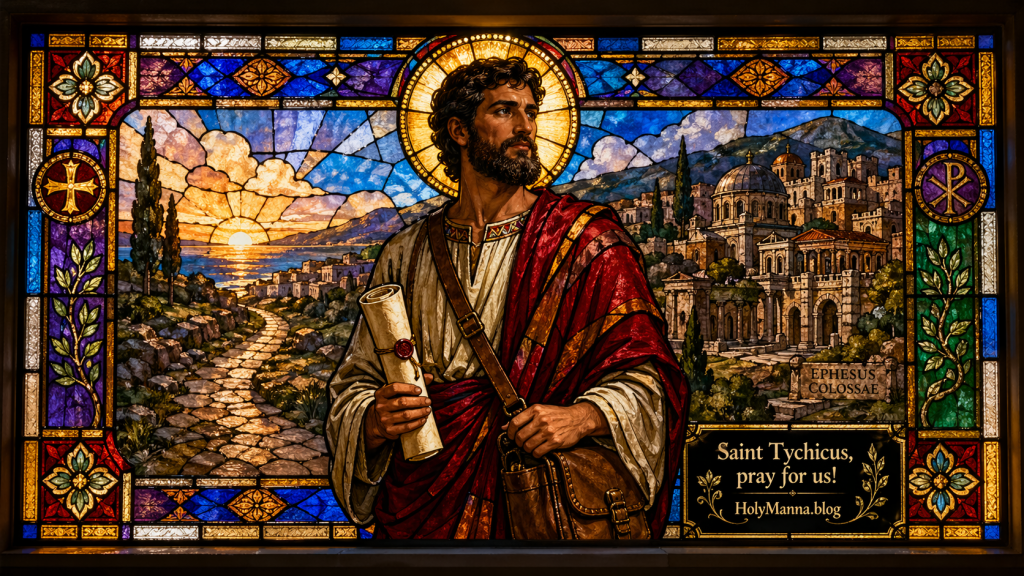
The Quiet Saint Who Carried the Word
Saint Tychicus is one of those saints who steps into Scripture quietly, serves faithfully, and then disappears without demanding attention. He was not one of the Twelve Apostles. He did not leave behind a famous book, a dramatic martyrdom account, or a collection of sermons. Yet Saint Paul trusted him with something priceless: apostolic letters, personal news from prison, and the task of strengthening Christian communities.
Tychicus is mentioned in Acts 20:4, Ephesians 6:21-22, Colossians 4:7-9, Titus 3:12, and 2 Timothy 4:12. Those few verses are enough to show the heart of the man. Saint Paul calls him “my beloved brother, trustworthy minister, and fellow slave in the Lord” in Colossians 4:7. In Ephesians 6:22, Paul says Tychicus was being sent so that the faithful might know Paul’s situation and so that he might “encourage your hearts.”
That is the soul of Saint Tychicus. He was a trusted messenger, a faithful servant, and a man sent to bring courage to anxious Christians. The Church remembers him because holiness does not always look dramatic. Sometimes holiness looks like being reliable enough to be sent.
From Asia to the Roads of the Gospel
Very little is known with certainty about the early life of Saint Tychicus. Catholic tradition identifies him as a native of the Roman province of Asia, likely connected to the region around Ephesus in modern-day Turkey. His family background, childhood, and conversion story have not been preserved.
That silence is important. It reminds the faithful that not every saint comes with a full biography. Some saints are known mostly by the fruit of their faithfulness. Tychicus enters the biblical story already as a companion of Saint Paul, traveling with him during a dangerous time in the Apostle’s missionary work.
In Acts 20:4, Tychicus appears among the men accompanying Paul after a plot was formed against him. He is listed alongside other early Christian workers such as Timothy and Trophimus. This means Tychicus was not a casual believer watching from a distance. He was part of the apostolic mission at ground level, walking the roads, crossing the seas, facing risk, and helping the young Church stay united.
The Catechism of the Catholic Church teaches that the Gospel was handed on by the apostles through preaching, example, institutions, and inspired writings, and also through those associated with the apostles. CCC 76 and CCC 857-860 help Catholics understand why someone like Tychicus matters. He belonged to that living stream of apostolic witness. He helped carry the faith from one community to another.
The Man Paul Could Trust
Saint Tychicus is most known for carrying Saint Paul’s letters to the early Christian communities, especially the letters associated with Ephesus and Colossae. In the ancient world, carrying a letter was not like dropping an envelope in a mailbox. The messenger often explained the letter, shared the sender’s circumstances, answered questions, and represented the sender personally.
That means Tychicus was not simply a delivery man. He was Paul’s trusted voice on the road.
When Paul wrote to the Colossians, he said, “Tychicus, my beloved brother, trustworthy minister, and fellow slave in the Lord, will tell you all the news of me.” Colossians 4:7. Paul then says he is sending him so that the community may know Paul’s circumstances and receive encouragement.
In Ephesians 6:21-22, Paul gives almost the same description. Tychicus is the beloved brother and faithful minister who will make Paul’s situation known and encourage the hearts of the faithful.
That little phrase matters. Tychicus was a saint of encouragement. He carried doctrine, yes. He carried news, yes. But he also carried courage. He brought the warmth of apostolic friendship to Christians who may have been afraid, confused, or discouraged because Paul was suffering in prison.
No verified quotations from Saint Tychicus himself survive. The famous words connected to him are Paul’s words about him, and they may be the best portrait of his soul: “beloved brother,” “trustworthy minister,” and “fellow slave in the Lord.”
A Servant of Unity and Charity
One detail that can easily be missed is that Tychicus may have been connected to the collection for the Church in Jerusalem. The men listed in Acts 20:4 were associated with Paul during a time when he was gathering aid for the suffering Christians in Jerusalem. This was not merely financial assistance. It was an act of Catholic unity before the word “Catholic” was commonly used as a title for the Church.
The Gentile churches were helping the mother Church in Jerusalem. The Body of Christ was learning to suffer and give together. Tychicus appears in that circle of trust.
This gives his life a beautiful depth. He did not only carry letters. He likely participated in the Church’s early work of charity, communion, and practical love. His faith was not sentimental. It was useful. It moved from city to city, from church to church, from need to need.
In a world that often celebrates visibility, Saint Tychicus reminds Catholics that hidden service can strengthen the whole Church.
The Companion of Onesimus
One of the most moving biblical scenes connected to Tychicus comes from Colossians 4:7-9. Paul sends Tychicus together with Onesimus, whom Paul calls “a faithful and beloved brother.”
Onesimus is the formerly enslaved man associated with Paul’s Letter to Philemon. Scripture does not explicitly say that Tychicus carried the Letter to Philemon, but Catholic writers have often reflected on the strong possibility that Tychicus and Onesimus traveled together to Colossae with Paul’s messages.
Imagine that journey for a moment. Tychicus, the trusted messenger, walking beside Onesimus, the man whose story became one of reconciliation, mercy, and Christian brotherhood. The journey itself becomes almost like a living parable of the Gospel. One man carries apostolic teaching. The other carries the wound and hope of restored relationship. Together, they approach a Christian community that must learn what it means to live as one family in Christ.
That story is not a legend. It is rooted in Scripture, though some details about the letters they may have carried together must be stated carefully. What can be said for certain is that Paul sent them together, and he trusted them both.
Possible Bishop, Certain Servant
After the New Testament references, the details of Saint Tychicus’s later life become uncertain. Roman Catholic tradition commemorates him at Paphos in Cyprus, and some traditions identify him as a bishop there. Other ancient traditions connect him with Colophon, Chalcedon, or Neapolis in Cyprus. Some even say he was appointed bishop by Saint Andrew the Apostle.
These traditions are meaningful, but they cannot all be verified. Catholic historical sources are careful here. The safest statement is that Saint Tychicus is remembered as a disciple and co-worker of Saint Paul, with later traditions associating him with episcopal ministry in Cyprus and Asia Minor. His exact later office and location cannot be established with certainty.
Some traditions also list him among the Seventy or Seventy-Two Disciples sent by the Lord in Luke 10. This is a beautiful tradition, but it should not be treated as certain historical fact. Ancient lists of the Seventy vary, and Catholic scholarship is cautious about them.
What remains certain is enough. Tychicus belonged to the apostolic age. He served Paul. He strengthened the churches. He was trusted with the Word.
Faithful Through Hardship
There is no preserved Roman Catholic martyrdom account for Saint Tychicus. His death likely occurred in the first century, but the place, date, and manner of his death are not known with certainty. He may have died peacefully after a life of missionary service, or he may have suffered in ways that history did not record.
What can be known is that his life was not easy. To travel with Saint Paul was to share in danger. Paul’s world included imprisonments, plots, shipwrecks, riots, hunger, suspicion, and persecution. Anyone trusted enough to move in Paul’s circle had to possess courage.
Tychicus appears in Paul’s life not during comfortable moments, but during serious ones. He is present when Paul is under threat. He is sent when Paul is imprisoned. He is still useful near the end of Paul’s life, when 2 Timothy 4:12 says, “I have sent Tychicus to Ephesus.”
That sentence is short, but it says so much. Paul needed companions, yet he sent Tychicus away for the sake of the Church. Tychicus was still being sent, still being trusted, still serving Christ.
Miracles, Memory, and Local Tradition
No verified miracles of Saint Tychicus are recorded in the New Testament, and no major Roman Catholic source preserves a specific miracle story clearly attached to him.
There are local traditions, especially in Cyprus, connected to churches dedicated to Saint Tychicus. One pious tradition tells of a revelation associated with the building or location of a church in Paphos dedicated to him. This story belongs to local Christian devotion, but it cannot be verified from Roman Catholic sources.
His relics are not associated with a major universal pilgrimage in the way that some better-known saints are. His cultural impact is quieter, centered especially around the biblical lands connected with Paul’s missions, Asia Minor, Ephesus, Colossae, and Cyprus. In some devotional reflections, he is seen as a fitting patron for messengers, letter carriers, Christian communicators, and all who serve the Church behind the scenes. This patronage is devotional rather than formally universal.
Saint Tychicus is commemorated on April 29 in the Roman Martyrology. There he is remembered as a disciple of Saint Paul and as the beloved brother and faithful minister praised in Scripture. That is his enduring honor. The Church has not forgotten the man who carried encouragement.
The Saint of Hidden Fidelity
Saint Tychicus teaches that holiness does not require fame. It requires fidelity.
He did not need to be the author of Ephesians to have a role in bringing it to the Church. He did not need to be Saint Paul to serve beside Saint Paul. He did not need to be remembered by crowds to be remembered by God.
There is something deeply Catholic about that. The Church is full of hidden saints: mothers and fathers, catechists and ushers, sacristans and teachers, priests and religious, caregivers and quiet intercessors, people who show up, serve faithfully, and help others stay close to Christ.
The Catechism of the Catholic Church teaches that the Church is apostolic because she is founded on the apostles, hands on their teaching, and continues their mission. CCC 857-860. Tychicus stands inside that apostolic mission as a faithful servant of the Word. He carried the message physically so others could receive it spiritually.
His life asks a simple but serious question: Can Christ trust this heart to carry His encouragement to someone else?
A Reflection for Everyday Faith
Saint Tychicus is a saint for ordinary Catholics who want their lives to matter but may not feel important. He shows that the hidden tasks of faith are never wasted. The message sent, the visit made, the encouragement offered, the quiet act of charity, the prayer spoken for someone in distress, all of it can become part of God’s work.
He also teaches the virtue of reliability. Paul could send him because Paul trusted him. That is not a small thing. A trustworthy Christian is a gift to the Church. A person who keeps promises, speaks truth, carries peace, and strengthens others becomes a living letter of the Gospel.
Catholics today can imitate Saint Tychicus by becoming people who encourage rather than drain, who carry truth without harshness, who serve without needing attention, and who remain faithful even when the work feels unnoticed.
Who needs encouragement from this heart today? Who needs a message of hope, a word of truth, or a reminder that Christ has not abandoned them?
Saint Tychicus reminds every believer that the Church is strengthened not only by famous saints, but also by faithful ones.
Engage with Us!
Share your thoughts and reflections in the comments below. Saint Tychicus may not be one of the most famous saints in the Church, but his life speaks powerfully to anyone who has ever wondered whether hidden service really matters.
- What stands out most about Saint Tychicus being trusted by Saint Paul?
- How can his example help Catholics become more faithful messengers of encouragement in daily life?
- Is there someone in your life who needs you to “encourage their heart” this week?
- What hidden act of service might God be asking from you right now?
- How does Saint Tychicus challenge the modern desire to be noticed, praised, or publicly recognized?
May the example of Saint Tychicus inspire every Catholic heart to serve faithfully, speak truth with love, and encourage others with the mercy of Christ. A life of faith does not have to be loud to be holy. It only has to be faithful, humble, and filled with the love and mercy Jesus taught us.
Saint Tychicus, pray for us!
Follow us on YouTube, Instagram and Facebook for more insights and reflections on living a faith-filled life.


Leave a Reply