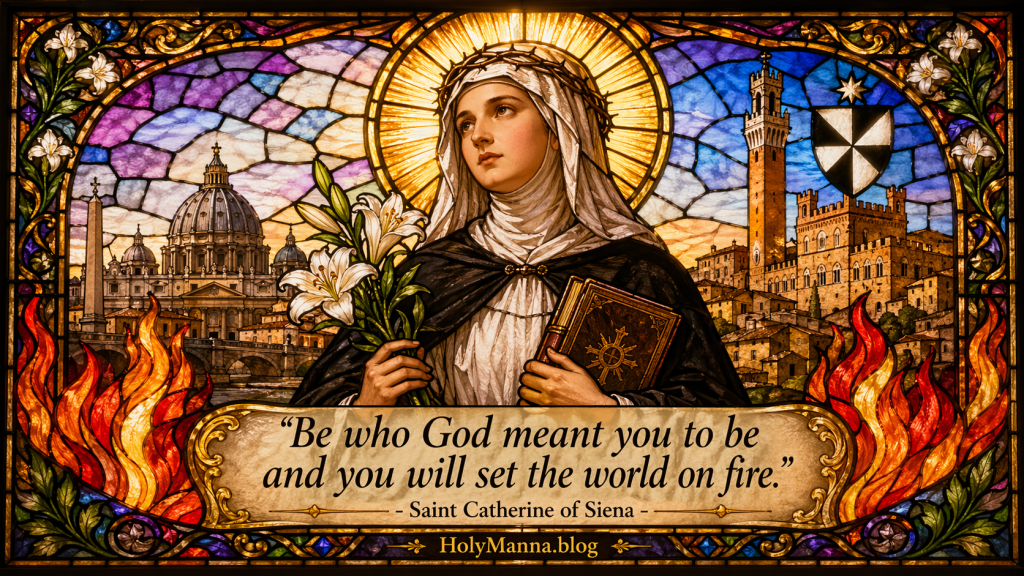
A Woman on Fire for Christ and His Church
Saint Catherine of Siena is one of those saints who makes holiness feel dangerous in the best possible way. She was not a queen, not a university scholar, not a nun behind monastery walls, and not someone with worldly power. She was a lay Dominican woman from Siena who gave herself so completely to Jesus Christ that popes, politicians, priests, soldiers, sinners, and ordinary families began to listen.
Born in 1347 and dying in 1380 at only thirty-three years old, Catherine lived a short life that burned with supernatural intensity. She served the sick, prayed with heroic discipline, wrote with astonishing spiritual depth, advised Church leaders, called sinners to conversion, helped bring Pope Gregory XI back from Avignon to Rome, and became one of the great mystical voices in Catholic history.
The Church honors her as a virgin, mystic, reformer, Doctor of the Church, co-patroness of Italy, co-patroness of Europe, and one of the great witnesses to the truth that holiness is not passive. Holiness is not sitting quietly while the world falls apart. Holiness is union with Christ so deep that love becomes courage.
The Catechism of the Catholic Church teaches that the saints reveal the holiness of Christ and strengthen the Church by their example and intercession. CCC 828 says that in canonizing saints, the Church recognizes “the power of the Spirit of holiness within her.” Saint Catherine is a blazing example of that power. She shows what happens when a soul stops asking for comfort and starts asking to belong entirely to Jesus.
A Child of Siena Chosen for Something Greater
Catherine was born Caterina Benincasa in Siena, Italy, on March 25, 1347. Her father, Giacomo Benincasa, was a wool dyer, and her mother, Lapa, cared for their large household. Catholic tradition often says Catherine was one of twenty-five children, with some accounts noting that she had a twin sister who died in infancy. Whether counted as the twenty-third or twenty-fourth surviving child in different sources, the important point is clear. Catherine was not born into luxury. She grew up in a loud, crowded, working family.
From her childhood, Catherine seemed marked by God. Catholic tradition says that when she was about six or seven years old, she saw a vision of Christ in glory above the Dominican church in Siena, accompanied by Saints Peter, Paul, and John the Evangelist. Soon after, around age seven, she privately vowed her virginity to Christ.
That vow was not a childish mood. It became the direction of her entire life.
When her family later encouraged marriage, Catherine resisted. In one famous story, she cut off her hair to make herself less attractive to potential suitors. Her family was not pleased. They gave her difficult household work and tried to pull her out of her life of solitude and prayer. Yet Catherine turned even that into spiritual training. She learned how to build an inner room with God, what she later called the “cell of self-knowledge.”
This became one of her great teachings. Catherine believed that a person must enter the truth about the self before God. Not self-hatred. Not ego. Truth. A soul must know its weakness, sin, dignity, dependence, and belovedness before God. That is deeply Catholic. Grace does not erase reality. Grace heals reality.
Eventually Catherine joined the Third Order of Saint Dominic, becoming one of the Mantellate, lay Dominican women who lived lives of prayer, penance, and service. This is one of the most important facts about her life. Catherine was not a cloistered nun. She lived her vocation in the world. Her holiness was formed in a family home, in the streets of Siena, among the sick, near the poor, and eventually in the middle of Church politics.
That makes her incredibly powerful for ordinary Catholics. She shows that sanctity is not only for those with titles, degrees, habits, collars, or public platforms. A soul truly surrendered to Christ can become fire.
The Bride of Christ and the Servant of the Sick
Catherine’s early years were marked by prayer, fasting, penance, and mystical union with Christ. Her spiritual life was intense, and it must be understood through the Catholic view of private revelation. The Catechism teaches that private revelations do not add to the deposit of faith and are not meant to improve or complete Christ’s definitive Revelation. They may help the faithful live the Gospel more fully in a particular time, but they must always lead back to Christ and His Church. CCC 67.
Catherine’s mystical experiences did exactly that. They did not make her self-important. They made her more obedient, more sacrificial, more courageous, and more consumed with love for Christ.
One of the most famous stories from her life is her mystical marriage to Jesus. According to the tradition preserved by Blessed Raymond of Capua, her confessor and biographer, the Blessed Virgin Mary presented Catherine to Christ, and Jesus placed a ring on her finger. The ring was visible only to Catherine. Christ is said to have told her, “I, your Creator and Saviour, espouse you in the faith.”
This story should be understood as mystical and devotional, not as something ordinary Christians should try to reproduce emotionally. Its meaning is deeply Catholic. Catherine belonged to Christ as a bride belongs to her bridegroom. Her consecrated virginity was not rejection of love. It was radical love ordered entirely toward Jesus.
Another famous mystical story is the exchange of hearts. According to Blessed Raymond, Christ appeared to Catherine, removed her heart, and placed His own heart within her. This story reflects the words of Saint Paul in Galatians 2:20: “It is no longer I who live, but Christ who lives in me.” Whether read as mystical biography or devotional theology, the message is clear. Catherine wanted to love with the Heart of Christ.
That love did not stay hidden. After years of solitude, Catherine began serving others with heroic charity. She cared for the sick, especially those suffering from diseases that others feared. She served the poor. She visited prisoners. She became known for compassion that was not sentimental, but costly.
During times of plague, Catholic tradition remembers Catherine as a fearless servant of the suffering. She nursed the sick, comforted the dying, and helped bury the dead. This is where her mysticism becomes impossible to dismiss as fantasy. Real union with Christ always produces real charity. The Bridegroom she loved was the Crucified One, and she met Him in the sick, the poor, the abandoned, and the sinful.
The Catechism teaches that charisms, whether extraordinary or simple, are graces of the Holy Spirit given for the building up of the Church. CCC 2003. Catherine’s mystical gifts were not spiritual entertainment. They were ordered toward mercy, service, conversion, and reform.
Miracles, Visions, and the Hidden Wounds of Christ
Many miracles and mystical gifts are associated with Saint Catherine. Some are well rooted in Catholic tradition and hagiography, especially through Blessed Raymond of Capua. Others should be presented as devotional stories rather than modern, medically verified events.
Catherine is associated with visions of Christ, ecstasies, prophecy, discernment of souls, healings, deliverance from evil spirits, and miraculous interventions during plague. One well-known story tells of Matteo Cenni, a friend of Catherine who became gravely ill during a plague outbreak. According to the traditional account, Catherine visited him, prayed for him, and he recovered. This is a miracle story preserved in Catholic tradition, though it cannot be verified by modern medical standards.
Another remarkable mystical event took place in Pisa in 1375. Catholic tradition says Catherine received the stigmata while praying before a crucifix. The wounds of Christ were impressed upon her, but at her request, they remained invisible during her lifetime. This detail is beautiful because Catherine was not seeking spectacle. She wanted union with Christ Crucified, not attention.
The invisible stigmata says something profound about her soul. Some wounds are real even when the world cannot see them. Some holiness is hidden even when its effects are public. Catherine carried the Passion of Christ not as a performance, but as a mystery of love.
Catherine’s devotion to the Eucharist was also central. She lived with intense love for Holy Communion. The Catechism teaches that “The Eucharist is the source and summit of the Christian life.” CCC 1324. Catherine’s strength flowed from Christ, especially Christ present in the Eucharist. Her extreme fasting and physical austerities should not be imitated casually or without spiritual direction. The lesson for ordinary Catholics is not to copy every external practice. The lesson is to let Jesus become the center of everything.
Her greatest written work, The Dialogue, presents the soul’s conversation with God the Father. One of its most famous images is Christ as the Bridge between Heaven and earth. Catherine describes Jesus as the Bridge by which souls cross from sin and death into eternal life. That image is simple, powerful, and deeply Catholic. Nobody climbs to Heaven by ego, talent, or moral self-improvement. The way is Christ.
In John 14:6, Jesus says, “I am the way, and the truth, and the life.” Catherine’s whole life was a commentary on that one line.
A Fearless Daughter in a Wounded Church
Catherine lived during a painful time in Church history. The papacy had been residing in Avignon, France, instead of Rome. Italian city-states were divided by political violence. Corruption and weakness among some clergy caused scandal. Then, near the end of Catherine’s life, the Great Western Schism tore at the unity of the Church.
Catherine did not respond with cynicism. She responded with love, prayer, tears, and truth.
She wrote letters to popes, cardinals, priests, rulers, soldiers, and ordinary Christians. Her words could be tender, but they could also be brutally direct. She called people to repentance. She called clergy to holiness. She called leaders to peace. She called the pope to courage.
Her most famous public mission involved Pope Gregory XI. Catherine urged him to leave Avignon and return to Rome, the See of Saint Peter. This was not a small matter. The pope faced political pressure, fear, resistance, and complicated alliances. Yet Catherine wrote and spoke with astonishing boldness. She addressed him as a spiritual daughter who loved the Church, not as a rebel trying to tear it down.
Gregory XI returned to Rome in 1377. Catherine was not the only factor, but Catholic history remembers her as one of the powerful spiritual voices that helped move him.
This is one of the reasons Catherine matters so much today. She loved the Church enough to suffer for her, and she loved the truth enough to speak it. She did not use Church corruption as an excuse to abandon the Church. She used it as a reason to become holier.
After Gregory XI died, the Great Western Schism began in 1378. Catherine supported Pope Urban VI and spent her final years in Rome praying, writing, and pleading for unity. She offered herself for the Church at a time when the Body of Christ was visibly wounded by division.
Catherine was not a martyr in the formal sense. She was not killed for the faith. Yet she endured severe hardships. She faced suspicion, political danger, physical suffering, spiritual anguish, and exhaustion. In Florence, during a violent uprising, an attempt was made on her life. She survived, and tradition says she grieved that she had been deprived of the “red rose” of martyrdom.
That detail is intense, but it reveals her heart. Catherine did not want comfort more than Christ. She wanted total union with Him.
Her final years were marked by increasing physical weakness. She died in Rome on April 29, 1380, at the age of thirty-three. The number is hard to miss. Like the Lord she loved, Catherine poured herself out by thirty-three.
The Saint Who Kept Speaking After Death
After Catherine died, devotion to her spread and deepened. She was buried in Rome at Santa Maria sopra Minerva, where her body remains venerated. Her head and thumb were later brought to Siena, where they are preserved and honored. To modern ears, this may sound strange, but Catholic devotion to relics is rooted in the truth that the body matters. The saints’ bodies were temples of the Holy Spirit, and God often works through material things because Christianity is incarnational.
The Catechism teaches that the saints in Heaven do not stop caring for the Church on earth. CCC 956 says, “Their intercession is their most exalted service to God’s plan.” Catherine’s relics, writings, feast day, and intercession continue to draw Catholics toward Christ.
There is also a famous legend connected to the relic of Catherine’s head. According to the story, when her head was being brought from Rome to Siena, guards stopped those carrying it. They prayed for Catherine’s help, and when the bag was opened, it appeared to contain rose petals instead of the relic. Once they arrived safely in Siena, the head appeared again. This is a devotional legend and cannot be historically verified, but it reveals how deeply Siena loved Catherine and how her memory became woven into the city’s Catholic identity.
Catherine was canonized by Pope Pius II in 1461. Later, Pope Pius XII named her co-patroness of Italy, along with Saint Francis of Assisi. Pope Paul VI declared her a Doctor of the Church in 1970, making her one of the first women to receive that title. Saint John Paul II later named her co-patroness of Europe, along with Saint Bridget of Sweden and Saint Teresa Benedicta of the Cross.
That honor is not symbolic fluff. Catherine helped shape Europe spiritually and historically. She worked for peace among cities, reform in the Church, the return of the pope to Rome, and unity during schism. She proves that the contemplative soul can also be a force in history.
Her writings remain part of her legacy. The Dialogue, her letters, and her prayers reveal a soul obsessed with mercy, truth, the Blood of Christ, and the salvation of souls. One of her most beautiful lines from The Dialogue says, “O mercy! My heart drowns in thinking of you: for no matter where I turn to think, I find only mercy.”
Another famous quote associated with her is often given in popular form as “Be who God meant you to be and you will set the world on fire.” The more historically precise version from her correspondence is closer to “If you are what you ought to be, you will set fire to all Italy.” Either way, the meaning is pure Catherine. Holiness is not bland. A soul fully alive in God becomes flame.
Other sayings attributed to her and rooted in her spirituality include “Love transforms one into what one loves,” and “The world is lost through silence.” These words fit the woman who loved contemplation, but refused cowardice.
In Siena, Catherine remains beloved. Her feast is celebrated with religious and civic devotion. Her home, now a shrine, draws pilgrims. The Basilica of San Domenico preserves her relics. Each year, Catholics honor her not only as a medieval mystic, but as a daughter of Siena, a daughter of the Church, and a witness for Europe.
The Saint for Catholics Who Are Tired of Being Quiet
Saint Catherine of Siena speaks powerfully to Catholics today because she destroys a few comfortable lies.
She destroys the lie that laypeople cannot become saints of serious influence. She destroys the lie that mystics are useless dreamers. She destroys the lie that loving the Church means pretending everything is fine. She destroys the lie that truth and charity are enemies.
Catherine’s life shows that the deeper a soul enters Christ, the more courageously that soul loves the world.
Her story is especially needed in an age of confusion, noise, scandal, and spiritual laziness. Catherine would not tell Catholics to panic. She would not tell them to rage online. She would not tell them to abandon the Church. She would tell them to repent, pray, receive the Eucharist worthily, serve the poor, speak the truth, obey Christ, and become who God created them to be.
How would life change if holiness were treated less like a private hobby and more like a mission?
Catherine teaches that reform begins in the soul. The Church is renewed when Catholics become saints. Families are renewed when Catholics become saints. Culture is renewed when Catholics become saints. The world is not set on fire by comfort, complaining, or cowardice. It is set on fire by charity.
Her life also teaches that truth must be spoken from love. Catherine corrected popes and leaders, but she did not do it because she hated authority. She did it because she loved Christ, loved the Church, and loved souls. That distinction matters. Correction without love becomes bitterness. Love without truth becomes weakness. Catherine held both together.
She also teaches that suffering can become an offering. Her final years were full of pain, disappointment, division, and exhaustion. Yet she offered herself for the unity of the Church. In a culture that often treats suffering as meaningless, Catherine reminds Catholics that suffering joined to Christ can become prayer.
Engage With Us!
Share your thoughts and reflections in the comments below. Saint Catherine of Siena was bold, mystical, practical, and completely surrendered to Jesus Christ, so her life gives every Catholic plenty to wrestle with.
- Where is God calling you to be more courageous in speaking the truth with love?
- What part of Saint Catherine’s life challenges you the most: her prayer, her service to the sick, her obedience, her boldness, or her love for the Church?
- How can you build a deeper “cell of self-knowledge” in your own daily prayer life?
- Where do you need to stop choosing comfort and start choosing holiness?
- If you became who God created you to be, what kind of fire might Christ light through your life?
Saint Catherine of Siena reminds the Church that one soul surrendered to Jesus can still shake history. Her life was not easy, safe, or quiet, but it was full of grace. May her example encourage every reader to live with courage, serve with compassion, love the Church faithfully, and do everything with the love and mercy Jesus taught us.
Saint Catherine of Siena, pray for us!
Follow us on YouTube, Instagram and Facebook for more insights and reflections on living a faith-filled life.

 Holy Manna!
Leave a comment