Memorial of Saint Catherine of Siena, Virgin and Doctor of the Church – Lectionary: 281
Sent by the Light
There is a holy pattern in today’s readings: God shines His light into the hearts of His people, then sends them out so that others may find their way home.
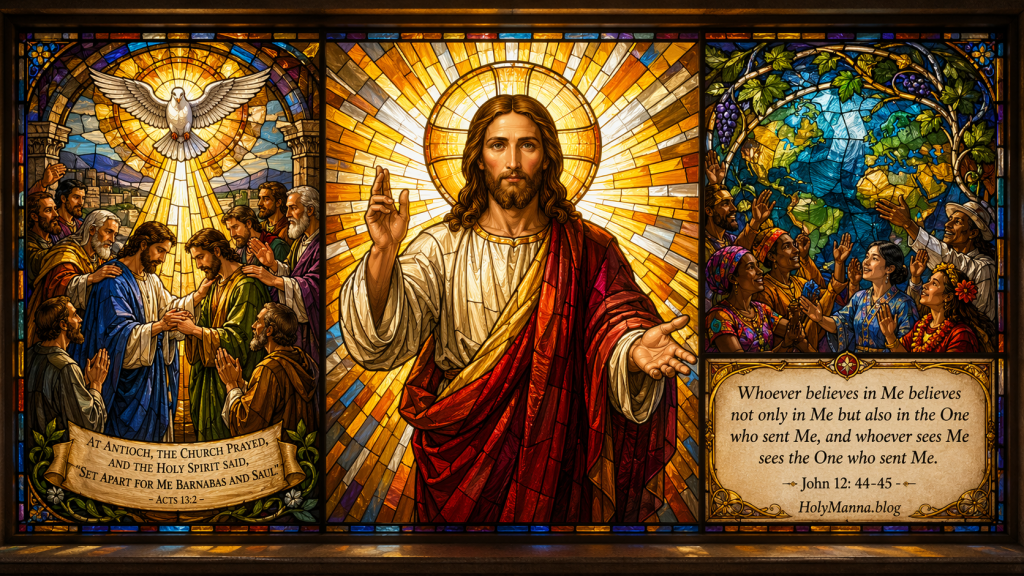
In Acts 12:24-13:5, the early Church is gathered in Antioch, a city where Jews and Gentiles, prophets and teachers, prayer and mission all begin to meet. The disciples are not rushing ahead with their own plans. They are worshiping, fasting, and listening. Only then does the Holy Spirit speak: “Set apart for me Barnabas and Saul for the work to which I have called them.” Acts 13:2 The mission of the Church begins in communion with God, not in human ambition.
That same missionary desire rises in Psalm 67, where Israel prays for God’s blessing, not as a private privilege, but as a light for the world: “So shall your way be known upon the earth, your victory among all the nations.” Psalm 67:3 God blesses His people so that His mercy, truth, and salvation may become visible through them. This is the heart of the Church’s catholic mission, which The Catechism teaches is rooted in Christ’s command to bring the Gospel to all nations. CCC 849-856
Then, in John 12:44-50, Jesus reveals the deepest source of that mission. He is not merely a teacher sent with helpful ideas. He is the Light sent by the Father. He says, “I came into the world as light, so that everyone who believes in me might not remain in darkness.” John 12:46 To receive Christ is to receive the Father’s own saving Word. To reject His Word is to refuse the very light that was given for eternal life.
On this Memorial of Saint Catherine of Siena, Virgin and Doctor of the Church, the readings feel especially alive. Catherine was a woman of intense prayer, burning love for Christ, and bold service to the Church. Like the Church in Antioch, she listened before she acted. Like the psalmist, she desired the renewal of all peoples. Like the Gospel, she knew that only Christ’s light could scatter the darkness of sin, division, and fear.
Today’s central theme is clear: the Word of God grows when hearts receive the Light of Christ and allow the Holy Spirit to turn prayer into mission. These readings invite every Catholic to ask a simple but serious question: Where is Christ asking this life to become a blessing, a witness, and a light for others today?
First Reading – Acts 12:24-13:5
A Church on Her Knees Becomes a Church on Mission
The first reading brings us into one of the great turning points in the life of the early Church. After persecution, imprisonment, martyrdom, and uncertainty, Acts quietly announces that the Gospel cannot be chained: “But the word of God continued to spread and grow.” Acts 12:24 This is the same Church that had watched Saint James suffer martyrdom, Saint Peter be imprisoned, and Herod oppose the followers of Christ. Yet the Word keeps moving, because the mission of the Church does not depend on worldly power. It depends on the Holy Spirit.
The setting soon shifts to Antioch, one of the most important cities in the Roman Empire and one of the earliest centers of Gentile Christianity. Antioch was diverse, wealthy, cosmopolitan, and spiritually hungry. It was also the place where believers were first called Christians. In this reading, the Church at Antioch is worshiping, fasting, and discerning together when the Holy Spirit calls Barnabas and Saul to missionary work. This moment begins the first major missionary journey of Saint Paul.
This fits beautifully into today’s central theme: the Word of God grows when hearts receive the Light of Christ and allow the Holy Spirit to turn prayer into mission. The Church does not simply decide to expand. She listens, fasts, prays, lays hands, and sends. On the Memorial of Saint Catherine of Siena, this reading is especially fitting, because Catherine’s whole life showed that deep prayer and bold mission are not opposites. They belong together.
Acts 12:24-13:5 – New American Bible (Revised Edition)
24 But the word of God continued to spread and grow.
Mission of Barnabas and Saul. 25 After Barnabas and Saul completed their relief mission, they returned to Jerusalem, taking with them John, who is called Mark.
13:1 Now there were in the church at Antioch prophets and teachers: Barnabas, Symeon who was called Niger, Lucius of Cyrene, Manaen who was a close friend of Herod the tetrarch, and Saul. 2 While they were worshiping the Lord and fasting, the holy Spirit said, “Set apart for me Barnabas and Saul for the work to which I have called them.” 3 Then, completing their fasting and prayer, they laid hands on them and sent them off.
First Mission Begins in Cyprus. 4 So they, sent forth by the holy Spirit, went down to Seleucia and from there sailed to Cyprus. 5 When they arrived in Salamis, they proclaimed the word of God in the Jewish synagogues. They had John also as their assistant.
Detailed Exegesis
Verse 24: “But the word of God continued to spread and grow.”
This verse is short, but it carries the entire confidence of the early Church. In the previous chapter, the Church faces real danger. Herod persecutes believers, James is killed, and Peter is arrested. From a human perspective, the mission looks fragile. From God’s perspective, the Word is alive and unstoppable.
The phrase “spread and grow” shows that the Gospel is not merely being repeated. It is taking root. It is bearing fruit. It is changing lives. This echoes the parables of Jesus, especially the seed that grows silently and the mustard seed that becomes a great tree. The Church grows not because Christians are powerful, but because the Word of God is living, fruitful, and full of divine life.
This also reflects what The Catechism teaches about the Church’s mission. The Gospel is not a private possession. It is meant to be proclaimed, received, lived, and shared. The Word grows when believers allow it to shape their homes, decisions, speech, sacrifices, and public witness.
Verse 25: “After Barnabas and Saul completed their relief mission, they returned to Jerusalem, taking with them John, who is called Mark.”
Barnabas and Saul have just completed a work of charity. They had brought relief to the Christians in Judea during a time of need. This detail matters because apostolic mission is never separated from concrete love. The same men who will preach the Word also carry aid to suffering believers.
John Mark is also introduced here as their companion. He will later become an important figure in the early Church, traditionally associated with Saint Mark the Evangelist. At this stage, he is an assistant in the mission, reminding readers that evangelization is not usually the work of isolated individuals. The Church moves as a communion of persons, each with a role to play.
This verse also shows the rhythm of Christian life. Service leads to mission. Charity prepares the heart for proclamation. The Church that feeds the hungry and supports the suffering becomes more credible when she speaks of Christ.
Verse 1: “Now there were in the church at Antioch prophets and teachers: Barnabas, Symeon who was called Niger, Lucius of Cyrene, Manaen who was a close friend of Herod the tetrarch, and Saul.”
Antioch appears here as a living image of the catholicity of the Church. The community includes men from different backgrounds, cultures, and social locations. Barnabas came from Cyprus. Lucius was from Cyrene in North Africa. Manaen had connections to Herod’s court. Saul had been a Pharisee and former persecutor of Christians. Symeon, called Niger, likely reflects the cultural and ethnic diversity present in the community.
This is not a social club built around natural similarity. This is the Church, gathered by Christ and animated by the Holy Spirit. People who would not naturally belong together are made one in the Body of Christ.
The mention of prophets and teachers also shows that the early Church was not chaotic. The Holy Spirit gave gifts for building up the Body. Prophets helped the Church hear and respond to God’s will. Teachers formed believers in the truth of the apostolic faith. This matters because mission requires both spiritual sensitivity and doctrinal clarity. Zeal without truth becomes noise. Truth without charity becomes cold. The Church needs both.
Verse 2: “While they were worshiping the Lord and fasting, the holy Spirit said, ‘Set apart for me Barnabas and Saul for the work to which I have called them.’”
This is the heart of the reading. The Church is worshiping and fasting when the Holy Spirit speaks. Mission begins in prayer. The Church is not brainstorming a project. She is listening to God.
Fasting is significant because it creates space for obedience. It weakens the tyranny of appetite and sharpens the soul’s attention to God. In Scripture, fasting often accompanies repentance, discernment, and preparation for mission. Here, fasting becomes part of the Church’s listening posture.
The Holy Spirit says, “Set apart for me.” Barnabas and Saul do not belong first to themselves. They belong to God. Their mission is not self-invented. It is a calling. This is deeply Catholic because the Church discerns and confirms mission within the Body, not apart from it. Personal calling and ecclesial communion belong together.
This verse also reveals the Holy Spirit as a divine Person who speaks, commands, sends, and directs the Church. The mission of Paul and Barnabas is not merely an administrative decision. It is the action of God.
Verse 3: “Then, completing their fasting and prayer, they laid hands on them and sent them off.”
The Church responds to the Spirit with more fasting and prayer. That is important. Even after hearing the call, the community does not rush forward casually. They remain in a posture of reverence.
The laying on of hands is a powerful biblical gesture. It can signify blessing, commissioning, identification, and the invocation of God’s grace. In this context, it marks Barnabas and Saul as being publicly entrusted to their mission by the Church. Their sending is personal, spiritual, and ecclesial.
This verse reminds Catholics that mission is not individualistic. Even heroic saints are sent from within the Church. Saint Paul will become one of the greatest missionaries in Christian history, but here he is first a man prayed over by the Church. Before he preaches to nations, he kneels under the hands of his brothers.
Verse 4: “So they, sent forth by the holy Spirit, went down to Seleucia and from there sailed to Cyprus.”
Luke makes the real sender unmistakable: Barnabas and Saul are “sent forth by the holy Spirit.” The Church lays hands on them, but the Holy Spirit sends them. This protects the mission from becoming merely human. The apostles travel, preach, suffer, and labor, but God is the primary mover.
Seleucia was the port city connected to Antioch, and Cyprus was Barnabas’s homeland. The mission begins with real geography, real travel, and real risk. Evangelization is spiritual, but it is never vague. It sends people to actual places, actual communities, and actual souls.
This verse also shows that grace does not erase human history. Barnabas returns toward familiar territory, but now with a mission larger than personal memory or local identity. The Gospel takes what is familiar and turns it outward for the salvation of others.
Verse 5: “When they arrived in Salamis, they proclaimed the word of God in the Jewish synagogues. They had John also as their assistant.”
When Barnabas and Saul arrive in Salamis, they begin by proclaiming the Word in the synagogues. This follows the pattern seen throughout Acts. The Gospel is first announced to Israel, because Jesus is the fulfillment of the promises made to Abraham, Moses, David, and the prophets. Christianity is not a rejection of Israel’s story. It is the fulfillment of God’s covenant plan in Christ.
The synagogue setting also reminds readers that the early Christian mission was deeply rooted in Scripture. Paul and Barnabas were not offering a new philosophy detached from revelation. They were proclaiming that the Law and the Prophets find their fulfillment in Jesus Christ.
John Mark’s presence is mentioned again. He serves as an assistant, a reminder that mission includes both public preaching and hidden support. Not everyone stands at the front. Some serve by preparing, assisting, carrying, organizing, encouraging, and accompanying. In the Church, hidden service is never wasted when it is done for Christ.
Teachings
This reading reveals that the Church is missionary by nature. She does not exist only to preserve internal comfort. She exists to worship God, form disciples, and carry the saving light of Christ to the nations.
The Catechism of the Catholic Church teaches this clearly: “The Church on earth is by her nature missionary since, according to the plan of the Father, she has as her origin the mission of the Son and the Holy Spirit.” CCC 850
That single sentence explains Acts 13. The Church is missionary because God Himself is the source of mission. The Father sends the Son. The Father and the Son send the Holy Spirit. The Holy Spirit sends the Church.
The Catechism also teaches: “The ultimate purpose of mission is none other than to make men share in the communion between the Father and the Son in their Spirit of love.” CCC 850
This is why Barnabas and Saul are sent. They are not sent merely to win arguments, build influence, or expand an organization. They are sent so souls may enter communion with the living God.
The reading also gives a Catholic model of discernment. The Church at Antioch worships, fasts, listens, and confirms the call through a communal act. This is not emotional impulse. It is spiritual discernment within the Church.
The same pattern appears in the life of Saint Catherine of Siena. Her public mission flowed from her hidden union with Christ. She served the sick, guided souls, urged reform, worked for peace, and spoke boldly to Church leaders, but her courage came from prayer. She reminds the Church that contemplation is not an escape from mission. It is the fire that makes mission holy.
This reading also reflects the truth taught in The Catechism: “The whole Church is apostolic, in that she remains, through the successors of St. Peter and the other apostles, in communion of faith and life with her origin: and in that she is ‘sent out’ into the whole world. All members of the Church share in this mission, though in various ways.” CCC 863
That final line matters for daily life. “All members of the Church share in this mission, though in various ways.” CCC 863 Some are sent to preach in foreign lands. Some are sent to teach children. Some are sent to serve a spouse faithfully. Some are sent to bring Christ into a workplace, classroom, hospital room, parish ministry, or online space. The mission is one, but the forms are many.
Reflection
This reading gently challenges the modern Catholic soul. It asks whether prayer is being treated as an escape from responsibility or as preparation for mission. The Church at Antioch did not worship and fast so they could stay comfortable. They worshiped and fasted until they were ready to be sent.
That is a serious word for ordinary life. A person can pray every day and still resist being sent. A person can love Catholic truth and still avoid the uncomfortable work of witness. A person can admire saints like Catherine of Siena and still hesitate when God asks for courage, sacrifice, or obedience.
The first step is to recover the Antioch pattern. Worship before deciding. Fast before reacting. Listen before speaking. Pray before planning. The Holy Spirit still speaks to the Church, but noisy hearts often struggle to hear Him.
The next step is to accept that mission usually begins close to home. Barnabas goes first toward Cyprus, his own homeland. For many Catholics, the first mission field is not across the ocean. It is the dinner table, the group chat, the office, the parish, the friendship that needs truth, or the family wound that needs mercy.
This reading also invites humility. John Mark’s role as assistant matters. Not every mission looks impressive. Some holy work is hidden, ordinary, and unglamorous. But the Word of God grows through both the preacher and the assistant, both the missionary and the intercessor, both the saint in public and the servant in the background.
Where is the Holy Spirit asking for prayer before action?
What comfort might need to be surrendered so that the Word of God can grow through this life?
Who is waiting to encounter the light of Christ through one faithful Catholic witness today?
The Church in Antioch listened, fasted, laid hands, and sent. Saint Catherine listened, prayed, suffered, and served. The same Holy Spirit still calls ordinary Catholics into extraordinary faithfulness. The Word of God continues to spread and grow whenever a soul stops asking only for blessing and begins asking to be sent.
Responsorial Psalm – Psalm 67:2-6, 8
A Blessing Meant to Become a Light for the Nations
The responsorial psalm gives the Church a missionary heartbeat. After hearing in Acts 12:24-13:5 that “the word of God continued to spread and grow” and that Barnabas and Saul were sent out by the Holy Spirit, Psalm 67 teaches why God blesses His people in the first place. His blessing is never meant to stop with them. It is meant to shine through them.
This psalm echoes the priestly blessing from Numbers 6:24-26, where Israel prayed that the Lord would bless His people and let His face shine upon them. In the Old Testament, the “face” of God represents His favor, nearness, mercy, and saving presence. To have God’s face shine upon someone is to live under His loving gaze.
But Psalm 67 expands that blessing outward. Israel asks to be blessed so that God’s way may be known “among all the nations.” Psalm 67:3 This is not a selfish prayer for comfort. It is a prayer that the whole world may come to know, praise, and revere the Lord. On this Memorial of Saint Catherine of Siena, the psalm fits beautifully with the day’s theme: the Word of God grows when hearts receive the Light of Christ and allow the Holy Spirit to turn prayer into mission.
Psalm 67:2-6, 8 – New American Bible (Revised Edition)
2 May God be gracious to us and bless us;
may his face shine upon us.
Selah
3 So shall your way be known upon the earth,
your victory among all the nations.
4 May the peoples praise you, God;
may all the peoples praise you!5 May the nations be glad and rejoice;
for you judge the peoples with fairness,
you guide the nations upon the earth.
Selah
6 May the peoples praise you, God;
may all the peoples praise you!8 May God bless us still;
that the ends of the earth may revere him.
Detailed Exegesis
Verse 2: “May God be gracious to us and bless us; may his face shine upon us.”
The psalm begins with a humble plea for grace. Before Israel asks God to change the nations, Israel asks God to bless His own people. This is important because mission begins with receiving. A person cannot share a light that has not first been welcomed. A soul cannot become a witness to mercy without first being touched by mercy.
The phrase “may his face shine upon us” recalls the priestly blessing given through Aaron in Numbers 6. In that blessing, God places His name upon Israel. Here, the psalmist is asking for the same divine favor, but with a larger horizon. God’s people are not blessed so they can become spiritually comfortable. They are blessed so they can reveal the goodness of the Lord.
In Catholic life, this points toward the meaning of grace. Grace is not only personal help from God. It is participation in His life. When God’s face shines upon the soul, the soul is meant to shine with His mercy, patience, truth, and holiness.
Verse 3: “So shall your way be known upon the earth, your victory among all the nations.”
This verse gives the purpose of the blessing. God blesses His people so that His way may be known on earth. The psalmist is not asking for Israel to be admired. He is asking for God to be known.
The word “way” suggests God’s path, His commandments, His covenant, His saving plan, and His manner of dealing with humanity. The word “victory” points to God’s saving power. In the light of Christ, Catholics can hear this verse as a prophecy of the Gospel going out to all nations. The salvation promised to Israel reaches its fullness in Jesus Christ, the Light of the world.
This verse also connects directly to the first reading. Barnabas and Saul are sent so that God’s way may be known beyond Antioch, beyond Judea, and eventually beyond the boundaries of the known Jewish world. The Church is not a closed circle. She is a lamp set on a stand.
Verse 4: “May the peoples praise you, God; may all the peoples praise you!”
The psalm now becomes a chorus of universal worship. The repeated desire is not simply that people behave better or become more religious in a vague sense. The prayer is that all peoples may praise the one true God.
This is deeply Catholic. The Church does not believe that Jesus is one spiritual option among many. She proclaims Him as the Savior of the world. Yet this proclamation must always be made with humility, charity, patience, and love. The goal of mission is not conquest in a worldly sense. The goal is communion with God.
The repetition of “may all the peoples praise you” shows the longing of God’s heart. He desires every nation, every culture, every family, and every wounded soul to come into the joy of His praise.
Verse 5: “May the nations be glad and rejoice; for you judge the peoples with fairness, you guide the nations upon the earth.”
This verse reveals why the nations can rejoice. God’s rule is not tyranny. His judgment is fair. His guidance is trustworthy. Human rulers can be corrupt, selfish, confused, or cruel. God judges with perfect justice and guides with perfect wisdom.
For ancient Israel, surrounded by nations with different gods, kings, customs, and forms of worship, this was a bold confession. The Lord was not merely Israel’s tribal deity. He was the just Judge and true Guide of all nations. His authority extended over the whole earth.
For Catholics, this verse points to the Kingdom of God. Christ does not come only to save isolated individuals. He comes to restore all things in Himself. His lordship touches conscience, family, culture, politics, economics, suffering, mercy, justice, and peace. When the nations live under His truth, they do not become less human. They become more fully alive.
Verse 6: “May the peoples praise you, God; may all the peoples praise you!”
The refrain returns, and its repetition teaches the heart what to desire. The psalmist wants the whole world caught up in praise. This is worship as the destiny of humanity.
Catholic worship is never meant to be private sentiment alone. At every Mass, the Church joins heaven and earth in praise of the Father, through the Son, in the Holy Spirit. The Eucharist forms Catholics into people who are blessed, broken, and sent. That means the praise offered inside the church must become witness outside the church.
The refrain also challenges narrowness. God’s people should never be satisfied with private salvation while the world remains in darkness. The heart formed by God wants others to know Him too.
Verse 8: “May God bless us still; that the ends of the earth may revere him.”
The psalm ends by returning to blessing, but again the blessing has a purpose: “that the ends of the earth may revere him.” God’s gifts are meant to awaken reverence.
This final verse gives the whole psalm its shape. Blessing leads to witness. Witness leads to praise. Praise leads to reverence. Reverence leads the nations back to God.
In the context of today’s readings, this verse prepares the soul to understand the Gospel. Jesus comes as Light so that people may not remain in darkness. The Father sends the Son. The Son reveals the Father. The Holy Spirit sends the Church. The blessing of God becomes mission.
Teachings
Psalm 67 reveals that God’s plan of salvation has always had a universal horizon. Israel was chosen not because God lacked concern for the rest of the world, but because through Israel He would bring blessing to all nations. This promise begins with Abraham, when the Lord says, “All the families of the earth will find blessing in you.” Genesis 12:3
In Christ, that promise reaches its fulfillment. The blessing given to Abraham becomes the Gospel announced to the nations. The Church carries this mission because she has been sent by Christ Himself.
The Catechism of the Catholic Church teaches: “The Church on earth is by her nature missionary since, according to the plan of the Father, she has as her origin the mission of the Son and the Holy Spirit.” CCC 850
This teaching fits perfectly with Psalm 67. The Church is missionary because God’s love is missionary. The Father sends the Son. The Son and the Father send the Holy Spirit. The Holy Spirit sends the Church into the world.
The Catechism also teaches: “All men are called to this catholic unity of the People of God. And to it, in different ways, belong or are ordered: the Catholic faithful, others who believe in Christ, and finally all mankind, called by God’s grace to salvation.” CCC 836
That quote helps explain the psalm’s repeated longing: “May all the peoples praise you!” Psalm 67:4 The Church’s desire is not that a select few know God while everyone else remains far away. The Church desires what God desires: the salvation of the world.
Saint Catherine of Siena lived this universal longing in a bold and concrete way. Her love for Christ became love for the Church, for sinners, for the sick, for political peace, and for the renewal of Christian life. She did not keep grace private. She allowed the blessing of God to become a mission of truth and mercy.
This is why the psalm belongs so beautifully to her memorial. Catherine knew that holiness is never meant to become spiritual self-protection. Holiness is light. It is fire. It is a gift received from God and poured out for others.
Reflection
This psalm asks a very practical question: what is happening with the blessings God has already given?
It is easy to pray, “May God be gracious to us and bless us.” Psalm 67:2 That is a good prayer. The Church should pray it often. Families should pray it. Parishes should pray it. Struggling souls should pray it. But Psalm 67 does not allow blessing to become selfish. It immediately asks that God’s way be known upon the earth.
That means every blessing carries responsibility. A peaceful home can become a place of welcome. A steady job can become a way to practice generosity. A Catholic education can become service to the confused. A restored faith can become encouragement for someone who feels lost. A forgiven past can become testimony to God’s mercy.
The psalm also challenges Catholics to think beyond private devotion. Prayer should make a person more generous. Worship should make a person more patient. The Eucharist should make a person more willing to be sent. If God’s face shines upon a soul, that soul should not make peace with darkness.
A simple way to live this psalm is to begin the day by asking God for His blessing, then asking whom that blessing is meant to serve. Another way is to make praise visible through ordinary faithfulness: speak well of God, refuse bitterness, pray before decisions, treat people justly, and let Catholic joy be real enough for others to notice.
Where has God already blessed this life?
Who might need to encounter His mercy through that blessing?
Does this home, workplace, parish ministry, or online presence help others know God’s way upon the earth?
If the ends of the earth are meant to revere Him, what small corner of the world can begin praising Him today?
Psalm 67 teaches that grace is never meant to end in the soul that receives it. God blesses His people so that His face may shine through them. The blessing becomes witness, the witness becomes praise, and the praise becomes a doorway through which the nations can begin to revere the Lord.
Holy Gospel – John 12:44-50
The Light Sent by the Father
The Holy Gospel brings us to a solemn turning point in The Gospel of John. Jesus has entered Jerusalem, His public ministry is coming to its close, and the shadow of the Passion is already near. These words are not casual remarks. They are a final public proclamation before the intimate events of the Last Supper, the Cross, and the Resurrection.
Saint John presents this passage as a kind of summary of Jesus’ whole mission. Jesus has come from the Father. Jesus reveals the Father. Jesus speaks the Father’s Word. Jesus shines as Light in the darkness. Jesus comes not to condemn the world, but to save it. Yet the human response to His Word has eternal weight.
This Gospel fits perfectly with today’s theme. In Acts 12:24-13:5, the Word of God spreads and grows as the Holy Spirit sends Barnabas and Saul. In Psalm 67, God blesses His people so that His way may be known among all nations. In John 12:44-50, Jesus reveals the source of that mission: the Father sends the Son as Light, and the Son speaks the saving Word that leads to eternal life.
On the Memorial of Saint Catherine of Siena, this Gospel feels especially powerful. Catherine gave her life to the Light of Christ and then carried that light into a wounded Church and a divided world. She understood that true reform begins when the soul receives Christ, obeys His Word, and refuses to remain in darkness.
John 12:44-50 – New American Bible (Revised Edition)
Recapitulation. 44 Jesus cried out and said, “Whoever believes in me believes not only in me but also in the one who sent me, 45 and whoever sees me sees the one who sent me. 46 I came into the world as light, so that everyone who believes in me might not remain in darkness. 47 And if anyone hears my words and does not observe them, I do not condemn him, for I did not come to condemn the world but to save the world. 48 Whoever rejects me and does not accept my words has something to judge him: the word that I spoke, it will condemn him on the last day, 49 because I did not speak on my own, but the Father who sent me commanded me what to say and speak. 50 And I know that his commandment is eternal life. So what I say, I say as the Father told me.”
Detailed Exegesis
Verse 44: “Jesus cried out and said, ‘Whoever believes in me believes not only in me but also in the one who sent me.’”
Jesus does not whisper this teaching. Saint John says He “cried out.” This gives the verse urgency. Jesus is publicly proclaiming the truth of His identity before His Passion. To believe in Him is not simply to admire a prophet, moral teacher, or miracle worker. To believe in Jesus is to believe in the Father who sent Him.
This verse reveals the unity of the Son with the Father. Jesus is sent by the Father, yet He is not separate from the Father’s divine life. His mission reveals communion, not competition. The Son does not draw attention away from the Father. He leads every believer into the Father’s heart.
This is central to Catholic faith. Christianity is not vague belief in God with Jesus added as an inspiring example. The Father is known through the Son, and the Son is received in faith as the One sent for the salvation of the world.
Verse 45: “And whoever sees me sees the one who sent me.”
Here Jesus takes the mystery even deeper. To see Jesus is to see the Father. This does not mean the Father and the Son are the same Person. It means the Son perfectly reveals the Father because He shares the same divine nature.
In the Old Testament, no one could see God’s face and live. God revealed Himself through covenant, law, prophecy, worship, and mighty deeds. But in Jesus Christ, the invisible God becomes visible in the flesh. The mercy of Jesus reveals the Father’s mercy. The holiness of Jesus reveals the Father’s holiness. The compassion of Jesus reveals the Father’s compassion. The obedience of Jesus reveals the Son’s perfect love for the Father.
This verse prepares the Church to understand why Jesus is the center of all revelation. A Catholic does not look beyond Jesus to find the real God. A Catholic looks at Jesus and sees the face of the Father shining upon the world.
Verse 46: “I came into the world as light, so that everyone who believes in me might not remain in darkness.”
This verse gathers up one of Saint John’s great themes: light and darkness. From the beginning of The Gospel of John, Jesus is presented as the true Light shining in the darkness. Darkness represents sin, ignorance, unbelief, confusion, fear, and separation from God. Light represents truth, grace, revelation, holiness, and life.
Jesus does not come merely to expose darkness. He comes to rescue people from it. His light is not cold or distant. It is saving light. It reveals sin, but only so the sinner can be healed. It reveals falsehood, but only so the soul can walk in truth. It reveals the Father, so the human heart no longer has to live like an orphan.
This verse also shows that faith is not passive. To believe in Christ is to step into His light. It means allowing Him to illuminate thoughts, desires, habits, wounds, relationships, ambitions, and fears.
Verse 47: “And if anyone hears my words and does not observe them, I do not condemn him, for I did not come to condemn the world but to save the world.”
This is one of the most consoling lines in the Gospel, but it must be read carefully. Jesus is not saying obedience does not matter. He is revealing the purpose of His first coming. He comes as Savior. He comes to rescue. He comes to bring mercy before judgment.
The phrase “hears my words and does not observe them” shows that hearing alone is not enough. The Word of Christ is meant to be obeyed. In biblical faith, listening and obeying belong together. A person who hears Christ but refuses to live according to His Word is resisting the very mercy offered for salvation.
Still, Jesus says His mission is salvation. He does not come looking for reasons to destroy sinners. He comes to call sinners out of death and into life. This is the heart of the Gospel. Christ takes sin seriously because He takes the human soul seriously.
Verse 48: “Whoever rejects me and does not accept my words has something to judge him: the word that I spoke, it will condemn him on the last day.”
Here Jesus gives the other side of mercy. The same Word that saves when received becomes judgment when rejected. God does not need to invent a new accusation against the soul. The rejected Word itself reveals the truth.
This verse has eternal seriousness. Jesus’ words are not inspirational suggestions. They are divine revelation. To reject Him is not merely to disagree with an idea. It is to reject the One sent by the Father.
The phrase “the last day” points to final judgment. Catholic faith teaches that every human life moves toward judgment, mercy, and eternity. This should not lead to despair. It should lead to conversion. While there is time, the Light still shines. While there is breath, the Word can still be received.
Verse 49: “Because I did not speak on my own, but the Father who sent me commanded me what to say and speak.”
Jesus reveals His perfect obedience to the Father. He does not speak as an isolated religious thinker. He speaks as the Son sent by the Father. His words carry divine authority because they come from the Father’s will.
This verse also reveals the harmony between Jesus’ mission and the Father’s love. The Father is not severe while Jesus is merciful. The Father sends the Son precisely because He loves the world. The words Jesus speaks are the Father’s saving command.
This matters deeply for Catholic life. Obedience is not spiritual slavery. In Christ, obedience is love. Jesus shows that true freedom is found not in self-invention, but in total communion with the Father’s will.
Verse 50: “And I know that his commandment is eternal life. So what I say, I say as the Father told me.”
The Gospel reaches its beautiful conclusion here. The Father’s commandment is not death, oppression, or arbitrary control. His commandment is eternal life.
This changes how the Christian hears the teachings of Christ and His Church. God’s commandments are not obstacles to happiness. They are the path to life. The commandments expose false freedom and lead the soul toward communion with God.
Jesus ends by returning to His perfect unity with the Father’s will: “What I say, I say as the Father told me.” His words are trustworthy because they are the words of divine love. His teaching is demanding because eternal life matters. His light is searching because darkness destroys. His mercy is urgent because salvation is real.
Teachings
This Gospel reveals Jesus as the fullness of divine revelation. The Father is not hidden from humanity in some unreachable distance. He has revealed Himself in His Son.
The Catechism of the Catholic Church teaches: “Christ, the Son of God made man, is the Father’s one, perfect and unsurpassable Word. In him he has said everything; there will be no other word than this one.” CCC 65
That teaching flows directly from John 12:44-50. Jesus does not merely bring one message among many. He is the Father’s definitive Word. When He speaks, God speaks. When He shines, God shines. When He saves, God saves.
The Catechism also teaches: “In Jesus Christ, the whole of God’s truth has been made manifest. ‘Full of grace and truth,’ he came as the ‘light of the world,’ he is the Truth.” CCC 2466
This helps explain why Jesus says, “I came into the world as light.” John 12:46 Christ is not simply one who gives helpful spiritual advice. He is Truth Himself. His light reveals reality as it truly is: God is Father, sin is darkness, mercy is offered, obedience leads to life, and eternity is real.
The Gospel also speaks clearly about judgment. Jesus says He came to save the world, but He also says the rejected Word will judge on the last day. Catholic teaching holds both truths together. Mercy is real. Judgment is real. Salvation is offered. Rejection has consequences.
The Catechism teaches: “Christ is Lord of eternal life. Full right to pass definitive judgment on the works and hearts of men belongs to him as redeemer of the world. He ‘acquired’ this right by his cross.” CCC 679
This judgment is not separate from His saving love. The One who judges is the One who died for sinners. The One whose Word judges is the One whose Word first invited, healed, warned, forgave, and called.
Saint Augustine, reflecting on this passage, saw the difference between Christ the source of light and the saints who reflect Him. The saints shine because they are illuminated by Christ. This is especially fitting on the Memorial of Saint Catherine of Siena. Catherine was not the Light. She was set on fire by the Light. Her holiness, courage, and wisdom came from union with Christ, the Word sent by the Father.
Saint Catherine herself captured the urgency of receiving and living the truth when she wrote: “Be who God meant you to be and you will set the world on fire.” This famous saying reflects the heart of today’s Gospel when read in a Catholic sense. A soul becomes fully alive not by inventing itself, but by receiving the light, truth, and mission of Christ.
Reflection
This Gospel asks for more than admiration. It asks for surrender to the Light.
Many people are comfortable with Jesus as comfort, but less comfortable with Jesus as truth. Many want Him as Savior, but hesitate when His Word asks for obedience. Yet in this Gospel, Jesus refuses to be divided. He comes to save. He comes as Light. He speaks the Father’s Word. His commandment is eternal life.
That means the Christian life cannot remain at the level of religious appreciation. It must become obedience shaped by love. If Jesus is the Light, then every hidden corner of the heart belongs under His gaze: grudges, habits, private sins, fears, compromises, ambitions, relationships, speech, and wounded memories.
The first step is simple and honest. Ask where darkness is being tolerated. Not every darkness looks dramatic. Sometimes it looks like resentment that has become normal. Sometimes it looks like entertainment that dulls the soul. Sometimes it looks like refusing to forgive. Sometimes it looks like avoiding prayer because silence might reveal what needs to change.
The next step is to listen to the Word of Christ as a path to life, not as a threat. Jesus says, “His commandment is eternal life.” John 12:50 The teachings of Christ are not meant to crush the soul. They are meant to save it. Confession, prayer, fasting, Scripture, the Eucharist, works of mercy, and obedience to the Church are not religious decorations. They are ways of stepping into the light.
This Gospel also invites Catholics to become clearer witnesses. If Jesus reveals the Father, then Christians are called to reveal Jesus. A faithful Catholic life should help others see something of Christ’s mercy, patience, truth, courage, and joy.
What part of this life still needs the light of Christ?
Where is Jesus being admired but not yet obeyed?
Which word of Christ has been heard many times but not yet fully accepted?
How can this soul become a clearer reflection of the Father’s mercy today?
Jesus came into the world as Light so that no one would have to remain in darkness. That is the mercy at the heart of the Gospel. The Light has come near. The Word has spoken. The Father has been revealed. Now the invitation is simple, serious, and full of hope: receive Him, obey Him, and let His light shine through this life for the salvation of others.
When the Light Becomes a Mission
Today’s readings come together like a beautiful movement of grace. In Acts 12:24-13:5, the Church is gathered in worship, fasting, and prayer when the Holy Spirit sends Barnabas and Saul into mission. The Word of God is not trapped by fear, persecution, distance, or uncertainty. It keeps moving because God keeps sending. “But the word of God continued to spread and grow.” Acts 12:24
Then Psalm 67 reveals why God blesses His people. His blessing is not meant to become private comfort. It is meant to become public witness. “So shall your way be known upon the earth, your victory among all the nations.” Psalm 67:3 A soul touched by God’s mercy is meant to become a signpost pointing others toward Him. A family blessed by God is meant to become a little domestic church. A parish strengthened by grace is meant to become a light in its neighborhood.
Finally, in John 12:44-50, Jesus reveals the source of every mission and every blessing. He is the Light sent by the Father. He comes not to condemn the world, but to save it. Yet His saving Word must be received, trusted, and obeyed. “I came into the world as light, so that everyone who believes in me might not remain in darkness.” John 12:46
On this Memorial of Saint Catherine of Siena, these readings feel especially alive. Catherine was a woman set on fire by Christ. Her prayer became courage. Her love for the Church became service. Her union with Jesus became a mission of truth, reform, mercy, and holiness. She shows that the Catholic life is not meant to be passive. Grace is meant to move. Prayer is meant to mature into witness. Blessing is meant to become light for others.
The message for today is simple and serious: receive the Light, listen to the Holy Spirit, and let God send this life where His love is needed. That may begin with a quiet act of obedience, a needed confession, a forgiven wound, a more disciplined prayer life, a courageous conversation, or a renewed commitment to serve the Church with humility and love.
Where is Christ asking this heart to step out of darkness and into His light?
Who needs to encounter God’s mercy through a more faithful witness today?
What mission might begin if prayer, fasting, and obedience became the first response instead of the last resort?
The Word of God still spreads and grows. The blessing of God still reaches outward. The Light of Christ still shines in the darkness. The invitation today is to stop hiding the flame and let the Holy Spirit turn an ordinary Catholic life into a living witness of eternal life.
Engage with Us!
Share your reflections in the comments below. Today’s readings invite every Catholic heart to listen more deeply, receive the Light of Christ more fully, and let the Holy Spirit turn prayer into mission.
- In the First Reading from Acts 12:24-13:5, the Church at Antioch worships, fasts, listens, and then sends Barnabas and Saul. Where is the Holy Spirit asking for more prayerful discernment before action? What mission might God be preparing through silence, fasting, and obedience?
- In Psalm 67:2-6, 8, God’s blessing is shown as a gift meant to lead all nations to praise Him. How has God blessed this life, family, parish, or work? How can that blessing become a witness that helps others know His mercy and truth?
- In the Holy Gospel from John 12:44-50, Jesus says, “I came into the world as light, so that everyone who believes in me might not remain in darkness.” Where is Christ inviting the heart to step out of darkness and into His light? Which word of Jesus needs to be received, trusted, and lived more fully?
- On this Memorial of Saint Catherine of Siena, Virgin and Doctor of the Church, how does her life of prayer, courage, and love for the Church challenge modern Catholics to stop hiding the flame of faith and become clearer witnesses to Christ?
May these readings help every soul live with deeper faith, greater courage, and a more generous love. The Word of God still spreads and grows when ordinary Catholics allow Christ to shine through them. Let everything today be done with the love, mercy, truth, and patience Jesus taught us.
Sacred Heart of Jesus, we trust in You!
Immaculate Heart of Mary, pray for us!
Saint Michael the Archangel, defend us in battle!
Follow us on YouTube, Instagram and Facebook for more insights and reflections on living a faith-filled life.


Leave a Reply