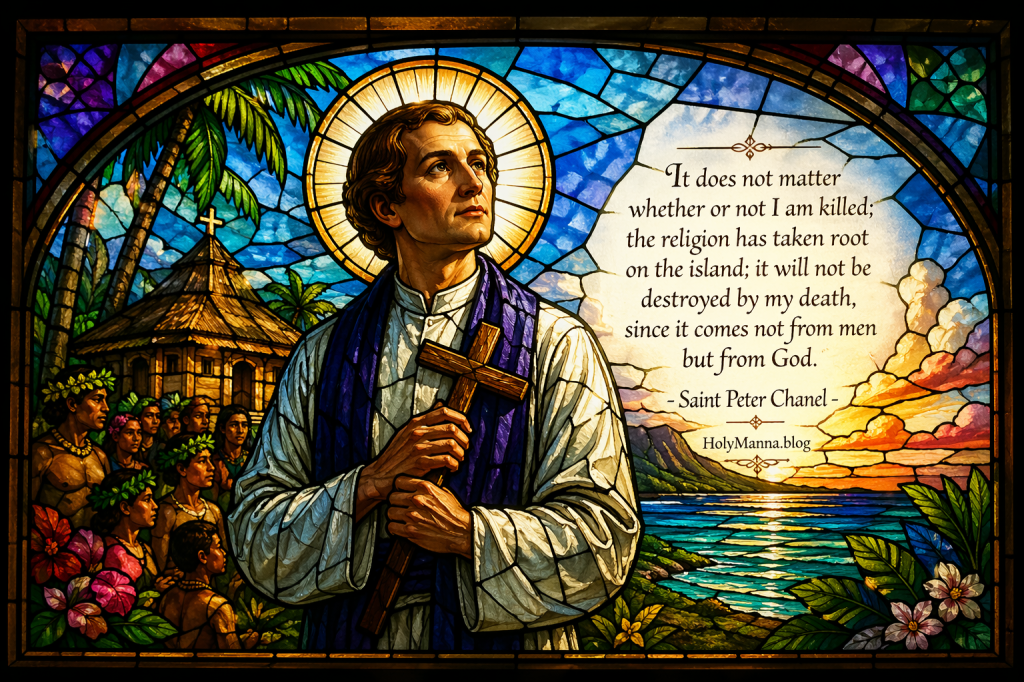
The Kind Heart That Conquered Futuna
Saint Peter Chanel was a French priest, a Marist missionary, and the first martyr of Oceania. He is remembered as a man whose life looked, at least from the outside, like a slow and painful failure. He preached, served, learned the local language, cared for the sick, and patiently loved the people of Futuna, yet he saw very few conversions during his lifetime.
And then, after his death, everything changed.
Saint Peter Chanel reminds the Church that holiness is not measured by visible success. Sometimes the seed must fall into the ground and die before it bears fruit. His life reflects the words of Christ in The Gospel of John: “Unless a grain of wheat falls to the earth and dies, it remains just a grain of wheat; but if it dies, it produces much fruit” John 12:24.
He is honored as the Protomartyr of Oceania, the Patron Saint of Oceania, and a heroic witness to the missionary heart of the Church.
From Shepherd Boy to Shepherd of Souls
Peter Louis Marie Chanel was born on July 12, 1803, in Cuet, France, into a humble farming family. As a child, he worked as a shepherd, which feels fitting when looking back on his life. Before he ever crossed oceans to seek lost sheep, he knew what it meant to watch, wait, guide, and protect.
A local priest, Father Jean-Marie Trompier, noticed Peter’s intelligence and piety and helped him receive an education. That priestly encouragement opened the door to Peter’s vocation. He entered seminary and was ordained a priest in 1827.
At first, he served in France as a diocesan priest. He became pastor of Crozet, a struggling parish that needed renewal. Peter did not arrive with noise or flash. He arrived with patience, prayer, teaching, and charity. He visited the sick, preached carefully, and helped restore Catholic life among his people.
Still, his heart longed for the missions. In 1831, he joined the Society of Mary, the Marists, a missionary community devoted to serving the Church under the patronage of the Blessed Virgin Mary. When the Marists were entrusted with mission work in Western Oceania, Peter volunteered.
The Man with the Kind Heart
Saint Peter Chanel arrived on the island of Futuna in 1837 with Brother Marie-Nizier. Futuna was a small island marked by tribal rivalries, traditional religious customs, and political tension. At first, the local ruler, King Niuliki, welcomed the missionaries. Peter began the slow work of evangelization.
He learned the language. He cared for the sick. He baptized the dying. He taught the faith patiently. He gave what he had, even when the mission seemed to produce almost no visible results.
The people came to recognize his gentleness. Catholic tradition remembers that they called him “the man with the good heart.” That title may be one of the most beautiful things ever said about a missionary. Before many accepted his message, they recognized his charity.
This is deeply Catholic. The faith is not spread by argument alone. It is carried by love. The Catechism of the Catholic Church teaches that the Church is missionary by her very nature, because she is sent by Christ to all nations CCC 849. Peter Chanel lived that mission not as a conqueror, but as a servant.
No major verified miracles during his lifetime are commonly preserved in accessible Catholic accounts. His “miracle” was quieter: the miracle of perseverance when nothing seemed to be working.
When the Gospel Threatened Power
As Christianity began to take root, King Niuliki grew suspicious. The king feared that conversion to the Catholic faith would weaken his authority and disrupt the traditional order of the island. The situation became especially tense when the king’s son, Meitala, showed interest in baptism.
For rulers who confuse authority with control, the Gospel is dangerous. Christ teaches that all power must bend before truth, mercy, and God. That kind of freedom can unsettle any system built on fear.
Peter Chanel understood the danger. A famous saying attributed to him expresses his trust in God’s work: “It does not matter whether or not I am killed; the religion has taken root on the island; it will not be destroyed by my death, since it comes not from men but from God.”
On April 28, 1841, attackers came to Peter’s hut. He was beaten, wounded, and finally killed when Musumusu struck him with an adze. During his suffering, Peter reportedly said in Futunan, “Malie fuai”, which means “It is well for me.”
That final phrase is not the language of defeat. It is the language of surrender. It is the soul saying, even in blood and pain, that Christ is enough.
His martyrdom matters because it shows the highest form of Christian witness. The Catechism teaches: “Martyrdom is the supreme witness given to the truth of the faith” CCC 2473. Peter Chanel did not merely preach Christ. He gave his life for Him.
The Island That Converted After His Death
After Saint Peter Chanel’s death, what had seemed impossible began to happen. The faith spread across Futuna. Within a few years, the island embraced Catholicism. Even those connected to his murder eventually came under the influence of the Gospel.
This is the great legacy of Saint Peter Chanel. He did not live to see the harvest. He died while the field still looked barren. But God was working beneath the surface.
His relics were recovered and honored. His memory became especially beloved among the Marists and throughout Oceania. He was beatified by Pope Leo XIII in 1889 and canonized by Pope Pius XII on June 12, 1954.
Catholic sources refer to healings and graces obtained through his intercession, though detailed popular accounts are not always easily verified. The most famous grace associated with him remains the conversion of Futuna after his martyrdom.
Today, the Basilica of Saint Peter Chanel in Poi, Futuna, stands near the place associated with his martyrdom. His feast is celebrated on April 28, especially by the Marists and Catholics throughout Oceania.
There are no major legendary miracle stories widely attached to Saint Peter Chanel in the same way as some ancient saints. His story is powerful because it is so human, so missionary, and so painfully real.
The Saint of Hidden Fruitfulness
Saint Peter Chanel is the perfect saint for anyone who feels like their efforts are not working.
Parents who pray for children who have wandered from the faith can look to him. Catechists who wonder whether anyone is listening can look to him. Priests, missionaries, bloggers, teachers, and quiet servants who feel unseen can look to him.
His life says something very simple and very challenging: be faithful anyway.
Love anyway. Pray anyway. Teach anyway. Serve anyway. Keep showing up with a kind heart.
The fruit belongs to God.
Where might God be asking for faithfulness rather than visible success?
Who needs to encounter Christ through patience, gentleness, and a good heart?
What would change if the goal today was not to be impressive, but to be faithful?
Saint Peter Chanel shows that the Gospel does not always take root quickly. Sometimes it grows underground. Sometimes the holiest work is hidden. Sometimes the person who plants the seed never gets to see the tree.
But in Christ, nothing offered in love is wasted.
Engage with Us!
Share your thoughts and reflections in the comments below.
- Have you ever felt like your prayers or efforts were not bearing fruit?
- What part of Saint Peter Chanel’s patience speaks most strongly to your own faith journey?
- How can you become a person with “a good heart” in your family, parish, workplace, or community?
- Where is God asking you to trust Him with the harvest instead of demanding immediate results?
May Saint Peter Chanel teach us to serve with patience, suffer with courage, and love with a heart rooted in Christ. May we live with steady faith, trusting that God can bring life from sacrifice, conversion from suffering, and mercy from places that seem impossible. And may everything we do be done with the love and mercy Jesus taught us.
Saint Peter Chanel, pray for us!
Follow us on YouTube, Instagram and Facebook for more insights and reflections on living a faith-filled life.


Leave a Reply