Tuesday of the Fourth Week of Easter – Lectionary: 280
Gathered Into One Shepherd’s Hand
There is something deeply comforting in today’s readings for Tuesday of the Fourth Week of Easter: while the world scatters, confuses, divides, and wounds, Christ gathers. That is the thread running through every passage today. In Acts 11:19-26, believers are driven from their homes by persecution, yet the Gospel travels with them and takes root in Antioch. In Psalm 87, Zion is praised as the city where even the nations can be counted among God’s own. In John 10:22-30, Jesus reveals the heart of it all by declaring that His sheep hear His voice, follow Him, and remain forever secure in His hand. The central theme is the risen Christ gathering a people to Himself and forming them into one flock, one household, one Church.
This makes today’s readings especially rich in historical and spiritual meaning. The Church in Acts is still young, still bruised from persecution after Stephen’s martyrdom, and still learning how wide the mercy of God truly is. Antioch becomes one of the first great places where the Gospel clearly breaks beyond Jewish boundaries and begins drawing in the Gentiles in visible numbers. That matters because it shows the Church’s catholicity already unfolding in history. This is not an afterthought. This is the plan of God being revealed. The song of Psalm 87 had already hinted at this mystery, portraying Zion not merely as the city of one people, but as a spiritual mother in whom even foreign nations can be named as if born there. What had been sung in hope begins to appear in fact.
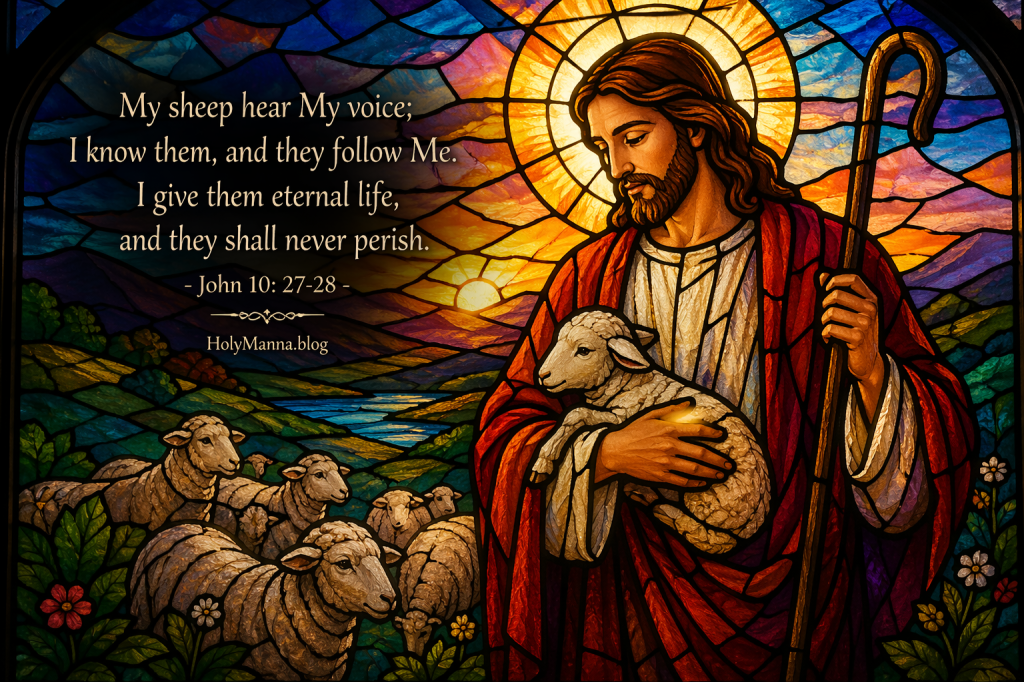
Then the Gospel places everything in the mouth of Christ Himself. During the Feast of Dedication, in the temple at Jerusalem, Jesus is pressed to speak plainly about who He is. His answer is not just a claim about His mission, but a revelation of His identity and authority. “My sheep hear my voice; I know them, and they follow me.” These are not the words of a mere teacher offering advice. These are the words of the divine Shepherd who knows His flock personally and gives them eternal life. The Church’s growth in Acts, the nations gathered in Psalm 87, and the promise of security in John 10 all meet here. The flock can be gathered because the Shepherd is not only sent by the Father. He is one with the Father.
That is what makes today’s readings feel so alive for the Catholic heart. They remind the faithful that Christianity is not just about isolated belief or private inspiration. It is about being gathered by Christ into something real, visible, and enduring. The scattered are brought home. The outsider is invited in. The believer learns to recognize the voice of the Shepherd above every competing voice in the world. What does it mean to belong to Christ so fully that His voice becomes more familiar than fear, noise, or doubt? That is the question quietly waiting beneath today’s readings, and it is the perfect doorway into the Word God gives His Church today.
First Reading – Acts 11:19-26
When the scattered become missionaries and strangers become family
The first reading opens in the shadow of suffering, but it quickly becomes a story about the surprising freedom of grace. The Church has been shaken by the persecution that followed the martyrdom of Stephen. Believers have been pushed out of Jerusalem and scattered across the eastern Mediterranean world, into places like Phoenicia, Cyprus, and Antioch. On the surface, it looks like a moment of weakness. Yet this is exactly how the Lord begins widening the reach of the Gospel. What violence meant to crush, God uses to spread the Word.
Antioch matters here in a very special way. It was one of the great cities of the ancient world, wealthy, influential, and deeply mixed in culture and language. Jews lived there, but so did many Gentiles, including Greeks who had no place in the covenant of Israel by birth. That makes this reading a turning point in salvation history. The Gospel is no longer appearing only as a message preached within Jewish circles. In Antioch, the Church begins to show her universal face. This fits perfectly with today’s theme. Christ the Good Shepherd is gathering one flock from many peoples, and in Antioch that gathering starts becoming visible in a new and public way.
Acts 11:19-26 – New American Bible (Revised Edition)
19 Now those who had been scattered by the persecution that arose because of Stephen went as far as Phoenicia, Cyprus, and Antioch, preaching the word to no one but Jews. 20 There were some Cypriots and Cyrenians among them, however, who came to Antioch and began to speak to the Greeks as well, proclaiming the Lord Jesus. 21 The hand of the Lord was with them and a great number who believed turned to the Lord. 22 The news about them reached the ears of the church in Jerusalem, and they sent Barnabas [to go] to Antioch. 23 When he arrived and saw the grace of God, he rejoiced and encouraged them all to remain faithful to the Lord in firmness of heart, 24 for he was a good man, filled with the holy Spirit and faith. And a large number of people was added to the Lord. 25 Then he went to Tarsus to look for Saul, 26 and when he had found him he brought him to Antioch. For a whole year they met with the church and taught a large number of people, and it was in Antioch that the disciples were first called Christians.
Detailed Exegesis
Verse 19 – “Now those who had been scattered by the persecution that arose because of Stephen went as far as Phoenicia, Cyprus, and Antioch, preaching the word to no one but Jews.”
The verse begins with pain, but it is already carrying the seed of mission. The persecution surrounding Stephen’s death did not silence the disciples. It sent them outward. In the mystery of divine providence, suffering became the road by which the Gospel traveled. At this stage, however, the preaching remained directed only to Jews. That makes sense historically and religiously. The earliest Christians were Jews who had come to believe that Jesus was the promised Messiah of Israel. They did not yet fully grasp how far the mission would stretch. This verse captures the Church in transition, still faithful, still preaching, but not yet fully aware of the breadth of Christ’s plan.
Verse 20 – “There were some Cypriots and Cyrenians among them, however, who came to Antioch and began to speak to the Greeks as well, proclaiming the Lord Jesus.”
This verse is one of the great missionary breakthroughs in the Acts of the Apostles. Men from Cyprus and Cyrene cross a line that many in the early Church had not yet crossed. They begin speaking to the Greeks as well. This is not a rejection of Israel. It is the flowering of God’s promise to bless all nations through His saving work. The content of their preaching is important too. They proclaim the Lord Jesus. That title matters. Jesus is not being offered as one religious teacher among many in a cosmopolitan city. He is announced as Lord. Antioch, with all its mixture of peoples and beliefs, becomes the place where the lordship of Christ begins to be proclaimed more clearly beyond Jewish boundaries.
Verse 21 – “The hand of the Lord was with them and a great number who believed turned to the Lord.”
The Church never grows merely by strategy, personality, or momentum. Luke makes the true cause clear: the hand of the Lord was with them. This is biblical language for divine action, power, and favor. The fruit that follows is not only numerical growth but conversion. The people turned to the Lord. That is the language of repentance and faith. Real evangelization always leads to that turning. It does not simply attract attention. It brings souls into living relationship with Christ. This verse reminds the reader that every genuine conversion is a work of grace before it is a human success story.
Verse 22 – “The news about them reached the ears of the church in Jerusalem, and they sent Barnabas [to go] to Antioch.”
The Church in Jerusalem does not ignore what is happening far away. She responds. This shows something deeply Catholic and apostolic. The Church is already living as a real communion, not a loose collection of private ministries. Jerusalem hears, discerns, and sends. Barnabas is chosen as a trusted representative. That matters because discernment belongs to the life of the Church. New movements of grace are not meant to remain detached from apostolic oversight. This verse quietly reveals order, unity, and pastoral care at work in the early Church.
Verse 23 – “When he arrived and saw the grace of God, he rejoiced and encouraged them all to remain faithful to the Lord in firmness of heart.”
Barnabas is a beautiful model of spiritual maturity. He comes to Antioch not with suspicion or insecurity, but with eyes trained to recognize grace. He saw the grace of God and rejoiced. That is the response of a holy man. He does not need to control what God is doing in order to affirm it. He then encourages the believers to remain faithful in firmness of heart. The phrase suggests perseverance, stability, and deep-rooted loyalty to Christ. In a city full of distractions, religious plurality, and moral confusion, the new disciples would need that firmness. The Christian life cannot survive on enthusiasm alone. It requires steadfastness.
Verse 24 – “For he was a good man, filled with the holy Spirit and faith. And a large number of people was added to the Lord.”
Luke pauses to describe Barnabas himself. He is a good man, filled with the holy Spirit and faith. This is not filler. The Church grows through holy people. Barnabas’s goodness is not vague niceness. It is the fruit of a life yielded to God. Because he is full of the Holy Spirit and faith, he becomes an instrument through whom others are added to the Lord. Once again, Luke keeps the focus right where it belongs. People are not added to Barnabas. They are added to the Lord. The true evangelizer never builds a personality cult. He helps others belong more fully to Christ.
Verse 25 – “Then he went to Tarsus to look for Saul,”
This short verse carries quiet but enormous significance. Barnabas recognizes that the work in Antioch needs help, and he goes looking for Saul. This is an act of humility and wisdom. Barnabas does not cling to importance. He is willing to bring in another laborer, even one whose gifts may eventually outshine his own in public memory. Saul, who will later be known as Paul, has already encountered Christ and received a mission, but here he is being drawn into the next stage of that calling. Antioch becomes one of the great training grounds for apostolic mission.
Verse 26 – “And when he had found him he brought him to Antioch. For a whole year they met with the church and taught a large number of people, and it was in Antioch that the disciples were first called Christians.”
This verse brings the whole passage to a powerful conclusion. Barnabas and Saul do not merely visit. They stay, teach, and form the Church. Christian identity is not built only through a dramatic conversion moment. It is also shaped by sustained catechesis, community, and perseverance. Then comes the famous line: “it was in Antioch that the disciples were first called Christians.” The name marks a moment when the followers of Jesus have become publicly recognizable as a distinct people. They belong to Christ. They live under His name. In a city of many identities, they receive the name that matters most. The world sees something new, and the Church begins to be known by the One to whom she belongs.
Teachings
This reading reveals the Church becoming visibly catholic. That word does not first mean Roman, ethnic, or political. It means universal, whole, destined for all peoples. The Catechism of the Catholic Church teaches this plainly in CCC 830: “The word ‘catholic’ means ‘universal,’ in the sense of ‘according to the totality’ or ‘in keeping with the whole.’ The Church is catholic in a double sense: First, the Church is catholic because Christ is present in her.” Antioch is one of the first places where that universality becomes unmistakable in history. The Gospel is reaching Greeks, the Church is receiving them, and the household of God is widening before the eyes of the world.
The missionary character of the Church also shines through this reading. The Church is not an inward-looking circle guarding a private inheritance. She is sent. CCC 849 says, “Having been divinely sent to the nations that she might be ‘the universal sacrament of salvation,’ the Church, in obedience to the command of her founder and because it is demanded by her own essential universality, strives to preach the Gospel to all men.” That is exactly what is unfolding in Antioch. What began in Jerusalem is now moving outward, not as a betrayal of Israel, but as the fulfillment of God’s plan to gather all nations in Christ.
There is also an important lesson here about ecclesial discernment and apostolic unity. Barnabas is sent by the Church in Jerusalem, and he does not resist the new work of God. He confirms it, strengthens it, and helps organize it. That is deeply Catholic. Grace does not destroy order. The Holy Spirit does not lead souls away from the Church Christ founded, but more deeply into her life. Antioch is not becoming a rival church. It is becoming a living branch of the one apostolic Church.
The city of Antioch would later hold a place of deep importance in Christian memory. It is especially fitting that Saint Ignatius of Antioch, one of the great bishops and martyrs of the early Church, came from that same Christian soil. His witness helps illuminate the significance of this passage. In his Letter to the Smyrnaeans, he wrote: “Wherever Jesus Christ is, there is the Catholic Church.” That short line sounds almost like the mature fruit of what began in today’s reading. Antioch was one of the places where believers first learned, in lived reality, that belonging to Christ meant belonging to a visible communion that embraced peoples far beyond old boundaries.
Barnabas also stands as a model of Christian leadership. He sees grace and rejoices. He encourages firmness of heart. He makes room for Saul. This is a saintly pattern worth noticing. The Church needs leaders who are secure enough to recognize the work of God in others, wise enough to strengthen it, and humble enough to share the mission. This passage is not only about expansion. It is about the kind of holiness that makes true growth possible.
Reflection
This reading has a way of meeting people right where they are, especially in seasons that feel scattered, uncertain, or disruptive. The first believers did not choose persecution, exile, or instability. Yet the Lord was already at work in the middle of it. That is a needed reminder. God is not limited to neat plans, calm seasons, or ideal circumstances. Sometimes He builds through the very things that seem to break everything apart.
There is also a challenge here for daily Christian life. Barnabas did not arrive in Antioch looking for problems first. He arrived looking for grace. That is not naïve optimism. It is spiritual maturity. In ordinary life, it is easy to notice what is wrong in a parish, a family, a friendship, or a culture. It is harder, and holier, to notice where God is already working and to strengthen it. One practical step from this reading is to become more like Barnabas in speech. Encourage someone in the faith. Strengthen a new believer. Welcome the person who feels out of place. Rejoice when Christ is drawing others to Himself.
Another step is to examine whether Christian identity is truly the deepest identity shaping daily life. Antioch was the place where the disciples were first called Christians. That name was not casual. It meant they were marked by Christ. In a culture full of labels, loyalties, and manufactured identities, this reading asks whether the name Christian is really being lived from the inside out. Does the way daily life is lived make it clear that Christ is the center? Is there a willingness to remain faithful to the Lord with firmness of heart when the culture pulls the other way? Is there room in the heart to rejoice when grace appears in unexpected people and places?
This reading also invites a more missionary spirit. The men from Cyprus and Cyrene did not keep Christ to themselves. They spoke. Many believers today hesitate for understandable reasons. There is fear of rejection, fear of awkwardness, fear of not knowing enough. Yet this passage reminds the faithful that the Lord’s hand is what gives fruit. The task is not to control outcomes. The task is to speak of Jesus with honesty, charity, and courage.
In the end, Acts 11:19-26 tells a story the Church never outgrows. Christ keeps gathering. The Gospel keeps moving. The scattered are not forgotten. The outsider is not beyond His reach. The Church becomes more fully herself when she welcomes the grace of God, stays rooted in apostolic truth, and lets the name of Christ become the name by which everything else is judged. That is not only the story of Antioch. It is the calling of every Catholic heart today.
Responsorial Psalm – Psalm 87
The city of God becomes the birthplace of the nations
The responsorial psalm for today sounds like a song about Jerusalem, but it is doing something much deeper than praising an ancient city. Psalm 87 is a hymn of Zion, likely sung in the worship life of Israel, and it comes from the tradition of the Korahites, a group associated with sacred song. In the Old Testament, Zion is the holy mountain, the dwelling place of God, the place of covenant, worship, and promise. Yet this psalm takes that familiar image and opens it wide. It dares to say that peoples once seen as foreign, distant, or even hostile will be counted as born there. Saint John Paul II called this psalm a hymn to Jerusalem as a city of peace and universal mother, and that insight fits today’s readings beautifully, because the same God who gathers Greeks in Antioch is the God who had already promised, in figure, to gather the nations into one holy people.
This is why the psalm fits so naturally with the first reading and the Gospel. In Acts 11, the Church begins to show her universal face as Gentiles turn to the Lord in Antioch. In John 10, Jesus speaks as the Good Shepherd whose sheep hear His voice and remain safe in His hand. Psalm 87 stands between those two readings like a bridge. It sings ahead of time what Christ fulfills in history: the family of God will not remain closed in on itself. Zion will become mother to many peoples. The city of God will become the home of all who are reborn by grace.
Psalm 87 – New American Bible (Revised Edition)
Zion the True Birthplace
1 A psalm of the Korahites. A song.
His foundation is on holy mountains,
2 The Lord loves the gates of Zion
more than any dwelling in Jacob.
3 Glorious things are said of you,
O city of God!
Selah4 Rahab and Babylon I count
among those who know me.
See, Philistia and Tyre, with Ethiopia,
“This one was born there.”
5 And of Zion it will be said:
“Each one was born in it.”
The Most High will establish it;
6 the Lord notes in the register of the peoples:
“This one was born there.”
Selah
7 So singers and dancers:
“All my springs are in you.”
Detailed Exegesis
Verse 1. “His foundation is on holy mountains,”
The psalm begins with foundation. Zion is not holy because of political strength, human beauty, or military success. It is holy because God has chosen it. The image of holy mountains reminds the reader that God establishes His saving work on ground set apart for Himself. Spiritually, this points beyond earthly Jerusalem to the deeper truth that God Himself is the foundation of His people. The Church later reads this through Christ, who is the true cornerstone and sure foundation of the new and everlasting covenant.
Verse 2. “The Lord loves the gates of Zion more than any dwelling in Jacob.”
The gates of Zion are not mentioned casually. In the ancient world, city gates were places of entry, judgment, public life, and identity. To say that the Lord loves the gates of Zion is to say that He delights in the place where His people gather before Him. This is covenant language. God has chosen a place where He makes Himself known and where His people come into communion with Him. In light of the New Covenant, the Church sees here a foreshadowing of the visible people of God, gathered by divine love, not by human preference.
Verse 3. “Glorious things are said of you, O city of God!”
This verse gives the tone of wonder. Zion is not ordinary because her glory comes from the God who dwells there. Saint John Paul II pointed out that the psalmist knows this claim sounds daring, which is why the psalm pauses to draw attention to it. Jerusalem was not the capital of a vast empire, yet glorious things are spoken of her because she belongs to God’s saving plan. This matters spiritually. The people of God are glorious not because of worldly prestige, but because the Lord has made His home among them.
Verse 4. “Rahab and Babylon I count among those who know me. See, Philistia and Tyre, with Ethiopia, ‘This one was born there.’”
Now the psalm becomes astonishing. Rahab here is a poetic name for Egypt. Babylon, Philistia, Tyre, and Ethiopia represent nations beyond Israel, some powerful, some wealthy, some hostile, all outside the covenant people in the ordinary sense. Yet the Lord says of them, “This one was born there.” Saint John Paul II explained that the psalm places these peoples into the spiritual register of Jerusalem as natives, as those entitled to belong. This is one of the boldest universal notes in the Psalter. What was once foreign is being brought near. What was once outside is being named as home.
Verse 5. “And of Zion it will be said: ‘Each one was born in it.’ The Most High will establish it;”
Zion is now portrayed not simply as a city, but as a mother. She becomes the place where people are said to be born. This is the language of belonging, identity, and inheritance. It points toward a mystery that the Church would later understand with great clarity: God’s people are not held together by bloodline alone, but by a new birth from above. The Most High establishes Zion, and because He establishes her, she becomes fruitful beyond all human expectation. John Paul II said, “Zion is sung as mother, not just of Israel, but of all humanity.” That line opens the whole psalm.
Verse 6. “The Lord notes in the register of the peoples: ‘This one was born there.’”
This is the language of citizenship and recognition. In the ancient world, to be entered in the register of a city meant more than a sentimental connection. It meant acknowledged belonging. The Lord Himself is doing the registering. He is the one declaring who belongs to His city. In the light of Christ and the Church, this verse begins to sound almost baptismal. God is the one who gives a new identity. He writes His people into the household of grace. He makes strangers into sons and daughters.
Verse 7. “So singers and dancers: ‘All my springs are in you.’”
The psalm ends not with argument, but with joy. The peoples gathered into Zion do not merely receive a legal status. They discover their source. Saint John Paul II reflected that the nations rediscover their source in the city of God, like a river of living water making the world fruitful. The image of springs suggests life, refreshment, origin, and joy. Everything living flows from God’s presence. In Christian reading, this finds its fullest meaning in Christ, from whose pierced side flow the saving waters that give birth to the Church and nourish the nations.
Teachings
This psalm helps reveal the Church’s catholicity long before the word catholic appears in Christian language. What Zion is in figure, the Church becomes in fulfillment. The Catechism says in CCC 830: “The word ‘catholic’ means ‘universal,’ in the sense of ‘according to the totality’ or ‘in keeping with the whole.’ The Church is catholic in a double sense: First, the Church is catholic because Christ is present in her.” That line matters here because Psalm 87 is not praising universality as a vague human ideal. It is praising a people made universal because God is present in their midst.
The psalm also helps explain why the Church cannot ever become tribal, narrow, or merely local in spirit. CCC 831 says: “Secondly, the Church is catholic because she has been sent out by Christ on a mission to the whole of the human race: All men are called to belong to the new People of God. This People, therefore, while remaining one and only one, is to be spread throughout the whole world and to all ages in order that the design of God’s will may be fulfilled: he made human nature one in the beginning and has decreed that all his children who were scattered should be finally gathered together as one.” That could almost serve as a commentary on this psalm. The nations named in Psalm 87 are a prophecy of the one people Christ gathers from every land.
Saint John Paul II drew this out with remarkable clarity when he taught that Psalm 87 does not only imagine nations coming toward Zion, but actually presents Zion as their point of origin. He said, “The Psalmist sees in Zion the origin of all peoples.” He also said, “Zion is sung as mother, not just of Israel, but of all humanity.” That is a deeply Catholic way of reading this passage. The Church is not a closed circle defending a heritage for a few. She is the family in which scattered humanity is gathered, healed, and made at home in Christ.
There is also a strong ecclesial note here. CCC 832 teaches: “The Church of Christ is really present in all legitimately organized local groups of the faithful, which, in so far as they are united to their pastors, are also quite appropriately called Churches in the New Testament…. In them the faithful are gathered together through the preaching of the Gospel of Christ, and the mystery of the Lord’s Supper is celebrated…. In these communities, though they may often be small and poor, or existing in the diaspora, Christ is present, through whose power and influence the One, Holy, Catholic, and Apostolic Church is constituted.” That teaching helps connect the psalm to Antioch. The same Zion once sung by Israel now appears sacramentally in the Church spread through the world, where Christ gathers His people in Word and Eucharist.
Reflection
There is something deeply healing in this psalm for anyone who has ever felt spiritually homeless. The world hands out identities that shift with fashion, tribe, success, politics, and desire. God does something different. He names people into a home. He says, in effect, that those who seemed far off can be counted as born in His city. That is not sentimental. That is salvation. The Catholic faith has always insisted that grace does not merely improve a person’s private inner life. Grace incorporates a person into the household of God, into a people, into a communion, into a real family with a real Shepherd.
This psalm also calls for a conversion of vision. It asks whether the heart still looks at others as outsiders first, or whether it has begun to see what God desires for them. The Lord names Egypt, Babylon, Philistia, Tyre, and Ethiopia not to erase truth, but to show the wideness of His saving plan. Daily life can become cramped and suspicious. Parishes can become inward-looking. Families can become harsh. Communities can become frightened of what is unfamiliar. This psalm pushes back against that narrowness. It reminds the faithful that God delights in gathering, adopting, and giving a home. Is there a willingness to rejoice when God draws in the people who seemed least likely to belong? Is the Church being loved as a home wide enough for the nations, or treated like a private club for the already comfortable?
A practical way to live this psalm is to recover a deeper gratitude for belonging to the Church. Pray for a more catholic heart. Speak about the faith in a way that invites rather than merely critiques. Welcome newcomers at Mass. Learn to see the parish not as a convenience, but as a living sign that all the springs of grace flow from God through His Church. And when the soul feels scattered, rootless, or worn thin, come back to the truth this psalm sings with such joy: in the city of God, the Lord still gives His people a name, a birthplace, and a home.
Holy Gospel – John 10:22-30
The Shepherd’s voice cuts through the winter and calls His flock to trust
Today’s Gospel takes place during the Feast of the Dedication in Jerusalem, a feast that remembered the cleansing and rededication of the Temple after its desecration in the time of the Maccabees. Saint John also tells us that it was winter, and that Jesus was walking in the temple area, in the Portico of Solomon. That detail is not just scenery. It gives the whole scene a certain spiritual feel. The air is cold, the questions are sharp, and the tension is real. Jesus is standing in the holy place, surrounded by people demanding clarity, yet many of them are not really seeking the truth. They want an answer, but not necessarily faith.
This Gospel fits perfectly into today’s theme because it reveals the One who gathers the scattered. In the first reading, the Church begins to spread outward and the disciples are first called Christians in Antioch. In Psalm 87, Zion is pictured as the mother-city in which even the nations are counted among God’s people. Here in John 10, the deepest reason for all of that finally comes into view. Christ can gather one flock from many peoples because He is the Good Shepherd, and not only the Good Shepherd, but the Son who is one with the Father. The Church’s unity, mission, and safety all begin here, in the voice and identity of Jesus Himself.
John 10:22-30 – New American Bible (Revised Edition)
Feast of the Dedication. 22 The feast of the Dedication was then taking place in Jerusalem. It was winter. 23 And Jesus walked about in the temple area on the Portico of Solomon. 24 So the Jews gathered around him and said to him, “How long are you going to keep us in suspense? If you are the Messiah, tell us plainly.” 25 Jesus answered them, “I told you and you do not believe. The works I do in my Father’s name testify to me. 26 But you do not believe, because you are not among my sheep. 27 My sheep hear my voice; I know them, and they follow me. 28 I give them eternal life, and they shall never perish. No one can take them out of my hand. 29 My Father, who has given them to me, is greater than all, and no one can take them out of the Father’s hand. 30 The Father and I are one.”
Detailed Exegesis
Verse 22 – “The feast of the Dedication was then taking place in Jerusalem. It was winter.”
The Feast of the Dedication refers to the celebration of the Temple’s purification and restoration after it had been profaned. This historical background matters because Jesus is now standing in the Temple during a feast about restoring true worship. In that setting, He reveals Himself as the One in whom true worship is fulfilled. The mention of winter also carries a quiet symbolic weight. There is a chill not only in the weather, but in the hearts of many around Him. The setting prepares the reader for a moment in which divine truth is offered in the midst of spiritual coldness.
Verse 23 – “And Jesus walked about in the temple area on the Portico of Solomon.”
The Portico of Solomon was a covered colonnade on the eastern side of the temple precincts. It provided shelter, which makes sense in winter, but Saint John likely includes it for more than practical detail. Jesus is in the temple, in a place associated with Israel’s sacred memory and royal wisdom, and there He walks openly. There is no secrecy in Him. He is not hiding His identity. He is present in the Father’s house, and the decisive question is whether the people around Him will recognize who stands before them.
Verse 24 – “So the Jews gathered around him and said to him, ‘How long are you going to keep us in suspense? If you are the Messiah, tell us plainly.’”
The demand sounds reasonable at first. They ask Jesus to speak plainly. Yet the Gospel makes clear that the real problem is not lack of information. Jesus has already been revealing Himself through His words and works. Their demand shows a heart that wants certainty without surrender. They are asking for a statement, but they are not yet disposed to receive the truth in faith. This is often how unbelief works. It pretends the problem is lack of evidence, when the deeper issue is resistance of heart.
Verse 25 – “Jesus answered them, ‘I told you and you do not believe. The works I do in my Father’s name testify to me.’”
Jesus answers with both sadness and clarity. He has told them, but they do not believe. His works already testify to Him because His deeds are done in the Father’s name. In Saint John’s Gospel, the works of Jesus are not random miracles or displays of power. They are signs that reveal His identity. The healings, the teachings, the authority, and the mercy all point toward who He is. This verse teaches that faith is not irrational. Christ gives testimony through His works. Yet evidence alone does not force belief. The heart must be open to grace.
Verse 26 – “But you do not believe, because you are not among my sheep.”
This is one of the hardest lines in the passage, but it must be read carefully. Jesus is not describing an arbitrary exclusion, as if some are denied access without reason. He is exposing the spiritual reality of their resistance. His sheep are those who belong to Him, receive Him, and recognize His voice. Their unbelief reveals that they are not living as those who belong to His flock. The line is a warning. It shows that there is a real difference between standing near Jesus and truly belonging to Him.
Verse 27 – “My sheep hear my voice; I know them, and they follow me.”
This verse is the heart of the passage. It gives a complete picture of discipleship in three movements: hearing, being known, and following. The sheep hear His voice. That means more than noticing religious words. It means inward recognition, docility, and trust. Jesus says, “I know them,” which reveals a deeply personal love. He does not love His people as a crowd. He knows them individually. Then He says, “and they follow me.” True discipleship does not end with inspiration or admiration. It becomes a lived response. The sheep move after the Shepherd.
Verse 28 – “I give them eternal life, and they shall never perish. No one can take them out of my hand.”
Here Jesus speaks with divine authority. No prophet merely says, “I give eternal life,” as though life everlasting were in his own hand to distribute. Jesus speaks as the source of life. He not only guides the flock. He saves it. He promises that His sheep shall never perish and that no one can take them from His hand. This is one of the most consoling promises in the Gospel. It does not mean the Christian life will be free from suffering, persecution, or temptation. It means that no created power can finally overpower the saving grasp of Christ.
Verse 29 – “My Father, who has given them to me, is greater than all, and no one can take them out of the Father’s hand.”
Jesus now deepens the promise by joining His hand to the Father’s hand. The sheep belong to the Father and are entrusted to the Son. Their security rests not in their own strength, but in the power of God. This verse reveals both the tenderness and majesty of divine providence. The flock is not wandering through history unattended. The Father is guarding what He has given, and the Son is holding what the Father loves. The Christian life is fragile in human terms, but it is secure in divine hands.
Verse 30 – “The Father and I are one.”
This final line is the summit of the passage. Jesus is not merely saying that He agrees with the Father or works in moral harmony with Him. He is revealing a unity so profound that the crowd will soon understand it as a claim to divinity. This is why the Church has always read this verse as one of the great testimonies to the divine sonship of Christ. The Shepherd who gathers the flock is not just sent by God in the way a prophet is sent. He is one with the Father. That is why His voice has absolute authority. That is why His hand gives eternal life. That is why His flock can rest secure.
Teachings
This Gospel is one of the clearest places where the Church sees both the tenderness of Christ the Good Shepherd and the glory of Christ the eternal Son. The image of the flock is not accidental or decorative. It reaches deep into the Church’s understanding of herself. The Catechism teaches in CCC 754: “The Church is, accordingly, a sheepfold, the sole and necessary gateway to which is Christ. It is also the flock of which God himself foretold that he would be the shepherd, and whose sheep, even though governed by human shepherds, are unfailingly nourished and led by Christ himself, the Good Shepherd and Prince of pastors, who gave his life for his sheep.” That quotation brings together so much of today’s Gospel. Christ is the gateway, the Shepherd, and the One who nourishes and leads His flock through the life of the Church.
This means Christianity cannot be reduced to private spirituality. The sheep belong to a flock. They are gathered, led, protected, and fed. The Church is not an optional add-on to a personal relationship with Jesus. She is the flock He gathers. That truth is deeply needed in an age that prefers individual spirituality without obedience, doctrine, sacrament, or communion.
The Gospel also reveals Christ’s divine identity in a way that cannot be softened or explained away. The Catechism says in CCC 253: “The Trinity is One. We do not confess three Gods, but one God in three persons, the ‘consubstantial Trinity’.” When Jesus says, “The Father and I are one,” the Church hears not a vague statement of cooperation, but a revelation that the Son shares fully in the divine life of the Father. This is one reason the early Church fought so fiercely to defend the truth of Christ’s divinity. If Jesus were not truly God, then His promise to give eternal life would be empty. But because He is the eternal Son, His promise is real, His hand is secure, and His voice must be obeyed.
There is also a beautiful pastoral teaching here about the nature of faith. Jesus does not describe His disciples primarily as thinkers, activists, or spectators. He calls them sheep who hear His voice and follow Him. Saint Augustine often returned to this theme when speaking about the Gospel of John. He understood that faith is not merely hearing sounds, but recognizing the voice of the Shepherd with the heart. There is a difference between listening to religion from a distance and belonging to Christ from within. That difference is the difference between curiosity and discipleship.
Historically, this Gospel also stands in a meaningful place during Eastertide. The Church reads these shepherd passages after Easter because the risen Christ has not abandoned His people. He remains their living Shepherd. The Resurrection does not remove His closeness. It confirms it. The One who died for the sheep now lives forever to guard them, lead them, and bring them to eternal life.
Reflection
This Gospel speaks with unusual power to a world full of noise. There are voices everywhere competing for attention, loyalty, fear, outrage, and desire. Some flatter. Some manipulate. Some confuse. Some promise freedom while leading people deeper into bondage. Into that noise, Jesus says something simple and unforgettable: “My sheep hear my voice; I know them, and they follow me.” That line invites a serious examination of conscience. Which voice is shaping daily life most deeply? Is it Christ’s voice in Scripture, prayer, and the teaching of the Church, or the voice of culture, anxiety, appetite, and endless distraction?
One of the most practical ways to live this Gospel is to make space for that voice to be heard. That means silence. It means prayer with the Scriptures. It means fidelity to Sunday Mass and love for the sacraments. It means learning to recognize that Christ’s voice does not merely comfort. It also corrects, calls, and redirects. The sheep who hear His voice are not the ones who use Jesus to baptize their own preferences. They are the ones willing to follow where He leads.
This Gospel also offers deep comfort to anyone carrying fear. Jesus does not say that His sheep will never suffer. He does not say they will never be tested. He says that they will never be lost from His hand. That is a different and deeper promise. In daily life, that can mean clinging to Christ during confusion, temptation, grief, or uncertainty with a more childlike trust. It can mean refusing despair. It can mean remembering that salvation rests finally not on personal strength, but on the faithfulness of the Shepherd.
There is also a strong challenge here about belonging. Some in the temple were physically close to Jesus, yet spiritually far from Him. That danger has not disappeared. It is possible to be around holy things without surrendering to the Holy One. It is possible to know religious language without knowing the Shepherd. Is the heart truly listening to Christ, or only collecting religious ideas? Is there a willingness to follow when His voice contradicts comfort, pride, or personal plans? Is trust being placed more in personal control, or in the hand that no one can overpower?
In the end, this Gospel is not just a lesson about sheep. It is a revelation of Jesus. He is the Shepherd whose voice must be heard, the Savior whose hand cannot fail, and the Son who is one with the Father. That is why the Church can go out to the nations. That is why the scattered can be gathered. That is why Christians can live with courage in a cold and restless world. The flock is safe not because the world is gentle, but because the Shepherd is divine.
Home in the Shepherd’s Voice
Today’s readings come together like one quiet, powerful story about what God does with scattered lives. In Acts 11:19-26, persecution sends believers out into the world, but the Lord turns that scattering into mission. In Psalm 87, Zion is no longer seen only as a city for one people, but as a mother-city where even the nations can be counted among God’s own. In John 10:22-30, Jesus reveals the deepest reason this is possible: He is the Good Shepherd whose sheep hear His voice, follow Him, and rest secure in His hand. What seemed divided is being gathered. What seemed far off is being brought near. What seemed uncertain is being held fast by Christ.
That is the great message of the day. The Christian life is not about building a private spirituality and hoping it holds together. It is about being gathered by Jesus into His flock, strengthened in His Church, and taught to recognize His voice above every lesser voice. Antioch shows the Church growing. Zion shows the nations being welcomed home. The Gospel shows the heart of it all. The One leading this people is not merely a wise teacher or holy messenger. He is the Son who can say with full authority, “The Father and I are one.”
There is something deeply encouraging here for anyone who feels stretched, distracted, or spiritually worn down. The Lord is still gathering. He is still calling. He is still writing names into His household and drawing souls into His mercy. No season of confusion is beyond His reach. No heart is too far to hear His voice again. The invitation is simple, but it is not shallow. Stay close to the Shepherd. Listen for His voice in Scripture, in prayer, in the sacraments, and in the teaching of His Church. Let that voice become more familiar than fear, more trusted than personal instinct, and more loved than the noise of the world.
Take the next step with courage. Return to prayer with more honesty. Go to Mass with more attention. Read the Word of God with a more open heart. Encourage someone who feels far from the Church. Choose fidelity over drift. Choose trust over spiritual restlessness. What would change if Christ’s voice became the loudest voice in daily life? That is the question these readings leave behind, and it is a beautiful one to carry into the day. The flock is not wandering alone. The Shepherd is still speaking, and His hand is still holding fast.
Engage with Us!
Share your reflections in the comments below. Today’s readings open up so much to pray with, especially for anyone trying to listen more closely to Christ and live more faithfully in His Church.
- In the First Reading from Acts 11:19-26, what stands out most about the way God used persecution and scattering to spread the Gospel? Is there any difficult season in life that the Lord may be trying to transform into a moment of grace, witness, or growth?
- In the Responsorial Psalm, Psalm 87, what does it mean to see the city of God as a home wide enough for all peoples? Does the heart reflect that same generosity, or is there still a tendency to keep faith small, private, or closed off from others?
- In the Holy Gospel from John 10:22-30, what does it look like in daily life to truly hear the voice of the Good Shepherd and follow Him? Which voices most often compete with Christ for attention, trust, and obedience?
- Looking at all three readings together, where is Christ trying to gather what feels scattered right now? Is there an invitation to return more deeply to prayer, to the sacraments, or to a stronger sense of belonging in the Church?
Let today be more than a good reflection. Let it become a way of living. Stay close to the Shepherd, remain faithful in heart, and do everything with the love, mercy, and truth that Jesus taught.
Sacred Heart of Jesus, we trust in You!
Immaculate Heart of Mary, pray for us!
Saint Michael the Archangel, defend us in battle!
Follow us on YouTube, Instagram and Facebook for more insights and reflections on living a faith-filled life.

 Holy Manna!
Leave a comment