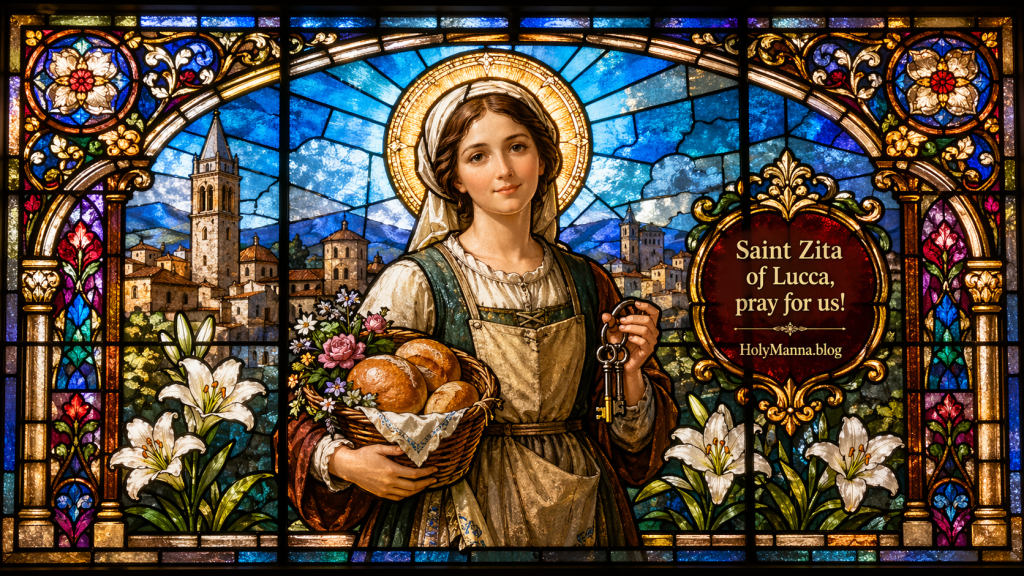
The Saint of the Kitchen Door and the Gates of Heaven
Saint Zita of Lucca is one of those saints who can stop a person in his tracks, especially in an age that constantly celebrates visibility, status, and applause. She did not found a religious order. She did not preach in public squares. She did not write a theological masterpiece. She spent her life doing household work, serving in another family’s home, praying, fasting, and caring for the poor. Yet the Church has honored her for centuries because her life proves something beautiful and deeply Catholic: holiness can grow in the most ordinary places.
Born in the early thirteenth century near Lucca in Italy, Saint Zita became known for humility, hard work, mercy, and a heart completely given to God. Her feast is celebrated on April 27, and she is especially revered as the patron saint of domestic workers, servants, homemakers, and those whose labor is often unseen. Her life speaks with quiet force to anyone who has ever felt overlooked, burdened, or trapped in daily duties that seem small in the eyes of the world.
Saint Zita matters because she reminds the faithful that no honest work is beneath the dignity of a Christian soul. When work is done with love, prayer, and charity, it becomes an offering to God. That is exactly the spirit found in The Catechism, which teaches that work can be a path to sanctification and a participation in God’s creation and service to neighbor, as taught in CCC 2427.
From a Poor Village to a Holy Calling
Saint Zita was born around the year 1218 in or near Monsagrati, close to Lucca in Tuscany. Catholic tradition remembers her as coming from a poor but devout family. Local tradition preserves the names of her parents as Giovanni and Buonissima. There is also a tradition that one of her sisters, Margherita, lived a life of notable holiness. These details belong to the Catholic memory surrounding her life, and they help paint the picture of a girl formed in a world of simplicity, hard work, and faith.
From childhood, Zita seems to have had a tender conscience before God. Catholic tradition remembers her as a girl who wanted to please the Lord in everything. She did not have the kind of education that would have drawn the attention of scholars or nobles, but she had something greater than worldly polish. She had a soul attentive to grace.
At about twelve years old, she entered service in the household of the Fatinelli family in Lucca. That was not unusual for a poor girl of her time, but what she did with that life was extraordinary. She remained in that household for the rest of her days. Instead of despising the hiddenness of domestic labor, she allowed God to sanctify her through it.
This was not a dramatic conversion story in the way some saints have one. Saint Zita did not move from a life of public sin to a life of heroic repentance. Her path was quieter and, in some ways, more challenging. She deepened in faith through fidelity. She became a saint by persevering in goodness day after day, year after year, in the place where God had planted her.
What she became most known for was this union of prayer and work. She rose early to attend Mass when possible. She prayed while doing her duties. She fasted. She gave to the poor. She lived the ordinary life with extraordinary love.
Holiness in Aprons, Bread, and Everyday Mercy
The beauty of Saint Zita’s life is that it was not divided into sacred moments and ordinary moments. Everything belonged to God. The kitchen belonged to God. The laundry belonged to God. The keys of the household belonged to God. The table, the bread, the errands, the fatigue, the silence, and the long routine all became material for sanctity.
Catholic tradition remembers her as a diligent and trustworthy servant. Over time, she was placed in charge of the household because even those who once doubted her came to trust her judgment and character. She was not lazy in the name of prayer, nor did she use work as an excuse to neglect prayer. A saying traditionally attributed to her captures that balance well: “Devotion is false if slothful.” Another traditional version says, “A servant is not holy if she is not busy.” That second wording is better understood as a later devotional phrasing and not necessarily a verbatim historical quotation, but both forms express the same Catholic truth. Real holiness makes a person faithful in duty.
Saint Zita was especially known for love of the poor. She gave food, clothing, and whatever aid she could to those in need. In her life, the corporal works of mercy were not theory. They were daily practice. This reflects the teaching of The Catechism, which names feeding the hungry and helping those in need among the essential works of Christian mercy, as taught in CCC 2447.
Many miracle stories are associated with her lifetime. The most famous is the story of the bread and flowers. According to the long-loved legend, Zita was carrying bread in her apron to give to the poor when someone accused her of taking food from the household. When her master demanded to know what she was carrying, she answered that it was flowers. When the apron was opened, the bread had become flowers. This story has been treasured for centuries, especially in Lucca, but it should be presented honestly as a legend that cannot be fully verified.
Another beloved story says that angels baked the bread or completed her household chores while she was delayed in prayer or at Mass. This too belongs to the saint’s devotional tradition and cannot be fully verified in the historical sense, but it reveals how generations of Catholics understood her sanctity. They believed heaven itself delighted to assist a servant who loved God so completely.
There are also stories that a pantry was replenished after she gave food to the poor, that she lent a cloak to a freezing beggar and it was mysteriously returned, that water became sweet like wine for travelers, and that she knew the time of her own death beforehand. These stories are part of her traditional Catholic legacy, though they cannot all be historically verified in the same way. Even so, they point to the same spiritual reality: Saint Zita’s life radiated charity, and people saw the hand of God in it.
The Cross She Carried Without Complaint
Saint Zita was not a martyr in the formal sense. She was not killed for the faith. Yet she carried real suffering, and she carried it in a profoundly Christian way.
Catholic accounts describe her early years in service as painful. Other servants were jealous of her diligence and piety. She was mocked, slandered, and mistreated. Her employers, influenced by accusations and resentment, were at times harsh toward her. This kind of suffering can be harder than dramatic persecution because it is so ordinary and so repetitive. It comes in the form of misunderstanding, ingratitude, and daily humiliation.
She endured these hardships with patience and meekness. She did not become bitter. She did not harden her heart. She continued to work, continued to pray, and continued to love the poor. In time, her constancy exposed the falsehood of the accusations against her. Those who once distrusted her came to admire her deeply.
That part of her story matters. Saint Zita shows that suffering does not always look like a Roman arena or a public execution. Sometimes it looks like being treated unfairly at work, carrying burdens nobody notices, and refusing to let resentment poison the soul. Her victory was the victory of perseverance. She let Christ shape her heart through hidden trials.
Wonders, Relics, and a City That Remembered
After Saint Zita’s death on April 27, most likely in 1278 according to the strongest local Catholic tradition, devotion to her spread quickly. The people of Lucca already regarded her as holy, and she was buried in the Basilica of San Frediano, where her relics remain an object of veneration to this day.
Catholic tradition reports that many miracles were attributed to her intercession after death. Accounts speak of healings, favors received through prayer, and a growing reputation for sanctity that made her one of Lucca’s most beloved heavenly patrons. Older Catholic sources even speak of a large number of miracles being examined in connection with her cult.
Her body became one of the most striking parts of her legacy. When her tomb was opened centuries later, her remains were found in a condition that inspired strong devotion, and her body has long been associated with incorruptibility in Catholic tradition. Today, she is still venerated in Lucca, where pilgrims and the faithful remember her at the Basilica of San Frediano.
Her cultural impact is remarkable. In Lucca, Saint Zita became so identified with the city that literary tradition remembers even great figures such as Dante referring to Lucca in connection with her name. That is astonishing for a woman who had no worldly rank. She became, in a sense, the spiritual face of her city.
Her feast on April 27 is still marked with devotion, and in Lucca there is a long-standing flower celebration associated with her memory, tied to the famous bread and flowers story. Even if that particular story cannot be historically verified, its symbolic meaning has endured. The bread meant for the poor became flowers in the memory of the Church, as if to say that no act of mercy offered to Christ is ever lost.
Saint Zita’s influence extended far beyond Italy. She came to be recognized widely as the patroness of domestic workers and women devoted to household care. Her name was also given to charitable works dedicated to helping vulnerable women, including Saint Zita’s Home in New York. That is part of her lasting legacy after death. The saint of the humble home became a protector of many who needed shelter, work, and dignity.
What Saint Zita Teaches the Soul Today
Saint Zita’s life cuts through a great deal of modern confusion. The world says a life matters when it is impressive. Saint Zita says a life matters when it is faithful. The world says hidden work is meaningless. Saint Zita says hidden work can become holy. The world says power and influence prove a person’s worth. Saint Zita says love, humility, and endurance reveal true greatness.
Her witness is especially important for anyone who feels stuck in ordinary responsibilities. She speaks to mothers and fathers, cleaners and cooks, office workers and caregivers, and anyone whose labor feels repetitive and unseen. She reminds the faithful that Jesus Himself lived most of His earthly life in hiddenness. Holiness does not need spectacle.
There is also a deep lesson here about mercy. Saint Zita did not merely endure suffering. She turned outward in love. She fed the poor. She gave what she had. She took seriously the presence of Christ in those who were hungry and cold. That remains a necessary challenge.
How different would daily life look if every chore were offered to God as prayer? How much peace might return to the soul if hidden duties were embraced as a vocation instead of a punishment? What if the path to holiness is much closer, and much more ordinary, than it first appears?
To imitate Saint Zita, it helps to begin with small acts done well. Rise and offer the day to God. Do the next duty with care. Resist complaining. Be generous to the poor. Pray in the middle of work instead of waiting for perfect silence. Bear unfairness without letting anger take root. Keep the home, the workplace, and the heart ordered for Christ. That is not glamorous spirituality. It is Catholic spirituality at its finest.
Engage with Us!
Share your thoughts and reflections in the comments below. Saint Zita’s life has a way of reaching straight into ordinary daily life, and that makes her story especially worth talking about.
- What part of Saint Zita’s hidden life speaks most strongly to the heart right now?
- Is there an ordinary duty in daily life that needs to be offered to God with more love and less resentment?
- How can greater charity toward the poor become a real and practical part of everyday life this week?
- What does Saint Zita’s example teach about holiness in work that feels unnoticed or unappreciated?
- In what area of life is Christ asking for more patience, humility, and quiet faithfulness?
Saint Zita reminds the faithful that the road to heaven is often walked through kitchens, workrooms, and ordinary duties done with extraordinary love. May her example encourage a life of steady faith, tender mercy, and cheerful perseverance. Live with courage, serve with humility, and do everything with the love and mercy Jesus taught us.
Saint Zita of Lucca, pray for us!
Follow us on YouTube, Instagram and Facebook for more insights and reflections on living a faith-filled life.


Leave a Reply