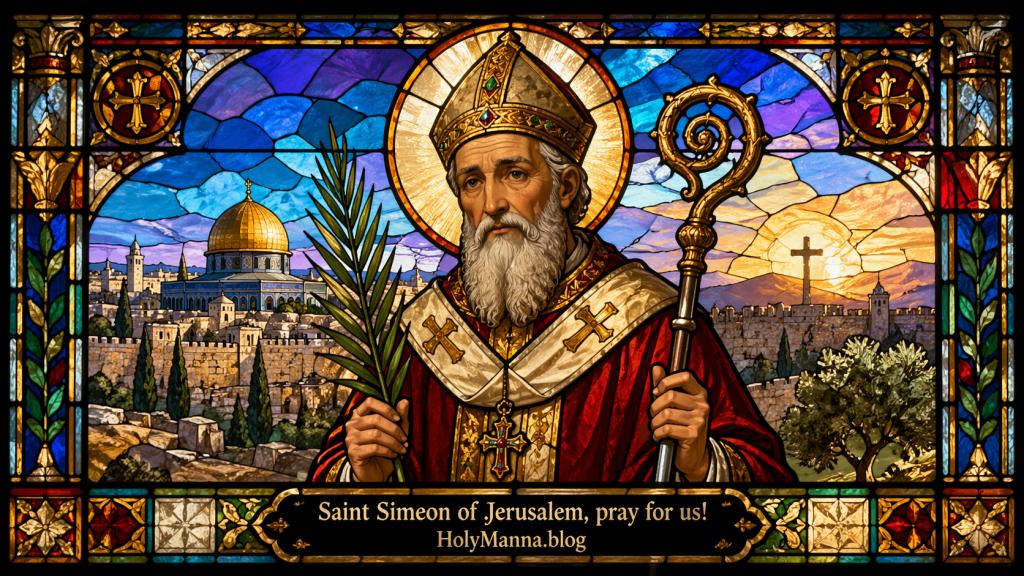
The Bishop Who Held Jerusalem Together
Saint Simeon of Jerusalem, sometimes called Symeon, stands near the very beginning of the Church’s earthly story. He is revered as the second bishop of Jerusalem after Saint James the Just, a kinsman of the Lord, a faithful shepherd of the first Christians, and a martyr who endured to the end. He is not one of the saints most Catholics hear about often, but his place in Christian tradition is profound. He belonged to that holy generation that stood close to the Apostles, guarded the flock in a time of danger, and handed on the faith when the Church was still young and vulnerable.
His life matters because it shows what fidelity looks like when everything feels fragile. Jerusalem was not just any city. It was the city of the Passion, the Resurrection, and Pentecost. To serve as bishop there after Saint James was no small thing. Simeon did not inherit an easy mission. He inherited a Church under pressure, a people living under suspicion, and a future clouded by war and persecution. Yet he remained steady. In that sense, he reflects what The Catechism teaches about the Church’s apostolic foundation: “The Church is apostolic because she is founded on the apostles” CCC 857. Simeon was one of the early men who helped preserve that apostolic life in the generation immediately after them.
From the Family of the Lord to the Service of the Church
Early Christian tradition remembers Simeon as the son of Clopas and as a relative of Jesus through the wider Holy Family. Catholic tradition has long cherished this connection, though it also handles the exact family details with care. What matters most is that the early Church saw him as a kinsman of the Lord and as a man worthy of great trust. After the martyrdom of Saint James the Just, the Apostles, disciples, and relatives of the Lord are said to have chosen Simeon to lead the Church in Jerusalem.
That detail alone says much about him. He was not just related to the Lord according to the flesh. He was also judged fit to care for the Lord’s people. He was chosen to stand where James had stood, to teach, govern, and preserve unity. In the early Church, that kind of responsibility was not handed out lightly.
Not much can be stated with certainty about his childhood, birthplace, or early personal life. The historical record is sparse, and it would be wrong to pretend otherwise. Still, his place in the life of the Jerusalem Church suggests a man formed by deep faith, by closeness to the earliest Christian community, and by a loyalty that had been tested over time. Tradition also holds that he was already among the believers before becoming bishop, and later Christian memory places him within that sacred circle of men who lived close to the events surrounding Christ and the Apostles.
He is most known for three things: succeeding Saint James as bishop of Jerusalem, guiding the Christian community through one of the most dangerous periods in its history, and dying a martyr’s death for Christ.
The Shepherd Who Guided the Flock Through Ruin
One of the most important stories connected with Saint Simeon is the flight of the Christians from Jerusalem before the city’s destruction. Early Christian tradition says that the believers were warned by divine revelation to leave Jerusalem and go to Pella. Catholic memory strongly associates Simeon with this event and sees him as one of the leaders who helped preserve the Christian community during that terrible upheaval.
This is one of the reasons his memory deserves more attention. He was not only a bishop in title. He was a real shepherd. When danger came, he helped lead the flock to safety. He did not abandon them. He did not lose heart. He helped carry the Church through the collapse of the old world around it.
After Jerusalem fell and was devastated, later Catholic tradition says that the Christians eventually returned, and that the Church in Jerusalem once again began to flourish. There are accounts that many were drawn to the faith through prodigies and signs associated with the Church during that time. Still, no specific miracle performed personally by Saint Simeon during his lifetime is securely preserved in the strongest historical sources. That is worth saying plainly. He is remembered less for dramatic miracle stories and more for steadfast holiness, faithful leadership, and endurance.
In a way, that makes his witness even more relatable. Not every saint is remembered for raising the dead or multiplying bread. Some saints are remembered because, when history shook, they remained standing. Simeon’s greatness was the greatness of fidelity. He kept watch. He guarded the inheritance. He remained close to Christ and to Christ’s people.
There are also later traditions and stories connected to his identity. Some ancient writers and later Christian traditions linked him with Simon the Zealot. That identification has never been firmly established, so it is best received as an old story rather than a verified historical fact. It remains part of the broader traditional memory surrounding him, but not a certainty.
A Cross in Old Age
If Saint Simeon’s life was marked by quiet perseverance, his death was marked by astonishing courage. Early Christian testimony says that he was denounced during the reign of the emperor Trajan both as a Christian and as a descendant of David. That second accusation is striking. It shows how seriously political authorities took any connection to Jewish royal lineage in that tense era.
He was arrested, tortured for many days, and finally crucified. Tradition says he was around one hundred and twenty years old. Even if that number strikes modern ears as extraordinary, it is part of the ancient memory handed down about him, and it underscores the same point the tradition wants to make: this was an old man who suffered with astonishing endurance for the name of Jesus.
His martyrdom matters because it reveals the full shape of his life. He began as a trusted servant of the early Church, shepherded believers through danger, and ended by following Christ all the way to the Cross. The Catechism teaches, “Martyrdom is the supreme witness given to the truth of the faith” CCC 2473. Simeon gave that witness not in youthful excitement, but in advanced age, after long years of service. There is something deeply moving about that. He did not merely start well. He finished well.
Some later devotional accounts add that he had rebuked those responsible for Saint James’s death and that he had already shared in the governance of the Jerusalem Church before becoming bishop. Those stories fit the larger picture of his life, but they cannot be verified with the same certainty as the ancient testimony about his succession and martyrdom. They should be received as part of traditional memory, not as proven historical detail.
The Saint Remembered After the Silence
After his death, Saint Simeon’s legacy endured primarily through the Church’s memory of his office, his kinship to the Lord, and his martyrdom. He became part of the long line of holy bishops who preserved the apostolic faith in its earliest days. His witness helped connect the age of the Apostles to the generations that followed.
Unlike some saints, he is not surrounded by a large body of well-attested miracle stories after death. No famous, universally accepted posthumous miracle stands at the center of his cult in the way it does for many later saints. Still, later Catholic tradition remembers the Church in Jerusalem as flourishing amid signs of grace, and his memory remained honored in both East and West. Several places in Europe have at various times claimed to possess relics associated with him, though the certainty of those claims cannot be verified.
His impact is more historical and spiritual than cultural in the popular sense. He did not become the patron of a great movement in the Latin West, nor did a major national devotion grow around his name. Yet his importance is still immense. He represents continuity. He represents fidelity in the generation after the Apostles. He represents a Church that was battered but not broken.
His feast has been commemorated in Catholic tradition on different dates, including April 27 and February 18 in different liturgical usages. That alone is a sign that the Church has not forgotten him. His memory has remained alive, even if quietly.
As for famous quotations, no verified personal saying of Saint Simeon survives in the historical record. The tradition preserves the witness of his life more than the sound of his own voice.
What Saint Simeon Teaches the Church Today
Saint Simeon of Jerusalem speaks powerfully to an age that often confuses noise with holiness. He did not leave behind celebrated writings. He is not remembered for dazzling speeches. He is remembered for being faithful when faithfulness was costly.
He teaches that some of the holiest lives are built on perseverance. He teaches that leadership in the Church is not about being noticed, but about protecting the flock. He teaches that it is possible to remain fruitful even in an age of collapse. He teaches that old age is not a season of spiritual retirement, but can become a crown of witness. He teaches that fidelity is beautiful, even when history barely notices.
There is also something deeply comforting in his example for ordinary Catholics. Not every Christian is called to dramatic public heroism. Many are called to guard what has been entrusted to them, to keep the faith in difficult times, to remain steady in prayer, and to endure with love. Simeon did exactly that. He stood in the gap for the Church in Jerusalem, and he did so without seeking glory for himself.
Where has God asked for patient fidelity rather than dramatic success? What part of life needs steadiness more than excitement right now? How might the witness of an elderly martyr challenge the temptation to spiritual laziness?
A good way to imitate Saint Simeon is to become dependable in the hidden places of life. Stay faithful to Sunday Mass. Defend unity in the Church. Pray for bishops and priests. Read The Acts of the Apostles and remember that the Church today is the same Church that men like Simeon helped preserve. When trials come, do not panic. Stay close to Christ. Stay close to the Church. Stay on the path.
Engage with Us!
Share your thoughts and reflections in the comments below. Saint Simeon of Jerusalem may not be one of the most famous saints, but his witness has a quiet strength that reaches right into modern life.
- What stands out most about Saint Simeon’s life: his leadership, his endurance, or his martyrdom?
- How does his example challenge the idea that holiness must always look dramatic or extraordinary?
- What does his faithfulness in old age teach about finishing the Christian life well?
- Have there been moments when God asked for steady perseverance rather than quick results? What did that look like?
- How can more prayer, unity, and courage be brought into daily life through the example of Saint Simeon?
May Saint Simeon inspire a life of steady faith, courageous endurance, and loving fidelity to Christ and His Church. May every duty be done with the love and mercy Jesus taught, and may that quiet faithfulness become a witness strong enough to carry others home.
Saint Simeon of Jerusalem, pray for us!
Follow us on YouTube, Instagram and Facebook for more insights and reflections on living a faith-filled life.


Leave a Reply