Monday of the Fourth Week of Easter – Lectionary: 279
When the Good Shepherd Gathers the Thirsty
There are days in the liturgy when the heart can almost feel the Church widening before its eyes, and today is one of those days. The readings for this Monday of the Fourth Week of Easter invite readers to stand in wonder before a God who refuses to keep His mercy small. In Acts of the Apostles, Peter explains why the Gospel has reached the Gentiles. In Psalm 42 and Psalm 43, the soul cries out in thirst for the living God and for His holy altar. In The Gospel of John, Jesus reveals the reason all of this is possible: “I am the good shepherd”, and “I lay down my life for the sheep.” The central theme uniting the whole day is the loving mission of Christ, the Good Shepherd, who gathers those who long for God into one flock through His sacrifice and the gift of the Holy Spirit.
These readings come from a pivotal moment in the life of the early Church. The Resurrection has changed everything, but the first Christians are still learning just how far the mercy of Christ extends. Many Jewish believers had grown up with clear religious boundaries, especially concerning ritual purity and fellowship with Gentiles. So when Peter welcomes Gentiles who have received the Word of God and the Holy Spirit, it is not a small adjustment. It is a moment of conversion for the Church herself. The Lord is teaching His people that the promise made to Israel has not been abandoned, but fulfilled and opened to the nations. At the same time, the Church hears again in the Gospel that Jesus is not merely a teacher with good advice. He is the Shepherd who freely offers His life so that the scattered may be gathered and the lost may be brought home.
That is why the psalm fits so beautifully between the first reading and the Gospel. The longing of the deer for running water becomes the longing of every human heart for communion with God. The Gentiles in Acts of the Apostles are not being handed a new philosophy or a new identity project. They are being welcomed into the living relationship for which every soul was made. The sheep in The Gospel of John are not being managed from a distance. They are being known, loved, and led by the One who gives everything for them. Today’s readings prepare readers to see that the Church is born from the pierced Heart of Christ, expanded by the Holy Spirit, and sustained by the deep thirst that only God can satisfy. What happens when the soul finally stops resisting the Shepherd’s voice and allows itself to be led home?
First Reading – Acts 11:1-18
When the Shepherd Calls the Nations Home
The first reading opens in the middle of a moment that must have felt shocking to the early Church. The Apostles and the believers in Judea have heard that Gentiles have accepted the word of God, and not everyone is ready to rejoice. For faithful Jews of the first century, table fellowship was not a small matter. Sharing a meal carried religious meaning, covenant meaning, and questions of purity. Peter has entered the house of uncircumcised men, eaten with them, and witnessed the Holy Spirit fall upon them. That is why he is challenged. This is not merely a disagreement about manners. It is a question about who belongs, how God saves, and whether the covenant promises in Christ are truly meant for all peoples.
This reading fits powerfully into today’s theme because it shows the Good Shepherd gathering sheep from beyond the boundaries many expected. In the Gospel, Jesus says that He has other sheep not of this fold. In Acts of the Apostles, that promise begins to unfold before the eyes of the Church. Peter is not inventing a new religion or setting aside God’s plan for Israel. He is witnessing the fulfillment of that plan in Christ. The risen Lord is widening the visible household of God, and the Church must learn to rejoice where God has already acted. What unfolds here is not compromise, but conversion. The Church is being taught to recognize the voice of the Shepherd and not to stand in the way of grace.
Acts 11:1-18 – New American Bible (Revised Edition)
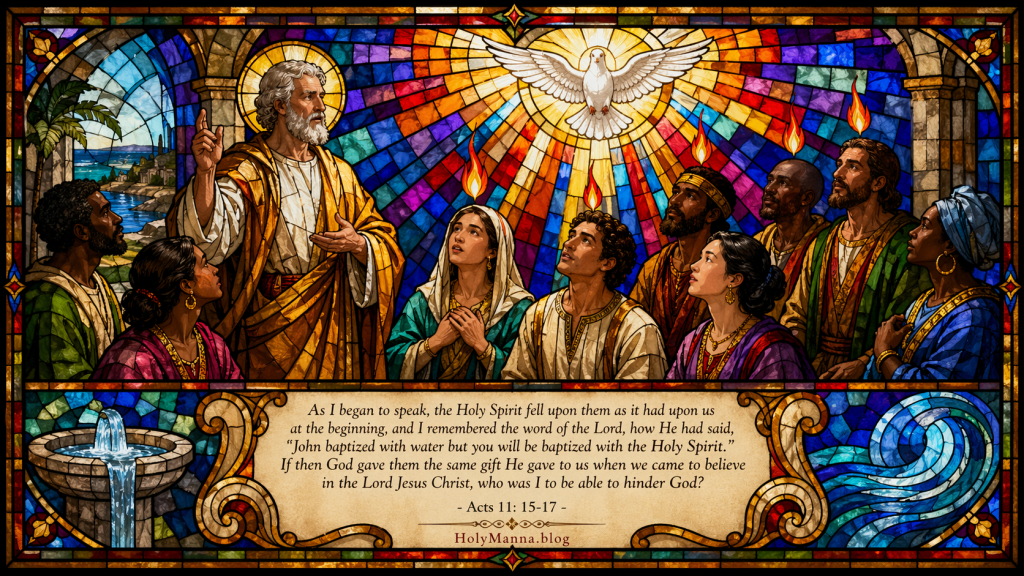
The Baptism of the Gentiles Explained. 1 Now the apostles and the brothers who were in Judea heard that the Gentiles too had accepted the word of God. 2 So when Peter went up to Jerusalem the circumcised believers confronted him, 3 saying, “You entered the house of uncircumcised people and ate with them.” 4 Peter began and explained it to them step by step, saying, 5 “I was at prayer in the city of Joppa when in a trance I had a vision, something resembling a large sheet coming down, lowered from the sky by its four corners, and it came to me. 6 Looking intently into it, I observed and saw the four-legged animals of the earth, the wild beasts, the reptiles, and the birds of the sky. 7 I also heard a voice say to me, ‘Get up, Peter. Slaughter and eat.’ 8 But I said, ‘Certainly not, sir, because nothing profane or unclean has ever entered my mouth.’ 9 But a second time a voice from heaven answered, ‘What God has made clean, you are not to call profane.’ 10 This happened three times, and then everything was drawn up again into the sky. 11 Just then three men appeared at the house where we were, who had been sent to me from Caesarea. 12 The Spirit told me to accompany them without discriminating. These six brothers also went with me, and we entered the man’s house. 13 He related to us how he had seen [the] angel standing in his house, saying, ‘Send someone to Joppa and summon Simon, who is called Peter, 14 who will speak words to you by which you and all your household will be saved.’ 15 As I began to speak, the holy Spirit fell upon them as it had upon us at the beginning, 16 and I remembered the word of the Lord, how he had said, ‘John baptized with water but you will be baptized with the holy Spirit.’ 17 If then God gave them the same gift he gave to us when we came to believe in the Lord Jesus Christ, who was I to be able to hinder God?” 18 When they heard this, they stopped objecting and glorified God, saying, “God has then granted life-giving repentance to the Gentiles too.”
Detailed Exegesis
Verse 1. “Now the apostles and the brothers who were in Judea heard that the Gentiles too had accepted the word of God.”
The news spreads quickly because this is no ordinary development. The Gentiles have not merely shown curiosity. They have accepted the word of God. Luke wants readers to see that the same Gospel preached to Israel is now bearing fruit among the nations. This is the beginning of a visible expansion of the Church’s mission, one rooted in the command of the risen Christ to preach to all nations.
Verse 2. “So when Peter went up to Jerusalem the circumcised believers confronted him,”
Peter returns to Jerusalem, the mother Church, and is immediately challenged. The phrase “circumcised believers” shows that these are not enemies of the faith, but Jewish Christians still trying to understand how the old covenant signs relate to the new covenant life in Christ. Their concern is real, even if incomplete. God often purifies His people not only from sin, but also from habits of thought that are too narrow for His mercy.
Verse 3. “saying, ‘You entered the house of uncircumcised people and ate with them.’”
The accusation centers on entering and eating. In the Jewish world of the time, such actions could imply religious association and ritual defilement. Yet Peter’s conduct reveals something new. In Christ, ceremonial boundaries that once marked Israel’s separation are now giving way to the deeper holiness of the Gospel. The problem is no longer uncleanness from outside foods or peoples, but the need for interior conversion and faith in Christ.
Verse 4. “Peter began and explained it to them step by step, saying,”
Peter does not answer with pride or irritation. He explains the matter carefully and patiently. This is important. The first Pope does not dismiss the scandal. He shepherds his brothers through it. The Church learns here that true authority is not arbitrary. It listens, teaches, discerns, and leads the faithful to recognize the action of God.
Verse 5. “I was at prayer in the city of Joppa when in a trance I had a vision, something resembling a large sheet coming down, lowered from the sky by its four corners, and it came to me.”
Peter receives the revelation while at prayer. That detail matters. Major turns in salvation history often come in prayer, where human plans are quieted and divine instruction is received. The sheet descending from heaven suggests something universal, reaching in all directions. Heaven is opening a lesson Peter could not have arrived at by custom alone.
Verse 6. “Looking intently into it, I observed and saw the four-legged animals of the earth, the wild beasts, the reptiles, and the birds of the sky.”
The collection of animals echoes the categories of creation and includes creatures traditionally regarded as unclean under Mosaic dietary laws. The vision is deliberately unsettling. God is confronting Peter with the limits of his inherited categories. The issue is not that the Law was bad, but that it was preparatory. Now the fullness of redemption in Christ is arriving.
Verse 7. “I also heard a voice say to me, ‘Get up, Peter. Slaughter and eat.’”
The command comes directly from heaven. Peter is not moving on his own initiative. The Lord is teaching him through a concrete command that presses against his formed conscience. It is a moment of obedience that will prepare him for something even greater: receiving Gentiles into the life of grace without treating them as profane.
Verse 8. “But I said, ‘Certainly not, sir, because nothing profane or unclean has ever entered my mouth.’”
Peter’s resistance is sincere. He is not being rebellious. He is trying to remain faithful according to what he has known. That makes the moment more powerful. God sometimes leads faithful people beyond previous stages of understanding into the fullness of His plan. Peter’s holiness is real, but it still needs purification and enlargement.
Verse 9. “But a second time a voice from heaven answered, ‘What God has made clean, you are not to call profane.’”
This is the turning point of the vision. God alone has authority to declare clean what man once considered unclean under the old order. The immediate image concerns food, but the deeper application reaches persons. Those whom God is cleansing by grace are not to be rejected by human prejudice. The Church must learn to name as holy what God has touched.
Verse 10. “This happened three times, and then everything was drawn up again into the sky.”
The repetition confirms the seriousness of the revelation. In Scripture, threefold repetition often signals divine certainty and completeness. Peter cannot dismiss this as confusion or private imagination. The lesson is being impressed upon him firmly because the Church will need clarity for the mission ahead.
Verse 11. “Just then three men appeared at the house where we were, who had been sent to me from Caesarea.”
Providence moves immediately. The vision is not an abstract theological exercise. It is followed by concrete circumstances. God often teaches by joining revelation and real-life encounter. Peter is being prepared inwardly just as the Gentile messengers arrive outwardly.
Verse 12. “The Spirit told me to accompany them without discriminating. These six brothers also went with me, and we entered the man’s house.”
The Holy Spirit gives direct guidance. Peter is told to go “without discriminating,” which strikes at the heart of the issue. This is not a call to ignore truth, but a call to obey God without partiality. The mention of the six brothers is also important. Peter has witnesses. What happened in Cornelius’s house is ecclesial, not private. The Church can verify it.
Verse 13. “He related to us how he had seen [the] angel standing in his house, saying, ‘Send someone to Joppa and summon Simon, who is called Peter,’”
Cornelius, a Gentile, has also been prepared by God. The Lord is working on both sides before Peter arrives. This shows the harmony of divine grace. Cornelius is not saved by vague sincerity alone. He is directed toward Peter, toward apostolic preaching, and toward the visible means by which salvation will be received.
Verse 14. “‘who will speak words to you by which you and all your household will be saved.’”
This verse is deeply Catholic. Salvation comes through the word preached by the Apostle. God uses human ministers and audible proclamation. Grace is not opposed to mediation. The household dimension also anticipates the communal nature of conversion and baptism. God calls persons, but He often gathers families and communities into His covenant life.
Verse 15. “As I began to speak, the holy Spirit fell upon them as it had upon us at the beginning,”
The Gentiles receive the Holy Spirit in a way that recalls Pentecost. This is decisive evidence. God Himself is testifying that the Gentiles are not outsiders to be tolerated, but persons truly being drawn into the same saving mystery. The Church sees that the same Spirit who descended upon Jewish believers now descends upon the nations.
Verse 16. “and I remembered the word of the Lord, how he had said, ‘John baptized with water but you will be baptized with the holy Spirit.’”
Peter interprets the event through the words of Jesus. That is how the Church reads history rightly. Experience alone is not enough. It must be illuminated by the Lord’s teaching. The descent of the Spirit confirms that the saving promises of Christ are at work. The old preparation of John yields to the sacramental and Spirit-filled life of the new covenant.
Verse 17. “If then God gave them the same gift he gave to us when we came to believe in the Lord Jesus Christ, who was I to be able to hinder God?”
Peter reaches the heart of the matter. The gift is the same. The faith is the same. The Lord is the same. Therefore, Peter cannot resist what God is doing. This is one of the most beautiful lines in the Acts of the Apostles because it shows holy humility. True authority does not block grace. It recognizes, confirms, and serves the work of God.
Verse 18. “When they heard this, they stopped objecting and glorified God, saying, ‘God has then granted life-giving repentance to the Gentiles too.’”
The reading ends not in division, but in worship. The believers stop objecting and glorify God. That is the right end of all authentic doctrinal clarification. The Church does not merely settle arguments. She comes to praise the Lord more fully. The phrase “life-giving repentance” is especially rich. The Gentiles are not being offered a lesser path. They are being granted the same conversion that leads to life in Christ.
Teachings
This reading teaches that the Church is truly Catholic, which means universal, because Christ came to save all nations and gather them into one people. What Peter witnesses in the house of Cornelius is not a side story. It is one of the clearest moments in the New Testament showing that the promises made to Israel reach their fulfillment in a Church open to every people, language, and nation. The door is opened by Christ, confirmed by the Spirit, and recognized by Peter.
The Catechism speaks directly to this mystery in CCC 781: “At all times and in every race, anyone who fears God and does what is right has been acceptable to him. He has however willed to make men holy and save them, not merely as individuals without any mutual bond, but by making them into a single people, a people which acknowledges him in truth and serves him in holiness.” That is exactly what unfolds in this reading. God is not collecting isolated spiritual seekers. He is building a people.
This passage also teaches the sacramental logic of the Church. Cornelius is told to send for Peter, who will speak words by which he and his household will be saved. God uses Apostles, preaching, and sacramental incorporation. The Catechism says in CCC 1226: “From the very day of Pentecost the Church has celebrated and administered holy Baptism.” It also teaches in CCC 1267: “Baptism makes us members of the Body of Christ: ‘Therefore . . . we are members one of another.’ Baptism incorporates us into the Church.” The Spirit falling upon the Gentiles does not bypass the Church. It confirms that they too are called into her sacramental life.
There is also a lesson here about Peter’s role in the Church. He receives the revelation, discerns the event, explains it to the brethren, and guides the community toward unity. This does not mean Peter replaces God. It means God chooses to work through Peter’s office for the good of the flock. That fits beautifully with today’s Gospel, where the one Shepherd continues to guide His people visibly through the Apostles and their successors.
Saint John Chrysostom saw Peter’s humility as crucial here. He noted that Peter did not speak as a man defending his own honor, but as one showing that God had done everything. The lesson remains timely. The holiest leaders are not the ones who draw attention to themselves, but the ones who help others recognize the action of God. In the history of the Church, this reading has often been a touchstone for missionary expansion, especially when the Gospel crossed cultural frontiers into lands that once seemed distant from biblical history. The Church has returned again and again to this passage to remember that no nation is beyond the reach of Christ.
Another important teaching lies in the phrase “life-giving repentance.” Repentance is not presented here as shame without hope, but as a grace that leads to life. Conversion is not the enemy of joy. It is the doorway to joy. When God grants repentance, He is not humiliating a soul for sport. He is freeing that soul to live.
Reflection
This reading still speaks with surprising force because the temptation to hinder God has never really disappeared. It simply changes clothes. Sometimes it appears as spiritual pride. Sometimes it shows up as suspicion toward people who do not fit familiar expectations. Sometimes it hides inside family grudges, social divisions, parish cliques, or quiet judgments that decide in advance who is likely to respond to grace and who is not.
Peter’s example offers a better path. He stays close to prayer. He listens when God unsettles him. He obeys the Spirit. He gives an account with patience. He refuses to call profane those whom God is drawing near. That is a searching word for daily life. A Christian cannot honestly pray for souls while quietly resenting the ways God may choose to reach them.
This reading also invites a deeper trust in the Church. God does not save through vague spirituality alone. He gathers through preaching, repentance, baptism, and communion in the body of believers. That means daily life should include a real openness to conversion, a reverence for the sacraments, and a willingness to let the Lord stretch the heart beyond comfort and habit.
One practical step is to examine where judgment has replaced hope. Another is to pray for the grace to welcome whom Christ welcomes without weakening the truth Christ teaches. A third is to remember that repentance is life-giving, not life-crushing. When the Lord convicts the heart, He is opening a door, not shutting one.
Is there anyone being treated as if grace could not possibly reach them?
Has the heart allowed old labels, fears, or resentments to become stronger than confidence in the Holy Spirit?
What would change this week if repentance were received not as defeat, but as the beginning of life?
Responsorial Psalm – Psalm 42:2-3; 43:3-4
When the Thirsty Heart Finds the Way Home
The responsorial psalm today sounds like the prayer of a soul that has wandered far enough to know what it truly misses. These verses come from Psalm 42 and Psalm 43, which many scholars and saints have long understood as closely joined, almost like one extended cry from the heart. They carry the voice of a worshipper who feels distant from the sanctuary, longing not simply for comfort, but for the living God Himself. In ancient Israel, the Temple was the place of sacrifice, praise, and covenant communion. To be cut off from that holy place was not merely emotional pain. It was a spiritual ache. That is why the psalmist does not say that he misses a feeling. He says that his soul thirsts for God and longs to come again to the altar.
This psalm fits beautifully into today’s theme because it reveals what lies beneath the drama of the other readings. In Acts of the Apostles, the Gentiles are being welcomed into the saving life of God. In The Gospel of John, Jesus reveals Himself as the Good Shepherd who gathers His sheep into one flock. Here in the psalm, the Church hears the inner cry of every sheep who is being drawn by that Shepherd. Beneath all confusion, wandering, and resistance is a deeper hunger. The human heart was made for the face of God, the light of God, and the altar of God. The psalm gives words to that hunger and points toward the worship that fulfills it.
Psalm 42:2-3; 43:3-4 New American Bible (Revised Edition)
2 As the deer longs for streams of water,
so my soul longs for you, O God.
3 My soul thirsts for God, the living God.
When can I enter and see the face of God?3 Send your light and your fidelity,
that they may be my guide;
Let them bring me to your holy mountain,
to the place of your dwelling,
4 That I may come to the altar of God,
to God, my joy, my delight.
Then I will praise you with the harp,
O God, my God.
Detailed Exegesis
Verse 2. “As the deer longs for streams of water, so my soul longs for you, O God.”
The image is simple and unforgettable. A deer searching for running water is not dealing with a passing preference. It is dealing with necessity. Water is life. The psalmist uses that image to show that God is not an optional addition to a mostly complete life. God is life itself. The soul is not merely interested in Him. The soul longs for Him because it was made for Him. In Catholic reading, this verse speaks not only of emotional desire, but of the deepest orientation of the human person toward communion with the Creator. It also prepares the heart to hear the language of living water that will later be fulfilled in Christ.
Verse 3. “My soul thirsts for God, the living God. When can I enter and see the face of God?”
The longing becomes even more intense here. The psalmist does not thirst for an idea of God, or for relief from suffering alone, but for the living God. That phrase matters. Israel did not worship a concept, a force, or a memory. Israel worshipped the God who speaks, acts, saves, and enters covenant. The desire to “see the face of God” expresses a longing for presence, favor, and nearness. In the old covenant, that longing was experienced in relation to the Temple. In the fullness of Catholic faith, this longing opens toward the liturgy, the Eucharist, and ultimately the beatific vision. The soul wants what only God can give: Himself.
Verse 3 of Psalm 43. “Send your light and your fidelity, that they may be my guide; Let them bring me to your holy mountain, to the place of your dwelling,”
Now the prayer shifts from longing to petition. The psalmist asks for light and fidelity, or truth, to lead him home. He knows that the heart does not find God by instinct alone. It must be guided. This is deeply important for Christian life. Desire by itself is not enough. The soul also needs divine guidance, revelation, and grace. The “holy mountain” and the “place of your dwelling” point to the place where God is worshipped and adored. For the Catholic reader, this becomes a rich image of the Church, where the Lord continues to gather His people by truth and grace. The Shepherd does not merely awaken desire. He leads the flock.
Verse 4 of Psalm 43. “That I may come to the altar of God, to God, my joy, my delight. Then I will praise you with the harp, O God, my God.”
This is the destination of the whole movement. The psalmist is not content with private spirituality. He wants to come to the altar of God. In ancient Israel, the altar was the place of sacrifice, covenant, and praise. In Catholic life, the altar reaches its fullest meaning in the Eucharistic sacrifice, where Christ the Good Shepherd feeds His flock with His own life. Notice also how personal the language becomes. God is not described as a distant ruler only, but as “my joy, my delight.” This is what happens when the soul arrives where it belongs. The heart that was thirsty becomes a heart of praise.
Teachings
This psalm teaches that the deepest movement of the human heart is toward God. That truth runs through all of Catholic tradition. The Catechism says in CCC 27, “The desire for God is written in the human heart, because man is created by God and for God; and God never ceases to draw man to himself. Only in God will he find the truth and happiness he never stops searching for.” That sentence could almost serve as a commentary on today’s psalm. The deer longs for water because that is what sustains its life. The soul longs for God because that is the One for whom it was made.
The psalm also speaks powerfully to the Church’s teaching on prayer. Prayer is not a performance for the already perfect. It is the cry of the thirsty. The Catechism says in CCC 2560, “If you knew the gift of God! The wonder of prayer is revealed beside the well where we come seeking water: there, Christ comes to meet every human being. It is he who first seeks us and asks us for a drink. Jesus thirsts; his asking arises from the depths of God’s desire for us. Whether we realize it or not, prayer is the encounter of God’s thirst with ours. God thirsts that we may thirst for him.” That is a remarkable way to read this psalm. The heart is seeking God, yes, but even before that, God is drawing the heart to Himself.
There is also a deeply sacramental lesson here. The psalmist longs to be brought to the altar of God. The Catholic soul hears in those words more than a memory of the Temple. It hears a longing fulfilled in the Mass. The Catechism teaches in CCC 1324, “The Eucharist is ‘the source and summit of the Christian life.’ ‘The other sacraments, and indeed all ecclesiastical ministries and works of the apostolate, are bound up with the Eucharist and are oriented toward it. For in the blessed Eucharist is contained the whole spiritual good of the Church, namely Christ himself, our Pasch.’” The psalm’s thirst reaches its fulfillment not in vague inspiration, but in sacramental communion with Christ.
Saint Augustine’s famous line from Confessions shines here with particular force: “You have made us for yourself, O Lord, and our heart is restless until it rests in you.” That is the sound of this psalm. Restlessness is not solved by entertainment, success, romance, or even religious busyness by itself. The heart rests only in God. Saint Augustine understood that human longing is not a problem to be erased. It is a signpost. When it is purified, it becomes a path back to the Lord.
This psalm also has a strong Easter resonance. During Eastertide, the Church is still rejoicing in the Resurrection, still meditating on Baptism, and still contemplating the new life given in Christ. The thirst for living water and the longing for the altar fit this season perfectly. The risen Christ is not only victorious over death. He is the answer to the soul’s oldest ache. He leads His flock to living waters and into the worship of the Father.
Reflection
This psalm speaks with quiet honesty because it refuses to pretend that the soul can live on lesser things. Modern life offers endless distractions, but very little refreshment. A person can stay busy, informed, entertained, and still feel strangely dry inside. That dryness is not always a sign that something is wrong. Sometimes it is a sign that the heart is finally telling the truth. It was never made to live on noise. It was made for God.
There is also something deeply comforting here. The psalmist does not hide his longing. He turns it into prayer. That is a lesson worth holding onto. Instead of numbing hunger, the Christian is called to bring it before the Lord. Instead of pretending everything is fine, the soul can ask for light, fidelity, and guidance. Instead of wandering without direction, it can ask to be led back to the holy mountain, to the dwelling place of God, to the altar where Christ gives Himself.
In daily life, that may mean making room for silence before prayer instead of rushing through it. It may mean going to Mass with more intention and less routine. It may mean examining what has been used to quench spiritual thirst and admitting that some habits only deepen it. It may mean returning to Eucharistic adoration, confession, or a more faithful rhythm of prayer. The Good Shepherd gathers His flock, but the sheep must still learn to follow His voice toward the water that truly satisfies.
What has the heart been thirsting for most lately?
Has that thirst been leading closer to the living God, or deeper into distraction?
What would it look like this week to ask the Lord, with real honesty, to send His light and truth to lead the way back to His altar?
Holy Gospel – John 10:11-18
The Shepherd Who Refused to Run
Today’s Gospel stands at the center of the whole day like a steady flame. Jesus does not speak here in vague spiritual language. He names Himself plainly: “I am the good shepherd.” For the people listening to Him, that image carried centuries of meaning. Israel knew the language of shepherds from the lives of Abraham, Moses, and David. Even more importantly, Israel knew that the Lord Himself had promised through the prophets to shepherd His people, especially after the failure of false leaders. In Ezekiel 34, God rebukes the shepherds who fed themselves instead of the flock and declares that He Himself will search for His sheep. So when Jesus calls Himself the Good Shepherd, He is not simply saying that He is kind or gentle. He is revealing His divine mission. He is the promised Shepherd of Israel, and more than that, He is the Son who lays down His life and takes it up again.
This Gospel fits perfectly into today’s theme because it explains how the scattered are gathered and how the thirsty are brought home. In Acts of the Apostles, Peter begins to see that the Gentiles are also being called into the life of grace. In the psalm, the soul thirsts for the living God and longs for His altar. Here, Jesus reveals why that gathering can happen at all. He does not build His flock through force, manipulation, or distance. He gathers it through sacrificial love. He knows His sheep. He calls those outside the fold. He faces the wolf instead of fleeing. He gives His life freely so that there may be “one flock, one shepherd.” This is not only a comforting image. It is the heart of the Gospel itself.
John 10:11-18 – New American Bible (Revised Edition)
11 I am the good shepherd. A good shepherd lays down his life for the sheep. 12 A hired man, who is not a shepherd and whose sheep are not his own, sees a wolf coming and leaves the sheep and runs away, and the wolf catches and scatters them. 13 This is because he works for pay and has no concern for the sheep. 14 I am the good shepherd, and I know mine and mine know me, 15 just as the Father knows me and I know the Father; and I will lay down my life for the sheep. 16 I have other sheep that do not belong to this fold. These also I must lead, and they will hear my voice, and there will be one flock, one shepherd. 17 This is why the Father loves me, because I lay down my life in order to take it up again. 18 No one takes it from me, but I lay it down on my own. I have power to lay it down, and power to take it up again. This command I have received from my Father.”
Detailed Exegesis
Verse 11. “I am the good shepherd. A good shepherd lays down his life for the sheep.”
Jesus begins with one of the great “I am” statements in The Gospel of John. This is not merely a job description. It is a revelation of identity. The word “good” here means more than morally decent. It suggests beauty, nobility, and fullness. Jesus is the true Shepherd, the perfect Shepherd, the Shepherd in whom all the promises of God are fulfilled. The shocking part is what follows. Shepherds protect sheep, but Jesus says that the good shepherd lays down his life for them. He is already pointing toward the Cross. His leadership is defined not by self-preservation, but by self-gift.
Verse 12. “A hired man, who is not a shepherd and whose sheep are not his own, sees a wolf coming and leaves the sheep and runs away, and the wolf catches and scatters them.”
Here Jesus introduces the contrast. The hired man works for wages, not for love. He has proximity to the flock, but no real belonging to it. When danger comes, his lack of love is exposed. This line would have stung in a religious culture that had seen poor spiritual leadership before. It also echoes the prophets, especially the rebuke of false shepherds in Ezekiel 34. The wolf represents whatever attacks the people of God: sin, lies, persecution, division, and the powers opposed to the kingdom. Christ does not deny the danger. He shows that the difference lies in whether the shepherd stays.
Verse 13. “This is because he works for pay and has no concern for the sheep.”
Jesus goes straight to the heart of the matter. The hired man’s problem is not weakness alone, but lack of concern. He serves only while service benefits him. That is the opposite of Christ’s heart. This verse becomes a searching judgment on every form of hollow leadership, whether civil, familial, or religious. Wherever responsibility is treated as an opportunity for self-interest, the pattern of the hired man begins to appear.
Verse 14. “I am the good shepherd, and I know mine and mine know me,”
Jesus repeats the title, but now adds intimacy. He knows His own, and His own know Him. In biblical language, this kind of knowing is not superficial recognition. It is covenant knowledge, personal communion, loving familiarity. The sheep are not statistics. They are known. Catholic faith rests deeply on this truth. Christ does not save masses in the abstract. He calls persons by name and draws them into living relationship with Himself.
Verse 15. “just as the Father knows me and I know the Father; and I will lay down my life for the sheep.”
This is one of the most astonishing lines in the passage. Jesus compares His knowledge of the sheep to the mutual knowledge between Himself and the Father. He is drawing the life of believers into the very love of the Trinity. The sheep are not merely managed by divine power. They are brought into communion through the Son. Then Jesus returns immediately to the Cross. This communion is not sentimental. It is purchased through His sacrifice. The Shepherd knows the sheep so deeply that He gives Himself for them.
Verse 16. “I have other sheep that do not belong to this fold. These also I must lead, and they will hear my voice, and there will be one flock, one shepherd.”
This verse stretches the horizon outward. Jesus is speaking first within the world of Israel, but He is already pointing beyond it. The “other sheep” have long been understood by the Church as the Gentiles who will also be called into salvation. This connects beautifully with the first reading, where Peter begins to recognize that God has granted life-giving repentance to the Gentiles too. The future Jesus announces is not many rival flocks with many shepherds, but one flock under one shepherd. This is a deeply Catholic verse. It points toward the unity of the Church founded by Christ and extended to all nations.
Verse 17. “This is why the Father loves me, because I lay down my life in order to take it up again.”
The love between the Father and the Son is not being created here, as if it did not exist before. Rather, Jesus reveals that His obedient self-offering is perfectly pleasing to the Father. His death is not a tragedy outside God’s plan. It is part of the saving mission He has embraced in filial love. The phrase “in order to take it up again” also keeps the Resurrection in view. The Cross and Resurrection belong together. The Shepherd lays down His life, but He is not overcome by death.
Verse 18. “No one takes it from me, but I lay it down on my own. I have power to lay it down, and power to take it up again. This command I have received from my Father.”
Jesus ends with majestic freedom. He is not a victim of fate or merely of human violence. Men will indeed arrest, judge, and crucify Him, but beneath all of that stands His own sovereign offering. He lays down His life freely. He also has authority to take it up again. This is a claim no mere man can make. It reveals both His obedience and His divine authority. The Cross is therefore not the collapse of His mission, but its triumph. The Shepherd chooses the path of sacrifice in order to save the sheep.
Teachings
This Gospel teaches that Christ is the fulfillment of God’s promise to shepherd His people personally. He is not one more leader among others. He is the true Shepherd whose love is revealed most fully in His voluntary sacrifice. The Catechism speaks of the Church in shepherding language in CCC 754: “The Church is, accordingly, a sheepfold, the sole and necessary gateway to which is Christ. It is also the flock of which God himself foretold that he would be the shepherd, and whose sheep, even though governed by human shepherds, are unfailingly nourished and led by Christ himself, the Good Shepherd and Prince of Shepherds, who gave his life for his sheep.” That is the heart of this passage. Christ does not simply visit the flock. He forms it, feeds it, and dies for it.
This Gospel also teaches that the death of Christ was freely embraced as an act of obedient love. The Cross was not a tragic accident. It was the willing self-offering of the Son. The Catechism says in CCC 609: “By embracing in his human heart the Father’s love for men, Jesus ‘loved them to the end,’ for ‘greater love has no man than this, that a man lay down his life for his friends.’ In suffering and death his humanity became the free and perfect instrument of his divine love which desires the salvation of men. Indeed, out of love for his Father and for men whom the Father wants to save, Jesus freely accepted his Passion and death.” Those words fit today’s Gospel with remarkable clarity. The Good Shepherd lays down His life because divine love does not remain distant from human misery.
The passage also shines light on the unity Christ wills for His people. The line “one flock, one shepherd” has always mattered deeply in Catholic life. The Catechism says in CCC 764: “This Kingdom shines out before men in the word, in the works and in the presence of Christ. To welcome Jesus’ word is to welcome ‘the Kingdom itself.’ The seed and beginning of the Kingdom are the ‘little flock’ of those whom Jesus came to gather around him, the flock whose shepherd he is. They form Jesus’ true family.” The Church is not a man-made coalition of religious interests. She is the flock gathered around the Shepherd who speaks, saves, and unites.
This Gospel also guards against every shallow understanding of Christian leadership. Christ’s contrast between the Good Shepherd and the hired man has shaped centuries of Catholic preaching about bishops, priests, fathers, mothers, and all who are entrusted with souls. Saint Gregory the Great spoke with sobering clarity about this responsibility. He wrote, “The wolf comes upon the sheep when any unjust man or robber oppresses the faithful and humble. But he who seemed to be the shepherd and was not, leaves the sheep and flies, because he fears danger for himself, and dares not stand in the way of injustice.” That warning still lands with force. Wherever love is replaced by self-protection, the spirit of the hired man is already at work.
There is also a Eucharistic depth here. The Shepherd who lays down His life does not only die once in history and remain distant. He continues to feed His flock through the sacramental life of the Church, above all in the Eucharist. The same Jesus who says “I lay down my life for the sheep” is the One who gives His Body and Blood for the life of the world. The altar longed for in the psalm is reached through the sacrifice announced in this Gospel.
Reflection
This Gospel reaches into daily life with unusual force because it asks a very personal question: whose voice is really being followed? The world is full of hired voices. Some speak loudly through fear. Some through flattery. Some through ideology. Some through appetite. Some through endless self-focus. They promise direction, but they do not stay when the wolf comes. They cannot save because they do not love like Christ loves.
The Good Shepherd is different. He knows His own. He does not love in the abstract. He does not disappear in danger. He does not ask the flock to go where He has refused to go Himself. He enters suffering, faces death, and transforms it from within. That means Christian life is not mainly about admiring Jesus from a distance. It is about learning to recognize His voice, trust His love, and remain close to His Church even when the path leads through sacrifice.
This Gospel also presses on the heart in a practical way. It asks whether daily choices are being shaped more by the Shepherd’s voice or by the hired voices of comfort, convenience, and fear. It asks whether those entrusted with others are loving them sacrificially or only when it is easy. It asks whether the unity Christ desires is being served through charity, fidelity, and truth, or quietly wounded by pride and stubbornness.
A faithful response begins with closeness. Spend time with the Shepherd in prayer. Listen to His voice in Scripture. Meet Him at the altar. Go to confession when sin has scattered the heart. Stay near the visible flock He has gathered in His Church. Let His example reshape the way responsibility is carried in family life, parish life, and daily work. The wolf still prowls, but the Shepherd has not abandoned His sheep.
Is the heart truly listening for the voice of Christ, or mostly reacting to the loudest voices around it?
Where has fear tempted the soul to act more like a hired servant than like someone who loves?
What would change this week if the love of the Good Shepherd were trusted enough to follow Him without bargaining?
Led to the Altar, Gathered by the Shepherd
Today’s readings come together like one clear invitation from the risen Christ. In Acts of the Apostles, the Church learns that God’s mercy is wider than human expectation, and that the Holy Spirit is drawing even the Gentiles into the saving life of Christ. In Psalm 42 and Psalm 43, the soul gives voice to the ache that lives in every human heart, a thirst that no earthly comfort can satisfy. In The Gospel of John, Jesus reveals the answer to that thirst and the source of that mercy: “I am the good shepherd”, the One who lays down His life so that the scattered may be gathered into one flock.
That is the great message of the day. God is not distant from human longing. He answers it. He does not abandon His people to confusion, division, or spiritual hunger. He leads them. He gathers them. He brings them to the altar. The same Lord who opened the doors of the Church to the nations is the same Lord who still calls souls by name, still searches for the wandering, and still feeds His flock with grace. The heart of the Christian life is not merely trying harder or knowing more. It is letting the Good Shepherd lead the soul where it was always meant to go: into truth, into communion, and into the living presence of God.
The call today is both simple and serious. Stay close to the Shepherd. Refuse the voices that scatter the heart. Bring spiritual thirst honestly to the Lord instead of trying to bury it beneath distractions. Return to prayer with greater trust. Return to the sacraments with greater hunger. Return to the altar with greater love. The Shepherd who gave His life has not stopped calling, and the soul that follows Him will never be led toward emptiness. What would change if this week were lived like someone who truly believes that Christ knows, loves, and is actively leading His flock home?
Engage with Us!
Readers are invited to share their reflections in the comments below. What stood out most in today’s readings? What part of the Good Shepherd’s voice seems to be echoing most clearly in the heart today?
- In the First Reading from Acts 11:1-18, where might God be asking for a larger, more generous heart, especially toward people who may have once seemed distant, difficult, or unlikely to respond to grace?
- In the Responsorial Psalm from Psalm 42:2-3; 43:3-4, what has the soul been thirsting for most lately, and has that thirst been leading closer to the living God or toward things that cannot truly satisfy?
- In the Holy Gospel from John 10:11-18, what does it mean personally to trust Jesus as the Good Shepherd, especially in moments of fear, confusion, or sacrifice?
- Looking at all three readings together, where is Christ trying to gather, heal, or lead the heart more deeply into His flock and toward His altar?
Keep walking in faith, stay close to the sacraments, and let every part of daily life be shaped by the love and mercy Jesus has shown. The Good Shepherd still calls, still leads, and still teaches His people how to love with courage, humility, and joy.
Sacred Heart of Jesus, we trust in You!
Immaculate Heart of Mary, pray for us!
Saint Michael the Archangel, defend us in battle!
Follow us on YouTube, Instagram and Facebook for more insights and reflections on living a faith-filled life.

 Holy Manna!
Leave a comment