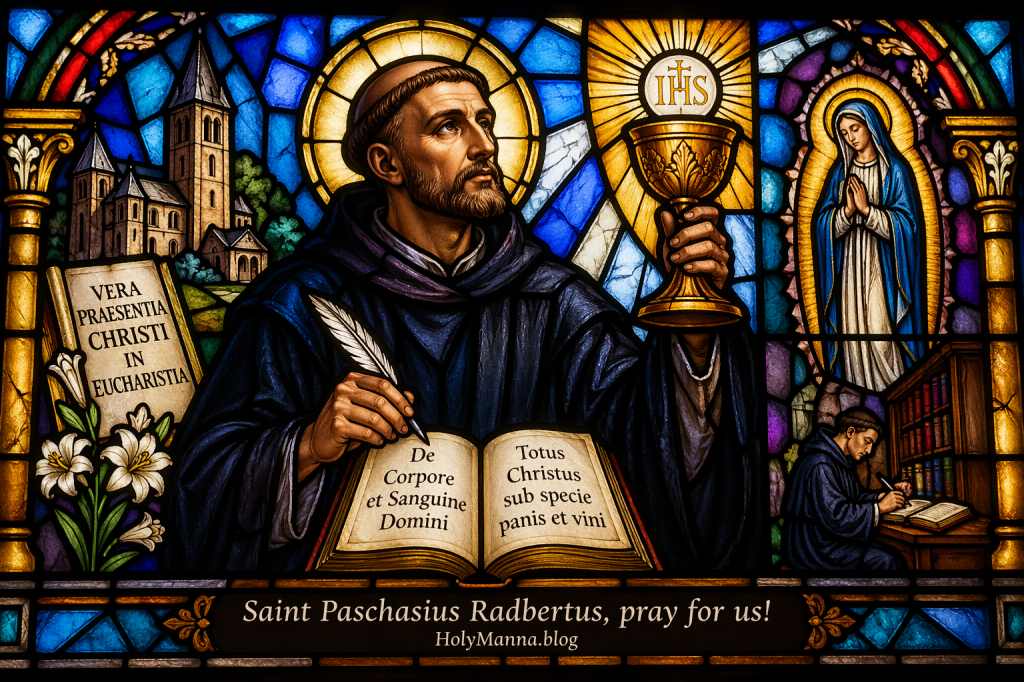
The Monk Who Helped the Church Speak Clearly About the Eucharist
Saint Paschasius Radbertus is one of those saints who may not be widely known in every Catholic household, but his legacy quietly reaches the altar at every Mass. He was a Benedictine monk, later an abbot, and one of the great theological minds of the ninth century. He is especially revered for defending the truth that the Holy Eucharist is truly the Body and Blood of Jesus Christ. In a time when the Church was still working out how best to explain this mystery, Paschasius spoke with unusual boldness and clarity.
He is also remembered for his reverence for the Blessed Virgin Mary and for his faithful life as a monk shaped by humility, prayer, and study. He was not a missionary saint who crossed oceans, nor a martyr who died in public witness before a crowd. His greatness came in another way. He gave his mind, his heart, and his life to contemplating the mysteries of Christ and handing them on to the Church. That is why he is still honored in Catholic tradition and remembered on April 26.
From Abandoned Child to Son of the Church
The beginning of Paschasius Radbertus’s life is deeply moving. Catholic tradition holds that he was born near Soissons in France in the late eighth century, most commonly around A.D. 785 or 786. As an infant, he appears to have been abandoned. That alone would have been enough to break many lives before they even began. But grace was already at work. He was taken in and raised by the Benedictine nuns at Notre-Dame of Soissons.
There is something profoundly Catholic about that beginning. A child cast aside by the world was received by the Church. A boy with no secure earthly future was given a spiritual home. The same Church that would later benefit from his theology first became his mother. That early formation under the care of religious women seems to have left a lasting impression on him, especially in his tenderness toward the mysteries of Christ and his love for the Virgin Mary.
As he grew older, he entered the Benedictine monastery of Corbie, one of the great monastic centers of his age. There he was formed in prayer, discipline, study, and the common life. He lived under the guidance of Abbot Adalard, whom he greatly admired and later wrote about. Paschasius became known for his intelligence and his ability to teach, and he was entrusted with instructing younger monks.
His faith was not marked by a dramatic conversion from paganism or open unbelief. Instead, his story is one of deepening fidelity. His conversion was the quieter kind, the kind that happens in the steady rhythm of prayer, obedience, liturgy, and study. It was a life increasingly surrendered to God. That kind of conversion does not usually make headlines, but it builds saints.
He is most known for becoming one of the Church’s early great defenders of the Real Presence of Christ in the Eucharist. His best known theological work, De corpore et sanguine Domini, would make his name endure for centuries. He also wrote on the Blessed Virgin Mary, defending her perpetual virginity, a truth the Church continues to profess in The Catechism at CCC 499.
The Scholar of the Altar and the Mystery of Christ
Paschasius eventually became abbot of Corbie after the death of Abbot Isaac. One remarkable detail from his life is that he remained a deacon and refused priestly ordination out of humility. That detail says a great deal about the man. He was clearly respected enough to lead a great monastery, yet he did not seek honors for himself. He seems to have understood that holiness is not about climbing higher, but about belonging more completely to Christ.
His life’s most important work centered on the Eucharist. In De corpore et sanguine Domini, Paschasius defended the truth that after consecration, the Eucharist is not merely a sign in a loose or symbolic sense, but truly Christ Himself. This matters immensely, because the Church teaches that in the Blessed Sacrament, Christ is present “body and blood, soul and divinity” as The Catechism teaches in CCC 1374. Paschasius stood in that same stream of belief, helping the Church speak with greater precision about the mystery Catholics already adored.
One of the most beautiful lines associated with him expresses the depth of his Eucharistic faith: “It is the same Christ who by the Holy Spirit produces His flesh.” In context, he was drawing a parallel between the mystery of Christ’s conception in the womb of the Blessed Virgin Mary and His sacramental presence on the altar. That is classic Catholic thinking. The same Lord who came into the world through Mary comes sacramentally to His people in the Eucharist.
Paschasius was also known for his Marian theology. In his work De Partu Virginis, he defended the perpetual virginity of Mary. He saw clearly that Marian doctrine always protects Christological truth. To honor the Virgin Mother rightly is to honor the mystery of the Incarnation rightly. In that sense, he was not only a theologian of the Eucharist, but also a servant of Our Lady.
As for miracles during his lifetime, the historical record from Catholic sources is restrained. No well-attested catalogue of miracles worked directly by Paschasius during his earthly life survives in the way it does for some other saints. That does not make his life any less holy. It simply means the Church remembers him more for his theological witness, monastic fidelity, and doctrinal influence than for public miracles performed before crowds.
There are, however, miracle stories connected to his writings and theological outlook. Paschasius recounted Eucharistic miracles as part of his defense of the Real Presence. One well-known story associated with this theological tradition is that of a priest named Plegilus, who was granted a vision of Christ under the form of a child in the Eucharist. This story is tied to Eucharistic tradition and to Paschasius’s theological witness, but it should be understood as part of the wider Christian witness surrounding Eucharistic belief rather than as a verified miracle personally performed by the saint himself.
Why should this saint be remembered and imitated today? Because he reminds the Church that truth is worth defending, especially when that truth is Jesus Himself. He shows that study can be holy, that doctrine can be an act of love, and that the mysteries of the faith are not dry ideas but living realities. In an age tempted to reduce everything to symbols, feelings, or vague spirituality, Paschasius still points Catholics back to the altar and says, in effect, that Christ is truly here.
Trials in the Cloister and the Cross Without Martyrdom
Paschasius did not suffer martyrdom, but that does not mean his life was free of hardship. In fact, his suffering came in a quieter and often more painful form. It came through the burdens of leadership, conflict within the monastery, and the hidden trials of fidelity.
After becoming abbot of Corbie, he faced internal tensions and disagreements. The sources do not present his abbacy as a triumphant rise marked by worldly success. Instead, after about seven years, he resigned his office. That resignation was not a failure in the eyes of faith. Sometimes holiness appears less like public victory and more like humble surrender. Paschasius laid down authority and returned to the life of prayer and study. There is something deeply Benedictine in that. Stability did not mean clinging to position. It meant remaining rooted in God.
His hardships also included the labor of defending difficult truths in a time of theological debate. His Eucharistic teaching sparked controversy, especially when others responded critically to his formulations. Yet the Church has remembered him as orthodox in substance, even if later generations would refine some of the language around these mysteries. He bore the weight of theological misunderstanding and debate, but he endured it in service to Christ and His Church.
This kind of suffering matters. Not every saint bleeds in the amphitheater. Some saints suffer in the library, in the cloister, in the loneliness of leadership, in misunderstanding, and in relinquishment. Paschasius teaches that those hidden crosses are still real crosses. He carried them without becoming bitter. That may be one of his most relevant lessons for modern Catholics.
Wonders at His Tomb and a Legacy That Outlived His Century
After his death at Corbie, Saint Paschasius Radbertus continued to be honored by the Church. Catholic sources note some uncertainty about the exact year of his death, though it is generally placed around A.D. 860. What is clearer is what followed. He was buried at Corbie, and over time numerous miracles were reported at his tomb.
These posthumous miracles became an important part of his legacy. The tradition preserved by Catholic sources says that under Abbot Fulco, so many miracles were reported at his grave that his relics were solemnly translated by papal order on July 12, 1073, from the Church of Saint John to the Church of Saint Peter at Corbie. That translation of relics is not a small detail. In Catholic history, it is often a sign of enduring veneration and recognition of sanctity. His tomb became a place of memory, honor, and prayer.
Specific miracle stories attached to his tomb are not preserved in great detail in the major Catholic reference works. So honesty requires saying that while numerous miracles were reported, the individual accounts are not all available in a form that can now be carefully verified. Still, the fact that these miracles were remembered so strongly that they led to the solemn translation of his relics speaks volumes about the devotion surrounding him.
His cultural impact is not primarily nationalistic or political. It is theological and ecclesial. He helped shape Catholic reflection on the Eucharist in a lasting way. When later controversies arose over the meaning of Christ’s presence in the Blessed Sacrament, Paschasius remained an important witness. In that sense, his voice continued to echo far beyond the walls of Corbie.
His influence also extended into Marian thought. His defense of Mary’s perpetual virginity placed him within the Church’s long and loving contemplation of the Mother of God. That means his legacy after death was not limited to miracles at his tomb. It also lived on in the Church’s prayer, doctrine, and theological memory.
As for legends or popular stories, Paschasius is not a saint surrounded by large bodies of folklore in the way some more widely beloved saints are. Most of what is remembered about him comes through historical and ecclesiastical sources rather than later legend. That actually makes his story even more striking. He did not need layers of embellishment to matter. His real life was already full of grace.
What This Saint Teaches the Church Today
Saint Paschasius Radbertus speaks powerfully to Catholics living in a distracted and shallow age. He reminds the faithful that some of the greatest saints are not always the loudest or most dramatic. Some are hidden monks. Some are teachers. Some spend their lives defending truths the world does not see as exciting, yet heaven sees them as precious.
His life teaches the value of reverence. Catholics are not meant to drift casually toward the Eucharist. The Church calls the Eucharist the “source and summit of the Christian life” in CCC 1324, and Paschasius spent his life helping believers understand why. He would likely challenge modern Catholics to ask whether they truly believe that Jesus is present on the altar, in the tabernacle, and in Holy Communion. Do daily habits show real faith in the Eucharistic Lord, or has familiarity dulled wonder?
He also teaches humility. This was a man trusted with leadership who did not chase titles and who even refused priestly ordination out of humility. That is a needed witness in a world obsessed with platform, recognition, and influence. Paschasius shows that the deepest fruit often comes from hidden fidelity.
His Marian devotion is another lesson. He understood that love for Mary protects love for Jesus. The saint did not treat Marian doctrine as an optional extra. He saw it as part of the Church’s loving defense of the mystery of the Incarnation. Catholics today can learn from that balance. Devotion to Our Lady never competes with Christ. It leads more deeply to Him.
Practically speaking, this saint’s life can be imitated in ordinary ways. Catholics can spend more time in Eucharistic adoration. They can prepare more carefully for Mass and Holy Communion. They can study the faith not to win arguments, but to love God more deeply. They can pray the Rosary with greater attention. They can accept hidden sufferings without needing applause. They can remember that a quiet, disciplined, faithful life can still become radiant with grace.
Engage with Us!
Readers are warmly invited to share thoughts and reflections in the comments below. Saint Paschasius Radbertus may not be one of the most famous saints, but his life opens up deep questions about the Eucharist, humility, suffering, and the hidden ways God forms His servants.
- What stands out most in the life of Saint Paschasius Radbertus: his Eucharistic faith, his humility, or his quiet perseverance?
- How does his defense of the Real Presence challenge the way Holy Mass and Holy Communion are approached?
- What can be learned from a saint whose greatness came more through study, prayer, and hidden fidelity than dramatic public action?
- Does his story encourage a deeper love for the Blessed Virgin Mary and a stronger trust in the Church’s teaching?
- What part of daily life could be more fully surrendered to Christ with the same quiet faithfulness Saint Paschasius lived?
May the example of Saint Paschasius encourage every heart to love Jesus more deeply in the Holy Eucharist, to honor His Blessed Mother more tenderly, and to live with the quiet courage of a soul rooted in truth. Let everything be done with the love, mercy, and faithfulness that Jesus taught and revealed to His Church.
Saint Paschasius Radbertus, pray for us!
Follow us on YouTube, Instagram and Facebook for more insights and reflections on living a faith-filled life.


Leave a Reply