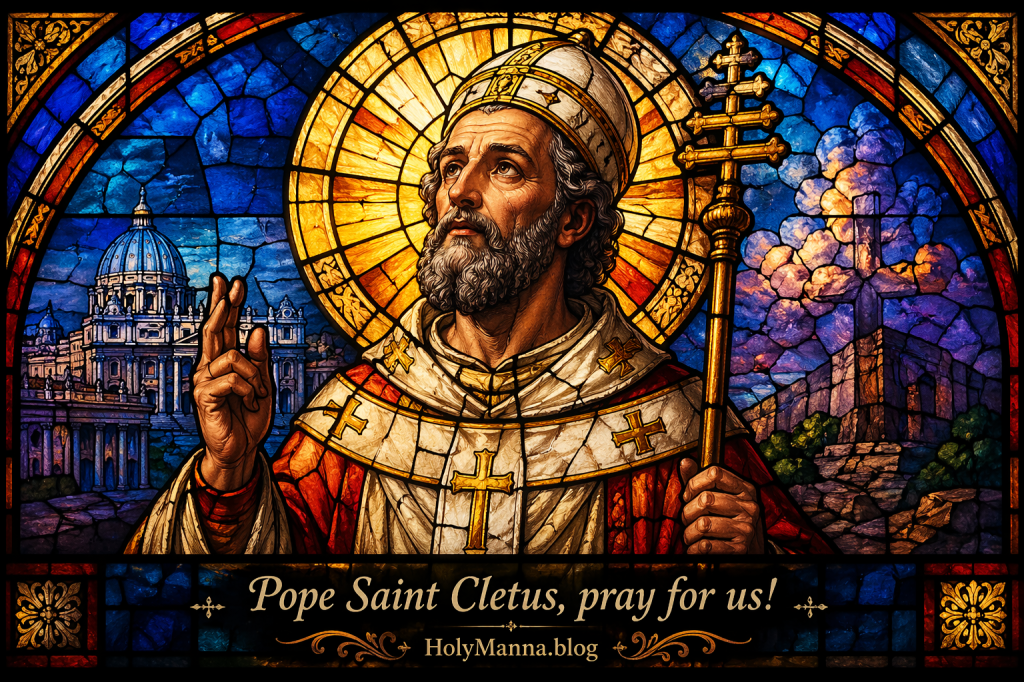
The Quiet Keeper of Peter’s Flame
Pope Saint Cletus, also known as Saint Anacletus or Anencletus, is one of those early saints whose life is partly hidden in the mist of the Church’s first years, yet whose importance is impossible to miss. He is honored as the third Pope and the second successor of Saint Peter, which places him very near the beginning of the visible life of the Church. In a time when Christianity was still young, fragile, and often persecuted, Pope Saint Cletus helped guard the apostolic faith that had been handed down from Christ to the Apostles and from the Apostles to their successors.
That is why he is revered. He stands as one of the earliest witnesses to what the Church still teaches in The Catechism: that the Apostles handed on their mission to their successors so that the Gospel might remain alive in every age. CCC 77 and CCC 861 help show why a saint like Cletus matters so much. His life reminds Catholics that the Church is not built on ideas alone. She is built on Christ, handed on through real men, real suffering, real fidelity, and real apostolic succession.
Pope Saint Cletus is most remembered for holding firm in the earliest years of the Roman Church, for his place in that line of succession after Saint Peter, and for being remembered in the ancient Roman Canon of the Mass. Even though history preserves only a small number of facts about him, the Church has never forgotten his name.
From the Streets of Rome to the Chair of Peter
Catholic tradition holds that Cletus was Roman by birth. Ancient church sources connect him with Rome and say that his father was named Emelianus or Emilianus. Tradition also places him in one of the districts of the city, which helps root him in the ordinary world of first-century Roman life. He did not come from the age of great basilicas and public processions. He came from the age of house churches, whispered prayers, and believers who never knew whether the next day might bring peace or violence.
Because he lived so close to the apostolic age, there is no dramatic conversion story preserved in the way later saints sometimes have. There is no detailed account of a youthful rebellion followed by a sudden return to God. Instead, what can be said is simpler and in some ways more beautiful. Cletus seems to have been formed in the living faith of the early Church and drawn into deeper service until he was entrusted with the care of the Roman Christian community itself.
He is most known for being one of the earliest Popes, but he is also known for the historical confusion around his name. Catholic tradition generally holds that Cletus and Anacletus are the same person. That detail may sound small, but it is actually one of the more surprising facts about him. One of the earliest Popes in history is remembered with great honor, yet the record of his name came down through the centuries in multiple forms. Even that says something about how ancient his memory is. He belongs to the Church’s earliest heartbeat.
A Hidden Life of Service in the Early Church
The life of Pope Saint Cletus during his pontificate was likely marked by quiet, demanding, and often dangerous pastoral work. He was not known for grand public miracles or for lengthy writings that survived the centuries. He was known for steadfastness. He was known for helping preserve the Church in Rome when it was still developing its structure and identity in the world.
Catholic tradition says that he ordained twenty-five priests for the service of the Roman Church. Some traditions also say that he helped organize the Christian community in Rome more deliberately and that he may have had a role in honoring or marking the burial place of Saint Peter. These traditions are ancient and meaningful, though not all of them can be firmly verified by historians. Still, they fit the picture Catholics have always held of him: a shepherd helping strengthen the flock at the very foundations of the Church.
This matters because saints are not only remembered for dramatic wonders. Some saints are remembered because they kept the fire burning when the world was dark. Pope Saint Cletus was one of those men. He served close to the tomb of Peter, close to the memory of the Apostles, and close to the suffering Church that would one day spread across the world. Catholics should remember him because his life shows that fidelity itself is a form of greatness. He reminds the faithful that hidden service in the Church can shape history more deeply than public applause ever could.
As for miracles during his lifetime, no well-attested miracle stories are preserved in the major Catholic sources concerning Pope Saint Cletus. That is worth stating plainly. There are traditions about his leadership and service, but no specific miracle accounts can be confidently verified from the Roman Catholic historical record. His sanctity shines less through miracle stories and more through apostolic faithfulness, pastoral care, and perseverance.
Faithful Under Pressure
The early Popes did not govern in comfort. They led under the shadow of persecution, suspicion, and uncertainty. Pope Saint Cletus would have shepherded the Church in an age when Christians were still vulnerable in the Roman world. Catholic tradition remembers him as a martyr, and that memory has remained strong in the Church’s liturgical life even though the exact details of his death are not well preserved.
Tradition places his martyrdom during the time of the Emperor Domitian. Whether every later detail can be historically confirmed or not, the Catholic memory of him as a martyr carries deep meaning. A martyr is not simply someone who dies. A martyr is someone whose life becomes a witness. Pope Saint Cletus belongs to that early company of saints who did not merely preach the faith with their lips, but sealed their witness with suffering.
There are no widely accepted stories of miraculous escapes or dramatic divine interventions associated with his persecution. The sources are simply too sparse for that. But there is something powerful in that silence. His witness is not wrapped in spectacle. It is wrapped in constancy. He appears in Catholic memory as a man who endured the hardships of the age, carried the burden of the Roman Church, and died in fidelity to Christ.
His burial near Saint Peter on the Vatican Hill is one of the strongest historical details associated with him. That fact alone is moving. The shepherd who followed Peter in service was laid to rest near Peter in death. It is a quiet but beautiful image of apostolic continuity.
The Memory That Never Faded
After his death, Pope Saint Cletus continued to live in the prayer of the Church. That is where his legacy becomes especially powerful. He is remembered in the Roman Martyrology and in the ancient Roman Canon of the Mass. To be named in the Church’s Eucharistic prayer across the centuries is no small honor. It means that even when the details of his earthly life were not preserved in full, the Church still held onto his memory at the altar.
His principal feast is celebrated on April 26. Older liturgical traditions also associated him with July 13, and older calendar customs paired him with Saint Marcellinus. These details show that his veneration has ancient roots, even if it did not develop into the kind of widespread popular devotion seen with some later saints. His impact is more foundational than dramatic. He helped hold the Church together at the beginning, and the Church has continued to honor him ever since.
No verified posthumous miracle stories are securely attached to Pope Saint Cletus in the major Catholic sources. There are no famous healing accounts or widely documented relic miracles that can be confidently presented as historical fact. Because this post is meant to stay honest and rooted in Catholic sources, that should be said clearly. There may have been later stories or local traditions, but no specific miracle accounts emerged in the main Catholic record reviewed here that can be responsibly presented as verified.
Even so, his impact after death is real. His burial near Saint Peter, his place in the Roman liturgy, his remembrance among the earliest Popes, and his witness to apostolic succession all give him a lasting role in the life of the Church. Culturally, his greatest impact is found in the Catholic understanding of continuity. He helps show that the Church today is not a new invention. She is the same Church, handed on generation after generation, through saints like him.
No verified personal quotations from Pope Saint Cletus survive in the Catholic record. That absence is not a weakness. In a strange way, it makes his witness even more striking. The Church remembers not his rhetoric, but his fidelity.
What Pope Saint Cletus Still Teaches the Church
There is something deeply needed in the witness of Pope Saint Cletus. Modern life often teaches people to chase visibility, to build influence, and to measure value by how loudly a name echoes. But this saint speaks from a very different place. He teaches that holiness does not depend on fame. It depends on faithfulness.
His life invites Catholics to love the Church not as a vague spiritual idea, but as the Body of Christ handed down through history. He encourages believers to value apostolic succession, to take seriously the gift of the papacy, and to see that Christ has never abandoned His Church. CCC 857 and CCC 881 help illuminate that truth. The Church is still apostolic. The Church is still built on the foundation laid by Christ through Peter and the Apostles.
Pope Saint Cletus also teaches the beauty of quiet endurance. Not every saint leaves behind books, visions, or dramatic miracles. Some saints preserve the Church by doing the next faithful thing, day after day, under pressure. That kind of holiness is still needed in daily life. It is needed in marriage, in fatherhood, in parish life, in work, in hidden acts of service, and in every moment when a soul chooses fidelity over comfort.
How often is holiness overlooked because it looks too ordinary?
What if some of the greatest saints are the ones who simply stayed faithful when no one was watching?
What would daily life look like if it were lived with the quiet strength of a man like Pope Saint Cletus?
A practical way to live his example is to remain close to the Church even when the world seems unstable, to treat the faith as a treasure that has been handed down and not reinvented, and to serve Christ without needing attention in return. Pope Saint Cletus shows that a soul can help hold up the Church simply by standing where God placed him and refusing to let go.
Engage with Us!
Please share your thoughts and reflections in the comments below. The life of Pope Saint Cletus may seem hidden at first glance, but that hiddenness can speak powerfully to anyone trying to live the faith in ordinary life.
- What stands out most about a saint whose greatness was rooted more in faithfulness than in fame?
- How does Pope Saint Cletus help deepen appreciation for apostolic succession and the continuity of the Catholic Church?
- What areas of daily life need more quiet perseverance, courage, and trust in Christ?
- How can the example of the early martyrs strengthen the heart when living the faith feels costly or lonely?
- What does Pope Saint Cletus teach about serving God faithfully even when few details of that service are ever seen or remembered by the world?
May the witness of Pope Saint Cletus encourage every heart to remain close to Christ and His Church, to cherish the faith that has been handed down, and to live each day with the love and mercy Jesus taught us.
Pope Saint Cletus, pray for us!
Follow us on YouTube, Instagram and Facebook for more insights and reflections on living a faith-filled life.


Leave a Reply