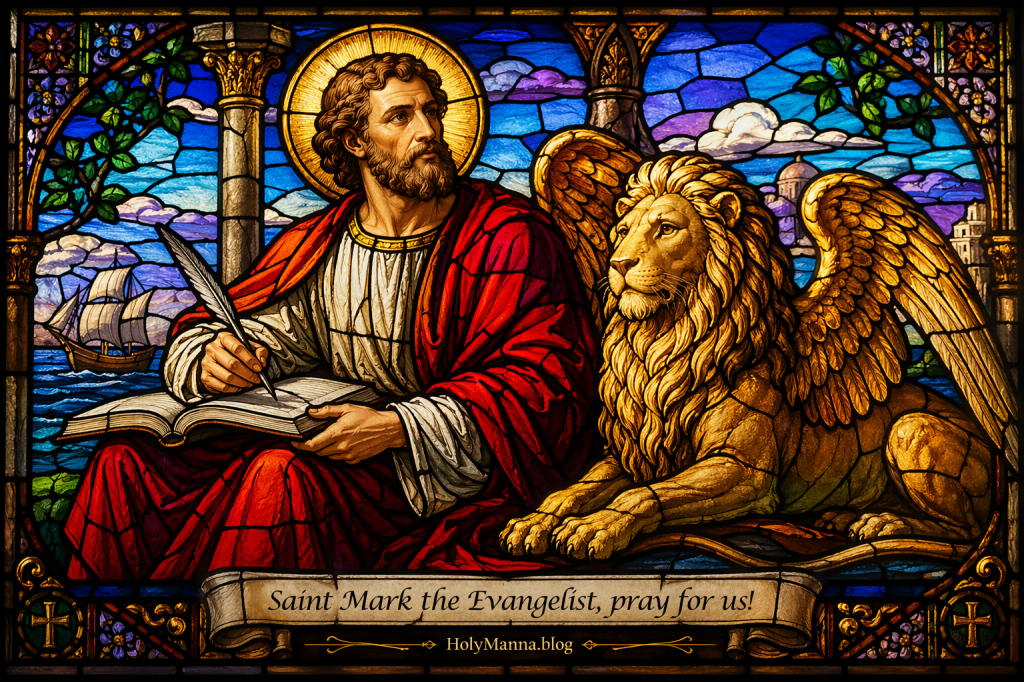
The Lion Who Wrote the Gospel
Saint Mark the Evangelist stands close to the very heart of Christian memory. He is revered as one of the four Evangelists, the inspired author of The Gospel of Mark, a companion of Saint Peter, a helper in the apostolic age, and the saint traditionally honored as the founder of the Church in Alexandria. In Catholic tradition, he is remembered not only as a writer, but as a man entrusted with handing on the living voice of the apostles to the whole Church.
That is why Saint Mark matters so much. His Gospel is short, vivid, urgent, and full of movement. It does not wander. It proclaims Christ. Again and again, Mark brings the reader face to face with Jesus as the Holy One who heals, commands, suffers, dies, and rises. Many in the Church have long believed that Mark wrote down what Saint Peter preached, which gives his Gospel a deeply apostolic warmth and force. When the Church hears Mark, the Church hears the apostolic witness speaking with clarity.
He is often shown with a winged lion, a symbol of strength, royal dignity, courage, and the powerful proclamation of Christ. His feast is celebrated on April 25, and his legacy stretches from Jerusalem to Rome, from Alexandria to Venice, and from the first century to every Catholic church where the Gospel is proclaimed at Mass.
From John Mark to Gospel Witness
Catholic tradition generally identifies Saint Mark with John Mark of the New Testament. Scripture places him in Jerusalem, in the home of his mother Mary, whose house was already a gathering place for believers. That detail matters. It suggests that Mark did not come to the Christian faith from a distance. He grew up close to the life of the early Church, close to prayer, close to the apostles, and close to the mystery of Christ’s saving work unfolding in history.
He was also connected to Saint Barnabas, who is described as his cousin. That family tie helped draw him into missionary life. Mark joined Barnabas and Saint Paul on their travels, but at one point he left them and returned home. That decision became serious enough that later, when Barnabas wanted to take Mark again, Paul refused. The disagreement between Paul and Barnabas became so sharp that they separated.
That moment is one of the most striking parts of Mark’s story. It is also one of the most encouraging. The Church does not remember Mark as a man ruined by an early failure. The Church remembers him as a man who matured, persevered, and became useful again in the work of the Gospel. Later, Saint Paul spoke warmly of him and even asked that Mark be brought to him because he was helpful in ministry. Saint Peter, too, referred to him affectionately as “my son,” showing the closeness of their spiritual bond.
So Saint Mark is known not only for writing a Gospel. He is known for something deeply human and deeply hopeful. He stumbled early, but grace did not leave him there. He grew into a trusted servant of Christ. That alone makes him a powerful saint for anyone who has ever started badly, failed publicly, or feared that an earlier weakness had disqualified them from serving God.
The Evangelist Who Preserved Peter’s Preaching
Saint Mark is most known for writing The Gospel of Mark, which many ancient Christian voices connected to the preaching of Saint Peter. In Catholic tradition, this is one of the great treasures of his life. Mark may not have been one of the Twelve Apostles, but he stood close enough to the apostolic fire to preserve it faithfully.
His Gospel begins with words that still strike like a bell through the centuries: “The beginning of the gospel of Jesus Christ [the Son of God].” In that opening line, the whole mission of Mark seems to appear. He wants the world to know that Jesus Christ is not one teacher among many, not one moral guide among many, but the long-awaited Son through whom salvation has come.
The Gospel he wrote is marked by urgency, movement, and clarity. Jesus teaches, heals, rebukes demons, forgives sins, and reveals His authority with breathtaking force. Mark does not sentimentalize discipleship. He shows weakness, fear, misunderstanding, suffering, and the cost of following Christ. That honesty makes the Gospel all the more believable. It also reflects the hard realism of the apostolic Church.
Catholic tradition also sees something fitting in Mark’s literary style and his personal story. The man who knew what failure felt like helped write a Gospel in which weak disciples are still called, corrected, and sent. The man who learned through service and humility helped preserve one of the Church’s clearest portraits of Jesus in action.
Signs, Wonders, and Beloved Traditions
The New Testament does not explicitly record miracles performed by Saint Mark himself. What it gives instead is something even more foundational. It shows his closeness to the apostolic mission and his role in the inspired transmission of the Gospel. Still, later Catholic tradition preserves several miracle stories associated with him during his lifetime, and these stories became part of his beloved legacy.
One of the most famous traditions tells of Mark’s arrival in Alexandria. According to this account, the strap of his sandal broke, and he brought it to a shoemaker named Anianus. While repairing it, Anianus injured his hand with an awl. Mark is said to have invoked the name of the one true God, applied clay or spittle to the wound, and healed him. This miracle reportedly opened Anianus’s heart to the faith, and he became one of Mark’s first converts and later his successor in Alexandria. This story has long been cherished in Christian tradition, but it cannot be historically verified.
Other traditions say Mark preached in Libya, Pentapolis, and Egypt, performed many healings, converted large numbers of pagans, and overthrew idols through the power of Christ. These accounts highlight what Christians came to believe about the fruitfulness of his mission. They present Mark as a preacher whose words were accompanied by signs of divine favor. These stories belong to the saint’s traditional legacy, but they cannot be historically verified in detail.
Even so, these miracle traditions reveal something important. The Church remembered Mark as more than a writer. She remembered him as a missionary, a preacher, and a vessel of divine grace whose work helped establish living Christian communities.
A Saint Who Suffered for the Gospel
Like so many saints of the apostolic age, Mark was remembered as a man who did not serve Christ in comfort. Catholic tradition holds that his preaching in Alexandria provoked fierce opposition. The city was spiritually significant, culturally influential, and religiously divided. To preach Christ there was not a small thing. It required courage, endurance, and deep trust in God.
Ancient Christian tradition says that enemies seized Mark during pagan festivities, tied a rope around him, and dragged him through the streets of Alexandria. He was then imprisoned. Some accounts say that in prison he was strengthened by heavenly consolation and prepared for death in peace. The next day, his suffering continued until he died. The Church has long venerated him as a martyr.
At the same time, careful Catholic scholarship notes that the detailed documentary evidence for the manner of his martyrdom comes from later centuries. So the story is handed down as venerable tradition, deeply rooted in Christian memory, but not established with the same certainty as the biblical details of his life.
That distinction matters because Catholic faith is not afraid of honesty. The Church does not need to exaggerate a saint in order to honor him. Mark’s greatness does not depend on dramatic embellishment. His greatness already shines in his fidelity to the Gospel, his closeness to the apostles, his labor for the Church, and the ancient witness that he suffered for Christ.
After Death, His Voice Grew Even Larger
Saint Mark’s legacy after death is immense. In many ways, it only grew larger with time. The Church of Alexandria long honored him as its founder, and that memory shaped one of the most influential Christian sees in history. His name became permanently linked with the faith of Egypt, with apostolic succession, and with the enduring witness of Christians who preserved the Gospel through centuries of struggle.
Tradition also says that after his martyrdom, those hostile to him intended to burn his body, but a storm or other sudden intervention interrupted their plans, and his body was preserved. This story became part of the saint’s posthumous memory, though it cannot be historically verified.
Centuries later, his relics became associated in a special way with Venice. Catholic tradition holds that his relics were transferred there from Alexandria. Whether every detail of that translation can be historically pinned down is another matter, but the result is beyond dispute. Saint Mark transformed the identity of Venice. His winged lion became the city’s most famous symbol. The great Basilica of Saint Mark became one of the most recognizable churches in the world. His memory shaped architecture, art, civic identity, and Christian imagination.
There are also traditions of healings and favors obtained through his intercession, especially in places dedicated to him or associated with his relics. These accounts contributed to his veneration and to the devotion of pilgrims through the centuries. Specific miracle claims from shrines and popular devotion cannot always be historically verified, but they testify to the love the faithful have long had for him.
His feast on April 25 also took on broader liturgical significance in the Roman tradition because of the Greater Litanies, or Major Rogation, a solemn day of supplication and procession. That means Saint Mark’s feast became linked not only to his personal memory, but also to the Church’s public prayer for protection, mercy, and blessing upon the land.
Why the Church Still Needs Saint Mark
Saint Mark still has much to teach the modern soul. His life speaks to people who are drawn to Christ but feel weak. It speaks to people who have failed in something important. It speaks to those who fear they started badly and may never recover. Mark’s story says otherwise.
He teaches that grace can mature a person over time. He teaches that humility matters. He teaches that a person can begin with hesitation and still end with deep usefulness in the kingdom of God. He teaches that closeness to apostolic truth matters more than personal flair. He teaches that the Gospel is not a private opinion, but a saving proclamation entrusted to the Church.
His example also invites Catholics to love Scripture more deeply. Mark did not leave behind long philosophical treatises or personal memoirs. He gave the Church Christ. He did that by writing a Gospel that is direct, faithful, and alive with urgency. In a distracted world, that simplicity feels almost prophetic.
There is also something deeply consoling in the fact that no verified personal sayings of Saint Mark survive outside the inspired Gospel associated with him. His life points away from himself and toward Jesus. Even in memory, Mark remains an Evangelist. He still disappears behind the One he proclaims.
One line from the Gospel associated with him captures the missionary force of his legacy: “Go into the whole world and proclaim the gospel to every creature.” Those words have stirred missionaries, martyrs, preachers, and ordinary believers for centuries. Through Mark, the Church still hears the call.
Learning to Live Like Saint Mark
Saint Mark can be imitated in practical, everyday ways. His life encourages Catholics to stay close to the Church, to remain humble after failure, and to trust that God can still use a life that has seen weakness. He reminds the faithful that holiness is not built on self-confidence, but on fidelity.
A good way to begin is by spending time with The Gospel of Mark prayerfully and slowly. Read it not as an academic exercise alone, but as the living word of God proclaimed through the Church. Notice the urgency. Notice the authority of Jesus. Notice the weakness of the disciples. Notice how often Christ moves toward suffering souls.
Saint Mark also invites Catholics to take mission seriously. That does not always mean traveling far away. Often it means speaking truth gently, teaching the faith clearly, praying with conviction, and living in a way that makes Christ visible in daily life. In a culture that often confuses noise with courage, Mark points toward a better path. Write the truth. Speak the truth. Live the truth. Stay close to the apostles. Stay close to Christ.
His life also offers a healing lesson for anyone carrying shame over the past. Mark once stepped back when others needed him most. Yet by grace, that was not the end of the story. The Church remembers him not for abandoning the road, but for returning to it faithfully. That is a deeply Christian pattern. Repentance is real. Growth is real. Restoration is real.
What part of Saint Mark’s story feels most familiar right now? Is it his early closeness to the Church, his season of weakness, his later faithfulness, or his courage in handing on the Gospel? Where might Christ be asking for greater trust, greater humility, or greater boldness today?
Engage with Us!
Share thoughts and reflections in the comments below. Saint Mark’s life opens the door to some beautiful and necessary questions about courage, failure, faithfulness, and love for the Gospel.
- What stands out most about Saint Mark’s journey from early weakness to lasting faithfulness?
- How does Saint Mark’s closeness to Saint Peter and Saint Paul deepen appreciation for the unity of the early Church?
- What does The Gospel of Mark reveal about Jesus that feels especially powerful or urgent today?
- Has there ever been a moment when failure became the beginning of deeper trust in God?
- What would it look like to proclaim the Gospel more clearly in ordinary daily life, at home, at work, or among friends?
Saint Mark reminds the faithful that God can do lasting things through humble servants. His life urges Christians to stay close to the Church, stay close to Scripture, and stay close to Christ even after weakness, confusion, or fear. May his example encourage a life of steady faith, courageous witness, and deep love for the truth. Live with conviction, speak with charity, and do everything with the love and mercy Jesus taught us.
Saint Mark the Evangelist, pray for us!
Follow us on YouTube, Instagram and Facebook for more insights and reflections on living a faith-filled life.


Leave a Reply