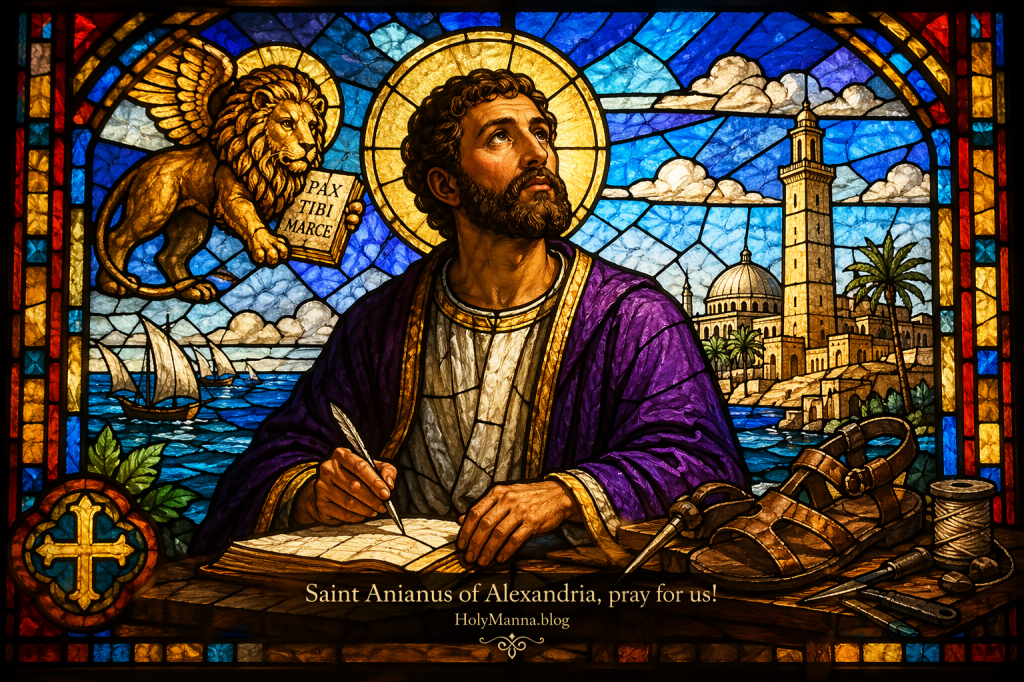
A Hidden Saint at the Birth of the Church in Egypt
Some saints step onto the page with thunder. Others arrive softly, almost in silence, and yet their place in salvation history is immense. Saint Anianus of Alexandria belongs to that second kind. He is revered in Catholic tradition as the disciple of Saint Mark the Evangelist and the first successor to Saint Mark in the See of Alexandria. That means he stood at the very beginning of one of the Church’s oldest apostolic centers, helping guard and pass on the faith in a city that would become one of the great hearts of Christian thought and witness. The Roman Martyrology remembers him simply and beautifully as “the disciple of Blessed Mark” and his successor, a man who “fell asleep in the Lord.”
Saint Anianus is significant not because many writings survive under his name, or because dramatic legends crowd every year of his life, but because he helped root the Gospel in Egypt at the apostolic age. In a world still shaped by pagan worship, imperial power, and uncertainty, he helped preserve the young Church after Saint Mark’s preaching had first taken hold in Alexandria. That quiet fidelity is one reason he is still revered.
The Wounded Hand and the Opened Heart
The earliest hard historical evidence about Saint Anianus is brief. Eusebius’ Church History and older Catholic reference works confirm that he succeeded Saint Mark in Alexandria in the eighth year of Nero and later died after serving twenty-two years as bishop. Those are the facts Catholics can hold with the greatest confidence.
The more personal details of his early life come from later Christian tradition. According to the ancient story preserved in the Acts of Mark and repeated in Catholic devotional sources, Anianus was a cobbler in Alexandria. Saint Mark entered the city, and the strap of his sandal broke. When Anianus tried to repair it, he accidentally wounded his hand with an awl and cried out “Heis ho Theos,” meaning “God is one.” Saint Mark seized that moment to preach Christ to him and then healed the wound. The story continues by saying that Mark entered Anianus’s home, preached the Gospel to his household, and baptized them. This cherished story has been loved for centuries in Christian memory, but the fuller details cannot be historically verified with certainty because they come from later tradition rather than the earliest historical record.
Even so, the spiritual beauty of the tradition is striking. A torn sandal, a wounded hand, a cry to the one God, and a heart opened to Christ. The Church has long loved stories like this because they show how grace often enters ordinary life through what looks like interruption, pain, or inconvenience. Saint Anianus is remembered as one of the first fruits of Saint Mark’s preaching in Egypt, and that alone makes his life worth pondering with gratitude.
The Bishop Who Guarded an Apostolic See
What Saint Anianus is most known for is his role as the first great shepherd after Saint Mark in Alexandria. The Church of Alexandria was no minor outpost. Catholic tradition holds that it was founded by Saint Mark and became the center from which Christianity spread throughout Egypt. Saint Anianus therefore stands at the beginning of a line that would one day include giants such as Saint Athanasius and Saint Cyril.
Later Catholic tradition says that Saint Mark entrusted the local church to Anianus, even ordaining him bishop while Mark was away. Older Catholic accounts say Anianus governed the church for some years with Mark still living and for many more after Mark’s death. That same tradition presents him as a man of remarkable holiness and preserves the judgment attributed to Eusebius that he was “well-pleasing to God, and admirable in all things.” The exact chronology in these later details is not equally certain in every point, but the broad Catholic picture is clear. Saint Anianus was a faithful pastor of a young and growing Church.
Grace at Work in His Lifetime
The miracle most closely associated with Saint Anianus during his lifetime is the healing of his wounded hand by Saint Mark. In the traditional account, that miracle opened the door to his conversion and the conversion of his household. This miracle cannot be verified with certainty in the same way as the bare fact of his episcopal succession, because the detailed story comes from later tradition.
Beyond that story, the surviving Catholic sources do not preserve a large catalogue of miracles worked personally by Saint Anianus. His greatness appears in another way. He helped hold fast to the faith in its fragile beginnings. He helped carry the Gospel into the life of Egypt. He served not through spectacle, but through perseverance. There is something deeply moving in that kind of sanctity. The Church does not remember only the saints who astonished crowds. She also remembers the saints who quietly kept the lamp burning.
Trials Without a Crown of Martyrdom
Saint Anianus is not chiefly remembered as a martyr, and the strongest Catholic historical sources do not describe a martyrdom for him. Instead, he appears as a confessor and bishop who endured the ordinary hardship of leading a small Christian flock in a city where the faith was still new and vulnerable. Alexandria was intellectually powerful, religiously diverse, and often hostile to the Gospel. To shepherd the Church there after Saint Mark required courage, stability, and deep trust in God.
There is also a sober contrast in his story. Saint Mark, his master in the faith, was remembered for martyrdom. Saint Anianus was remembered for endurance. Not every saint dies in public witness before a mob. Some are asked to carry on after the heroic figure is gone. Some are asked to remain, to organize, to strengthen, to protect, and to hand on what they received. Saint Anianus seems to have lived precisely that hidden kind of heroism.
After Death, a Memory That Never Quite Disappeared
The posthumous legacy of Saint Anianus is quieter than that of more famous saints, but it is real. Catholic tradition kept his memory alive in the Church’s liturgical remembrance and in the line of Alexandrian succession. Older Catholic hagiographical tradition also records that Saint Epiphanius mentioned a church in Alexandria built in his honor, which suggests that local devotion to him was established early. That report belongs to later tradition and cannot be verified with complete certainty, but it does show that his memory was not forgotten.
The major Catholic sources do not preserve a broad cycle of posthumous miracles attached to Saint Anianus in the way they do for many later saints. His after-death impact is seen more in veneration, memory, and apostolic continuity than in a large collection of miracle reports. In that sense, his greatest miracle may be historical and ecclesial. The Church in Alexandria endured, grew, and became one of the great centers of Christian life, and Saint Anianus belongs to that foundation.
His liturgical remembrance also reflects this quiet but lasting place in the Church. He is commemorated in The Roman Martyrology on April 25 alongside Saint Mark. Some older traditions also connect his death with November 26, though Catholic historical witness is not completely uniform on that point. What is clear is that the Church has continued to remember him as a holy bishop linked forever to Saint Mark and the apostolic birth of Egyptian Christianity.
What Saint Anianus Teaches the Church Today
There is something deeply comforting about Saint Anianus. He was not a saint of dazzling self-promotion. He was not preserved in history by long writings or dramatic speeches. He was a man who received the faith, stayed faithful, and helped others remain faithful too. In an age that often prizes visibility, Saint Anianus reminds Christians that hidden fidelity matters immensely in the kingdom of God.
His life teaches that ordinary moments can become the place of conversion. A wound, a conversation, a visit to one’s home, a word about God, these can become the beginning of everything. His life also teaches that the Church is built not only by apostles who preach in public, but by successors who preserve, guard, and hand on what they have received. That is a needed lesson in every generation.
Where has God been trying to enter through an interruption, a wound, or an unwanted inconvenience? Is there a quiet duty that has been treated as small, even though it may be the very place where holiness is being formed? What would it look like to imitate Saint Anianus by serving faithfully even without recognition?
A practical way to live his example is to take more seriously the hidden vocations of daily Christian life. Guard the faith in the home. Speak of Christ naturally. Stay close to the Church. Be dependable in prayer. Be faithful in the tasks that seem unseen. Many souls are strengthened by the quiet perseverance of one believer who simply refuses to let the lamp go out.
Engage With Us!
Readers are warmly invited to share their thoughts and reflections in the comments below. Saint Anianus is one of those saints who can easily be overlooked, but his life opens up beautiful questions about quiet holiness, apostolic faith, and perseverance.
- What part of Saint Anianus’s life speaks most strongly to the heart: his conversion, his hidden leadership, or his steady faithfulness?
- Has there ever been an ordinary moment in life that later seemed like a moment of grace?
- What hidden responsibility might God be asking to carry with greater love and devotion?
- How can Saint Anianus’s example help strengthen faith at home, in parish life, or in daily work?
May Saint Anianus pray for every soul trying to remain faithful in quiet ways. May his example teach the beauty of steady perseverance. And may every part of life be lived with the love, mercy, and fidelity that Jesus Christ taught His Church from the beginning.
Saint Anianus of Alexandria, pray for us!
Follow us on YouTube, Instagram and Facebook for more insights and reflections on living a faith-filled life.


Leave a Reply