Feast of Saint Mark, Evangelist – Lectionary: 555
Clothed in Grace, Sent Into the World
There is something deeply stirring about a feast day where the Church lets Saint Peter and Saint Mark speak almost side by side. In the First Reading, Peter closes his letter with the warm greeting of “Mark, my son”, and in the Gospel, the Church proclaims the risen Christ sending His disciples into the whole world. Taken together, these readings reveal a central theme that is both challenging and consoling: the disciple who is truly sent by Christ must first be humbled, steadied, and anchored in grace. The Church does not give mission without formation, nor proclamation without surrender.
That is what makes today’s feast so rich. Saint Mark is honored not simply as a writer, but as an Evangelist, a man through whom the Holy Spirit handed on the saving words and deeds of Christ. The background of these readings matters. The early Christians were not living in comfort or cultural influence. They were learning how to stay faithful in a world that could be hostile, confusing, and dangerous. Saint Peter writes to believers who must remain sober, vigilant, and humble under pressure. The Psalm answers that struggle with confidence, lifting the heart to sing of the Lord’s mercy and faithfulness through every age. Then The Gospel of Mark ends with the risen Jesus commanding the apostles to preach, baptize, and trust that He will continue working with them.
That movement is the key to the whole day. First comes humility before God. Then comes vigilance in spiritual battle. Then comes confidence in divine mercy. Only then does the disciple go out boldly into the world. In other words, today’s readings show that evangelization is not about religious self-confidence or natural charisma. It is about a soul that has learned to cast its anxieties on God, resist the enemy, stand firm in suffering, and trust that Christ still acts through His Church.
The Feast of Saint Mark also carries a beautiful apostolic tenderness. The Gospel is not passed on by isolated individuals building private spiritual projects. It is received, lived, and handed on within the family of the Church. Peter’s affection for Mark reminds the reader that the faith is personal, but never solitary. The same Church that formed the saints is still sent by Christ to proclaim the same Gospel to every creature. That gives today’s readings a powerful unity. They invite the reader to see that the Christian life is not divided between interior holiness and outward mission. The soul that kneels before God is the soul that can stand before the world.
This makes today’s feast a timely invitation. In an age full of noise, distraction, and spiritual pride, the Church points to the humble witness who remains firm in grace and then speaks with courage. Saint Mark’s feast reminds every believer that the Gospel still moves through human voices, faithful hearts, and ordinary lives surrendered to Christ. How is the Lord asking the heart to become more humble, more vigilant, and more ready to carry His truth into the world?
First Reading – 1 Peter 5:5-14
When the Shepherd Teaches the Flock How to Stand Firm
The Church gives this reading on the Feast of Saint Mark with real tenderness and purpose. These are Saint Peter’s closing words to a Christian community living under pressure, and they carry the warmth of a spiritual father speaking to sons and daughters who need courage. The passage begins with humility, moves through trust and spiritual combat, and ends with a beautiful reminder that Mark himself is near Peter as a beloved spiritual son. The liturgy is teaching something powerful here: before the disciple is sent into the world, he must first be clothed in humility, anchored in grace, and made steady in suffering. That fits today’s larger theme perfectly. Saint Mark, the Evangelist, is not presented as a lone hero, but as a man formed in apostolic friendship, ecclesial obedience, and perseverance. The notes on this passage also make clear that Babylon is understood here as Rome, and that Mark, my son reflects the early tradition of Mark as Peter’s close disciple and co-worker.
Peter’s words also carry the atmosphere of the early Church. Christians were not floating through a comfortable religious moment. They were learning how to stay faithful when suffering, temptation, fear, and instability pressed in from every side. That is why this passage feels so alive even now. Peter does not offer sentimental encouragement. He gives the Church a rule for survival and holiness: humility before God, trust in divine providence, vigilance against the devil, steadfastness in shared suffering, and peace in Christ. This is not soft spirituality. This is apostolic realism, and it prepares the soul for mission.
Detailed Exegesis
Verse 5. “Clothe yourselves with humility in your dealings with one another, for: God opposes the proud but bestows favor on the humble.”
Peter does not speak of humility as an optional personality trait. He speaks of it like a garment the Christian must consciously put on. The image is strong and practical. Humility is meant to cover the whole life of the believer, especially in his dealings with others. The verse also echoes Proverbs 3:34, showing that this is not a new lesson, but part of the consistent wisdom of God. Pride closes the soul to grace because pride tries to stand on its own. Humility opens the soul because it tells the truth about God and about the self. This is why the Christian community cannot remain healthy if pride is allowed to reign.
Verse 6. “So humble yourselves under the mighty hand of God, that he may exalt you in due time.”
Here Peter moves from relationships within the Church to the believer’s posture before God Himself. The phrase the mighty hand of God recalls the Lord’s saving power throughout salvation history. To humble oneself under that hand means accepting God’s timing, God’s will, and God’s way of leading the soul. Peter does not promise immediate relief. He promises exaltation in due time. That is deeply Christian. The disciple does not seize glory. He waits for it from God. This verse cuts against impatience, self-promotion, and spiritual ambition. It teaches that the road upward in the Christian life begins by going low before the Lord.
Verse 7. “Cast all your worries upon him because he cares for you.”
This is one of the most consoling lines in the New Testament, but Peter places it inside the call to humility. That matters. Anxiety is not always rooted in pride, but it often becomes heavier when the soul acts as though everything depends on its own strength. Peter does not say that worries are unreal. He says they must be cast onto the Lord because the Lord truly cares. The Catechism repeats this verse directly when it teaches divine providence: “Christ invites us to filial trust in the providence of our heavenly Father… and St. Peter the apostle repeats: ‘Cast all your anxieties on him, for he cares about you.’” CCC 322. The Christian life is not careless, but it must become trustful.
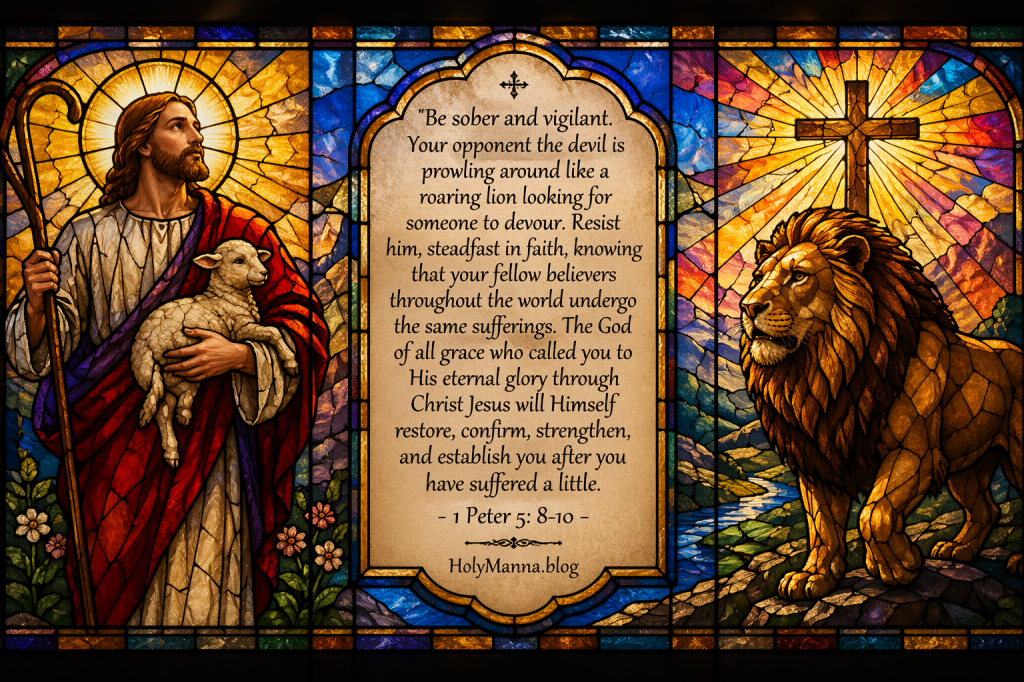
Verse 8. “Be sober and vigilant. Your opponent the Devil is prowling around like a roaring lion looking for someone to devour.”
Peter suddenly sharpens the tone. Christian humility is not dreamy passivity. It must become vigilance. To be sober is to be spiritually clear, not intoxicated by distraction, illusion, vanity, or sin. To be vigilant is to stay awake. Peter speaks of the devil as a real adversary, not a mere symbol. The image of the roaring lion is meant to wake the conscience. The Christian is living in a battlefield, not a playground. The Catechism says with equal clarity: “Prayer is both a gift of grace and a determined response on our part… prayer is a battle. Against whom? Against ourselves and against the wiles of the tempter who does all he can to turn man away from prayer, away from union with God.” CCC 2725. Peter’s warning is therefore not dramatic exaggeration. It is pastoral truth.
Verse 9. “Resist him, steadfast in faith, knowing that your fellow believers throughout the world undergo the same sufferings.”
The Christian does not defeat the devil by panic, novelty, or self-invention. He resists by remaining steadfast in faith. That means holding fast to what God has revealed, what the Church teaches, and what grace makes possible. Peter also breaks the lie of isolation. Suffering Christians are not alone. Their trials are shared by the wider body of believers. This matters because one of the enemy’s favorite tactics is to make a soul believe that its struggle is unique, shameful, and hidden from everyone else. Peter answers that lie with communion. The Church suffers together, and the Church stands together.
Verse 10. “The God of all grace who called you to his eternal glory through Christ Jesus will himself restore, confirm, strengthen, and establish you after you have suffered a little.”
This verse is full of hope. Peter does not deny suffering, but he places it inside a much bigger horizon. God has called the believer to eternal glory through Christ. Suffering is real, but it is not final. Peter uses a cascade of strong verbs: restore, confirm, strengthen, establish. God is not indifferent to the bruised and weary soul. He is actively shaping it. The Church reads this in continuity with the apostolic promise that present sufferings are not worth comparing with the glory to come. Peter wants the Christian to see trial not as proof of abandonment, but as a passing fire through which grace is at work.
Verse 11. “To him be dominion forever. Amen.”
Peter ends the doctrinal heart of the passage with doxology. That is important. True theology leads to worship. After speaking of pride, anxiety, demonic assault, and suffering, Peter fixes the eyes of the Church on the dominion of God. The devil prowls, but he does not reign. Suffering wounds, but it does not rule history. God has dominion forever. This short verse restores perspective. The Christian life is not ultimately defined by what threatens the believer, but by the God who holds all things in His power.
Verse 12. “I write you this briefly through Silvanus, whom I consider a faithful brother, exhorting you and testifying that this is the true grace of God. Remain firm in it.”
Peter now speaks personally and reveals the letter’s purpose. He is exhorting and testifying. The faith is not a private theory. It is the true grace of God, something objective, received, and handed on. Peter also mentions Silvanus, whom tradition identifies with the companion of Paul. That detail quietly reveals the unity of the apostolic Church. Petrine and Pauline circles are not rivals here. They are joined in the same Gospel. Peter’s last imperative in this verse is simple and weighty: remain firm. Not innovate endlessly. Not drift with the age. Remain firm in grace.
Verse 13. “The chosen one at Babylon sends you greeting, as does Mark, my son.”
This verse is one of the reasons the reading is so fitting for the Feast of Saint Mark. The chosen one refers to the Church, and Babylon is understood as a code name for Rome. Then Peter mentions Mark with striking affection: “Mark, my son.” This is not merely a passing greeting. It reflects a living spiritual bond. The Church has long seen in this line a window into Mark’s formation under Peter’s care. On the day the Church honors Mark the Evangelist, she lets Peter himself present Mark not first as an author, but as a son in the faith. That is beautiful and instructive. The Gospel is handed on through fatherhood, friendship, fidelity, and communion in the Church.
Verse 14. “Greet one another with a loving kiss. Peace to all of you who are in Christ.”
Peter’s final words are full of ecclesial warmth. The loving kiss is not sentimental decoration. In the early Church it was a sign of communion, reconciliation, and shared belonging in Christ. Peter ends not with strategy, but with peace. That is the fruit of the whole passage. Humility, trust, vigilance, resistance, perseverance, and fidelity do not produce a hard and suspicious Christianity. They produce peace in Christ. This is the peace of souls that know they are held by grace, guarded by truth, and united in the Body of Christ.
Teachings
This reading teaches that humility is not weakness. It is the proper posture of the creature before the Creator, and of the disciple before the Master. The Catechism says it with luminous clarity: “But when we pray, do we speak from the height of our pride and will, or ‘out of the depths’ of a humble and contrite heart? He who humbles himself will be exalted; humility is the foundation of prayer… ‘Man is a beggar before God.’” CCC 2559. That line from Saint Augustine, “Man is a beggar before God”, goes straight to the heart of Peter’s message. The soul that knows its poverty is the soul that can finally receive grace.
The reading also teaches a thoroughly Catholic realism about spiritual warfare. Peter does not flatter the Church with the illusion that holiness happens automatically. The Catechism echoes him: “Prayer is both a gift of grace and a determined response on our part… prayer is a battle. Against whom? Against ourselves and against the wiles of the tempter who does all he can to turn man away from prayer, away from union with God.” CCC 2725. A few paragraphs later, the same section warns: “Another temptation, to which presumption opens the gate, is acedia… decreasing vigilance, carelessness of heart.” CCC 2733. Peter’s command to be sober and vigilant is therefore not an ancient exaggeration. It is perennial Catholic wisdom.
There is also a rich historical thread running through this passage. Babylon is understood as Rome and Mark is traditionally understood as Peter’s close disciple and co-worker there. So on Saint Mark’s feast, the Church is not merely remembering a name attached to a Gospel. She is remembering an Evangelist shaped in the living apostolic life of the Church. That historical connection matters because it reminds the faithful that revelation is handed on through real men, real communities, and real suffering endured in union with Christ.
A beautiful patristic line from Saint Gregory the Great also fits this reading with force: “The pride of the devil became the occasion of our perdition, and the humility of God has been found the argument for our redemption.” Peter warns against the lion-like pride of the enemy and commands humility under the mighty hand of God. Gregory’s insight helps explain why. Pride ruined man because pride imitates the devil. Humility saves man because humility conforms him to Christ. The whole Christian life, in a sense, is a choice between those two likenesses.
Reflection
This reading lands close to ordinary life because it touches the places where most souls actually struggle. Pride shows up in the need to control everything, to win every argument, to be noticed, or to refuse correction. Anxiety shows up in sleeplessness, overthinking, irritability, and the quiet fear that everything rests on human shoulders. Spiritual combat shows up in discouragement, temptation, resentment, distraction, impurity, and the slow deadening of vigilance. Peter’s answer to all of it is steady and sane: humble the heart before God, hand over the burdens, stay awake, resist the enemy, and remain firm in grace.
In daily life, this means choosing a few very concrete acts of fidelity. It means beginning the day with a deliberate act of surrender to God rather than plunging straight into noise. It means naming anxieties in prayer instead of feeding them in silence. It means taking temptation seriously before it grows teeth. It means returning to confession when the soul has drifted. It means remembering that suffering does not mean God has stepped away. Peter says the opposite. The God of all grace is restoring, confirming, strengthening, and establishing His people even now.
Where has pride made the heart defensive instead of teachable? What burden still has not truly been cast upon the Lord? What habits have weakened vigilance and made the soul easier to trouble? What would it look like this week to remain firm in the true grace of God rather than drifting into fear or self-reliance?
This First Reading is a gift for anyone who feels worn down, proud, anxious, tempted, or spiritually tired. Peter does not shame the struggling believer. He fathers him. He teaches him how to stand. And on the Feast of Saint Mark, the Church lets that fatherly voice ring out again so that the faithful may remember that great evangelists are not made by talent alone. They are made by humility, vigilance, suffering borne with faith, and peace received in Christ.
Responsorial Psalm – Psalm 89:2-3, 6-7, 16-17
A Song for Hearts That Trust the Faithful God
The Church places this psalm between Saint Peter’s sober warning and Saint Mark’s missionary Gospel like a deep breath of confidence. After hearing about humility, vigilance, and the reality of spiritual struggle, the faithful are taught to sing. That is not an accident. Psalm 89 is a royal and covenantal psalm, one of the great biblical hymns that celebrates the Lord’s mercy, His faithfulness, and His enduring promises. In its fuller setting, it recalls God’s covenant with David and praises the Lord as the One whose rule stands above heaven and earth. For Israel, this was not abstract poetry. It was a way of remembering that even when history shook and enemies raged, the Lord had not forgotten His word.
That makes this psalm especially fitting for the Feast of Saint Mark. The Gospel is being sent into the world, but the Church is not sent out on human energy alone. She goes forth singing of God’s mercy and trusting His faithfulness. Saint Peter tells believers to remain firm in grace. Saint Mark’s Gospel shows the apostles going out to preach everywhere. The psalm reveals the inner posture that makes such mission possible. The one who knows the Lord’s mercy can persevere. The one who trusts the Lord’s faithfulness can walk into a hostile world without losing heart. The central theme shines here with quiet strength: humble disciples become courageous witnesses because they know the God who is faithful forever.
Detailed Exegesis
Verse 2. “I will sing of your mercy forever, Lord, proclaim your faithfulness through all ages.”
This opening line is a declaration of praise, but it is also a decision. The psalmist does not wait for perfect circumstances before singing. He chooses to proclaim the mercy of the Lord across time. The word translated as mercy carries the rich biblical sense of covenant love, the steadfast love by which God binds Himself to His people. Faithfulness is paired with mercy because God does not love in passing moods. He loves with constancy. This verse teaches the soul how to remember. It tells the faithful that the right response to God’s works is not silence, but proclamation. That fits today’s feast beautifully, because Saint Mark’s whole vocation is tied to proclamation. The Gospel is not merely preserved. It is announced.
Verse 3. “For I said, ‘My mercy is established forever; my faithfulness will stand as long as the heavens.’”
The psalmist now gives the reason for his song. God’s mercy is not fragile, and His faithfulness is not temporary. Both are established. The heavens in biblical language signify stability, order, and grandeur. By comparing divine faithfulness to the heavens, the psalm teaches that God’s promises do not collapse under pressure. For a Christian, this reaches its fullest meaning in Christ, in whom all the promises of God find their fulfillment. The verse also comforts the heart that feels unsteady. Human loyalties fail, human moods shift, and human plans break apart, but the mercy of God remains founded on something eternal. This is why the Church can still sing in difficult times.
Verse 6. “The heavens praise your marvels, Lord, your loyalty in the assembly of the holy ones.”
This verse widens the scene from the individual believer to the whole created and heavenly order. The heavens themselves praise the Lord’s marvels. God’s glory is not admired only on earth. It is acknowledged in the court of heaven. The phrase assembly of the holy ones points toward the worship of the heavenly host, where God’s loyalty is known and adored. The Church hears in this a reminder that earthly worship participates in something much greater than itself. The Mass is never a closed room experience. It is joined to the praise of heaven. So when the Church sings this psalm, she is joining her voice to a much larger chorus. That gives strength to weak hearts. The faithful do not praise alone.
Verse 7. “Who in the skies ranks with the Lord? Who is like the Lord among the sons of the gods?”
This is a cry of holy comparison, and the answer is obvious. No one is like the Lord. In the ancient world, surrounded by pagan nations and their false gods, Israel’s worship had to remain sharply clear on this point. The Lord is not one powerful being among many. He is utterly unique. He is incomparable. The verse guards the soul against idolatry in every age. For ancient Israel, that meant rejecting rival deities. For modern Christians, it means refusing to treat power, success, pleasure, politics, beauty, or self-will as ultimate. Today’s readings call believers into mission, but this verse reminds them that mission begins with worship. The disciple can preach Christ boldly only if he has already learned that no one compares with the Lord.
Verse 16. “Blessed the people who know the war cry, who walk in the radiance of your face, Lord.”
This is a striking image. The war cry can also suggest the festal shout, the sacred cry of a people gathered for worship and battle under God’s kingship. Either way, the meaning is rich. Blessed are the people who recognize the sound of belonging to the Lord. They know His call. They live under His banner. And because they do, they walk in the radiance of your face. In Scripture, the face of God is a way of speaking about His favor, presence, and blessing. To walk in that radiance is to live in covenant friendship with Him. This verse ties directly into the missionary theme of the day. The Church can go into the world only because she first walks in the light of God’s presence.
Verse 17. “In your name they sing joyfully all the day; they rejoice in your righteousness.”
The final verse of the responsorial selection ends in joy. The people of God do not rejoice in themselves. They rejoice in the Lord’s name and in His righteousness. That matters. Christian joy is not rooted in self-esteem or worldly success. It is rooted in who God is. His name represents His revealed identity, His nearness, His action in history. His righteousness means His perfect justice, fidelity, and holiness. The believer rejoices because God is true, good, and worthy of trust. This closes the psalm with a kind of spiritual balance. The people who face battle, who need mercy, and who depend on covenant faithfulness are not left gloomy. They are made capable of joy.
Teachings
This psalm teaches that worship is born from memory. The believer sings because he remembers who God is and what God has done. That is deeply Catholic. The Catechism says, “Remembering the works the Lord had done for his people, the Psalmist opened the floodgates of his heart in praise of his God. From thanksgiving and lamentation to wonder and praise, the prayer of the people is lifted up to God.” CCC 2581. That line fits this psalm perfectly. The song of mercy is not sentimental emotion. It is covenant memory becoming praise.
The psalm also teaches that God’s faithfulness is the foundation of confidence. The Catechism speaks of this same truth when it says, “The revelation of prayer in the Old Testament comes between the Fall and the restoration of man, that is, between God’s painful call to his first children: ‘Where are you? … What is this that you have done?’ and the response of God’s only Son on coming into the world: ‘Lo, I have come to do your will, O God.’ Prayer is bound up with human history, for it is the relationship with God in historical events.” CCC 2568. Psalm 89 is exactly that kind of prayer. It is not detached from history. It sings in the middle of history, trusting that God remains faithful through every age.
Saint Augustine saw the psalms as the prayer of Christ and His Church together. In speaking of the psalms, he wrote, “Our Lord Jesus Christ Himself is the chief singer of the Psalms.” That insight helps illuminate this responsorial psalm on the Feast of Saint Mark. The mercy and faithfulness sung here are not vague religious ideas. They are fulfilled in Christ, proclaimed in the Gospel, and carried to the nations by the apostles. The Church does not merely admire divine mercy from a distance. She meets it in the Person of Jesus.
There is also a strong ecclesial note in the verse about the assembly of the holy ones. The Church’s worship on earth is never isolated from heaven. The Catechism teaches, “In the earthly liturgy we share in a foretaste of that heavenly liturgy which is celebrated in the holy city of Jerusalem toward which we journey as pilgrims.” CCC 1090. That means this psalm is more than a beautiful text. It is an invitation to enter the praise of heaven even now. On a feast of evangelization, that is important. The Church’s mission flows out of worship and returns to worship.
Reflection
This psalm reaches into ordinary life with a quiet kind of strength. Most people do not spend their days composing songs, but everyone is singing something in the heart. Some sing fear. Some sing resentment. Some sing disappointment. Some sing the names of their wounds over and over until those wounds begin to sound like identity. Psalm 89 teaches the faithful to sing something better. It teaches the soul to remember mercy, to speak of faithfulness, and to interpret life through the character of God rather than through the instability of circumstances.
That has very practical consequences. It means that when anxiety rises, the heart can answer it by naming the Lord’s past faithfulness. It means that when discouragement settles in, the believer can deliberately praise before he feels like praising. It means that worship at Mass is not something added onto life, but something that retrains the whole inner world. A soul formed by this psalm begins to walk differently. It begins to live less like an orphan and more like one who knows the radiance of the Father’s face.
This psalm also asks something searching of the heart. What song has been repeated most often in the soul lately? Has the heart been proclaiming fear through all ages, or the Lord’s faithfulness through all ages? Does daily life show the marks of someone who walks in the radiance of God’s face? What would change if praise became a deliberate habit instead of an occasional reaction?
On the Feast of Saint Mark, this responsorial psalm becomes the music of mission. The Church cannot carry the Gospel into the world with a heart full of panic and forgetfulness. She must remember mercy. She must sing faithfulness. She must know that the Lord stands above every rival and that His promises do not break. Then, like the apostles who went forth while the Lord worked with them, the faithful can move through the world with steady joy, confident that the God they praise is the same God who sends, sustains, and saves.
Holy Gospel – Mark 16:15-20
The Risen Lord Sends His Church Into the World
On the Feast of Saint Mark, the Church proclaims the missionary ending of The Gospel of Mark, and the choice is deeply fitting. Saint Mark is honored as an Evangelist, and this Gospel passage places the reader at the very heart of evangelization itself. The risen Christ speaks with clarity, authority, and divine urgency. He sends His disciples into the whole world, ties salvation to faith and Baptism, promises signs that will accompany believers, and then ascends to the right hand of the Father while continuing to work through His Church. This is not a quiet farewell scene. It is the beginning of apostolic mission.
That makes this Gospel the perfect culmination of today’s theme. The First Reading showed that the disciple must be humble, vigilant, and steadfast under pressure. The Psalm taught the heart to sing of the Lord’s mercy and faithfulness. Now the Gospel shows what all of that prepares the soul for: mission. The Church is not gathered merely to be comforted. She is gathered so that she may be sent. Saint Mark’s feast reminds the faithful that the Gospel is not a dead memory from the first century. It is a living proclamation, entrusted to the Church, confirmed by Christ, and carried into every age by men and women formed in grace.
There is also a strong early Church atmosphere surrounding this passage. The apostolic community had encountered the risen Lord and was now being charged with a task that would stretch far beyond the boundaries of Israel. The command to preach to the whole world would have sounded immense, even impossible, to a small band of disciples. Yet that is the point. The mission of the Church has always been too large for human strength alone. It can only be carried out because the risen Jesus still acts with His people. That truth sits at the center of this Gospel and gives it both its gravity and its joy.
Detailed Exegesis
Verse 15. “He said to them, ‘Go into the whole world and proclaim the Gospel to every creature.’”
The risen Christ speaks with kingly authority. This is not a suggestion. It is a command. The apostles are sent outward, not inward. The Gospel is meant for the whole world because Christ came for the salvation of all. The phrase every creature shows the universality of the mission. The Church is not a private spiritual club or an ethnic religious movement. She is catholic, which means universal. This verse reveals the missionary heart of Christianity from the beginning. Christ sends His disciples because the good news is meant to be heard, received, and proclaimed among all peoples.
Verse 16. “Whoever believes and is baptized will be saved; whoever does not believe will be condemned.”
This verse holds together faith, Baptism, and salvation with great seriousness. Belief is not mere opinion. It is the obedient response to the revelation of God in Christ. Baptism is not a symbolic extra added on later. It is the sacrament by which one enters into Christ, receives new life, and is incorporated into His Church. The Catechism teaches this clearly: “The Lord himself affirms that Baptism is necessary for salvation. He also commands his disciples to proclaim the Gospel to all nations and to baptize them.” CCC 1257. This verse does not invite harshness or pride. It invites gratitude, urgency, and fidelity. The Church must preach because salvation is not trivial, and Baptism is not optional sentiment.
Verse 17. “These signs will accompany those who believe: in my name they will drive out demons, they will speak new languages.”
Christ now describes signs that will accompany believers. The first is the driving out of demons in His name. This reveals the victory of Christ over the kingdom of Satan. The Church does not go into the world merely to offer moral advice. She goes bearing the authority of Jesus over evil. The second sign is speaking new languages. This can be understood both in the extraordinary sense seen in the apostolic age and in the broader missionary sense. The Gospel crosses borders, enters cultures, and becomes intelligible to people from every nation. Wherever Christ is truly preached, new speech is born. Souls begin to speak the language of grace, repentance, truth, and praise.
Verse 18. “They will pick up serpents [with their hands], and if they drink any deadly thing, it will not harm them. They will lay hands on the sick, and they will recover.”
These words have often been misunderstood, but the Church does not receive them as a license for presumption or spectacle. Christ is not commanding reckless behavior. Rather, He is showing that His divine power will accompany the apostolic mission. Serpents and deadly things evoke danger, hostility, and the forces of death. Healing the sick reveals the mercy of the Kingdom breaking into human weakness. Saint Gregory the Great, reflecting on this passage, taught that such signs were especially fitting in the Church’s beginning, when the Gospel was first being planted in the world. Yet the deeper truth remains for every age: Christ’s mission carries divine power with it. The Church still confronts evil, still prays for healing, and still bears witness that the risen Lord is stronger than death.
Verse 19. “So then the Lord Jesus, after he spoke to them, was taken up into heaven and took his seat at the right hand of God.”
This verse is solemn and majestic. The Ascension is not Christ disappearing into irrelevance. It is Christ entering visibly into heavenly glory and taking His place at the right hand of the Father. The Catechism explains the meaning beautifully: “Christ’s Ascension marks the definitive entrance of Jesus’ humanity into God’s heavenly domain, whence he will come again.” CCC 665. To sit at the right hand of God means that Christ reigns. His mission on earth has not failed or faded. It has been vindicated and enthroned. The One who sends the Church is now the glorified Lord who governs history and intercedes for His people.
Verse 20. “But they went forth and preached everywhere, while the Lord worked with them and confirmed the word through accompanying signs.”
This is one of the most consoling missionary verses in all of Scripture. The apostles go forth in obedience, but they do not go alone. The Lord works with them. That is the secret of the Church’s endurance through every century. Evangelization is never just human effort. Christ Himself remains active in the preaching of the Gospel. The apostles proclaim, but the Lord confirms. The Church speaks, but the Lord acts. This verse also closes the passage with movement. The Gospel does not end in paralysis or nostalgia. It ends in mission, because the risen Christ still works in and through His Body.
Teachings
This Gospel teaches the universality of the Church’s mission. Christ did not found a message for a small spiritual circle. He sent His Church to every people and every nation. The Catechism states this plainly: “Having been divinely sent to the nations that she might be ‘the universal sacrament of salvation,’ the Church, in obedience to the command of her founder and because it is demanded by her own essential universality, strives to preach the Gospel to all men.” CCC 849. That is the heart of this passage. The Church evangelizes because Christ commands it and because souls are made for Him.
The Gospel also teaches the necessity and dignity of Baptism. The Church has always guarded this truth with seriousness and tenderness. The Catechism says, “Baptism is necessary for salvation for those to whom the Gospel has been proclaimed and who have had the possibility of asking for this sacrament.” CCC 1257. This teaching does not shrink God’s mercy. It honors Christ’s own words and Christ’s own gift. Baptism is not an empty ritual. It is new birth, cleansing from sin, and incorporation into the death and Resurrection of Christ.
This passage further teaches that the Ascension is the beginning of a new mode of Christ’s presence, not the end of His nearness. The Catechism says, “Christ, since the beginning, has exercised his priesthood by sharing with the Church his one priesthood. Henceforth the liturgy is the work of the whole Christ.” This helps illuminate the line that “the Lord worked with them.” The ascended Christ is not passive. He is alive, reigning, interceding, sanctifying, and acting through His Church. The apostles preach because Christ is still present and powerful.
A beautiful word from Pope Saint Gregory the Great helps explain the promised signs: “Was this said for all, that they should take up serpents, and if they should drink any deadly thing, it should not hurt them? Yet because the Holy Church daily does spiritually what then she did through the Apostles corporally, these signs follow the faithful.” Gregory then explains that when priests cast out evil spirits by exorcism, when the faithful renounce worldly speech and speak the language of heaven, and when sinful habits are overcome by grace, the Church still lives these signs in a spiritual way. That is deeply Catholic and deeply sane. The power of Christ is real, but it is ordered toward salvation, holiness, and the triumph of grace.
There is also a historical tenderness here on Saint Mark’s feast. The Church remembers that Mark was closely associated with Saint Peter and served the apostolic mission by handing on the Gospel in written form for the life of the Church. So when this passage is read today, it becomes more than a commissioning text. It becomes the feast of an Evangelist who obeyed that commission. Mark did not merely record the mission of the apostles. He became part of it. His Gospel still carries the voice of the risen Christ into the world.
Reflection
This Gospel speaks directly into a time when many Catholics feel hesitant, distracted, or uncertain about mission. It is easy to think evangelization belongs only to priests, missionaries, or unusually gifted people. But the risen Christ does not speak only to specialists. He speaks to disciples. Every believer is called to carry the Gospel into the world in some concrete way. That may happen in a family, a workplace, a parish, a classroom, a friendship, or a hidden act of witness that no one else fully sees. The point is not theatrical religion. The point is fidelity.
This passage also corrects a modern temptation to reduce Christianity to private comfort. Christ did not rise from the dead so that His disciples could remain spiritually self-contained. He rose and sent them. That means daily life must become missionary ground. It means speaking the truth when silence would be easier. It means taking Baptism seriously and living in a way that reflects belonging to Christ. It means praying with confidence against evil, caring for the sick, and trusting that grace still works powerfully even when the results cannot yet be seen.
There is a practical wisdom here as well. The soul that wants to live this Gospel should begin with a few simple acts of obedience. It should pray for courage before speaking about the faith. It should return often to the grace of Baptism by renouncing sin and renewing fidelity to Christ. It should receive the sacraments seriously. It should remember that the mission does not depend on human brilliance. The Lord works with His people. That changes everything. It means the faithful do not need to manufacture fruitfulness. They need to remain close to Christ and go where He sends them.
Where has the heart treated the Gospel as private comfort instead of a message meant to be shared? What fear has made witness more timid than it should be? Does daily life show real confidence that the risen Lord still works with His Church? What would change if each ordinary day were received as a place of mission?
On the Feast of Saint Mark, this Gospel sounds like a trumpet. The risen Jesus reigns, sends, saves, and still acts. The apostles went forth because they trusted that He was with them. The Church still goes forth for the same reason. And every faithful soul, no matter how ordinary it may seem, can become part of that same great story when it believes, obeys, and allows the Lord to work through it.
Sent by Grace, Held by Christ
The readings for the Feast of Saint Mark come together like the final notes of a strong and beautiful hymn. Saint Peter teaches the heart to bow low before God, to cast every anxiety on Him, and to stay watchful in the middle of spiritual battle. Psalm 89 teaches the soul to remember that the Lord’s mercy is not passing and His faithfulness does not break. Then The Gospel of Mark lifts the eyes to the risen Christ, who sends His disciples into the world and continues to work with them. Together, these readings reveal one clear message: the Christian who is humble before God, steady in trust, and rooted in praise becomes a fitting instrument for the Gospel.
That is the real beauty of today’s feast. Saint Mark is honored not merely because he wrote down sacred words, but because he belonged to the living mission of the Church. He was formed in apostolic faith, carried along by grace, and became part of the great work of proclaiming Christ to the nations. The same pattern remains true now. God does not usually build His kingdom through the proud, the self-satisfied, or the distracted. He forms faithful witnesses out of hearts that are surrendered, vigilant, and willing to go wherever He sends them.
This means the call of today’s liturgy is both simple and demanding. Humble the heart. Hand over the burdens. Resist what pulls the soul away from God. Sing of His mercy even before every problem is solved. Then go into daily life as someone who truly belongs to Christ. The world does not need more noise. It needs Catholics whose peace is real, whose faith is steady, and whose lives quietly but clearly proclaim that Jesus is Lord.
What would change if this day were lived as someone sent by Christ rather than simply someone getting through another schedule? What burden needs to be surrendered, what fear needs to be confronted, and what small act of witness needs to be embraced? Let this feast of Saint Mark be more than a remembrance. Let it become an invitation to live the Gospel with greater courage, deeper humility, and stronger confidence that the risen Lord still works with His Church.
Engage with Us!
Please share your reflections in the comments below. The Word of God often opens a different door in each heart, and it is always a gift to hear how the Lord is speaking through the readings of the day.
- In the First Reading from 1 Peter 5:5-14, where is the Lord asking the heart to grow in humility, vigilance, or deeper trust? What burden needs to be cast more honestly upon Him?
- In the Responsorial Psalm from Psalm 89:2-3, 6-7, 16-17, what helps the soul remember the Lord’s mercy and faithfulness in difficult seasons? What would it look like to praise Him more intentionally each day?
- In the Holy Gospel from Mark 16:15-20, how is Christ calling daily life to become a place of witness? What fears or hesitations may be holding back a more courageous proclamation of the Gospel?
May this feast of Saint Mark stir fresh love for Christ, deeper confidence in His grace, and a stronger desire to live as faithful disciples in the middle of the world. Let every word, every choice, and every act of service be shaped by the love and mercy Jesus taught, so that others may see His light and be drawn closer to Him.
Sacred Heart of Jesus, we trust in You!
Immaculate Heart of Mary, pray for us!
Saint Michael the Archangel, defend us in battle!
Follow us on YouTube, Instagram and Facebook for more insights and reflections on living a faith-filled life.

 Holy Manna!
Leave a comment