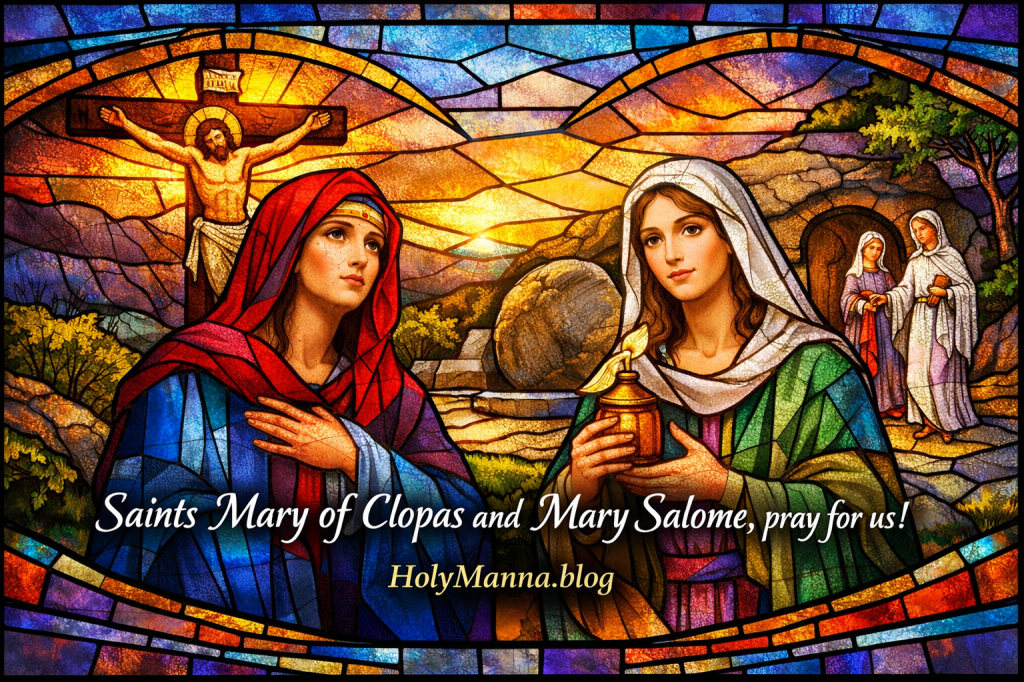
The Women Who Stayed When Others Fled
Some saints are remembered for preaching to crowds, governing kingdoms, or leaving behind pages of spiritual wisdom. Saints Mary of Clopas and Mary Salome are remembered for something quieter, and in many ways, something even more piercing. They stayed.
These holy women appear in the Gospel accounts of the Passion and Resurrection as faithful disciples who remained close to Jesus when the cost of love became painfully clear. They stood near the Cross. They watched the burial. They went to the tomb. In a world that often admires noise, ambition, and visibility, these saints are honored by the Church for steadfastness, courage, and fidelity.
That is why they matter so much in Christian tradition. They were not spectators drifting at the edges of salvation history. They were witnesses. They belonged to that group of holy women whose love for Christ remained steady in the darkest hour. The Catechism teaches that the women who came to the tomb were among the first to encounter the mystery of the Resurrection and to carry its message to the apostles, CCC 641. That gives Mary of Clopas and Mary Salome a place of astonishing dignity in the life of the Church.
They are revered because they show what faithful love looks like when everything seems lost.
At the Foot of the Cross
The most certain things known about these saints come from Sacred Scripture.
Mary of Clopas is named in The Gospel of John among the women standing by the Cross of Jesus. Tradition commonly identifies her with the Mary described elsewhere as the mother of James the Less and Joses, and likely also with “the other Mary” who appears in the Passion and Resurrection narratives. That means she is remembered not simply as a passing figure in the crowd, but as one of the women who remained close to Christ in His suffering and who continued to keep watch even after His death.
Mary Salome is named in The Gospel of Mark among the women present at the Crucifixion and again among the women who brought spices to the tomb. Catholic tradition has long held that she is most probably the same woman identified in The Gospel of Matthew as the mother of the sons of Zebedee, which would make her the mother of Saints James the Greater and John the Evangelist. If that identification is correct, then Mary Salome was not only a disciple of Christ, but also the mother of two apostles who would help shape the early Church.
That alone is enough to make these saints memorable. But what makes them truly luminous is not merely who they knew or where they stood. It is why they remained. They loved Jesus.
Roots, Family, and the Hidden Life of Faith
The early life of both saints is mostly hidden from history, and that hiddenness itself is part of their witness.
Mary of Clopas is known to Catholic tradition as the wife of Clopas. Some ancient Christian traditions hold that Clopas was related to Saint Joseph, which would make Mary of Clopas a close relative of the Holy Family. This has often been used to explain why James the Less and others are called the “brothers” of the Lord in Scripture, not as children of the Blessed Virgin Mary, but as close relatives in the broader family sense common in the ancient world. The Church has preserved this tradition with reverence, though not every detail can be established with complete historical certainty.
Mary Salome is remembered most probably as the mother of James and John, the sons of Zebedee. That places her inside one of the most remarkable families in the New Testament. Imagine that household. Two sons leave nets and boats behind to follow Christ. One becomes the first apostle to be martyred. The other becomes the beloved disciple, the evangelist, and the seer of The Book of Revelation. Their mother appears not as a distant background figure, but as a woman drawn into the mystery of Christ’s life, suffering, and rising.
In both cases, these women seem to have deepened in faith not through public conversion stories, but through discipleship. They followed. They served. They remained near Jesus. Their holiness did not begin in spectacle. It grew in proximity to Christ.
Mary Salome may also be connected to one of the most human scenes in the Gospels. If she is indeed the mother of the sons of Zebedee, then she is the woman who asked Jesus, “Command that these two sons of mine sit, one at your right and the other at your left, in your kingdom” Mt 20:21. That moment is almost disarming in its honesty. It reveals a mother who still thinks in earthly terms, yet who will later stand near the Cross and walk toward the tomb. Her story shows that discipleship matures. Christ purifies love. What begins in natural ambition can be transformed into sacrificial fidelity.
No verified saying of Mary of Clopas has been preserved in Scripture.
Their Life, Their Witness, and the Miracle of Fidelity
These saints are not remembered because they worked public miracles in the way some later saints did. No verified miracle performed by Mary of Clopas or Mary Salome during their earthly lives is recorded in the Gospels. That is important to say plainly, because their greatness does not depend on dramatic wonders.
Their greatness is the miracle of fidelity.
They followed Christ during His public ministry. They remained part of the circle of holy women who ministered to Him. They endured the scandal of the Cross. They watched when others ran. They came to the tomb not with triumph, but with spices. They came expecting death and encountered the first light of Easter.
That kind of faith deserves to be remembered because it is the kind of faith most Christians are actually called to live. Most believers will never preach from a pulpit to thousands. Most will not found religious orders or write theological masterpieces. But every Christian is called to remain with Christ in sorrow, confusion, waiting, and love.
Mary of Clopas and Mary Salome show that steadfast discipleship is not second-tier holiness. It is real sanctity.
Sorrow, Courage, and the Cost of Staying Near Jesus
These saints were not martyrs in the formal sense preserved by the Church, and no certain account of martyrdom is attached to either of them in the strongest sources. Still, their lives were marked by a profound form of suffering.
They witnessed the Passion.
That sentence can be read too quickly. They saw the betrayal, the violence, the humiliation, the wounds, the blood, and the apparent collapse of every hope. They stood near the place where the Son of God was crucified. They lived through the terror of being associated publicly with a condemned man. They entered the grief of Holy Saturday. They walked toward the sealed tomb under the weight of loss.
The Church should never treat this lightly. Their hardship was real. Their trial was not abstract. These women had the courage to remain near Jesus when such closeness could bring danger, suspicion, public shame, and heartbreak.
This is why their witness cuts so deeply into the Christian soul. They loved Christ not only when He healed the sick and multiplied loaves. They loved Him when He was mocked, rejected, and slain.
After Death, Tradition, Relics, and Lasting Devotion
The legacy of these saints after death unfolds through liturgy, devotion, and local tradition.
The Church remembers both Saints Mary of Clopas and Mary Salome in the Roman Martyrology on April 24. Their names remain joined to the memory of the Passion and the empty tomb. This liturgical remembrance matters because the Church is not merely preserving historical trivia. She is honoring witnesses whose lives illuminate the mystery of Christ.
For Mary of Clopas, later traditions say that she may have traveled as a missionary after the Resurrection. Some traditions place her in Spain, even associating her with Ciudad Rodrigo. Other traditions place her in France alongside figures such as Lazarus and his sisters. These stories have been handed down in Catholic memory, but they cannot be verified with certainty. Even so, they show how deeply Christians across generations desired to remain close to those who had remained close to Christ.
Mary Salome developed a particularly notable local devotion in Veroli, Italy, where she is honored as patroness. Her relics are venerated there, and the city has long celebrated her with liturgical feasts, processions, and public devotion. There is also a tradition concerning the rediscovery of her relics after the collapse of the basilica in the earthquake of 1349. This tradition forms part of her enduring local veneration. The rediscovery itself belongs to the history of devotion and cannot establish every ancient detail with certainty, but it has had lasting cultural and spiritual importance.
As for posthumous miracles, the major Roman Catholic sources do not preserve a large catalog of well-attested miracle stories for either saint in the way that later medieval or modern saints often have. Their impact after death has come less through a long list of documented wonders and more through liturgical memory, intercession, local devotion, relic veneration, and the spiritual force of their Gospel witness. Where later traditions or local claims exist, they deserve respect, but they cannot always be historically verified.
That does not lessen their importance. It actually highlights something beautiful. These saints do not need layers of legend to matter. The Gospel itself is enough to make them unforgettable.
What These Saints Teach the Church Today
There is something deeply consoling about Saints Mary of Clopas and Mary Salome.
They remind the Church that holiness is often quiet. It is often hidden. It is often measured not by outward success, but by whether a soul remains near Jesus when nothing seems to make sense.
These women teach Christians how to stand at the Cross without turning away. They teach patience in grief. They teach loyalty when faith feels costly. They teach the kind of love that keeps showing up.
Their example matters in everyday life. It matters for the mother praying for her children. It matters for the man trying to stay faithful in a culture that mocks conviction. It matters for the person who feels unseen in the Church, or worn down by suffering, or confused by God’s silence. These saints say, with their lives, that staying near Jesus is never wasted.
Where in life is Christ asking for greater fidelity right now?
Is love for Jesus strong enough to remain close to Him even in suffering, confusion, or disappointment?
Their lives suggest practical lessons that still speak clearly. Remain faithful to Sunday Mass. Stay close to the sacraments. Do not run from the Crosses permitted by God. Pray for the grace to persevere when feelings disappear. Love Christ not only when He seems consoling, but also when He seems hidden.
That is the road these women walked. That is why the Church still honors them.
Engage With Us!
Share your thoughts and reflections in the comments below. These holy women often do their work quietly in the heart, and that makes their witness worth pondering slowly.
- What stands out most about the faithfulness of Saints Mary of Clopas and Mary Salome?
- Have there been moments in life when staying close to Jesus felt costly or difficult?
- What does their presence at the Cross teach about courage, love, and perseverance?
- How can greater faithfulness be lived out this week in prayer, family life, work, or suffering?
- Which is harder in this season of life: standing with Christ in sorrow, or trusting Him while waiting for resurrection light?
May the witness of Saints Mary of Clopas and Mary Salome strengthen every heart to remain near Jesus, to walk with Him through suffering, and to live each day with the love, mercy, and steadfast faith He taught.
Saints Mary of Clopas and Mary Salome, pray for us!
Follow us on YouTube, Instagram and Facebook for more insights and reflections on living a faith-filled life.

 Holy Manna!
Leave a comment