Faithful Unto Blood
Saint Fidelis of Sigmaringen stands in Christian memory as a priest, missionary, martyr, and fearless witness to the Catholic faith. He was born Mark Rey in Sigmaringen, trained as a lawyer, became known for defending the poor, and then walked away from a successful career because he could no longer tolerate the corruption he saw around him. He entered the Capuchin Franciscans, took the name Fidelis, which means faithful, and lived that name all the way to his death.
The Church reveres him because he did not love comfort more than truth. He preached Christ with courage, served the poor with tenderness, and embraced hardship without bitterness. In an age torn by religious division, he gave himself completely to the work of calling souls back to the fullness of the Catholic faith. His life reminds the faithful that holiness is not only found in quiet cloisters or peaceful homes. Sometimes holiness walks straight into danger with a crucifix in hand and the name of Jesus on its lips.
Saint Fidelis is especially remembered as the poor man’s lawyer, a zealous Capuchin missionary, and a martyr who refused to betray the faith. His witness reflects what The Catechism teaches about martyrdom, that martyrdom is the supreme witness given to the truth of the faith and means bearing witness even unto death, CCC 2473.
From Mark Rey to Father Fidelis
Saint Fidelis was born in Sigmaringen in Germany in 1577, though some older accounts give 1578. His father, Johann Rey, served as burgomaster of the town, and Catholic tradition remembers his family as rooted in the Catholic faith. He grew up in a household shaped by discipline, learning, and religion, and from an early age he showed strong intellectual gifts.
He studied philosophy and then civil and canon law at Freiburg. He was bright, cultured, and well educated. Some Catholic accounts also note that he loved music, knew multiple languages, and traveled through Europe while serving as tutor and guide to noble students. Even in those years, he did not live like a worldly man chasing pleasure. He visited churches, prayed deeply, helped the poor, and treated his travels almost like a pilgrimage.
After completing his studies, he earned distinction in law. Yet his legal career did not make him proud. It made him sorrowful. He saw dishonesty, greed, and manipulation in the courts. Rather than joining that corruption, he became known for defending those who could not defend themselves. That is why history remembers him as the poor man’s lawyer. Still, even this was not enough for the heart God was shaping.
He left the legal profession, was ordained a priest, and entered the Capuchin Franciscans in 1612. There he received the name Fidelis. The name was not decorative. It became the pattern of his whole life. He embraced prayer, penance, poverty, and obedience with seriousness and joy. He fasted, kept custody of the tongue, avoided gossip, loved silence, and lived like a man who truly believed eternity was real.
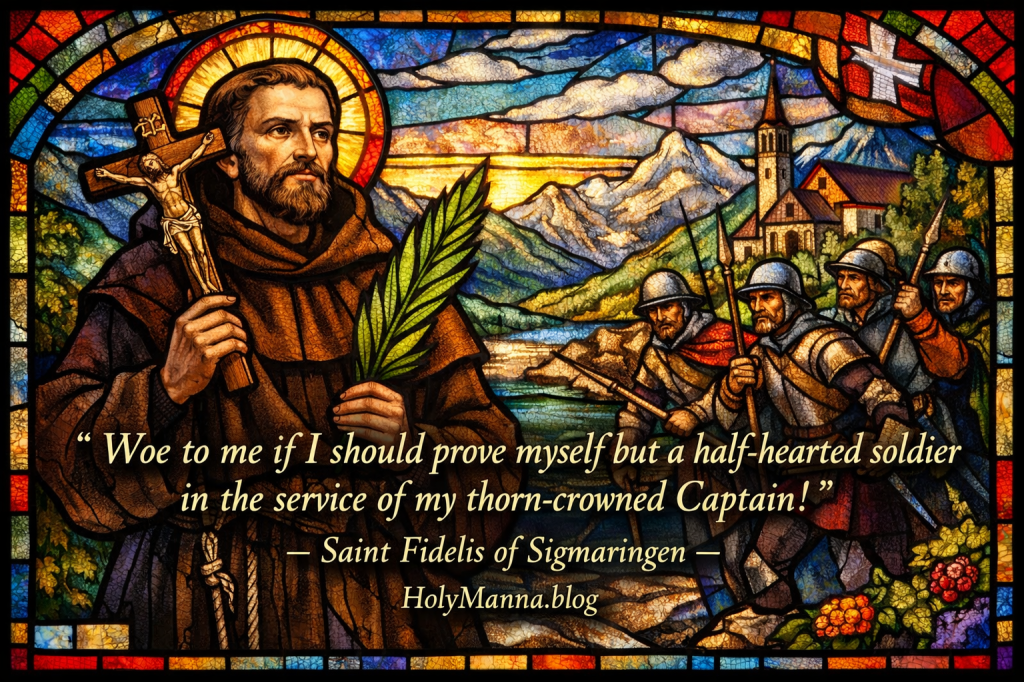
One of the sayings traditionally attributed to him reveals the fire of his soul: “Woe to me if I should prove myself but a half-hearted soldier in the service of my thorn-crowned Captain!” That line tells the whole story. Saint Fidelis did not want to belong to Christ halfway.
A Preacher of Truth and a Father to the Poor
As a Capuchin priest, Saint Fidelis became known for powerful preaching, spiritual discipline, and deep compassion. He served in different friaries, preached missions, heard confessions, and guided souls with clarity and seriousness. He was not soft about doctrine, but neither was he cold. He cared deeply for ordinary people, especially the poor, the sick, and those who had been led away from the faith.
He served courageously during times of disease and unrest. Catholic accounts remember him caring for sick soldiers during an epidemic, attending not only to their bodily suffering but also to their souls. Some traditions speak of remarkable recoveries and conversions connected to his ministry among the sick, though the surviving historical record does not preserve enough detail to verify each individual story with certainty. What can be said with confidence is that his charity made a deep impression and that many saw in him a priest who truly loved as Christ loves.
He also wrote spiritual reflections and prayers, later gathered under the title Exercitia spiritualia seraphicae devotionis. This matters because it shows that his preaching was not mere argument. It came from contemplation. He was a man of interior life. He was not simply trying to win debates. He was trying to save souls.
Saint Fidelis is important because he shows that truth and charity belong together. In a culture that often tries to separate the two, his life says otherwise. He preached the truth because he loved people. He embraced sacrifice because he loved Christ. He served the poor because he saw in them the face of the Lord. That kind of witness still matters. The Catechism teaches that charity is the form of all the virtues, CCC 1827. In Saint Fidelis, doctrine and charity moved together.
Signs of Grace in His Lifetime
The surviving Catholic sources do not present Saint Fidelis as a wonderworker in the same way they describe saints like Saint Padre Pio or Saint Martin de Porres. Instead, they emphasize the miracle of conversion, perseverance, and pastoral fruitfulness. That is important, because the Church has always understood that grace often works quietly in the turning of a soul back to God.
During his missionary work in the Grisons and Prättigau region of present-day Switzerland, he preached in places deeply marked by religious conflict. Catholic sources say that several people returned to the Church through his preaching, including notable figures from influential families. These conversions were not small matters. In a divided land, a return to the Catholic faith could cost a person status, relationships, and security. Yet his preaching, marked by zeal and conviction, moved hearts.
Another striking element of his life was his unusual peace in the face of danger. He seems to have sensed that martyrdom was approaching. He had long prayed for perseverance and for the grace to die for the faith if God willed it. That spiritual readiness itself is a kind of miracle of grace. There is nothing natural about a man walking toward likely death without panic, resentment, or compromise.
His ministry among the sick, his power in preaching, and the conversions associated with his work all form part of the living Catholic memory of his holiness. Still, honesty matters. The historical sources do not preserve a long list of individually documented miracles during his lifetime in the way later canonization records sometimes do. His greatness lies less in spectacular public wonders and more in heroic fidelity, sacrificial charity, and the spiritual fruit that followed his ministry.
The Road to Martyrdom
The mission that led to Saint Fidelis’s death took place in a dangerous and deeply divided region. He was sent as a missionary to strengthen Catholics and call others back to the Church in an area where Calvinist and Zwinglian influences had become strong. The political situation was tense, and religion was tied to regional conflict, suspicion, and violence.
Saint Fidelis did not enter that mission naively. He understood the risks. Yet he went anyway, carrying little, living simply, preaching often, and trusting God completely. Catholic tradition remembers him as the first martyr of the Congregation for the Propagation of the Faith, which later became widely known as Propaganda Fide. In other words, he belongs to the Church’s missionary history in a special way.
On April 24, 1622, after preaching at Seewis, he was confronted by armed opponents who demanded that he renounce the Catholic faith. Instead of saving himself by compromise, he remained firm. One of the most famous statements attributed to him in this final confrontation is “I came to extirpate heresy, not to embrace it.” Another tradition preserves his conviction in simpler form, that he had come to bring others to the Catholic faith, not to abandon it himself.
He was struck, surrounded, and brutally attacked. Catholic tradition says that after being wounded he fell to his knees and cried out, “Jesus, Mary. O God, come to my aid!” Another tradition preserves his prayer of mercy for those killing him: “Pardon my enemies, O Lord.” Then he was beaten to death.
His martyrdom matters because it was not the death of a reckless fanatic. It was the death of a priest who had already spent himself in prayer, charity, preaching, and service. The final blow only made visible what had been true for years. His life already belonged entirely to Christ.
Wonders, Relics, and the Saint’s Legacy After Death
After his death, devotion to Saint Fidelis grew steadily. Catholic tradition holds that six months after his martyrdom, his body was found incorrupt. Accounts differ on certain details surrounding the distribution of his relics, but Catholic memory consistently links his relics with Feldkirch and Chur. His head and other relics became objects of veneration, and the faithful came to see in them a sign that God had glorified His servant.
Tradition also reports that many miracles were attributed to his intercession after death. Older Catholic accounts say that as many as 305 miracles were submitted in connection with his cause, with several being recognized in the process leading to his beatification. Stories of healings, divine favors, and answered prayers circulated widely among the faithful. These reports belong to the saint’s devotional legacy. Many were accepted within the tradition surrounding his cause, though not every individual story can now be independently verified in a modern historical sense.
Another important tradition says that one of the men involved in his martyrdom, or closely connected to it, later repented and returned to the Catholic faith. That kind of conversion has always struck the Christian imagination deeply. The blood of martyrs has often softened the hearts of their persecutors. This particular story is part of the Catholic tradition around Saint Fidelis, though the exact details are not fully verifiable from the surviving records.
His impact after death was not limited to private devotion. He was beatified in 1729 and canonized in 1746. His feast is celebrated on April 24. He remains especially beloved among the Capuchins and in his hometown of Sigmaringen, where local Catholic devotion continues through annual celebrations such as the Fidelisfest. In some local customs, children are entrusted to his intercession in a special way. He is also honored as patron of lawyers and is associated with steadfast Catholic witness in times of confusion and conflict.
Culturally, Saint Fidelis remains a powerful figure because he forces a serious question. What does fidelity actually cost? In an age that often treats belief as a private preference, his life reminds the faithful that the truth of Christ is worth more than position, comfort, and even life itself.
What Saint Fidelis Teaches the Church Today
Saint Fidelis speaks clearly to modern Catholics. He teaches that success in the world means very little if the soul is being trained to compromise. He teaches that intelligence should serve truth, not vanity. He teaches that courage is not loudness, but steadiness. He teaches that charity is not weakness, and conviction is not cruelty.
His life also offers a needed lesson about integrity. He did not change careers because law was beneath him. He changed because he wanted holiness more than status. That kind of decision cuts against modern instincts. The world says to keep climbing, keep earning, keep building a name. Saint Fidelis says that a man must first ask whether he is becoming faithful.
There is also a lesson here about evangelization. He did not reduce the faith to vague kindness. He preached clearly. He loved deeply. He called people to conversion. That remains the Church’s mission. The Catechism teaches that the Church is missionary by her very nature because she is sent by Christ to all peoples, CCC 849. Saint Fidelis lived that mission with total seriousness.
For daily life, his example can be practiced in simple ways. Speak truth without cruelty. Refuse dishonest gain. Defend the vulnerable. Pray before making major decisions. Stay close to the sacraments. Love Christ enough that compromise begins to lose its appeal. What would change if fidelity, not comfort, became the measure of a Christian life? Where has fear been allowed to speak louder than conviction? What would it look like to serve Jesus as more than a half-hearted soldier?
Saint Fidelis did not become a saint by chasing extraordinary experiences. He became a saint by being faithful in study, faithful in work, faithful in prayer, faithful in poverty, faithful in mission, and finally faithful in death.
Engage with Us!
Readers are invited to share their thoughts and reflections in the comments below. Saint Fidelis of Sigmaringen has a way of stirring the conscience, especially for anyone trying to live faithfully in a confused world.
- What part of Saint Fidelis’s story stands out most strongly, his honesty as a lawyer, his missionary courage, or his martyrdom?
- Have there been moments when staying faithful to Christ felt costly or uncomfortable? What helped perseverance in those moments?
- How can Saint Fidelis’s example inspire greater courage in defending truth with both charity and conviction?
- What does being a “half-hearted soldier” for Christ look like today, and how can that be resisted?
- In what practical way can greater fidelity be lived this week at home, at work, or in prayer?
May the witness of Saint Fidelis of Sigmaringen strengthen every heart to live with courage, speak with truth, and love with mercy. May his prayers help the faithful remain steady in Christ and do everything with the love and mercy Jesus taught us.

 Holy Manna!
Leave a comment