Friday of the Third Week of Easter – Lectionary: 277
When Christ Stops a Man, Feeds a People, and Sends the World
There are days in the liturgy when the readings seem to rise like steps, each one lifting the heart a little higher until the whole picture comes into view. Today is one of those days. The Church places before us a persecutor struck down on the road to Damascus, a psalm that calls every nation to praise, and the hard, holy words of Jesus in The Gospel of John, where he declares, “Whoever eats my flesh and drinks my blood has eternal life”. Taken together, these readings reveal one central theme: the risen Christ gives divine life to the world by converting the sinner, feeding the faithful, and drawing all nations into communion with himself.
This is Easter faith in its full Catholic brightness. The risen Jesus is not a memory from the past or a private comfort for the devout. He is alive, reigning, acting, calling, healing, and feeding his people now. In Acts 9:1-20, Saul is not slowly talked into a new opinion. He is confronted by the living Christ, humbled, blinded, led like a child, and then restored through the ministry of the Church. The man who came to bind Christians in chains is himself bound by grace. His story shows that no sinner is beyond the reach of mercy, and no life is too far gone for Christ to claim it. The same Lord who stops Saul also sends Ananias, reminding the reader that conversion is never just an individual moment. It is deeply personal, but it always leads into the life of the Church.
That is why the Gospel fits so perfectly beside the first reading. Jesus does not only want admirers. He wants communion. In the synagogue at Capernaum, speaking to a crowd that struggles to understand him, he does not soften his words or retreat into vague symbolism. He says, “For my flesh is true food, and my blood is true drink”. The Church has always heard these words with reverence and realism. The One who changed Saul’s life is the same One who gives himself as heavenly food. Baptism begins the new life of grace, and the Eucharist sustains it. One sacrament opens the eyes. The other nourishes the soul. One brings a man out of darkness. The other teaches him how to remain in Christ.
Then the liturgy widens the horizon with Psalm 117, one of the shortest psalms and yet one of the broadest in vision: “Praise the Lord, all you nations! Extol him, all you peoples!” That little psalm sounds almost like a bell ringing through the whole world. It reminds the reader that today’s readings are not only about Saul, or Ananias, or one puzzled crowd in Capernaum. They are about the plan of God for all peoples. The mercy shown to Saul is meant for the nations. The Bread come down from heaven is meant for the life of the world. Even in these early Easter readings, the Church is already looking outward, beyond Jerusalem, beyond Damascus, beyond Israel, toward every land where Christ will be preached, adored, and received.
There is also an important historical texture holding these readings together. The Church is still young in Acts, still fragile in the eyes of the world, and yet already bearing the power of the Resurrection. The synagogue setting in John 6 matters too, because Jesus is speaking to a people formed by the memory of manna in the wilderness, Passover sacrifice, and covenant worship. He is not abolishing what came before. He is bringing it to fulfillment. The manna was real, but temporary. The Passover lamb was holy, but preparatory. Now the true Bread from heaven stands before them. Now the Lamb of God gives not merely a sign, but himself.
So the Church invites the faithful to enter these readings with wonder. Christ still stops the proud. Christ still heals the blind. Christ still feeds his people with divine life. Christ still sends his Church into the world. And beneath all of it runs one beautiful truth: the Lord does not save from a distance. He comes close enough to call by name, to touch wounded eyes, and to give his very Flesh and Blood so that his people may live forever.
First Reading – Acts 9:1-20
The persecutor falls, the disciple rises, and the Church watches grace rewrite a life
The first reading opens like the beginning of a storm. Saul is not wandering in confusion or laziness. He is moving with purpose, conviction, and fury. The Church in Acts is still young, fragile, and visibly exposed to persecution. The followers of Jesus are still known as those who belong to the Way, a title that reflects not merely a set of beliefs, but an entire manner of life shaped by the risen Lord. Saul sees this new movement as a threat to the faith of Israel. He believes he is defending God, even while resisting the work of God standing right in front of him.
That is what makes this passage so powerful. This is not merely the story of a bad man becoming a better man. This is the story of the risen Jesus revealing that no human zeal, no religious pride, and no hardened past can stand against divine mercy. The passage fits perfectly into today’s theme because it shows the first great movement of grace. Christ stops a man in his blindness, brings him into the life of the Church, and prepares him to carry the Gospel to the nations. The same Lord who will speak in The Gospel of John about giving his flesh as food for the life of the world first takes hold of Saul and gives him a new life altogether. Before the disciple can be fed, he must be converted. Before he can preach, he must be humbled. Before he can become an apostle, he must learn to be led.
Acts 9:1-20 – New American Bible (Revised Edition)
Saul’s Conversion. 1 Now Saul, still breathing murderous threats against the disciples of the Lord, went to the high priest 2 and asked him for letters to the synagogues in Damascus, that, if he should find any men or women who belonged to the Way, he might bring them back to Jerusalem in chains. 3 On his journey, as he was nearing Damascus, a light from the sky suddenly flashed around him. 4 He fell to the ground and heard a voice saying to him, “Saul, Saul, why are you persecuting me?” 5 He said, “Who are you, sir?” The reply came, “I am Jesus, whom you are persecuting. 6 Now get up and go into the city and you will be told what you must do.” 7 The men who were traveling with him stood speechless, for they heard the voice but could see no one. 8 Saul got up from the ground, but when he opened his eyes he could see nothing; so they led him by the hand and brought him to Damascus. 9 For three days he was unable to see, and he neither ate nor drank.
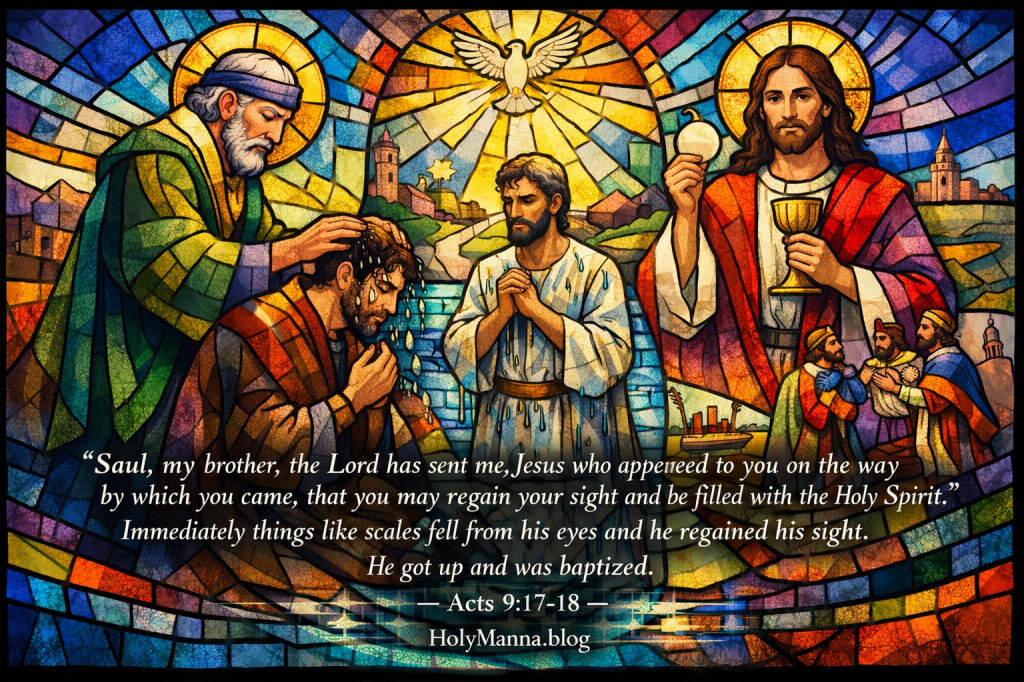
Saul’s Baptism. 10 There was a disciple in Damascus named Ananias, and the Lord said to him in a vision, “Ananias.” He answered, “Here I am, Lord.” 11 The Lord said to him, “Get up and go to the street called Straight and ask at the house of Judas for a man from Tarsus named Saul. He is there praying, 12 and [in a vision] he has seen a man named Ananias come in and lay [his] hands on him, that he may regain his sight.” 13 But Ananias replied, “Lord, I have heard from many sources about this man, what evil things he has done to your holy ones in Jerusalem. 14 And here he has authority from the chief priests to imprison all who call upon your name.” 15 But the Lord said to him, “Go, for this man is a chosen instrument of mine to carry my name before Gentiles, kings, and Israelites, 16 and I will show him what he will have to suffer for my name.” 17 So Ananias went and entered the house; laying his hands on him, he said, “Saul, my brother, the Lord has sent me, Jesus who appeared to you on the way by which you came, that you may regain your sight and be filled with the holy Spirit.” 18 Immediately things like scales fell from his eyes and he regained his sight. He got up and was baptized, 19 and when he had eaten, he recovered his strength.
Saul Preaches in Damascus. He stayed some days with the disciples in Damascus, 20 and he began at once to proclaim Jesus in the synagogues, that he is the Son of God.
Detailed Exegesis
Verse 1. “Now Saul, still breathing murderous threats against the disciples of the Lord, went to the high priest”
The verse begins with violence already alive in Saul’s heart. The image is striking. He is not simply speaking threats. He is breathing them. Hatred has become his atmosphere. Saul is introduced as a man whose zeal has been twisted by blindness. This is a warning to every age. Religious passion, when cut off from humility and obedience to God’s actual work, can become destructive rather than holy.
Verse 2. “and asked him for letters to the synagogues in Damascus, that, if he should find any men or women who belonged to the Way, he might bring them back to Jerusalem in chains.”
Saul’s persecution is organized, legal, and deliberate. Damascus lies outside Jerusalem, which shows how far Saul is willing to go to stamp out the Church. The mention of both men and women reminds the reader that the Gospel had already reached whole households and that persecution did not spare anyone. The title the Way is deeply meaningful. Christianity is not presented as an abstract philosophy. It is a path, a pilgrimage, a life lived in Christ.
Verse 3. “On his journey, as he was nearing Damascus, a light from the sky suddenly flashed around him.”
The light comes from heaven, which makes clear that this is not an interior feeling or a passing emotion. God acts. The initiative belongs entirely to Christ. Saul is not seeking Jesus. Jesus seeks Saul. In Catholic theology, grace always comes first. Conversion begins because God moves toward the sinner before the sinner fully knows how to move toward God.
Verse 4. “He fell to the ground and heard a voice saying to him, ‘Saul, Saul, why are you persecuting me?’”
Saul falls because no sinner stands upright before the unveiled holiness of God. Yet the heart of the verse is the question of Jesus. Christ does not say, “Why are you persecuting my followers?” He says, “Why are you persecuting me?” This reveals the deep union between Christ and his Church. To wound the Church is to wound Christ himself. This verse stands behind the Church’s understanding that the faithful truly belong to Christ as members of his Body.
Verse 5. “He said, ‘Who are you, sir?’ The reply came, ‘I am Jesus, whom you are persecuting.’”
Saul knows he is in the presence of overwhelming authority, but he does not yet understand who is speaking. Then comes the revelation. The crucified Jesus, whom Saul would have regarded as a failed messianic claimant, is alive. Everything changes in this moment. The resurrection is no longer a claim made by Christians. It is a living encounter. Saul’s whole world begins to collapse so that a truer world can be built in its place.
Verse 6. “Now get up and go into the city and you will be told what you must do.”
Christ reveals himself, but he does not give Saul every detail at once. Obedience begins with the next step. That is often how grace works. God does not usually unfold the whole road at once. He asks for surrender first. Saul, who came to bind others, must now obey a command he does not control. His conversion begins with submission.
Verse 7. “The men who were traveling with him stood speechless, for they heard the voice but could see no one.”
The companions confirm that something objective has happened. Saul is not inventing the event. At the same time, the encounter is given to Saul in a uniquely personal way. Conversion often has this double character. God acts publicly enough that the truth can be witnessed, but personally enough that the soul knows it has been addressed by name.
Verse 8. “Saul got up from the ground, but when he opened his eyes he could see nothing; so they led him by the hand and brought him to Damascus.”
The man who came as a powerful pursuer enters Damascus helpless. His physical blindness reveals his spiritual condition. For all his learning and zeal, Saul has not truly seen. Now he must be led by the hand like a child. Pride begins to die here. Grace often strips away false strength before giving true strength.
Verse 9. “For three days he was unable to see, and he neither ate nor drank.”
The three days echo the pattern of death and rising. Saul enters a kind of tomb of blindness, fasting, and helpless waiting. This is not merely punishment. It is purification. He must pass through darkness before receiving sight. The Church has always seen in this a pattern of conversion, where old certainties die so that the truth of Christ may be born in the soul.
Verse 10. “There was a disciple in Damascus named Ananias, and the Lord said to him in a vision, ‘Ananias.’ He answered, ‘Here I am, Lord.’”
The scene now shifts from Saul’s collapse to Ananias’s obedience. The response “Here I am, Lord” echoes the language of biblical vocation. God often advances his saving plan through ordinary, faithful disciples whose names are scarcely known outside one passage. Ananias is not famous like Peter or Paul, but he becomes essential to the story because he is available.
Verse 11. “The Lord said to him, ‘Get up and go to the street called Straight and ask at the house of Judas for a man from Tarsus named Saul. He is there praying’”
The detail of place grounds the story in real history. This is not a vague legend. It unfolds in houses, streets, and named persons. Saul, who came to hunt Christians, is now found praying. Grace has already begun its hidden work. Before Ananias ever arrives, Christ has already broken open Saul’s heart.
Verse 12. “and [in a vision] he has seen a man named Ananias come in and lay [his] hands on him, that he may regain his sight.”
The Lord prepares both men. Saul is given hope, and Ananias is given a mission. The laying on of hands is significant. In biblical and Catholic life, God often uses bodily signs to communicate spiritual grace. The faith is not purely internal. God touches souls through visible means, which prepares the reader for Saul’s Baptism a few verses later.
Verse 13. “But Ananias replied, ‘Lord, I have heard from many sources about this man, what evil things he has done to your holy ones in Jerusalem.’”
Ananias answers with honesty. His fear is not faithlessness. It is realism. Saul has done terrible harm. This verse honors the wounds of the Church. Christian mercy is never sentimental. It does not pretend evil was small. Ananias knows the danger and still brings it before the Lord.
Verse 14. “And here he has authority from the chief priests to imprison all who call upon your name.”
Saul’s threat is not rumor. It carries official backing. The early Christians are already marked by public invocation of the name of Jesus, which shows how central faith in Christ was from the beginning. To call upon the name of Jesus is an act of worship, trust, and identity. This is exactly what Saul has been trying to crush.
Verse 15. “But the Lord said to him, ‘Go, for this man is a chosen instrument of mine to carry my name before Gentiles, kings, and Israelites,’”
What a sentence this is. Saul is not merely forgiven. He is chosen. Christ does not only erase the past. He consecrates the future. The phrase chosen instrument shows that grace does not destroy personality, learning, or human strength, but redirects them toward divine purpose. Saul’s education, intensity, and courage will not disappear. They will be transformed and placed in service to Christ.
Verse 16. “and I will show him what he will have to suffer for my name.”
The call of Saul is glorious, but it is not comfortable. Christian vocation always includes the Cross. Saul once caused suffering. Now he will share in Christ’s suffering. This is not revenge. It is communion. The persecutor is being shaped into a witness whose life will bear the marks of the Lord he once opposed.
Verse 17. “So Ananias went and entered the house; laying his hands on him, he said, ‘Saul, my brother, the Lord has sent me, Jesus who appeared to you on the way by which you came, that you may regain your sight and be filled with the holy Spirit.’”
The tenderness of “Saul, my brother” should not be missed. Before Saul has done anything to earn trust, the Church receives him in mercy. Ananias becomes the instrument through whom Christ restores sight and pours out the Spirit. This verse beautifully displays how Christ works through his Church. The personal encounter with Jesus leads directly into ecclesial communion.
Verse 18. “Immediately things like scales fell from his eyes and he regained his sight. He got up and was baptized,”
This is one of the most vivid sacramental moments in Acts. The falling scales symbolize the removal of spiritual blindness. Yet the verse does not stop with restored sight. Saul is baptized. The new life is not complete until he enters sacramentally into Christ. Baptism is not treated as an optional public statement. It is the decisive doorway into the new life of grace.
Verse 19. “and when he had eaten, he recovered his strength.”
After fasting and darkness comes nourishment and strength. There is a beautiful rhythm here. Grace heals the soul, and then the man is strengthened for mission. God does not convert Saul merely to leave him stunned and passive. The Lord restores him so that he may rise and serve.
Verse 20. “He stayed some days with the disciples in Damascus, and he began at once to proclaim Jesus in the synagogues, that he is the Son of God.”
The change is immediate and unmistakable. Saul does not return to his old mission with a slight adjustment. He now proclaims the very Jesus he had opposed. The content of his preaching matters: “that he is the Son of God.” This is not merely admiration for a teacher. It is a confession of Christ’s divine identity. Saul’s conversion becomes witness, and witness becomes mission.
Teachings
This reading stands at the center of several major Catholic truths: conversion, the mystery of the Church as the Body of Christ, Baptism as the beginning of new life, and mission flowing from grace. Saul’s encounter with Jesus shows that conversion is first the work of God. A man on the road to destroy the Church is interrupted by mercy before he ever imagines asking for it. The Catechism speaks with striking clarity in CCC 1427: “Jesus calls to conversion. This call is an essential part of the proclamation of the kingdom: ‘The time is fulfilled, and the kingdom of God is at hand; repent, and believe in the Gospel.’ In the Church’s preaching this call is addressed first to those who do not yet know Christ and his Gospel. Also, Baptism is the principal place for the first and fundamental conversion. It is by faith in the Good News and by Baptism that one renounces evil and gains salvation, that is, the forgiveness of all sins and the gift of new life.”
That paragraph feels as though it were written with Saul in mind. His blindness, prayer, healing, and Baptism all move in one direction. The old life is being renounced, and a new life is being given. That is why Baptism matters so much in this passage. Saul does not simply have a private spiritual awakening. He is baptized into Christ and into the Church. The Catechism says in CCC 1265: “Baptism not only purifies from all sins, but also makes the neophyte ‘a new creature,’ an adopted son of God, who has become a ‘partaker of the divine nature,’ member of Christ and coheir with him, and a temple of the Holy Spirit.” Saul is not merely corrected. He is recreated.
The words of Jesus, “Why are you persecuting me?” also reveal the Church’s deep union with Christ. Saul thought he was hunting believers. Jesus reveals that he was attacking the Lord’s own Body. This is one of the clearest biblical foundations for the Catholic understanding of the Church as truly united to Christ. St. John Chrysostom saw a profound lesson here. Christ, who could have healed Saul directly and instantly, chose to send him to Ananias. Grace is personal, but it is not isolated. Christ saves through the Church he has formed.
Historically, this moment also becomes one of the great turning points in salvation history after the Resurrection and Pentecost. Saul, later Paul, will become the great apostle to the Gentiles. The man once sent with letters from earthly authorities becomes the man sent with the Gospel of the risen King. The nations praised in Psalm 117 begin to appear on the horizon already in this reading. Saul’s conversion is not only the rescue of one soul. It is the preparation of a missionary whose preaching, suffering, and witness will help carry the name of Jesus across the ancient world.
There is another lesson here that Catholic tradition has never stopped repeating. God does not waste a life, even a broken one. Saul’s intelligence, discipline, learning, and courage were real gifts, but they had been bent in the wrong direction. Grace did not erase those gifts. Grace purified and redirected them. That is often how God works in the lives of the saints. The very strengths that once served pride, anger, ambition, or self-will can become powerful instruments of holiness once surrendered to Christ.
Reflection
This reading reaches straight into ordinary life because most conversions do not begin with a beam of light on a public road, but they do begin with the same Lord. Christ still stops people in the middle of plans they are certain about. He still exposes the places where zeal has become pride, where conviction has become hardness, and where religion has become self-righteousness. Saul’s story is a reminder that a person can be sincere and still be wrong. A person can be intense and still be blind. That is why humility matters so much in the spiritual life.
There is also real comfort here for anyone carrying regret. Saul had a past that could have crushed him if grace had not intervened. Yet Christ did not define him forever by his worst sins. Christ named him, claimed him, and gave him a mission. That same mercy still works in the Church. Confession, prayer, penance, and faithful reception of the sacraments are not empty habits. They are the places where scales still fall from the eyes.
Ananias offers another challenge. He had every human reason to stay away. Yet he obeyed. There are moments when the Christian life requires walking toward the very person who seems difficult, threatening, or undeserving. Mercy is rarely convenient. It asks for trust. It asks for courage. It asks the heart to believe that Christ can truly change a person.
A good way to live this reading is to begin with honesty before God. Name the blindness instead of defending it. Bring pride, resentment, old sin, and false certainty into prayer. Receive the grace of the Church instead of trying to manage everything alone. Stay close to the sacraments. Listen for the next command of the Lord, even if it is only one step at a time. Then, like Saul, begin to speak the name of Jesus without shame.
Where has certainty become pride instead of obedience?
What scales need to fall from the eyes before Christ can be seen more clearly?
Is there a part of life where the Lord is asking for surrender before giving full understanding?
Who might need the courage, mercy, and obedience of an Ananias today?
Responsorial Psalm – Psalm 117
The shortest psalm becomes a song wide enough for the whole world
There is something beautiful about how small this psalm is and how large its vision becomes. Psalm 117 is the shortest psalm in all of Sacred Scripture, yet it opens the doors of praise to every nation on earth. In the worship of Israel, the psalms were not decorative pieces added to prayer. They were the living poetry of covenant worship, sung in the Temple, prayed in pilgrimage, and carried in the memory of God’s people through generations. This little psalm would have sounded familiar to Jewish ears, but in the light of the Resurrection it begins to shine with even greater force. What once sounded like a summons to praise now reveals itself as a prophecy of the Gospel going out to the ends of the earth.
That is why the Church places this psalm between Saul’s conversion and Christ’s Eucharistic teaching in The Gospel of John. In the first reading, the Lord seizes a persecutor and prepares him to carry his name before Gentiles, kings, and Israelites. In the Gospel, Jesus speaks of giving his flesh as true food and his blood as true drink for the life of those who receive him. Then this psalm rises like a clear response from the Church: all nations are being called in. The mercy given to Saul is not for Saul alone. The Bread from heaven is not for one people alone. The faithfulness of the Lord is forever, and his saving plan is wider than anyone expected.
Psalm 117 – New American Bible (Revised Edition)
The Nations Called to Praise
1 Praise the Lord, all you nations!
Extol him, all you peoples!
2 His mercy for us is strong;
the faithfulness of the Lord is forever.
Hallelujah!
Detailed Exegesis
Verse 1. “Praise the Lord, all you nations! Extol him, all you peoples!”
The first verse bursts open immediately. There is no long introduction and no slow preparation. The nations are summoned at once. In the Old Testament world, the nations often stood outside the visible covenant life of Israel, yet here they are called not merely to observe the God of Israel from a distance, but to praise him. This is one of the clearest signs in the psalter that God’s saving purpose was always larger than one ethnic or national boundary.
The two lines deepen one another. “All you nations” and “all you peoples” press the point with emphasis. No corner of humanity is excluded from the invitation. In the light of Easter, the verse sounds almost like the first breath of the Church’s missionary age. Saul, the man in today’s first reading, will become Paul, the apostle who carries this exact vision into city after city. The verse also reminds the reader that praise is not an optional extra in the spiritual life. Praise is the proper response of creation to the God who saves.
Verse 2. “His mercy for us is strong; the faithfulness of the Lord is forever. Hallelujah!”
The second verse tells the reader why the nations are summoned. They are not called because Israel has discovered an interesting local tradition. They are called because the mercy of the Lord is strong and his faithfulness endures forever. The whole missionary movement of salvation rests on who God is. His mercy is not thin, hesitant, or temporary. It is strong. His faithfulness is not seasonal, fragile, or dependent on human worthiness. It is forever.
The word Hallelujah seals the whole psalm in joy. It is the cry of praise that belongs especially to Easter, when the Church sees with full clarity that God’s mercy has conquered sin and death in Christ. The verse also holds together two truths the Christian heart always needs. God is merciful, and God is faithful. He is tender toward sinners, and he remains utterly true to his promises. Saul’s conversion proves this. The nations being called into praise prove it. The Eucharist promised by Christ proves it again.
Teachings
This little psalm carries the Catholic vision of universality in a remarkably concentrated form. The Church is not an afterthought added onto God’s work with Israel. She is the flowering of God’s promise to gather the nations into communion with himself. The Catechism teaches this plainly in CCC 543: “All men are called to enter the kingdom. First announced to the children of Israel, this messianic kingdom is intended to accept men of all nations. To enter it, one must first accept Jesus’ word.” That truth is already singing inside Psalm 117. The nations are called, the peoples are summoned, and the Kingdom is opening outward.
The psalm also teaches something essential about prayer. Praise is not just one devotional style among many. It is one of the highest responses of the soul before God. The Catechism says in CCC 2639: “Praise is the form of prayer which recognizes most immediately that God is God. It lauds God for his own sake and gives him glory, quite beyond what he does, but simply because HE IS.” That fits this psalm beautifully. The nations are not first invited to ask for things. They are invited to praise. The proper beginning of mission is adoration.
There is also a deeply important apostolic connection here. Saint Paul himself takes up this psalm in Romans 15:11 as evidence that the inclusion of the Gentiles was always part of God’s saving design. He writes, “Praise the Lord, all you Gentiles, and let all the peoples praise him.” That makes today’s liturgy especially rich. The very man converted in the first reading becomes the apostle who later quotes this psalm to explain the worldwide reach of the Gospel. The persecutor becomes the preacher of the very promise hidden in Israel’s songbook.
Historically, this psalm would have belonged to the prayer life of Israel long before the Church carried it into Christian worship. Yet in the early Church it gained renewed force because Christians saw in it the prophetic outline of what was unfolding before their eyes. Gentiles were being baptized. Pagan lands were hearing the Gospel. Communities from many peoples were beginning to confess the God of Israel as Father, Son, and Holy Spirit. The psalm’s brevity only makes its reach more striking. A few lines become a doorway into the catholicity of the Church.
There is another lesson here worth keeping close. The psalm gives the reason for universal praise not in human achievement, but in divine character. The Church does not go out to the nations because Christians are impressive. She goes out because God is merciful and faithful. The strength of mission rests in the strength of God.
Reflection
This psalm is a needed medicine for a narrow heart. It reminds the soul that God’s mercy is never small, private, or tribal. He is always gathering more, calling more, drawing more. Sometimes the spiritual life can become enclosed. Faith can shrink into personal preference, familiar habits, and a quiet concern for one’s own interior world. Then a psalm like this comes along and opens the windows. The Lord wants praise from all peoples. The Lord wants mercy to reach farther than comfort zones. The Lord wants the heart to rejoice that others are being called in too.
It also challenges the way praise is lived. Many people are comfortable asking God for help, but less practiced in praising him simply because he is good. This psalm teaches the soul to begin there. Praise reorders the heart. It lifts the eyes away from fear, resentment, and self-absorption. It teaches trust by rehearsing who God is. His mercy is strong. His faithfulness is forever. That is the kind of truth a Christian needs not only at Mass, but also in traffic, in disappointment, in family tensions, in unanswered prayers, and in the quiet weariness of ordinary life.
A simple way to live this psalm is to make praise more intentional each day. Begin prayer by blessing God before asking him for anything. Thank him for his mercy before listing burdens. Pray for the conversion of nations, neighbors, and enemies, not only for personal concerns. Let the heart become wider, more missionary, and more joyful. This is especially fitting in Easter, when the Church sees the risen Christ gathering people from every background into one Body.
Does prayer begin with praise, or only with requests?
Is there real joy when others are drawn into the mercy of God, even when their past has been messy or unexpected?
Has the heart become too small for the worldwide love of Christ?
What would change if each day began with the truth that the Lord’s mercy is strong and his faithfulness is forever?
Holy Gospel – John 6:52-59
The Lord offers himself as the Bread of eternal life.
The Gospel today brings the reader into one of the most demanding and beautiful moments in all of The Gospel of John. Jesus is teaching in the synagogue at Capernaum, speaking to a people formed by the memory of manna in the wilderness, the Passover lamb, and the covenant God made with Israel. These are not strangers to sacred food, sacrifice, and divine provision. They know what it means for God to feed his people. They know what it means to remember salvation through liturgical worship. Yet when Jesus says that his flesh is true food and his blood is true drink, even they are shaken.
That reaction matters. In Jewish religious life, blood was not something to be consumed. The Law treated blood as belonging to life itself and therefore as sacred to God. So when Jesus speaks this way, he is not using casual language. He is pressing his listeners toward a mystery greater than manna, greater than the old covenant signs, and greater than anything they had imagined. He is preparing the way for the Eucharist, where the sacrifice of the Cross will be made sacramentally present and the faithful will receive not ordinary bread, but Christ himself.
This reading fits perfectly into today’s larger theme. In the first reading, Saul is converted and brought into the life of grace. In the psalm, all nations are summoned to praise the Lord. Here in the Gospel, Jesus reveals how that new life is sustained and how the nations will truly live in him. Christ does not merely forgive sinners and send them on mission. He feeds them with his own divine life. The same risen Lord who stopped Saul on the road now tells the whole Church how to remain in him and live forever.
John 6:52-59 – New American Bible (Revised Edition)
52 The Jews quarreled among themselves, saying, “How can this man give us [his] flesh to eat?” 53 Jesus said to them, “Amen, amen, I say to you, unless you eat the flesh of the Son of Man and drink his blood, you do not have life within you. 54 Whoever eats my flesh and drinks my blood has eternal life, and I will raise him on the last day. 55 For my flesh is true food, and my blood is true drink. 56 Whoever eats my flesh and drinks my blood remains in me and I in him. 57 Just as the living Father sent me and I have life because of the Father, so also the one who feeds on me will have life because of me. 58 This is the bread that came down from heaven. Unlike your ancestors who ate and still died, whoever eats this bread will live forever.” 59 These things he said while teaching in the synagogue in Capernaum.
Detailed Exegesis
Verse 52. “The Jews quarreled among themselves, saying, ‘How can this man give us [his] flesh to eat?’”
The crowd’s reaction is immediate and troubled. They are not confused because Jesus has been vague. They are disturbed because he has been too clear. The quarrel shows that they understand his words in a real and concrete sense, and they cannot reconcile what they hear with their expectations. This verse is important because it sets the stage for what follows. If Jesus had meant something purely symbolic, this would have been the moment to soften the claim. Instead, he goes further.
Verse 53. “Jesus said to them, ‘Amen, amen, I say to you, unless you eat the flesh of the Son of Man and drink his blood, you do not have life within you.’”
The double “Amen, amen” signals solemn truth. Jesus is not retreating from the scandal. He intensifies it. He does not present eating his flesh and drinking his blood as a helpful devotion for especially serious believers. He presents it as necessary for life. This is sacramental language filled with covenant depth. The life Jesus gives is not mere biological existence. It is divine life, participation in communion with God. Without him, there is no life that endures.
Verse 54. “Whoever eats my flesh and drinks my blood has eternal life, and I will raise him on the last day.”
Now the promise becomes even more personal. What was stated negatively in the previous verse is now stated positively. Eternal life is attached to communion with Christ, and resurrection is promised to the one who receives him. The Eucharist is therefore not a sentimental religious custom. It is bound up with salvation, abiding life, and the hope of bodily resurrection. Jesus ties the sacrament directly to the final destiny of the believer.
Verse 55. “For my flesh is true food, and my blood is true drink.”
This verse leaves little room for reduction. Jesus does not say his flesh is merely like food or that his blood is merely like drink. He says they are true food and true drink. In the Catholic understanding, this is one of the clearest foundations for faith in the Real Presence. Christ gives what no earthly bread can give. He nourishes the soul with divine life because what is received is not a symbol separated from him, but Christ himself.
Verse 56. “Whoever eats my flesh and drinks my blood remains in me and I in him.”
Here Jesus reveals the fruit of Eucharistic communion. The Eucharist is not only about reverence, memory, or obligation. It is about abiding. To receive Christ worthily is to dwell in him and to have him dwell in the soul. This is covenant intimacy at its highest. The one who receives the Eucharist is drawn into communion with the living Lord in a real and life-giving way.
Verse 57. “Just as the living Father sent me and I have life because of the Father, so also the one who feeds on me will have life because of me.”
Jesus now places the Eucharist inside the mystery of the Trinity and his own mission from the Father. His life is eternally from the Father, and the believer’s supernatural life is from him. The Eucharist is not magic and not spiritual self-help. It is participation in the life of the Son, who is eternally one with the Father. To feed on Christ is to receive life from the One sent by the living Father.
Verse 58. “This is the bread that came down from heaven. Unlike your ancestors who ate and still died, whoever eats this bread will live forever.”
Jesus contrasts himself with the manna in the wilderness. The manna was real, holy, and miraculous, but it did not conquer death. It sustained earthly life for a time. Christ, the true Bread from heaven, gives what the manna could only foreshadow. He gives a life death cannot finally destroy. This verse is the hinge between the old covenant sign and its fulfillment. The gift of God in the desert pointed toward the greater gift of God in the Eucharist.
Verse 59. “These things he said while teaching in the synagogue in Capernaum.”
John closes this section by locating the discourse in the synagogue. That detail matters because it places Jesus’ teaching squarely within the religious world of Israel. He is not speaking in a pagan marketplace or among people ignorant of Scripture. He is speaking in a place of worship, interpretation, and covenant memory. In that setting, Jesus reveals that he himself is the fulfillment of what Israel’s worship had long anticipated.
Teachings
This Gospel stands at the heart of Catholic Eucharistic faith. The Church has always heard these words with realism, awe, and obedience. Jesus does not offer merely an inspiring metaphor about spiritual nourishment. He prepares his disciples for the sacramental mystery that will be instituted at the Last Supper and fulfilled in the sacrifice of Calvary. What he promises here, he gives there. What he gives there, the Church receives and celebrates until the end of the age.
The Catechism speaks with remarkable clarity in CCC 1374: *“The mode of Christ’s presence under the Eucharistic species is unique. It raises the Eucharist above all the sacraments as ‘the perfection of the spiritual life and the end to which all the sacraments tend.’ In the most blessed sacrament of the Eucharist ‘the body and blood, together with the soul and divinity, of our Lord Jesus Christ and, therefore, the whole Christ is truly, really, and substantially contained.’ ‘This presence is called “real” not by way of exclusion, as if the others were not “real,” but because it is presence in the fullest sense: that is to say, it is a substantial presence by which Christ, God and man, makes himself wholly and entirely present.’”
That paragraph protects the heart of the Gospel reading. Christ is truly present in the Eucharist, not merely remembered, not merely represented in a weak sense, but given substantially and fully. The Church also teaches in CCC 1324: “The Eucharist is ‘the source and summit of the Christian life.’ ‘The other sacraments, and indeed all ecclesiastical ministries and works of the apostolate, are bound up with the Eucharist and are oriented toward it. For in the blessed Eucharist is contained the whole spiritual good of the Church, namely Christ himself, our Pasch.’” That is why this reading fits today’s theme so well. Saul’s conversion leads into the sacramental life of the Church, and the Church’s life reaches its summit in the Eucharist.
The fruit of worthy Holy Communion is also beautifully described in CCC 1391: “Holy Communion augments our union with Christ. The principal fruit of receiving the Eucharist in Holy Communion is an intimate union with Christ Jesus. Indeed, the Lord said: ‘He who eats my flesh and drinks my blood abides in me, and I in him.’ Life in Christ has its foundation in the Eucharistic banquet: ‘As the living Father sent me, and I live because of the Father, so he who eats me will live because of me.’” That is almost a direct unfolding of today’s Gospel. The Church is not inventing a later theology foreign to Scripture. She is drawing out what Jesus himself says.
The saints and early Fathers speak with the same conviction. Saint Ignatius of Antioch, writing at the beginning of the second century, described the Eucharist as “the medicine of immortality, and the antidote that we should not die but live forever in Jesus Christ”. That line fits John 6 like a key fits a lock. Jesus promises eternal life and resurrection. Ignatius sees the Eucharist as exactly that life-giving medicine. Saint Cyril of Jerusalem also taught the faithful with plain Eucharistic realism: *“Since then He Himself has declared and said of the Bread, This is My Body, who shall dare to doubt any longer? And since He has Himself affirmed and said, This is My Blood, who shall ever hesitate, saying that it is not His blood?” Catechetical Lectures. The ancient Church did not hear John 6 as a reduction into symbol alone. She heard a promise fulfilled in sacrament.
Saint Augustine brings another essential note by stressing communion and transformation. He understood that Christ gives himself so that believers may become what they receive, the Body of Christ living in the world. The Eucharist therefore is never a private possession. It forms the Church, deepens charity, and binds the faithful into one Body. This matters because John 6 is not only about personal devotion. It is about abiding in Christ together as the people he feeds.
Historically, this Gospel has stood at the center of the Church’s Eucharistic preaching through the centuries, especially in times when the mystery was denied, reduced, or misunderstood. From the early Fathers to the medieval theologians, from Eucharistic processions to the solemn teaching of the Church in times of controversy, Christians have returned again and again to this chapter because it forces the question. Will Jesus be allowed to mean what he says? The Catholic answer has always been yes.
Reflection
This Gospel does not leave much room for a casual faith. Jesus speaks with a seriousness that cuts through religious vagueness. He does not say that admiration for him is enough. He does not say that keeping him as an inspiring moral teacher will give eternal life. He says that life is found in communion with him, and he gives that communion in a way so real that it scandalized his first hearers and still humbles the Church today.
That should lead to a very honest examination of heart. It is possible to stand near holy things without letting them truly change a life. It is possible to attend Mass while slowly forgetting who is on the altar. It is possible to receive the Eucharist out of habit, routine, or social expectation rather than with living faith, repentance, and hunger. This Gospel calls the soul back to wonder. The One being received is not merely blessed bread. He is the crucified and risen Lord, the Son sent by the living Father, the Bread come down from heaven.
This passage also speaks tenderly to spiritual exhaustion. Many people are trying to live on fumes. They are worn down by temptation, discouragement, noise, distraction, and the slow grind of ordinary burdens. Jesus does not answer that weariness by offering abstract advice. He offers himself. He feeds souls with his own life. That is why Eucharistic faith matters so much in daily life. The Christian does not survive by willpower alone. The Christian lives from Christ.
A faithful response begins with renewed reverence. Prepare well for Mass. Go to Confession regularly. Fast before receiving Holy Communion with intention, not just habit. Spend time in silence after receiving the Eucharist. Make acts of thanksgiving. Let the heart say with simplicity that it believes what Jesus says, even when the mystery is too deep to fully grasp. The saints did not exhaust the mystery of the Eucharist, but they loved it, received it, and were changed by it.
This Gospel also invites the reader to hunger again. Not for novelty, not for spiritual entertainment, not for passing inspiration, but for Christ himself. The world offers many things that briefly satisfy and then leave the soul empty again. Jesus alone says, in effect, that whoever feeds on him will live forever. That is not exaggeration. That is promise.
Is the Eucharist approached with living faith, or has it become too familiar?
What would change if every Holy Communion were received as a real encounter with the living Christ?
Where has the soul been trying to live on lesser food that cannot give lasting life?
Does the heart truly believe that Jesus meant what he said when he declared, “For my flesh is true food, and my blood is true drink”?
From the Road to the Altar, and Out Into the World
Today’s readings fit together like one living story of grace. In Acts 9:1-20, Saul is stopped in his violence, humbled in his blindness, and remade by the mercy of Christ. In Psalm 117:1-2, the horizon widens, and the praise of God is no longer held within one people alone, but stretches toward every nation and every heart. Then in John 6:52-59, Jesus reveals how that new life is sustained. He does not merely forgive from a distance or teach from afar. He gives himself as true food and true drink, so that those who receive him may remain in him and live forever.
That is the great thread running through the whole day. Christ converts. Christ gathers. Christ feeds. Christ sends. The persecutor becomes a preacher. The nations are summoned into praise. The faithful are invited into communion so deep that the Lord says, “Whoever eats my flesh and drinks my blood remains in me and I in him”. This is not a faith built on vague inspiration. This is a faith built on encounter, mercy, sacrament, and mission.
There is a steady challenge in these readings too. The soul cannot stay where it is. Saul cannot remain the man he was. The nations cannot remain silent. The listener in the synagogue cannot shrug off the words of Jesus as though nothing serious has been said. The same is true now. Every Christian is being asked to let Christ interrupt what is false, heal what is blind, and feed what is starving. The Lord still calls men and women out of old patterns, into the life of the Church, and toward the altar where heaven touches earth.
So the invitation at the end of this day is both simple and demanding. Let Christ stop the heart where it has grown proud or distracted. Let him remove the scales that make it hard to see clearly. Return to prayer with honesty. Return to Confession with trust. Return to the Eucharist with reverence, hunger, and love. Then rise and go where he sends, because the mercy that changes a soul is never meant to stay hidden.
What would happen if Christ were allowed to change everything, not just one small corner of life?
What if the next Holy Communion were received with the faith of someone who truly believes he is meeting the living God?
The Church places these readings before the faithful so that no one forgets what kind of Lord Jesus is. He is the Lord who finds the sinner on the road, the Lord who gathers the nations into praise, and the Lord who feeds his people with his very life. Stay close to him, and everything begins to change.
Engage with Us!
Share your reflections in the comments below. Today’s readings invite the heart into a real encounter with Jesus, the kind of encounter that changes vision, deepens worship, and teaches the soul how to live. These questions are meant to help prayer move into conversation and conversation move into daily life.
- In the First Reading from Acts 9:1-20, where might Christ be asking for a deeper conversion, a surrender of pride, or a willingness to let old ways die so that new life can begin?
- In the Responsorial Psalm, Psalm 117:1-2, how can praise become a more intentional part of daily prayer, especially in moments of stress, disappointment, or uncertainty?
- In the Holy Gospel from John 6:52-59, what does it mean to approach the Eucharist with greater faith, reverence, and gratitude, truly believing that Jesus gives his very self for the life of the world?
- Looking at all three readings together, where is the Lord calling for a life that is more faithful, more Eucharistic, more joyful, and more ready to share his mercy with others?
Keep walking in faith, even when the road feels humbling, stretching, or unclear. Christ still converts hearts, feeds souls, and sends his people into the world with purpose. Live boldly, love generously, and do everything with the love and mercy Jesus taught us.
Sacred Heart of Jesus, we trust in You!
Immaculate Heart of Mary, pray for us!
Saint Michael the Archangel, defend us in battle!
Follow us on YouTube, Instagram and Facebook for more insights and reflections on living a faith-filled life.


Leave a Reply