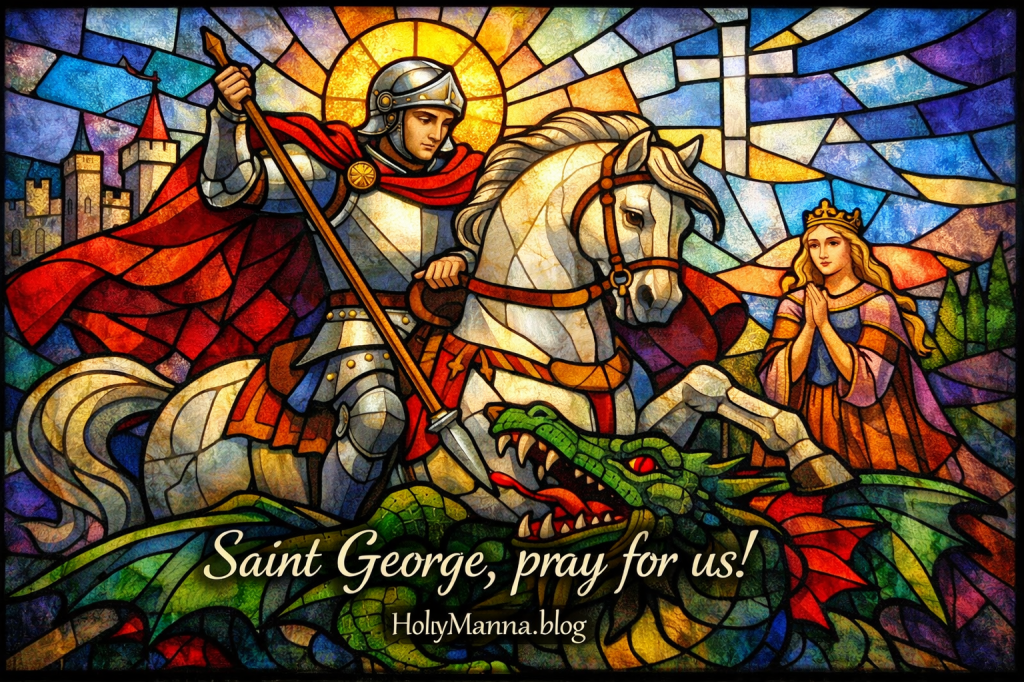
The Martyr Whose Courage Outlived the Empire
Among the saints honored by the Church, Saint George stands with a kind of bright and battle-tested clarity. He is remembered as a martyr, a witness, and a man whose name traveled far beyond the land where he died. Even people who know almost nothing about Christianity have usually heard his name. They may think first of the dragon, the horse, or the red cross on a white field. But the Church remembers something deeper. Saint George is revered because he gave his life for Jesus Christ.
From a Roman Catholic perspective, Saint George is important not simply because his story became famous, but because his witness became fruitful. He belongs to that great line of martyrs whose blood preached Christ more powerfully than many sermons. His historical biography is not preserved in full detail, and the Church is honest about that. Still, his ancient veneration, his enduring place in the liturgy, and the strength of devotion to him across centuries all point to something unmistakable. A real Christian martyr stood firm, and the memory of that fidelity could not be erased.
Saint George is especially revered as a patron of courage, soldiers, knights, scouts, and England. He is also remembered throughout Christian tradition as a sign that evil does not have the last word. His life and legacy invite the faithful to see bravery not as noise or pride, but as calm, steady loyalty to Christ when the cost becomes real.
A Quiet Beginning and a Public Witness
Much about Saint George’s early life comes down through tradition rather than fully documented history. Catholic tradition commonly places his birth in Cappadocia, in what is now part of modern Turkey, and associates his family with Christian faith. Some traditions say his mother was from Palestine, which helps explain why his memory became especially tied to Lydda, also called Diospolis, where he was buried and where devotion to him grew early and strongly.
What can be said with greater confidence is that George lived during the age of Roman persecution and was associated with military service. Tradition presents him as a soldier of noble bearing and real ability, a man who rose in rank within the Roman army under the emperor Diocletian. That detail matters, because it places him in the very heart of imperial power. He was not standing outside the machine. He was inside it. He knew its strength, its discipline, and its demands. And yet when the empire demanded what belonged to God, George did not bend.
In his case, there was no dramatic conversion from paganism to Christianity that the Church can firmly verify. He is more often remembered as one formed in the faith who deepened that faith through trial. When persecution broke out and Christians were ordered to deny Christ, George is said to have chosen public fidelity over personal safety. Tradition says he distributed his goods to the poor, declared himself openly as a Christian, and refused to offer pagan sacrifice. Whether every detail of that tradition can be proven or not, the heart of the story is fully in keeping with the Church’s memory of him: Saint George is known above all for steadfast faith under pressure and for the courage to confess Christ before worldly power.
He is most known for being a soldier-martyr. That is the foundation. The dragon story came later and became famous, but his real greatness is not that he fought a beast in legend. His real greatness is that he refused to betray Jesus when the Roman state could have rewarded compromise and punished truth.
Strength Under the Banner of Christ
Saint George’s importance in the life of the Church comes from what his witness represents. He reminds the faithful that holiness is not reserved for cloisters, deserts, or quiet corners. Holiness can appear in barracks, courts, battlefields, and political systems. It can appear wherever a Christian refuses to give Caesar what belongs to Christ.
Because the historically secure details of his life are limited, the Church does not present a long list of verified miracles from his lifetime in the same way she does for some later saints. No specific miracle from his earthly life can be firmly established with the same confidence as his martyrdom and ancient veneration. That honesty matters. It keeps devotion grounded in truth. Still, tradition surrounded Saint George with signs of heavenly strength, and later accounts portray him as a man protected by grace and unwavering in torment. These accounts reflect how generations of Christians understood him: as a saint in whom the power of Christ was visible.
The best way to remember Saint George is not by asking whether his life was filled with spectacular wonders, but by seeing the deeper miracle that the Church never tires of honoring. He remained faithful. In a world built on fear, ambition, and force, he did not surrender his soul. That kind of fidelity is not ordinary. It is the work of grace.
This is one reason the Church continues to remember and emulate him. Saint George teaches that courage is not recklessness. It is obedience to God when fear would be easier. He teaches that public identity means very little if private loyalty to Christ is weak. He teaches that even a man formed for warfare can become an icon of holiness when his strength is placed under the lordship of Jesus.
The Trial That Revealed the Man
Saint George’s hardships came from the same place that has tested countless saints: the collision between divine truth and earthly power. Under Diocletian’s persecution, Christians were pressured to renounce the faith, worship false gods, and submit outwardly to imperial religion. For many, the temptation was not only fear of death but fear of losing status, comfort, position, and security.
George had much to lose. If he truly held military rank, then his confession of Christ was not only spiritually costly but socially explosive. Tradition says he endured torture before his execution, and that he remained unwavering throughout. While the exact details of these torments come from later accounts that cannot all be historically verified, the Church has always preserved the essential truth that he suffered for Christ and died a martyr.
His martyrdom is significant because it shows what Christian freedom really looks like. The empire could command his body, but it could not command his conscience. It could threaten his life, but it could not force him to call evil good. In that sense, Saint George was already victorious before the sword ever fell. Martyrdom did not make him faithful. It revealed the faithfulness that was already there.
Tradition holds that he was beheaded at Lydda around the year 303 or 304. There, in the soil touched by his blood, devotion began to take root. The persecutors expected silence. Instead, the martyr’s witness spread across nations.
The Saint Who Kept Speaking After Death
After Saint George’s death, devotion to him grew with remarkable force. This is one of the clearest parts of his legacy. Churches were dedicated in his honor very early. Pilgrims visited his tomb. His name spread widely in the Christian East and then through the West. He became one of the most beloved martyrs in the Church, not because later Christians were careless, but because his witness had already taken deep root in the memory of the faithful.
His shrine at Lydda became one of the major places associated with his memory. Tradition held that a church was raised over his burial place, and his relics were honored in various locations. Rome also came to claim association with relics of Saint George, strengthening his place in the devotional life of the universal Church.
Stories of miracles and divine interventions multiplied after his death. Some traditions tell of healings attributed to his intercession. Others speak of protection in times of war, danger, illness, and distress. Medieval Christians came to invoke him especially in moments when courage was needed. Many of these miracle accounts belong to the living devotional tradition of the Church, but they cannot all be historically verified in detail.
The most famous story connected to Saint George after death is the slaying of the dragon. In this tale, George rescues a town oppressed by a dragon and saves a young woman marked for sacrifice. The image is unforgettable. It entered Christian imagination so deeply that it became the defining picture many people now associate with him. From a Catholic perspective, this story has spiritual value, but it is not part of the earliest historically secure record of his life. It cannot be verified as literal history. Even so, the symbolism is powerful and fully Christian. The dragon represents evil, chaos, and the ancient enemy. George’s victory points to the greater truth that Christ conquers the devil through the faith of His saints. This story cannot be verified.
Other posthumous traditions say Saint George appeared in battle to encourage or aid Christian forces. These accounts helped strengthen his reputation as a heavenly patron of soldiers and nations. They became especially influential during the age of chivalry and the Crusades. These stories played a large role in shaping his legacy, but they also cannot be verified in a strict historical sense.
His cultural and national impact is enormous. Saint George became the patron of England and remains deeply tied to English Christian identity. His feast day, April 23, is celebrated with special honor there. He is also associated with other lands and peoples, including Georgia and Catalonia. In Catalonia, the feast of Sant Jordi became linked with books and roses, giving his memory a surprisingly tender and literary expression. That is one of the most beautiful things about the saint’s legacy. A martyr associated with courage and battle also became linked with beauty, gifts, and public joy.
He is also counted among the Fourteen Holy Helpers in Catholic devotion and has been invoked against plague, disease, and danger. Over time, he became a saint whose image crossed borders with ease. Warriors prayed to him. Scouts looked to him. Nations adopted him. Artists painted him. Ordinary Christians called on him in fear and need. Few saints left such a broad cultural footprint.
What Saint George Still Teaches the Church
Saint George’s life offers a needed correction to modern habits of comfort and compromise. The world often praises conviction until conviction becomes costly. Then it asks for silence, adjustment, and surrender. Saint George reminds the faithful that truth is still worth suffering for.
There is also something deeply practical in his witness. He shows that fidelity is built before the great test arrives. A man does not stand firm in a courtroom or before an emperor by accident. He stands firm because he has already decided who his Lord is. That is where his example speaks so strongly to daily life. Christian courage is not only for dramatic moments. It begins in ordinary obedience. It begins in prayer, in honesty, in chastity, in keeping Sunday holy, in refusing lies, in defending the weak, in speaking truth with charity, and in choosing Christ when compromise would be easier.
Saint George also teaches that legends can sometimes grow around a saint because the truth at the center is already luminous. The Church does not need every later tale to be historically certain in order to honor the real holiness that gave rise to devotion in the first place. The martyr’s life is enough. The witness is enough. The blood poured out for Christ is enough.
For readers today, the question is not whether they will face the exact trial Saint George faced. The question is whether they will live with the same interior resolve. Where has fear been allowed to speak louder than faith? Where has comfort started to matter more than obedience to Christ? Where is the Lord asking for courage that has been delayed?
A practical way to imitate Saint George is to begin with small acts of steadfastness. Speak clearly about the faith without embarrassment. Defend someone who is mocked or mistreated. Refuse the lie that strength must be loud or cruel. Keep close to the sacraments. Stay near Our Lord in prayer. Read The Catechism and let the Church’s wisdom form the mind. Ask for the grace not merely to admire courage, but to practice it.
Saint George’s witness says that a Christian does not need worldly power to overcome evil. He needs fidelity. He needs grace. He needs Christ.
Engage with Us!
Readers are invited to share their thoughts and reflections in the comments below. Saint George’s story has inspired Christians across centuries, and it would be a blessing to hear how his witness speaks to hearts today.
- What stands out most in Saint George’s witness to Christ: his courage, his public confession of faith, or his perseverance in suffering?
- In what area of life is greater courage needed right now in order to follow Jesus more faithfully?
- How can Christian strength be lived in a way that is firm, holy, and full of charity rather than pride or anger?
- What does Saint George’s martyrdom teach about the difference between worldly power and true spiritual victory?
- How can his example help families, parishes, and communities raise up men and women who are not afraid to belong fully to Christ?
May Saint George inspire every heart to stand firm in the truth, walk with courage, and live each day with the love and mercy Jesus taught us.
Saint George, pray for us!
Follow us on YouTube, Instagram and Facebook for more insights and reflections on living a faith-filled life.

 Holy Manna!
Leave a comment